The Personal Struggles and Why ARPA is so Critically Important

I’m happy to share with you today a wonderfully written article by Eleanor Laise, Reporter, Barron’s Group, who effectively captures the human toll inflicted by MPRA legislation that saw 18 multiemployer pension plans slash promised benefits to their participants. Highlighting the conversation in Eleanor’s article is Carol Smallen, who I had the pleasure of first speaking with in August 2018 and whose story I shared on several occasions within this blog. Carol’s story is heart-wrenching, but regrettably, not unique! Importantly, Eleanor also introduces us to several other individuals who have been severely impacted by developments within a subset of the multiemployer pension plan universe.

When we, as an industry, discuss issues related to DB pension plans it is easy to get lost in the debate surrounding various investment theory/strategies, and often neglect the true reason why it is so important that these issues are addressed – the plan participants, who are our relatives, friends, and neighbors. These hard-working Americans went to their jobs each and every day with the expectation and understanding that they were entitled to a pension upon retirement that was going to be based on years of service and other elements. Why was it okay that the promise that they were given was not kept? We need to keep fighting for these individuals and for all American workers, who should have access to a defined benefit plan. Defined contribution plans were intended to be supplemental to DB plans, and not Social Security.

Right Idea, Wrong Implementation

There recently appeared an article in FundFire that suggested that plan sponsors, particularly corporate sponsors, were using their allocation to fixed income inefficiently. We absolutely agree! However, we find that the suggested implementation cited in that article to be just wrong. The article stated that corporate pension plans had roughly 40% in fixed income, which a consultant from a leading firm said was too much. Again, we agree. This consultant went on to say that plans should use US Treasury STRIPS in lieu of coupon bonds, which would allow them to put far fewer $s to work. This is incorrect math and needs to be tested. The pension objective is all about cash flows… asset cash flows versus liability cash flows.

US Treasury STRIPS are highly volatile and expensive. They performed well during the bond market’s lengthy bull market (since 1982), because they have longer durations than coupon bonds. Since we are near historic lows in interest rates now a trend toward higher interest rates (which most economists predict) would produce an opposite effect. Moreover, STRIPS do not secure benefit payments, as they have been stripped of their income component and they certainly are not low risk.

Does it really make sense to use STRIPS now? We would also suggest that the true pension plan objective is too “secure” the promised benefits in a cost efficient manner with prudent risk.  This is best accomplished through cash flow matching liabilities with coupon bonds. The difference in cost versus STRIPS could be close to 1% per year of liabilities (a 25-year benefit payment schedule = 25% cost savings). The higher the funded ratio the more the plan sponsor should allocate to defeasance through fixed income securities. We recommend that Retired Lives should be defeased as much as possible since they are the most certain, imminent, and important liabilities.

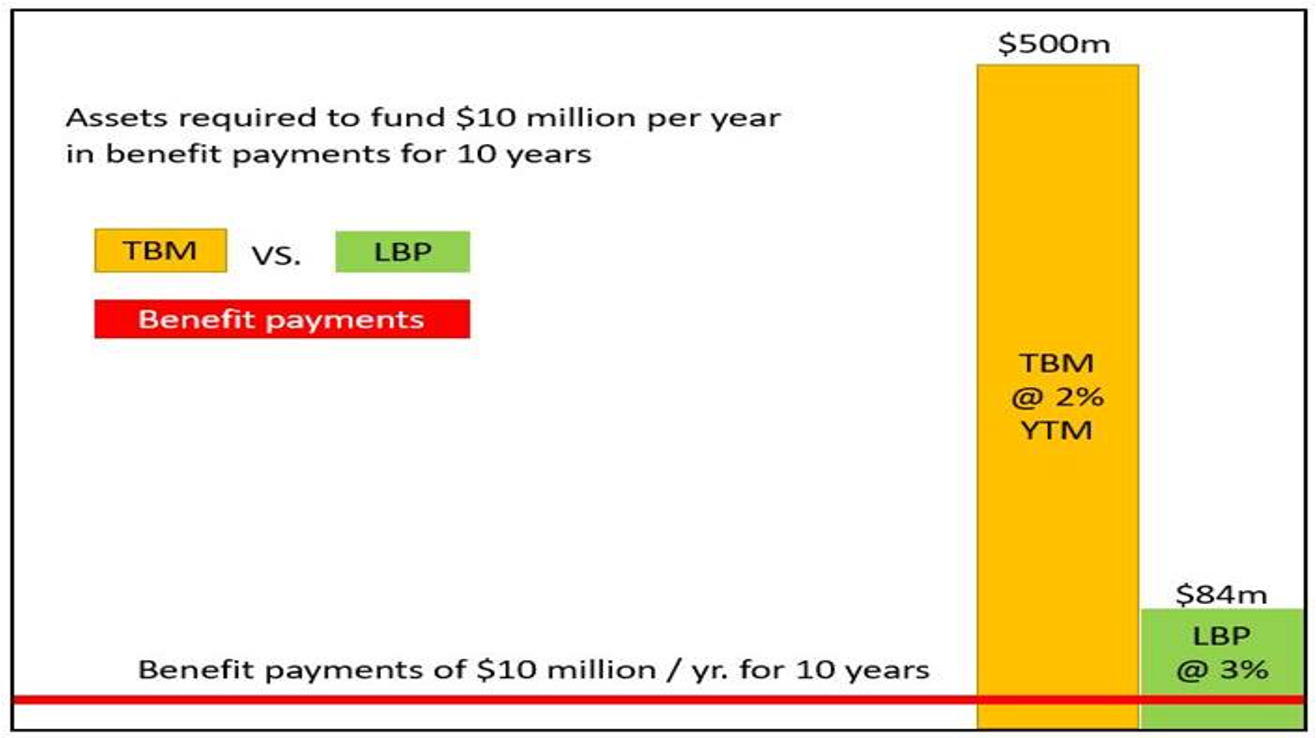
Do you want to improve the efficiency of your asset allocation? Would you like to put fewer assets into fixed income in this low-interest-rate environment? Adopting a cash flow driven investing (CDI) approach will accomplish your objectives. As the example below reflects, traditional bond management (TBM) requires an allocation of $500 million to fund $10 million in annual benefit payments in this 2% interest rate environment. This is very inefficient. By adopting a CDI approach, the fund can accomplish the objective of funding $10 million in benefit payments with ONLY $84 million. The additional $416 million can now be used in other asset classes to support alpha generation.

The allocation to fixed income is now 83.2% less than using a traditional bond manager. In a CDI implementation the $10 million in benefits is achieved through the use of principal, income, and reinvested income. In addition, bond math suggests that the longer the maturity and the higher the yield the lower the cost. Our cash flow matching process is a cost optimization model that will take advantage of both of these mathematical principles by biasing our portfolio to longer maturities. Thereby we can partially fund the next nine years of benefit payments with the income from a 10-year maturity at 3% yield versus a 1-year Bill providing the investor with 7 basis points and lower yields for the 1-9 year benefit payments.

A CDI strategy is the most cost efficient implementation in accomplishing the primary objective of securing the pension system’s promised benefits. Only an insurance company annuity can provide the same certainty of securing benefits, but at a much higher cost (@ 4% premium). We agree that pension plans should get smarter about the asset allocation that they adopt. It needs to be driven by the funded status and not the return on assets assumption. If plans were to start doing this, I don’t believe that there would be any debate as to how plans would approach their fixed income allocation.

Kamp Discusses ARPA and Other DB Stuff on Barron’s Live

I was extremely pleased to be asked to participate in a Barron’s Live interview today. Eleanor Laise and I discussed ARPA and other matters related to DB plans. With regard to ARPA we discussed the SFA calculation and discount rate issues. Despite some concerns about both, we at Ryan ALM have determined that the SFA working in conjunction with the legacy assets and future contributions can accomplish the primary objective set by Congress to pay benefits and expenses for the next 30-years, while still maintaining a surplus to meet future liabilities.

In addition, we talked about the state of public DB plans, including the use of Pension Obligation Bonds. Please don’t hesitate to reach out to me if you have any questions or comments related to what was discussed today.

NO! NO! NO!

We’ve written from time to time about individual pension plans whose unique situation has surprised us. Here is another example of a plan and the current asset allocation that just floored us! Here are the details: Closed plan, 150% funded based on the ROA and 95% funded using ASC 715, no more contributions, benefits can’t be enhanced, and the sponsor(s) can’t recapture any of the surplus. Given these characteristics one would assume that the asset allocation would be incredibly liability focused. Yet, that couldn’t be further from the truth. This plan is invested in 70% equity and equity-like product! This situation is outrageous.

Again, there is NO upside for anyone – neither the participant nor the plan sponsor. There is only downside risk, especially as equity market valuations and the underlying fundamentals seem extraordinarily stretched. In this particular case we were approached by the plan’s actuarial firm because they, too, recognized the incredible risk being taken in the management of these assets. Since this plan has won the battle… they have the potential to SECURE all of the promised benefits with little to no risk by cash flow matching assets to the liability cash flows. Should the equity markets fall, they have no way of recouping those losses because the fund no longer receives any contributions. They’d have to wait for the markets to recover the losses, but would they have the time? Remember a 25% equity correction requires a 33.3% recovery and a 50% correction requires a 100% recovery.

Through our analysis we are able to show that ALL of the benefits can be secured through cash flow matching. In fact:      

 • We can secure the benefits at a $6.2mm or 28.68% funding cost savings

• Leave a $4.8 mm surplus or 20%

• Reduce management fees by $100,000 per year or 50 bps.

This is one of those “no-brainer” moments that has one just shaking their head. How could this situation exist? Are we so focused as an industry on the return on asset assumption (ROA) that we’ve forgotten pension basics? Remember, the primary objective in managing a pension plan is to SECURE the promised benefits. Everything else is a distant second. I’m not sure how this situation will unfold. I hope that we will be given an opportunity to help this plan secure those promised benefits. Unfortunately, this situation is not unique, especially among smaller DB plans. As fiduciaries we have a responsibility to do what is best for the plan and the participants. Can anyone say that is true in this case?

SFA May Not be Perfect – But It Works!

I’ve been as much a critic of the PBGC’s Interim Final Results (IFR) as anyone. I was disheartened by how the PBGC decided that the Special Financial Assistance (SFA) should be calculated. That said, struggling multiemployer pension systems are still getting new found money that will enhance the funded status. Although the amount of the grant may be less than what was originally expected or intended by Congress through this legislative effort, we at Ryan ALM have determined that this SFA program can achieve success, but it very much depends on how the SFA and legacy assets are invested.

Many folks, including me, have been focused on the disconnect between the discount rate of 5.5% (3rd segment + 200 bps) and the potential yield (roughly 2%) from investment grade bonds within the SFA. This difference does create a funding gap between the cost to fund benefits and expenses for 30-years and the amount received, but it isn’t fatal. Many comments received by the PBGC during the 30-day comment period focused on the appropriateness of mandating a very conservative investment grade bond portfolio while this gap exists. But we believe that securing the SFA assets is paramount, while mirroring the intent of Congress.

A leading actuarial firm with a particular expertise in multiemployer plans provided us with an example of a hypothetical pension fund that would qualify to receive an ARPA grant based on the characteristics of this plan’s profile. In their example, the “client” had $100 million in beginning assets and liabilities of $256.6 million in liabilities discounted at 5.5% for a funding deficit of ($156.6 million). The funded ratio was only 39.0%. Based on the PBGC’s SFA calculation, this plan would be eligible for $180.7 million in Special Financial Assistance, which is forecast to be received in 2024 when the current assets will have declined to $63.4 million. Furthermore, they estimated a 2% return on SFA assets and a 6.75% return on legacy assets. Given these expectations the plan would likely be in a $28.1 million deficit by 2052 supporting the calls for changes to either the legislation or the PBGC’s guidelines or both.

Here’s the good news. Despite the appearance of a funding gap because the discount rate is much greater than the potential return on investment grade bonds, funding of benefits and expenses is a function of the SFA and legacy assets working in harmony. Ryan ALM is proposing that the SFA assets defease as many of the liabilities as possible once the grant is received (2024 in our example). By defeasing the promised benefits and expenses within the SFA bucket until those assets are exhausted, our approach fulfills the goal of Congress to “secure” benefits. Furthermore, the legacy assets and future contributions can now be managed with a slightly more aggressive risk profile as they aren’t needed for cash flow for the eight years from 2024 to 2031 that the SFA assets defease liabilities. Importantly, bonds are no longer needed within the legacy asset allocation. Rotating away from bonds to more equity-like products will increase the potential ROA from the existing legacy portfolio.

We have modeled a number of scenarios by tweaking the actuarial firm’s expected return on the SFA and legacy assets. For instance, an investment grade corporate bond portfolio used to defease the plan’s liabilities will provide a return somewhere in the area of 2.5% to 3% narrowing the gap to the discount rate and not the 2% used in the original scenario. Because we have eliminated bonds from our legacy assets during the 2024-2031 period in which we only use the SFA to pay benefits and expenses, the legacy portfolio should be able to achieve a return greater than the 6.75% used to calculate the SFA. In the scenario that we feel is most reasonable, we used a 2.5% return on the SFA, the 6.75% for the first three years (2021-2024), a 7.5% ROA for the legacy assets from 2024 to 2031, and a very modest 7.15% return from 2032 to 2051.

In this scenario, we are able to fully fund all future benefits and expenses for 30 years, while beginning 2052 with $77.4 million in assets to meet future liabilities. The other scenarios that we modeled used similar inputs and produced results in every case that had 2052 beginning with at least $42.6 million in assets available to meet future liabilities. I think that our inputs are extremely reasonable given the 30-year investing horizon. Furthermore, we have not had to dramatically increase risk in the legacy portfolio or the SFA portfolio to achieve these terrific results. Again, it is unfortunate that the calculation to determine the SFA was so conservative, but at the end of the day the grant money goes a long way to helping secure the promised benefits for plan participants, many who have endured tragic cuts for several years now. How the SFA assets are implemented is crucial to this program’s success. Having the SFA and the legacy assets working in harmony to achieve these positive results is critical.  It is imperative that the SFGA assets stay true to their objective of defeasing and funding benefits and expenses for as far out as possible. This requires a cash flow matching strategy with fixed income. To be clear, matching the 5.50% discount rate is NOT the objective of the SFA assets.

Lastly, I read a comment on the PBGC website that claimed that the legacy assets would need to achieve a 12%+ return in order for all the benefits and expenses to be paid. Nonsense! We have shown that a 39% funded plan (prior to getting the SFA) can achieve success even with a 7.5% return on legacy assets combined with only a 2.5% return on SFA assets. We’re happy to share our analysis with you. Don’t hesitate to reach out.

What is Risk?

There are many definitions of risk, but the one that we think is appropriate for pensions is that risk is the UNCERTAINTY of achieving the objective. In the case of a defined benefit pension plan, risk is not the volatility of returns, but the uncertainty of paying the promised benefits! There is nothing more important than building a corpus that can accomplish this objective with great certainty. The promise, as you know, is the plan’s scheduled benefit payments (liabilities) and they must be measured, monitored, and managed on a regular basis.

The American Rescue Plan Act (ARPA), signed into law by President Biden in March 2021, provides a lifeline to struggling multiemployer pension plans that are designated as in Critical and Declining status. The legislation calls for the US Treasury to provide the necessary funds to the PBGC which will then send payments to these plans through grants. The grant money, aka Special Financial Assistance (SFA), “shall be such amount required for the plan to pay all benefits due during the period beginning on the date of payment of the special financial assistance payment under this section and ending on the last day of the plan year ending in 2051, with no reduction in a participant’s or beneficiary’s accrued benefit as of such date of enactment”. In other words, secure the promised benefits for a 30-year period – no games!

How do you secure these benefits? The PBGC and the legislation have stated that the SFA should be invested in investment grade bonds as the means to “secure” these promised benefits. Why bonds? They are the only financial instrument that has a known cash flow that can be used to meet the pension plan’s obligations. Any other asset class or financial instrument will create uncertainty as to their cash flows and/or terminal value.

The PBGC presented their Interim Final Rules (IFR) on July 9th, which included a 30 day comment period. Not surprisingly, the PBGC received 101 submissions from individuals (mostly union members), unions, Congress, and investment advisory organizations. The comments covered a variety of topics identified in the legislation including how the SFA is to be calculated, the discount rate used (3rd segment (PPA) + 200 bps), eligibility, and the most common which dealt with the approved list of investments for the SFA. One firm, a leading fixed income shop providing ALM solutions articulated perfectly the goal of the legislation by stating “we need to uphold the spirit of the Butch Lewis Act (BLA). Moreover, the SFA needs to be based on “pillars of certainty”.” AMEN!

Plan participants in these struggling plans, and especially those that have already seen benefit reductions through MPRA (18 funds), want the promise that was made to them to be returned and secured for the next 30-years. They no longer want their benefits subjected to the whims of the market. I certainly don’t blame them. Everyone should take the time to read some of the horror stories on the Teamsters’ Facebook page that speak to the pain inflicted on individuals through these benefit cuts. Plan participants, through no fault of their own, have lost homes and much more, as benefits have been slashed by as much as 50% or more – horrible.

We hope that the PBGC continues to support the idea that the SFA should only be invested in investment grade bonds (IG) (with <5% in high yield as a result of downgrades after the IG bond was owned) and that those bonds be used to cash flow match SFA assets to the promised benefits and expenses (liabilities) securing the promise that has been made, while fulfilling the intent of the legislation. These plan participants have already lived through years of uncertainty. Creating an investment program that doesn’t secure the benefits would be unfair and harsh. Any investments where the cash flows are uncertain are risky assets. To repeat the intent of the ARPA legislation: the SFA needs to be based on “pillars of certainty”. Risky assets in the SFA bucket should not be allowed under ARPA.

Real Progress – But Hidden from View

I penned a post in July 2017 lamenting the fact that asset consultant performance reviews failed in nearly all cases to highlight the most important comparison a pension plan sponsor needs to see on a regular basis. I am speaking specifically about a comparison of a plan’s assets to their specific liabilities. We have witnessed real progress among DB plans of all varieties during the 12-months ending June 30, 2021. But in many cases, you wouldn’t know that was true. Why? In most examples, only a comparison of a plan’s assets to their total fund benchmark is reported. For instance, we recently read about a Midwest public pension system that had generated a 24+% gain for their total fund during the previous 1-year period only to have that performance looked upon poorly because their total fund asset focused benchmark had produced a 26+% gain. Silly!

The only comparison that matters is how the plan’s asset base is performing versus the promise that was made to their employees. At the end of the day assets need to pay the promised benefits. If there are enough assets to meet that obligation – great. It doesn’t matter one bit whether that plan ever beat their total fund asset bogey.

This reporting also raises another issue. If liabilities are to be highlighted, then how should they be measured? Well, in public fund land, GASB allows for the discount rate on liabilities to be the ROA. In the case of the Midwest plan cited their ROA is 6.75% (I applaud them for having a more realistic objective), but we know that liabilities are bond-like in nature and don’t grow at a constant rate. Given the gyrations in US interest rates during the last 18 months, it shouldn’t be surprising to anyone that liability growth, measured by a market-based rate (FAS AA corp.), would actually produce a negative growth rate for pension liabilities.

So, how does the 24% 12-month performance look versus a liability growth rate that is negative. I’d say that it was pretty outstanding. Does it really matter that their hybrid index benchmark produced a 26% return? Absolutely not! Remember, important decisions are constantly being made by pension trustees related to benefits, COLAs, contributions, asset allocation, etc. It behooves us as an industry to ensure that plan trustees are making these decisions based on the right metrics with the most important comparison being how assets are performing relative to a plan’s specific liabilities.

It keeps getting worse

The Inclusive Wealth Building Initiative is out with a study that provides a shocking picture of the US retirement landscape. “The Initiative, a project of The Economic Innovation Group, derived its data from various surveys, including the Census Bureau’s Survey of Income and Program Participation and the Bureau of Labor Statistics’ National Compensation Survey. The study also used the 2019 Current Population Survey’s Annual Social and Economic Supplement”, as the 2020 study may have been impacted by Covid-19 disruptions. The study found that ONLY 46% of workers had access to an employee-sponsored plan and worse, only 38% of those indicated that they are participating. These numbers are in stark contrast to other studies that I’ve seen. If accurate, this magnifies the retirement crisis that I’ve been fearing.

Not surprisingly, lower-waged American workers (those earning <$50,000) are participating to a far lesser extent. In fact, it is estimated that low-wage workers participate at a rate that is 6% lower than the average worker based on earnings, while being 25% lower than the top wage earners. As we’ve indicated before, it takes a certain level of income to be able to just live in the US and regrettably there are millions of American workers that fall below that level. The lack of discretionary income certainly prohibits most of these workers from funding a retirement program.

Some of the largest states by population, such as California and New York, have the lowest percentage of companies offering retirement benefits. In fact, the bottom 10 states in offering employer-sponsored plans to low-wage earners account for 43% of the country’s population, including CA, NY, FL, and TX. Every study that I’ve read highlights the fact that most Americans do not save outside of an employer-sponsored plan. The fact that <50% of Americans have access to a retirement plan is outrageous. The long-term implications are potentially quite severe, as many of these individuals will need support from the federal government’s social safety net. A pay-as-you-go system is far more costly than one that is pre-funded and built up over time through a proper retirement benefit. This reality is why we at Ryan ALM continue to fight to protect and preserve defined benefit (DB) plans for the masses, as DB plans are the best and least risky retirement vehicle.

Asking untrained participants to fund, manage, and then disburse a retirement benefit is poor policy that will lead to tragic outcomes. We are not prepared as a country to meet the challenges that this reality will create. I’m dismayed by the results of this study and you should be, too.

PBGC – Final Comments Due ARPA

We are just days away from the end of the PBGC’s American Rescue Plan Act (ARPA) comment period on the “Interim Final Rules”. We hope that the PBGC takes seriously the comments received related to the calculation of the Special Financial Assistance (SFA), as there is a strong likelihood that the current calculation will leave many of the plans receiving a grant insolvent prior to the 2051 period and certainly beginning with 2052. We believe that the intent of the legislation was too “secure” the funds necessary to meet the future benefits and expenses for the next 30-years. The ONLY way for these benefits and expenses to be secured is to defease those liabilities through a cash flow matching investing program.

Furthermore, the legislation currently calls for the SFA proceeds to be invested in investment grade bonds. We believe strongly that refusal on the part of the PBGC to address the discount rate (3rd segment under PPA plus 200 bps) will creates a shortfall in the amount of funds needed to fully fund liabilities for 30+ years. This will tempt plan sponsors to seek more yield and more risk into the SFA portfolio. Injecting more risk into the SFA portfolio would be imprudent given the goal of securing benefit payments, so amending the discount rate to include all three segments under PPA and eliminating the additional 200 bps makes the most sense. In this revised scenario an appropriate level of SFA needed to fund benefits is received, the proceeds can then be invested through a cash flow matching strategy securing those promises, and plans may just make it to the 2051 target.

It would be a travesty to finally get help for these struggling multiemployer plans only to have the implementation doomed to failure before the program even begins.

Is this how an Institutional investor should behave?

I would have preferred to use a saltier title for this post, but I watered it down quite a bit. In any case, I have just read about a major public pension system that decided to purchase 229,643 AMC shares during the second quarter. It hadn’t owned any shares of AMC as of 3/31/21. You may recall that AMC benefited tremendously as a MEME stock. In fact, the stock rocketed 27 times in value in the first quarter! This price appreciation was powered by individual investors using social media to push up the stock.

Amazingly, AMC, which had filed to sell more shares in June, warned investors that its stock was very risky at that time. So far in the third quarter, AMC stock has slipped 35.4% (as of 8/4 at 1:48 pm). In comparison, the S&P 500 has gained 2.3% so far in the third quarter. I am shocked by this decision. The behavior exhibited is certainly not institutional in nature. Aren’t we all taught to buy low and sell high? Purchasing this stock based on retail investor enthusiasm after the stock has appreciated 27 times and with little fundamental support speaks to desperation. Oh, yes, I forgot to mention that this public fund ranks as one of the most poorly funded plans in the country.

As of this afternoon, that stock purchase ($13 million at the time it was bought) is down more than $6 million or 46.4%. Yes, the $13 million “investment” is small relative to the size of the plan, but it seems as if the purchase was more like placing a bet on RED in Las Vegas or Atlantic City than it was an investment. Come on folks. This is no way to run a pension plan. A pension can not afford high volatility in its investments, which leads to volatility in the funded status and then contributions. If a higher contribution is required during the down cycles, the pension does not get this money back in the up cycles.