We Applaud Michigan’s Effort to Pass House Bill 5054

Many US states find themselves with surplus funds after significant support from ARPA legislation. Although direct DB pension plan support was not a permitted use of the ARPA proceeds, states with surpluses are looking for ways to prop up their underfunded systems. One state, Michigan is considering making available to its municipalities $1.15 billion in state grants to help pay down the unfunded pension liabilities.

“House Bill 5054 would make $900 million in grants available to municipalities with pension plans less than 60% funded and $250 million for those that are at or above the 60% mark if the governmental units agree to a series of conditions (my emphasis).” source: (The Bond Buyer)

The proposed legislation would also direct another $350 million to the state police retirement system. Local government groups are said to be in favor of this proposal as the state contemplates the allocation of $7 billion in surplus revenues.

Importantly, these grants would come with conditions that I believe are quite appropriate for plans that are as poorly funded as those that would be eligible to receive the payments. Pension systems that are <60% funded must make all actuarially determined contributions and hold the discount rate and the assumed rate of return (ROA) at current levels or lower. Furthermore, they must adopt the most recent mortality tables recommended by the Society of Actuaries and they must not enhance benefit payments for 10 years after accepting the grant or the local unit must repay the full value of the grant.

Future benefit increases can only be adopted if the system is 80% funded and the value of the new benefit is 100% funded. We, at Ryan ALM, are huge supporters of DB pension systems, but we believe that the current pension promise should absolutely be secured before benefits are enhanced. It makes little sense to us that pension systems jeopardize the plan’s overall funding in an attempt to elevate current payouts. The legislation limits Grants to a maximum of $100 million per system.

It is great to see legislators utilizing excess funds to sure up their pension systems. Poorly funded plans are hard-pressed to close the funding gaps through investment returns only. Remember that a 50% funded plan must beat the ROA by twice in order to maintain the funded status. Yes, a plan that is 50% funded and has a 7.5% ROA objective must generate at least a 14.5% annual return, or the funding gap grows in $ terms. How likely are we to see above-average returns from the capital markets given the extraordinary returns achieved in the markets since the Great Financial Crisis (GFC)? When investments fail to achieve the objective plans must contribute more. House Bill 5054, if passed, shows that the legislators are not waiting to see if Michigan plans fall short of their objectives. Good for them!

An ARPA Update

I hope that you had a great weekend. I can’t believe that February has already come and gone (effective today). Here’s the weekly update related to ARPA application filings, approvals, and payments. This is going to be a fairly simple update, as we haven’t had a new application filed since February 7th (Mid-Jersey Trucking Industry and Teamsters Local 701 Pension and Annuity Fund). We have had five applications approved (four of them with their initial filing) and each of those five Group 1 Priority plans have been paid their SFA as of February 18th. Here is a list of those plans:

Local 138 Pension Trust Fund
Idaho Signatory Employers-Laborers Pension Plan
Bricklayers and Allied Craftworkers Local 5 New York Retirement Fund Pension Plan
Road Carriers Local 707 Pension Plan
Local 408 International Brotherhood of Teamsters, Chauffeurs, Warehousemen and Helpers of America Pension Plan

The total dispersed so far is $1.1 billion, which continues to be a small drop in the bucket given that the estimated cost of the legislation is roughly $95 billion. Furthermore, the pace of filings among Group 2 Priority funds continues to be quite slow with only 7 plans having filed since becoming eligible in late December 2021. Within Group 2 we have 4 MPRA Suspension and Partition plans that have been filed and 3 identified as Critical and Declining.

Lastly, we have yet to get the Final, Final Rules from the PBGC on how this legislation should be implemented. Any talk/action related to expanding the list of eligible investments beyond the current investment-grade bonds limitation is inappropriate for the funding objective, especially when one notes the incredible volatility in markets to begin this year. If the legislation truly desires the ensuring of benefits (and expenses) for as long out as possible, allowing more volatile investments in the SFA bucket is a risky contradiction! Use the legacy assets to enhance returns but keep the SFA assets matched against liability cash flows to maximize the security of benefit payments. As it is, the goal of securing the promised benefits for 30 years is a pipe dream. Don’t shorten or endanger what is already a modest period of time.

This is the Impact of Riding the Asset Allocation Rollercoaster

I am happy to report that today’s post is the 1,000 produced on this blog. I’ve tried to cover many different aspects of pension management. My blogs are intended to help, encourage, urge, foster, persuade, promote, advance, and even implore change in how Pension America approaches the critically important task of protecting and preserving defined benefit pensions for the masses. Have I been successful? You tell me, but I’m not prepared to stop! There is much more work ahead of us.

For those of you who have followed this blog for some time, you will remember that I’ve used a rollercoaster to symbolize pension asset allocation. We tend to ride markets up and markets down with little regard for the long-term impact of how these moves actually impact the pension systems. I’m frequently told that markets always recover, and the last 12+ years are used as an example. Yes, markets recovered substantially from the depths of the two extraordinary corrections witnessed during the ’00s. But, often hidden from view is the impact that those significant drawdowns had on pension contributions. That growth has been mindboggling. Remember that any increase in contribution costs is NOT repaid when pension plans recover.

You might ask: How have contributions grown in an environment in which returns have been so spectacular? It is a fair question. Let’s review the pension funding formula: B+E = C+I where B+E are benefits and expenses, while C+I are contributions and investment earnings. Most pension systems were fully funded after 1999 and contribution expenses were modest and controlled. However, during the two major corrections of the ’00s, contributions (C) had to make up for the devastating impact of a very negative period for investment earnings (I). I present the following information as a representation of the brutality of this period on pension contributions. The data highlighted is for a large public fund plan in a major metropolitan area. This history is from their latest actuarial report.

Statutory
Fiscal YearsFunded RatioContribution paid% of Payroll
6/30/00146% $               68,619,745.000.90%
6/30/01143% $             100,024,692.001.30%
6/30/02135% $             105,660,069.001.20%
6/30/03124% $             107,992,496.001.20%
6/30/04114% $             310,589,074.003.50%
6/30/05109% $             822,763,025.008.90%
6/30/06101% $          1,024,358,175.0011.10%
6/30/0797% $          1,471,029,609.0015.50%
6/30/0897% $          1,874,242,487.0019.00%
6/30/0996% $          2,150,438,042.0020.60%
6/30/1075% $          2,197,717,073.0020.00%
6/30/1176% $          2,387,215,772.0020.80%
6/30/1276% $          3,017,004,318.0025.50%
6/30/1368% $          3,046,845,264.0025.50%
6/30/1468% $          3,114,068,148.0025.60%
6/30/1570% $          3,160,257,868.0025.60%
6/30/1671% $          3,365,454,212.0027.30%
6/30/1772% $          3,328,192,582.0026.50%
6/30/1876% $          3,377,024,173.0026.30%
6/30/1968% $          3,694,364,590.0026.70%
6/30/2074% $          3,726,701,492.0026.30%

Despite wonderful markets, contribution expenses for this fund have increased by 54.8 TIMES!! Not 54.8%. These additional contributions were required due to the I in the equation above producing significant negative experiences. When that occurs, the C has to make up the shortfall. The important fact is that these enhanced contributions are never returned to the employer. Instead of taking risks off the table and winning the game when this plan was dramatically overfunded on 06/30/00, they let the assets ride! The result has been devastating. If you think that this plan’s experience is unique, please think again. Most public pension systems were overfunded in 1999. A significant majority (most) are not today, and their contribution expenses have skyrocketed.

As we neared the end of 2021, we once again witnessed improved funding that was being hailed throughout our industry, but instead of doing anything to protect that improved funding, we elected to let the “good times roll”. How has that worked out since the beginning of 2022? Will this period of market destabilization once again lead to significant growth in contributions? For how much longer will these plans be able to convince their taxpayers (providers of C) that these plans should continue to be supported? Isn’t it time for a rethink?

The Importance of Dividends on the Total Return

Everyone in the Pension arena understands the actuarial formula: B+E = C+I, where outflows (benefits and expenses) equal inflows (contributions and investment earnings). This equation strives for harmony, but as we’ve witnessed through many decades, the uncertainty around I places a greater and greater emphasis on C.

When pension systems were first introduced, it was not uncommon, in fact, it was very common, that pension plans were managed in a similar fashion as lottery systems and insurance companies where liabilities (pension promises) were measured, monitored, and MANAGED. Unfortunately, we are in an environment where securing the promised benefits is passe and the focus has become an arms race trying to create the highest return. In periods of dislocation in the markets sponsoring entities are forced to contribute more and more placing a greater burden on those companies, municipalities, and states to make up for the shortfall. Does this make sense?

I just presented at the FPPTA with two members of a top consulting team. They presented data from Horizon Actuarial that had aggregated data from 39 entities forecasting future returns, risk, and correlation. Given how strong the last 12+ years have been for the markets, it isn’t surprising that the forward view is for below-average returns for the next decade (regression to the mean is a real thing). They used one of their client’s asset allocations and the Horizon forecasts to come up with a 5.3% expected return for this “model” portfolio for the next 10-years. This forecasted return also comes with a +/- 11+% standard deviation.

Wouldn’t it be great if the expected return for equities came with less uncertainty, but in an environment in which the dividend yield for the S&P 500 is only 1.29% (as of 12/31/21), most of the total return needs to come from price appreciation. This hasn’t always been the case. In fact, it was not unusual for the dividend yield on the S&P 500 to be in excess of 5% annually (the average yield has been 4.3% throughout time), with a peak yield being achieved in 1932 at 13.84%. Wow! Can you imagine starting the year with that type of return? You wouldn’t need for stocks to generate any price appreciation/return to meet your return on asset assumptions (ROA). The chart below highlights the importance of dividends on the S&P 500’s total return since 1940.

Why have we as investors in the US equity market accepted this recent development. Why are we assuming most, if not all, of the risk for being an equity investor? Shouldn’t we be demanding that corporate America provide more robust dividends? Sure, there have been changes in tax policy industry/sector exposures that might have led to some of the deemphasis of dividends, but it certainly doesn’t account for all. The current yield is only slightly higher than the lowest level achieved in 2020 (1.11%). The dividend yield used to be a value measure for the index with levels below 4% signifying over valuation. What does the 1.3% seen today portend?

As the chart above highlights, it is critically important that we allow dividends to be reinvested back into the S&P 500, as it drives roughly 60% of the total return over 20-year moving averages and 48% over 10-year moving averages. But, is that what we do within our pension systems? Not really. Plan sponsors are in search of liquidity every month to meet benefits and expenses. They often sweep all available cash from each of their managers irrespective of the growth potential for reinvestment. Given this practice, we would highly recommend that asset allocation strategies bifurcate the assets between liquidity and alpha buckets. The liquidity bucket should use the cash flows from bonds to meet all the current funding needs (liability cash flows), while the alpha bucket can now grow unencumbered as those assets are no longer a source of liquidity.

If the Horizon aggregated information with regard to return, risk, and correlation proves correct, the importance of dividends and dividends reinvested cannot be minimized. Investors shouldn’t accept or settle for a dividend yield in the 1.3% range which places most of the risk on US for a return necessary to meet our pension obligations. Let’s talk.

Like A Bridge Over Troubled Waters – Revisited

I produced the initial “Like A Bridge Over Troubled Waters” post on October 1, 2021. In that post, I highlighted the fact that the decade of the ’00s witnessed two episodic market events that produced nearly -50% declines in each instance crushing pension funding in the process. Most of Pension America had entered the ’00s with well-funded plans, and in many cases, pension systems that enjoyed a surplus. It was truly unfortunate that the focus at that time continued to be on achieving the return on asset assumption (ROA) and not on securing the promised benefits. For if they had adjusted their focus funded status and contribution costs would have been stable. Regrettably, funded ratios plummeted, and in the process, contributions skyrocketed.

The bridge that was referred to in the previous post was an asset allocation framework (not new) that called for plan assets to be bifurcated into liquidity (beta) and growth (alpha) buckets and away from a single asset allocation strategy focused exclusively on the ROA. In this implementation, benefits and expenses would be secured through the investment in a cash flow matching bond strategy that effectively used the asset cash flows from the bonds to meet the liability cash flows. This strategy bought time for the alpha assets to recoup their losses while also allowing them to grow unencumbered, as they were no longer a source of liquidity.

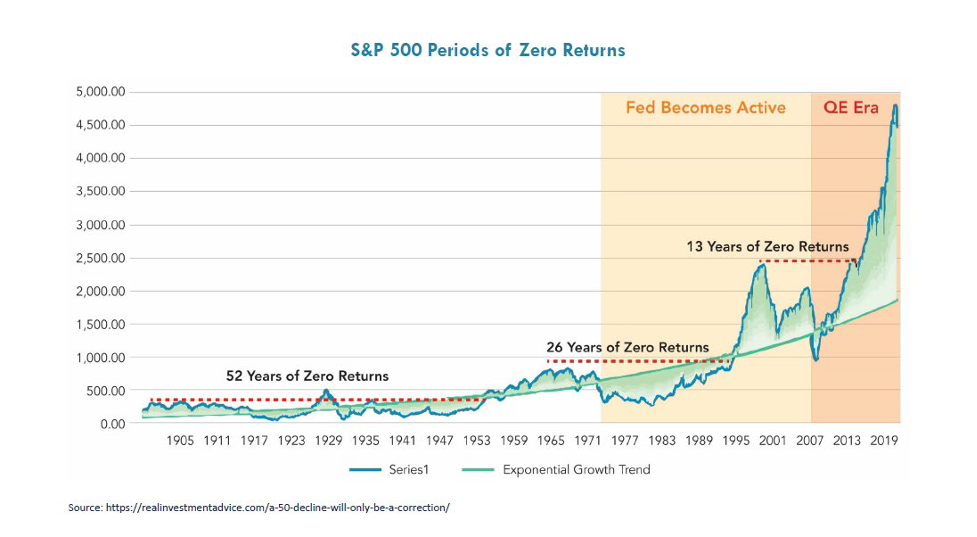
The markets – both stocks and bonds- have enjoyed an incredible period of time since the Great Financial Crisis that ended in March 2009. This period of time has once again created complacency for the plan sponsor and their advisors. Everyone knows that stocks outperform bonds over time (roughly 82% of the time in 10-year periods) and equities generally provide a positive return, so why do anything else – let the good times roll! Well, the growth in contributions from 2000 has been extraordinary despite the “strong” market returns of the last 12 years or so. How is that possible? Think that your system and the fund’s sponsor(s) can continue to support these rapidly growing contributions? Think again!

The chart above is mindblowing! I have realinvestmentadvice.com (who created the graph) and Chris Scibelli, for bringing this to my attention. In our previous post, we talked about a bridge that spanned roughly 12-13 years. Can you imagine being in the midst of a 52-year timeframe in which equities provide no return? How about that incredible stretch being followed by 26-year and 13-year episodes? Do you still think that equity markets (as defined by the S&P 500) always outperform or add value? Do you think that the trend of plowing more and more pension assets into equity and equity-like product makes sense? What if the 39-year bull market in bonds is dead? What if equities are about to produce another -50% decline as the risk-on trade ceases to exist because all the stimulus has dried up?

If these scenarios play out, do you think that Pension America’s DB systems survive? No way! I don’t care if public funds think that they are perpetual. Just because they may be perpetual doesn’t mean that they are sustainable! If you think that the significant increase in contribution expenses witnessed since the 2000 market correction is outrageous, just wait to see what happens when annual contributions become 30% or more of a municipality’s budget.

It is no secret that rates will rise as a result of significant inflation. Bondholders will not continue to buy bonds that have 5% or greater negative real returns. In a rising interest rate environment, both bonds and stocks will be hurt. In that scenario achieving the ROA will be incredibly problematic (impossible?). Most market participants haven’t lived through a bear market in bonds. It won’t be pleasant.

DB pension plans need to be protected and preserved. However, doing the same old, same old, is not the right strategy. Waiting for the markets to show their hand before doing something is like playing Russian Roulette. Now is the time to convert your traditional return-seeking fixed-income assets into a cash flow matching strategy that will use bonds for their intended purpose – cash flow! Bonds are the only asset with a known payout and terminal value. Use those knowns to construct a portfolio that will ensure that you have the assets needed to SECURE the promised benefits when the time comes due to make those payments. Trying to find liquidity in a rapidly deteriorating market environment is as difficult a task as exists.

By having your cash flow-driven investing program matched carefully with your plan’s liabilities, you not only improve liquidity, but you eliminate interest rate risk for that portion of the portfolio, as you will be defeasing a future value that isn’t interest-rate sensitive. Furthermore, you are extending the investing horizon for those alpha assets that need time to grow. They shouldn’t be a source of liquidity. It isn’t too late to adopt, but time to act might be getting short.

Ready for the Weekly ARPA Update?

If given the opportunity to watch paint dry or follow closely the activity surrounding developments related to American Rescue Plan Act (ARPA) and the Special Financial Assistance (SFA), I’d encourage you to sit down and watch some paint. Just make sure that it is a color that you like!

With regard to an update on the progress being made by poorly funded multiemployer plans, there has been ONE pension system, Mid-Jersey Trucking Industry and Teamsters Local 701 Pension and Annuity Fund, that has filed an application with the PBGC in February. The good news is that it is a MPRA Suspension & Partition eligible plan making it the fourth such type to file an application with the PBGC. As a reminder, there are 18 plans that received DOL approval to reduce the promised benefits that are part of the PBGC’s group 2 priority list.

Mid-Jersey Trucking has 1,621 participants in the plan and they have filed to receive $138.6 million in SFA. To date, five plans have had their applications approved and two have received their payments. The pace of approvals and distributions has been slow. Let’s hope that pace accelerates now that we’ve gotten through year-end and the Omicron spike. Lastly, we are still waiting on the PBGC to provide the Final, Final Rules that will govern the implementation of the SFA distribution. I’m at a loss as to why the delay, which is now seven months since the Interim Final Rules were provided in July 2021.

How’s Your Risk Control?

The Natixis 2021 Investment Management survey has been released. In one segment of the review 166 investment professionals across North America, who collectively represent $3.9 trillion in client assets under management and are responsible for selecting the products and strategies, were asked to assess the current environment and potential risks. Here are the results:

  • 86% of those surveyed believe high valuations are distorted by super-low rates and those valuations don’t reflect company fundamentals (66%)
  • 71% think the stock market has grown at a rate that isn’t sustainable (YTD 2022 performance certainly supports that notion)
  • Their top portfolio risk concerns are now inflation (76%), interest rates (76%), and volatility (51%)

We certainly agree that the uncertainty surrounding rising US interest rates could profoundly impact US stocks. Higher inflation readings than those seen in the last several decades will likely lead to a meaningful seachange in direction for the US Federal Reserve and their dovish policy. If the historically low rates have distorted valuations, it won’t take much of a rise in rates to see equities begin to reflect their “true” valuations. Couple the concerns raised above with the possibility of war between Russia and Ukraine and you have a formula for significantly more volatility.

As a plan sponsor, what are you doing to address these concerns? Are you looking to take risks off the table following a sustained period of improved funded status? If not, why not? If your goal is to SECURE the promised benefits at a reasonable cost and with prudent risk, doing nothing is not acceptable. Not only are you likely to witness underperformance from equities, but from traditional fixed income products, too. As we’ve discussed in several previous blog posts, a modest rise in rates (30 bps) will create enough of a price loss on a 7-year duration bond to produce a negative return for the year. That isn’t much of an interest rate move given the current level of inflation.

Once again, we recommend that pension plans separate the asset allocation decision into liquidity or beta (bonds) and growth or alpha buckets (non-bonds). Convert your current fixed income assets from a total return orientation to one that uses bonds for the certainty of their cash flows to match the plan’s liability cash flows. This conversion will improve the plan’s liquidity allowing the remainder of the assets (alpha assets) to grow unencumbered. The buying of time (extending the investment horizon) is an incredibly important investment tenet. Not sure how to begin? We’ve been doing this for many decades, and we’d be happy to guide you through this process. Call us!

Baby Steps, but Progress None-the-Less

In the latest ARPA news, New York State Teamsters Conference Pension and Retirement Fund (Syracuse, NY) with >33,000 participants is the third MPRA pension suspension plan to file an application with the PBGC for the SFA. The estimated payout is slightly greater than $1 billion making it the third-largest anticipated federal grant that has been filed so far. Of the five applications that have been approved, we still only have two that have received payments. As a reminder, the PBGC has 120 days to either accept the application as is or reject the application requiring an amended filing, which starts the review clock all over.

There are still 19 Priority Group One applicants waiting to hear about their plan’s filing. In addition, there are 5 Priority Group Two plans that have yet to hear, and many more within this cohort that have yet to file. In total, it is estimated that more than 200 plans will be eligible to seek federal support through ARPA. Now, if we can only get the “Final Final Rules” on how to invest the grant money we’ll be firing on all cylinders.

Are We at Peak Equity Ownership?

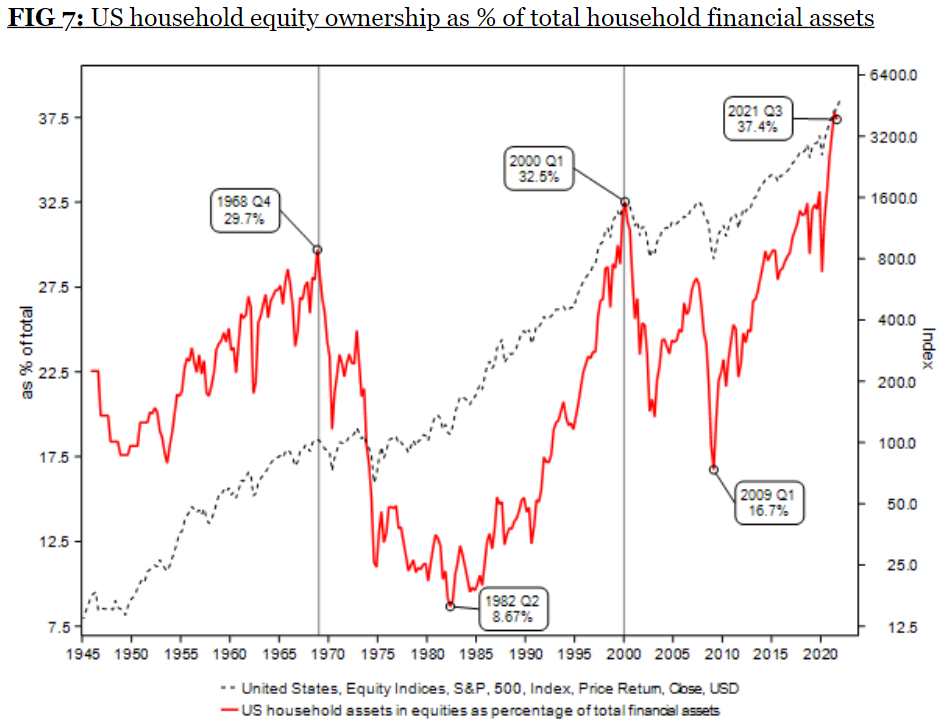
Longview Economics produced the graph below, which appeared in John Authers’ (Bloomberg) post today.

It certainly appears that the average US household is “all in” on equities! Previous peak ownership coincided with the massive unwinding of these positions from 1968 to 1982 and again from 2000 to 2009’s bottom. The unwinding that occurred during the decade of the ’00s witnessed two nearly 50% declines that wiped out incredible wealth, while significantly impairing the funded status for Pension America. Could we be on the cusp of a similar outcome? Will rising US interest rates be that catalyst? We’ve begun to see a great unwinding of historically low global short rates with the value of bonds with negative real rates is now at only roughly $6 trillion from an incredible $19 trillion in 2021.

As I reported earlier this year, inflows into US equity funds in 2021 (>$900 billion) eclipsed the total sum from the prior 19 years combined! Where is the fuel needed to sustain current levels of equity valuation? Will households maintain their current levels of ownership or will they begin to unwind? If the great unwinding occurs will it test the previous lows and what will that mean for US and global equity markets. Worse, what will it mean for our pension system that has made terrific strides in recent years to improve the long-term sustainability of these critically important programs?

Now is the time to rethink your asset allocation strategy, not once the household ownership is nearing levels last seen in early 2009. Secure those promised benefits by converting your current return-focused fixed income exposure into a cash flow matching program where assets and liabilities are carefully synchronized.

Much Ado About Nothing

There was an eye-popping headline on CNBC’s website, “Workers at private companies have amassed more than $400 million (my emphasis) in state-run retirement programs”. Sounds great, doesn’t it? That’s until one realizes that more than 430,000 accounts have been opened in California, Oregon, and Illinois since 2017’s initial launch. Regrettably, that equals ONLY about $930 per participant. That sum won’t get you much of a dignified retirement.

I believe that the only way for most individuals to save is through an employer-sponsored program. If one doesn’t exist, and it is estimated that roughly 57 million Americans don’t have access to an employer-sponsored plan, these state-sponsored programs could be useful in filling the void. More shocking to me than the minuscule account balances is the fact only 3 states have actually adopted legislation and implemented a program as of today. According to the article, 46 states have either adopted or “considered” legislation to sponsor a supplemental retirement program since 2012. Well, we know that three have implemented a program. What’s going on with the other 43? Furthermore, why are the other four not considering something at this time?

According to Vanguard’s latest report, workers appear to need all the help they can get, as the median account balance for individuals nearing retirement — those ages 55 to 64 — is only $84,714. Try living off the income produced from that account balance (roughly $1,700) in today’s low-interest-rate environment. I applaud the efforts of those that have engaged in this activity to provide a means to retirement security, but we need a greater sense of urgency if we are actually going to help the 57 million Americans who’ll find themselves at retirement’s door with few financial resources.

I remain convinced that the only way that we are going to have a majority of our workers ready for retirement is to have them participate in an employer-sponsored defined benefit plan (DB). As important as the effort is to provide workers with a state-sponsored retirement program, we are still asking untrained individuals to fund, manage, and then disburse a benefit with little knowledge on how to accomplish that objective.