The Fed’s Headwind Revisited

By: Russ Kamp, Managing Director, Ryan ALM, Inc.

Despite the recent equity and bond market rally, we believe that the Fed still has its work cut out for them. We published a post last week titled, The Fed’s Headwind? in which I wrote about strong employment and rising sentiment combining to create a substantial headwind for the Fed in trying to combat excessive inflation. Here is a wonderful chart that further supports our contention that demand for goods and services will not be thwarted at this level of interest rates given that the American consumer is still flush.

The consumer is still flush

Nearly $1.3 trillion in excess savings are available to consumers. The Covid windfall peaked at nearly $2.1 trillion in July 2021. Consumption since then has eaten into this windfall but much is left to allocate to further economic activity. Given these surplus savings, strong employment, and rising wages, albeit less than inflation, the Fed will likely have to continue to aggressively elevate interest rates. A late-day rally has US equities rising once more, but bonds are off quite a bit today as yields once again rise. The ADP National Employment Report came in at 208,000 today when forecasters were looking for 200,000. We truly haven’t seen a chink in the employment armor at this time. Perhaps Friday’s US Employment Report will begin to show some weakness. I wouldn’t be surprised if it doesn’t.

A Less Secure Future?

By: Russ Kamp, Managing Director, Ryan ALM, Inc.

I published a post on August 31, 2022, titled, “Let’s Get Realistic“. I provided a bit of a rant regarding the reporting for DC plan participants looking at an account balance of $1,000,000. I indicated that I thought any analysis done with this balance was unrealistic given that the median account balance for 55-64-year-olds according to Vanguard’s annual report was only a little more than $89,000. When applying the “4%” rule, a target percentage for withdrawals that would “ensure” that the participant didn’t exhaust their account balance in retirement, the annual amount to safely withdraw was a whopping $3,560/year. Oh, my.

Well, the news that I’m about to share doesn’t make this scenario any brighter. First, Vanguard has published additional information suggesting that <15% of their 401(k)/IRA participants have an account balance that is >$250,000. At $250,000 the 4% rule would produce an annual distribution of $10,000. That sum isn’t going to provide anyone with a dignified retirement. To make matters worse, recent research produced by Richard Sias and Scott Cederburg, finance professors at the University of Arizona; Michael O’Doherty, a finance professor at the University of Missouri, and Aizhan Anarkulova, a Ph.D. candidate at the University of Arizona, suggests that the 4% rule is really a 1.9% rule! The study is entitled “The Safe Withdrawal Rate: Evidence from a Broad Sample of Developed Markets.”

The implications are extraordinary. Regrettably, they too referenced an account holder with $1,000,000 in retirement assets. Why? Is this chosen threshold to make all of us in the industry feel as if we’ve really helped most people secure a dignified retirement? Let’s play the game. A holder of $1m would see their annual distribution fall from $40,000/year to a meager $19,000. But a more realistic application of the updated 1.9% rule would suggest that the median 55-64-year-old would now get to safely withdraw $1,691/year. Some retirement that will fund!

DC plans have been around for a long time, and many members of the private sector have only had exposure to DC offerings throughout their careers. We can’t use a lack of time in a plan as an excuse anymore. DC plans were intended to be supplemental to DB plans. They aren’t anymore. They are it! This social experiment is failing and those that we are supposed to be serving will suffer the consequences. I don’t know if the right answer for a plan participant is 4%, 1.9%, 6%, etc. I do know that DB plans provide a superior experience for the masses. The failure to maintain DB plans will produce profoundly negative outcomes. I’m not proud of our industry that this is the best we can do! Are you?

What Has the Fed Accomplished?

By: Russ Kamp, Managing Director, Ryan ALM, Inc.

The US equity and bond markets rallied significantly yesterday. Why? What changed from last Friday, last week, last month, last quarter, or year-to-date? The US continues to live with excessive inflation and the US Federal Reserve continues to say that it is committed to raising the Fed Funds Rate until they have accomplished its objective of driving inflation down and creating price stability. They are motivated by not wanting to risk a repeat of the Fed’s two-step in the 1970s!

Inflation will not be contained until demand for goods and services is weakened. Have they impaired the consumer at this point? No, if one looks at the following graph from the Daily Shot.

The US consumer continues to be employed and they are spending what they’ve earned. It certainly doesn’t seem like anything has changed since last week other than the calendar flipped, and we are now in October bringing with it the first day of trading in 2022’s fourth quarter. Federal Reserve Vice Chair Lael Brainard said the “US central bank will need to keep interest rates high for some time to bring inflation down”, even as she acknowledged the need to watch global financial-stability risks from rising borrowing costs.

The global financial markets have benefitted tremendously from the incredible tailwind of accommodative Fed policy for nearly four decades. Have we forgotten that there are risks associated with “investing”? Believing that interest rates and inflation were always going to be low was a critical mistake. We are now paying the piper.

ARPA Update as of September 30, 2022

By: Russ Kamp, Managing Director, Ryan ALM, Inc.

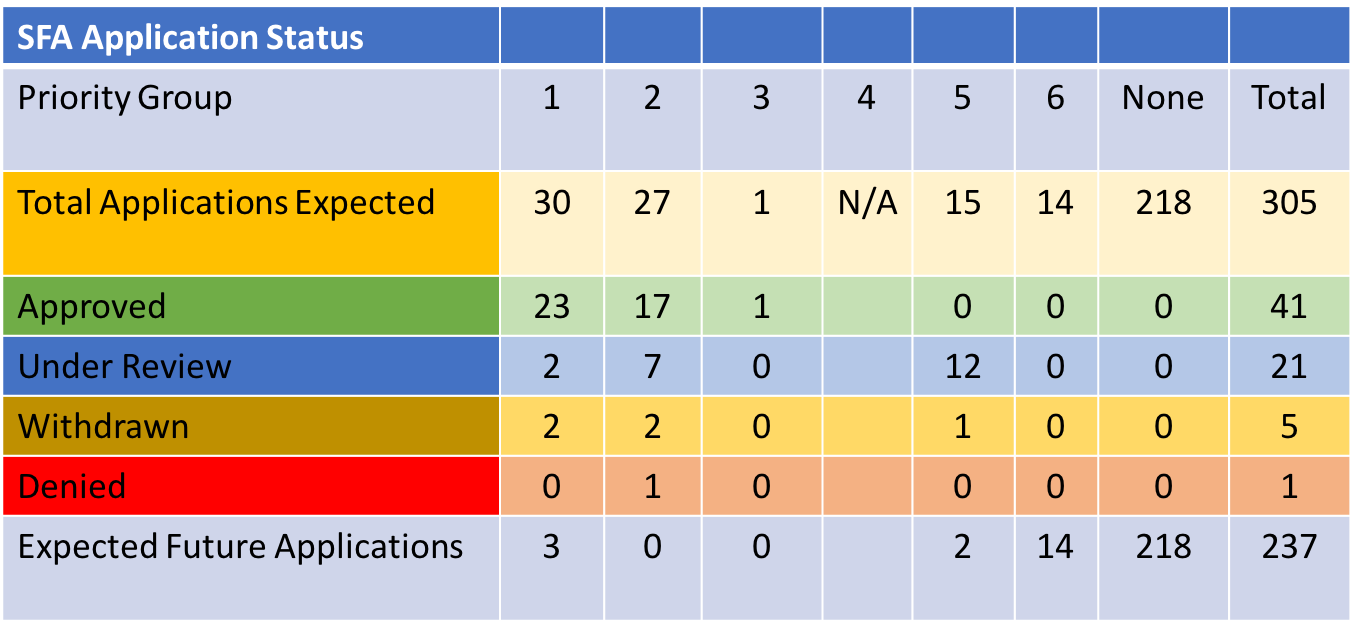
Members of the PBGC have their work cut out for them, as last week was particularly robust in terms of new applications for Special Financial Assistance (SFA) under ARPA. There were nine applications submitted last week, with six of those being initial applications (all Priority Group 1 or 2 members), two were supplemental applications, and the ninth was a revised supplemental submission.

The plans filing applications included the United Furniture Workers Pension Fund A, Plasterers Local 82 Pension Fund, Bakery Drivers Local 550 and Industry Pension Fund, Retirement Benefit Plan of GCIU Detroit Newspaper Union 13N with Detroit Area Newspaper Publishers, Ironworkers Local Union No. 16 Pension Plan, Graphic Communications Union Local 2-C Retirement Benefit Plan, Plasterers and Cement Masons Local No. 94 Pension Fund, Alaska Ironworkers Pension Plan, and the Local Union No. 466 Painters, Decorators and Paperhangers Pension Plan. The supplemental filings are in italics, while the plan submitting a revised supplemental application is highlighted in bold. The total amount of SFA sought is $518 million. The PBGC has 120 days to act on these submissions.

There was only one plan, Local Union No. 466 Painters, Decorators and Paperhangers Pension Plan, that withdrew an application (9/28), but they quickly resubmitted a revised application on 9/30/22. There were no applications approved or denied during the last week. With regard to plans being denied SFA under ARPA, there haven’t been any to date since applications were first filed in July 2021.

I remain concerned that there is a misunderstanding regarding the term return-seeking assets (RSA) for investments within the SFA bucket. As I’ve stated before, investments in investment grade (IG) bonds are return-seeking if they are not used to cash flow match (defease) the pension plans Retired Lives Liability chronologically from the first month’s payment as far out as the allocation lasts. Given the uncertainty in the bond markets because of high inflation, rising rates, and the Fed’s commitment to higher for longer, this misunderstanding could be quite costly. I’ve reached out once again to the PBGC encouraging them to provide clarification. 

We are supportive of the PBGC’s desire to minimize exposure to RSA (33% of the SFA), but given its current interpretation of IG bonds, we remain quite concerned. Generic bond indexes are producing significant negative year-to-date returns. The SFA bucket is a sinking fund and the sequencing of returns is critical to the success of this program. Witness steep drawdowns in the initial years and the SFA could be substantially and negatively impacted. As a reminder, the goal of the legislation is to FUND the promised benefits as far out into the future as possible. Putting all of the SFA into risky strategies does nothing to secure those promises. I’ll keep you informed as to whether or not I hear back from the PBGC.

LDI – aka Leverage Did It!

By: Russ Kamp, Managing Director, Ryan ALM, Inc.

The Bank of England certainly got a bunch of investors excited yesterday. They announced their intent of significant buying of long-dated Gilts which had nothing to do with a change in monetary policy, but everything to do with the very real systematic failure of LDI strategies supporting UK defined benefit pension systems. Had the UK central bank realized that monetary conditions had gotten too tight despite strong employment and decades of high inflation? Could the US Federal Reserve come to its senses and follow suit? It certainly seemed as if the collective investing community jumped to that conclusion. How silly. As I stated yesterday, what happens in the UK stays in the UK. 

As you may know, a significant percentage of the UK’s corporate pension system has engaged in “duration matching” strategies through derivatives and SWAPs. These instruments were often supported by leverage. According to an FT report, the use of leverage was as much as 7X. Incredible, but fiduciarily imprudent. Sure, these strategies had been working and pension funding had dramatically improved, but they’d only been operational during periods of falling interest rates. As we’ve said before, four decades of easy monetary policy that drove interest rates to historically low levels created a sense of false security. Once rates began to rise, and dramatically so, all bets were off. Amazing how quickly these derivative strategies called for additional collateral due to the rapid increase in interest rates this year.

Without the Bank of England stepping in and buying Gilts, the unwinding of these hedged strategies would have been magnified, as more Gilts would have been liquidated to meet prospective margin calls. The problem: UK pensions had adopted these leveraged positions so that they could have more of the assets dedicated to alpha-generating products such as private equity. As a result, liquidity wasn’t abundant and was mostly available through bond exposure. As the value of the Gilts plummeted (off 24% in short order), plans were going to need to find liquidity elsewhere. In many cases, this activity would have taken too long to meet margin calls and as a result, the swap and derivative exposure would have been unwound.

Warren Buffet, who is not a fan of leverage has said, “If you don’t have leverage, you don’t get in trouble. That’s the only way a smart person can go broke.” He’s also been less kind, stating, “When you combine ignorance and leverage, you get some pretty interesting results.” It wasn’t foolish on the part of DB sponsors and their advisors to try and mitigate interest rate risk by adopting LDI duration matching strategies. Ryan ALM does not recommend derivatives and SWAPs. We prefer the use of cash flow matching to fund benefits and secure the promise. There is no leverage! In cash flow matching, we carefully match up bond cash flows (principal and interest) with liability cash flows (benefits) to ensure that liquidity is sufficient to meet the plan’s obligations while allowing the alpha assets to grow unencumbered.

As for yesterday’s reaction in the US to the BOE’s bond purchasing in the UK, you need to stop thinking that the US Federal Reserve is going to do an about-face and begin to lower US rates. The Fed is committed to reducing inflation by raising interest rates. How many different ways must they state that message before US investors understand?

How’s Your Crystal Ball?

By: Russ Kamp, Managing Director, Ryan ALM, Inc.

Forecasting future market returns is fraught with peril! To Horizon Actuarial’s credit, they understand how challenging it is to forecast tomorrow’s market activity let alone 10-year, 20-year, and 30-year returns, risks, and correlations. Since 2010, they have acquired forecasts from leading consultants, actuaries, and investment managers, and since 2012, they’ve published those results. Let’s give a big thank you to Horizon and to the organizations that provide the inputs to this analysis. I find this survey to be helpful.

The 2022 forecast was published in August and mostly reflects the common wisdom that existed at the end of 2021. It would be quite interesting to see how those forecasts would change if they had a mulligan. I suspect that future returns from today forward would look better, especially for bonds. The fixed income returns in this analysis reflect an interest rate environment that had yet to break out from a nearly four-decade slide toward zero yields. The Treasury forecast, described as cash equivalents, predicted a 1.56% annualized return for the next 10 years. The 1-year T-Bill is yielding 4.16% today. The 3-year Note’s yield is 4.4%. Since corporate bonds trade off the Treasury yield curve and provide a healthy spread in yield, the investment grade corporate bond equivalent will be providing a very attractive yield in the 5%+ range.

As interest rates continue an upward trajectory, bond cash flows will become more robust providing greater coverage of liability cashflows (benefits and expenses). The higher the yield the smaller the present value $s needed to meet those future value promises. Bifurcate your asset allocation and create a liquidity bucket within your pension plan that takes advantage of these expanding yields. At the same time, transform your remaining exposure into a growth (alpha) portfolio that will now benefit from the “buying of time” from the liquidity bucket (e.g. 1-7 years). Horizon’s survey highlights expectations for a number of less liquid alternatives, including private equity (9.2%), real estate (5.4%), Infrastructure (6.4%), and private debt (6.9%) that will benefit from this asset allocation configuration. The survey also has an expectation for hedge funds at 4.8% annually for the next 10 years. However, given that short Treasuries are now yielding nearly that return why bother with those cumbersome and expensive offerings?

The last decades have been an unbelievable time for the capital markets and many pension systems. Regrettably, the days of Fed accommodation and low rates are gone. In their wake, we must adopt an approach that will help fund benefits while generating growth to meet tomorrow’s liabilities. Sitting back and doing nothing is not acting with fiduciary prudence. Adopting a bifurcated asset allocation is simple. Migrate your current return-seeking fixed income from an Aggregate-type portfolio to one focused on matching asset cash flows with liability cash flows. Then sit back and watch the magic unfold.

What Is In Store For Us?

By: Russ Kamp, Managing Director, Ryan ALM, Inc.

The US 10-year Treasury Note yield is fast approaching 4% (3.9% at 2.39 pm). The last time the yield was at this level was in August 2008. It seems almost certain that we will breach 4% in short order. As the chart below highlights, a 10-year Treasury Note yield above 4% is not rare. In fact, there was a 39-year stretch from 8/19/1963 (I was 4) when the Treasury Note yield broke above 4% until 9/16/2002 when it would next fall below 4%. The yield would once again rise above that level until the Summer of 2008 when the US would last see a 4 in front of the yield for the US 10-year Treasury Note.

Up, Up and Away!

The last 14 years have truly clouded our perspective regarding interest rates. We’ve become anchored to the idea that rates are always low, and that the Fed couldn’t possibly raise rates that might jeopardize our economic growth and strong employment. But raise rates they did! Furthermore, they have been incredibly consistent in stating that they will continue to increase the Fed Funds Rate for as long as necessary to get inflation moving down to the Fed’s desired target (2%). We would encourage those who believe that the Fed will raise rates and then immediately drive them back down to let go of that idea. As mentioned above, the yield on the 10-year Treasury Note has spent much more time above 4% than below.

ARPA Update as of September 23, 2022

By: Russ Kamp, Managing Director, Ryan ALM, Inc.

We are pleased to provide this most recent update on the PBGC’s execution of the ARPA legislation. Two plans, Pension Plan of the Printers League – Graphic Communications International Union Local 119B New York Pension Fund and Teamsters Local 641 Pension Plan (revised), have filed supplemental applications seeking additional SFA following the release of the PBGC’s Final Final Rules (FFR). The Printers are seeking an additional $15.3 million on top of the $90.6 million that they received in August, while Local 641 is asking for an additional $91.5 million following receipt of $516.9 million on May 2nd. Both of these pension plans were classified as Priority Group 1. The seeking of additional funds continues a trend that we’ve highlighted since the PPGC’s final rules were announced.

There have been no initial applications filed since the Toledo Roofers Local No. 134 Pension Plan submitted its SFA request on 9/1/22. No payments of SFA have been made this month, as the Toledo Pension Plan is the only approved application yet to be wired proceeds. Fortunately, we still don’t have any applications that were denied. As more and more Priority Group 1 and 2 plans file supplemental applications, we are still waiting on the PBGC’s approval for the only Group 3 plan (Central States). To date, there have been no Priority Group 4 plans to file an application, which have been eligible to submit an SFA application since July 1, 2022.

The Fed’s Headwind?

By: Russ Kamp, Managing Director, Ryan ALM, Inc.

The US Federal Reserve is raising the Fed Funds rate in an attempt to drive down demand for goods and services, as they battle our current inflationary environment. However, given the exceptionally strong labor market, they have their work cut out for them. Furthermore, consumer sentiment is once again rising. In fact, it has rebounded with ferocity as the chart below depicts.

As Bloomberg speculates, the reduction in gas prices may have fueled the rebound in consumer sentiment currently witnessed. With strong employment and improving (robust) sentiment, how much will demand be thwarted? With real rates still quite negative (-4.5% for the 10-year Treasury Note this morning), the Fed will likely need to raise interest rates until real positive rates are achieved and demand for goods and services tamped down. The Fed claims that they are committed to fighting inflation and that it will “do what it takes”, but the US consumer may make the Fed’s task more challenging given the elevated confidence.

Worst Year on Record!

By: Russ Kamp, Managing Director, Ryan ALM, Inc.

For multiemployer plans that have filed applications with the PBGC to receive Special Financial Assistance (SFA) through the ARPA legislation, investing that grant money comes with restrictions. Effective with the release of the Final Final Rules (7/6/22), the PBGC “allows plans to invest up to 33% of their SFA funds in return-seeking investments (e.g., publicly traded common stock and equity funds that invest primarily in public shares); with the remaining 67% restricted to high-quality fixed income investments.” Based on this language from the PBGC’s website one would assume that high-quality fixed income isn’t “return-seeking”. But if the bonds aren’t used to defease pension liabilities these financial instruments are absolutely return seeking!

Chart provided by Bloomberg

As the chart above reflects, 2022 is shaping up to be the worst year on record for the US 10-year Treasury Note and we aren’t even through the third quarter with the Federal Reserve likely providing more rate hikes before this calendar year concludes. Plan sponsors that received the SFA early in 2022 were forced to invest 100% of the proceeds in investment grade (IG) bonds. If they elected to seek exposure that would mirror a generic index such as the Bloomberg Barclays Aggregate Index, those funds have lost more than 12% YTD. For those plans that invested in fixed income and then diversified into equities following the PBGC’s release of the FFR, those equity assets have also been hit by a significant market correction that has erased all of the gains achieved from mid-June to early August. It has been a lose-lose proposition!

Regrettably, this market action has diminished the value of the SFA separate account. It didn’t have to be that way. This incredible grant (SFA) to struggling multiemployer plans should have been used to defease (SECURE) the promised benefits just as the legislation desired. Matching the bonds’ cash flows (principal and interest) with liability cash flows (benefits payments) would have protected your SFA from the significantly negative impact of rising interest rates because it is cash flow matching future values (benefit payments) which are not interest rate sensitive. Bonds are absolutely return-seeking instruments when not used to defease pension liabilities. The PBGC may have thought that they restricted the SFA bucket to having no more than 33% in RSA, but they made a terrible mistake when they didn’t instruct the plan sponsor community and their consultants to defease liabilities with the remaining 67% of the SFA bucket. As it is, 100% of the SFA can now be in RSA.

There is good news, we at Ryan ALM are aware that a couple of plan sponsors (and their consultants/actuaries) have used the fixed income exposure within the SFA to defease pension promises. In one case, 100% of the SFA is being used, and in the other, the strategy is to use 67% of the SFA to defease pension liabilities through a cash flow matching strategy. Great job!

We believe that the Federal Reserve will continue to raise the Fed Funds Rate until real interest rates are achieved. It is only at that point that inflation will be tamed. Given that the 10-year Treasury Note is currently providing a negative -4.6% real yield, we likely will witness more pain for both fixed income and equity markets. Don’t use the SFA assets in pursuit of some growth strategy. Use the SFA assets to secure as many years of benefit payments as possible as the ARPA legislation clearly states as the purpose of the grant. Use the plan’s legacy assets to pursue a growth strategy. Bifurcating your asset allocation into liquidity (SFA bucket) and growth (legacy portfolio) will provide a great structure for these challenging times.