Worst Year on Record!

By: Russ Kamp, Managing Director, Ryan ALM, Inc.

For multiemployer plans that have filed applications with the PBGC to receive Special Financial Assistance (SFA) through the ARPA legislation, investing that grant money comes with restrictions. Effective with the release of the Final Final Rules (7/6/22), the PBGC “allows plans to invest up to 33% of their SFA funds in return-seeking investments (e.g., publicly traded common stock and equity funds that invest primarily in public shares); with the remaining 67% restricted to high-quality fixed income investments.” Based on this language from the PBGC’s website one would assume that high-quality fixed income isn’t “return-seeking”. But if the bonds aren’t used to defease pension liabilities these financial instruments are absolutely return seeking!
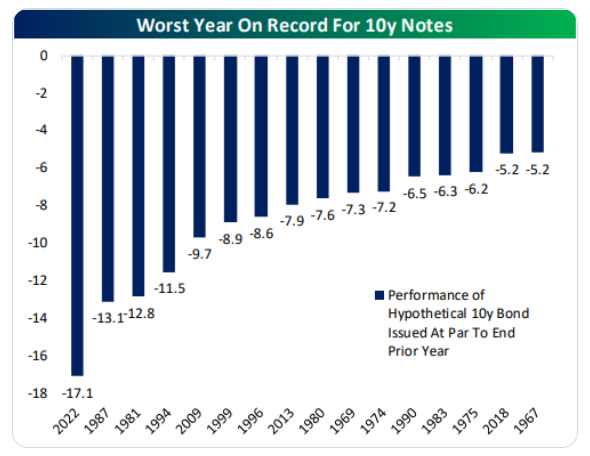
Chart provided by Bloomberg

As the chart above reflects, 2022 is shaping up to be the worst year on record for the US 10-year Treasury Note and we aren’t even through the third quarter with the Federal Reserve likely providing more rate hikes before this calendar year concludes. Plan sponsors that received the SFA early in 2022 were forced to invest 100% of the proceeds in investment grade (IG) bonds. If they elected to seek exposure that would mirror a generic index such as the Bloomberg Barclays Aggregate Index, those funds have lost more than 12% YTD. For those plans that invested in fixed income and then diversified into equities following the PBGC’s release of the FFR, those equity assets have also been hit by a significant market correction that has erased all of the gains achieved from mid-June to early August. It has been a lose-lose proposition!

Regrettably, this market action has diminished the value of the SFA separate account. It didn’t have to be that way. This incredible grant (SFA) to struggling multiemployer plans should have been used to defease (SECURE) the promised benefits just as the legislation desired. Matching the bonds’ cash flows (principal and interest) with liability cash flows (benefits payments) would have protected your SFA from the significantly negative impact of rising interest rates because it is cash flow matching future values (benefit payments) which are not interest rate sensitive. Bonds are absolutely return-seeking instruments when not used to defease pension liabilities. The PBGC may have thought that they restricted the SFA bucket to having no more than 33% in RSA, but they made a terrible mistake when they didn’t instruct the plan sponsor community and their consultants to defease liabilities with the remaining 67% of the SFA bucket. As it is, 100% of the SFA can now be in RSA.

There is good news, we at Ryan ALM are aware that a couple of plan sponsors (and their consultants/actuaries) have used the fixed income exposure within the SFA to defease pension promises. In one case, 100% of the SFA is being used, and in the other, the strategy is to use 67% of the SFA to defease pension liabilities through a cash flow matching strategy. Great job!

We believe that the Federal Reserve will continue to raise the Fed Funds Rate until real interest rates are achieved. It is only at that point that inflation will be tamed. Given that the 10-year Treasury Note is currently providing a negative -4.6% real yield, we likely will witness more pain for both fixed income and equity markets. Don’t use the SFA assets in pursuit of some growth strategy. Use the SFA assets to secure as many years of benefit payments as possible as the ARPA legislation clearly states as the purpose of the grant. Use the plan’s legacy assets to pursue a growth strategy. Bifurcating your asset allocation into liquidity (SFA bucket) and growth (legacy portfolio) will provide a great structure for these challenging times.
3 Times the Contribution Rate!

By: Russ Kamp, Managing Director, Ryan ALM, Inc.

Rising inflation, higher interest rates, growing levels of debt, and a generally higher cost of living across the board are weighing on the average American. All of this is happening just as October Three Consulting is out with a report estimating that contribution rates into defined contribution plans will have to increase by 3 X for a 25-year-old hoping to retire in 2063 relative to someone who retired in 2000. A replacement of 80% of one’s final salary once took a little more than 4% of pay to accomplish the objective. October Three is estimating that it will now cost nearly 14% of pay year in and year out to achieve this target. Good luck with that!

American workers who are fortunate to have access to a DC plan are contributing on average 7%, which is about half what October Three has calculated as the necessary contribution rate. Furthermore, that contribution rate was as of 2020, when many Americans were more flush during Covid-19 than they are today. Unfortunately, the retirement angst being felt isn’t reserved for the American worker. A new survey by the National Payroll Institute and the Financial Wellness Lab of Canada, which interviewed 3,000 Canadian workers, indicated that those saving between 1% and 5% of their pay increased to 34%, up from 27% in 2021. Regrettably, 9% of respondents said they aren’t saving anything. Furthermore, a significant majority of those in the survey indicated that they are financially stressed!

“Employees who said they’re stressed are living closest to their limits, with 91% spending all or more than their net pay, up from 82% in 2021.” Given these numbers, just how does a worker increase their contribution rate to as much as 14%? Is a dignified retirement no longer a possibility? Will this situation get even worse where loans and early withdrawals from DC plans escalate as costs increase further? Finally, who said that a supplemental savings plan should become everyone’s “retirement plan”. Most Americans and Canadians don’t have any supplemental income at this time! As a result, they aren’t likely going to have a retirement fund sufficient enough to achieve the objective. Great policy decision!

The Fed Has Spoken Once More!

By: Russ Kamp, Managing Director, Ryan ALM, Inc.

This is a recording. US interest rates are rising! Yes, US rates are rising. What shocking news! Fed Chairman Powell announced this afternoon that the US Federal Reserve was once again raising the Fed Funds Rate 75 bps to a range of 3.0% to 3.25%. This continues an aggressive path upward for US rates that began earlier this year as it became more apparent that inflation was not transitory. However, it has taken market participants a long time to come to grips with the Fed’s activity.

Following the FOMC meeting, Powell indicated that the Fed Funds Rate is likely to hit 4.25% by year-end 2022. Which would indicate to me a further 75 bps increase at the November meeting followed by another 50 bps increase come December. The Terminal rate for this interest rate hiking cycle is now forecast to be 4.625% at year-end 2023, which is 25 bps higher than what the market had previously forecast.

So much for a quick reversal in policy that would have US rates falling in 2023. Furthermore, Powell reiterated that “the chances of a soft landing are likely to diminish to the extent that policy has to be more restrictive,” But the alternative is worse, he added. “A failure to restore price stability would lead to greater pain later on,” Mr. Powell said. No one should be surprised by this stance, as Powell and the other members of the FOMC have been very consistent even if their message has fallen on deaf ears.

Furthermore, the Fed has slashed this year’s growth forecast to just 0.2% (Q4 to Q4) from 1.7%, and the 2023 forecast has been cut to 1.2% from 1.7%. Lower anticipated growth for the US economy can’t be good for jobs/employment… and the stock market. Will lower payrolls be enough to tamp demand for goods and services? Is a possible 4.625% year-end 2023 FFR high enough to dramatically impact our current 8%+ inflationary environment. Remember, it took significant real rates to thwart inflation in the early ’80s. We aren’t close to having real rates with the US 10-year Treasury only trading at a yield of 3.5% (3:45 pm).

Lastly, total return-focused fixed income strategies are getting destroyed in 2022 and it doesn’t appear that 2023 will provide much relief. Don’t use fixed income as a return-seeking instrument. Use bonds for the certainty of their cash flows. The matching of asset cash flows to liability cash flows will mitigate interest rate risk for that portion of the liability cash flow schedule. I don’t think that anyone’s crystal ball is particularly good so why guess as to the direction of rates?

ARPA Update as of September 16, 2022

By: Russ Kamp, Managing Director, Ryan ALM, Inc.

Last week didn’t bring much excitement as it relates to the ARPA legislation for multiemployer pension plans. But it was pretty exciting if you are a NY Giants football fan, as I have been since the mid-’60s. Two wins in a span of 8 days to start a season hasn’t been an easy feat for my beloved Giants. But I’ve digressed – sorry! With regard to ARPA, this was the week that wasn’t. There were no new applications submitted, previously submitted applications approved or denied, and the one approved application still waiting for payment continues to wait.

To date, 39 funds have filed applications seeking Special Financial Assistance (SFA). Of the 30 that have been approved, 19 have filed a supplemental application seeking additional SFA as a result of the amended PBGC guidelines. There are currently 28 applications in the “review” queue awaiting PBGC approval of which 9 have not received any SFA from the PBGC at this time. What is interesting to me is the fact that there were 114 plans identified by Cheiron as potential candidates during the development of the Butch Lewis Act (BLA). Those Critical and Declining plans at the time were approximately 10% of the universe of multiemployer pension plans.

The PBGC’s oversight of the ARPA legislation has been ongoing for about 14 months at this time. I would have expected more plans to have filed an initial application. The 39 applications represent only 34% of the initial list of candidates. The PBGC still has two priority groups (5 and 6) that aren’t eligible to file an application until 2/11/23. In addition, there may be other plans that will be eligible after Priority 6 plans have filed. Furthermore, 2022’s market action may drive some plans into a more difficult funded status. We’ll monitor that situation as we move through this rate cycle.

The US Ranks 18th In Retirement Readiness

By: Russ Kamp, Managing Director, Ryan ALM, Inc.

The Natixis Global Retirement Index is out for 2022, and the results suggest that the U.S. has a long way to go before our aging population is truly prepared for the “golden years”. The annual review provided by Natixis analyzes myriad factors for 44 countries beyond just interest rates, savings rates, and inflation. “People are living longer, and with age comes increased need for medical care. So the index considers health factors alongside finances. To ensure their finances hold up, the index considers key economic indicators that examine material wellbeing. And because retirees need to live in a clean, safe environment, the index considers the quality of life.” (Natixis report)

The rank of 18 is slightly worse than the U.S.’s rank in 2021, but up from 23 “achieved” in the initial study in 2012. The combined score for the U.S. based on all of the factors is 69%, which is down from 72% in 2021 and surprisingly 71% in 2012. Regrettably, the U.S. doesn’t score in the top 10 in any of the subcategories, including Health, Quality of Life, Material well-being, and Finances in Retirement. The best U.S. rank is in the Finances category where we rank 11th. Our worst score is in Material Well-being in which we rank 30th. This score is heavily influenced by income inequality.

This is a very disappointing study to read from the perspective of someone who has been involved in the US retirement industry for 40+ years. Yes, there are factors being considered in this study that fall outside of our control and responsibility, but I have often felt that most of us working in the retirement industry have done very well financially while the folks that we are serving continue to struggle. Not good!

Momma Said That There’d Be Days Like This!

By: Russ Kamp, Managing Director, Ryan ALM, Inc.

Inflation isn’t as tamed as believed (or hoped) by the investment community and as a result, the US Federal Reserve won’t be “forced” to ease rates anytime soon. Let’s feign shock! Regular readers of this blog know that we’ve been proclaiming higher rates for the foreseeable future. We believe that decades of falling inflation and US interest rates combined to create an extremely unprepared and complacent investment community. Well, today’s market action should shake the cobwebs from at least some folks.

It isn’t often that US equity indexes post >-4% declines in a day, but that is exactly what transpired today, as heavy bets appeared to have been made on the August CPI posting a bigger drop than forecast. When that expectation failed to materialize those bets were unwound faster than a Usain Bolt 100-meter sprint. As of today’s close, the S&P 500 had fallen by -4.3% and the Nasdaq had tumbled by -5.2%. The impact of falling equity markets and rising interest rates are painful for DB pension plan assets, but they are crippling for those multiemployer plans that receive Special Financial Assistance (SFA) grants through the ARPA legislation and PBGC oversight.

I’ve produced more than 1,100 posts on this blog since its inception. Of those 1,100+ posts, 66 mention SFA and many of those posts highlight the Ryan ALM view on how those assets should be invested. As the ARPA legislation states, SFA assets should be used to SECURE benefits chronologically. Despite the recent update (Final Final Rules) by the PBGC granting approval for a portion (33%) to be invested in return-seeking assets (RSA), we believe that investing in RSA violates the intent of the legislation. Days like today in the US equity markets certainly validate our concerns. Because the SFA is a sinking fund (pays the bills), and because the sequencing of results is so critically important, investing in RSA within the SFA bucket is an imprudent approach.

On September 1st, I produced a post titled, “A Precious Resource – Protect It!” which once again discussed the SFA and how this once-in-a-generation “gift” to Pension America shouldn’t be squandered. I am truly concerned that most of the plans that have received the SFA in 2022 have proceeded to invest the assets in either bonds that were RSA because they weren’t used to defease pension liabilities or bonds and equities given the loosening of constraints in the PBGC’s FFR. In either case, significant losses have likely occurred which significantly impacts a plan’s ability to secure as many benefits within the SFA as possible.

The Ryan ALM crystal ball is no better than anyone else’s. We’ve just been around for a long time and have seen many market cycles. Believe it or not, even a BEAR market in bonds (the last one in 1977 that ended in 1982). We understand that investing RSA in an inflationary environment coupled with rising rates is fraught with danger. Why play that game? Pension plans receiving the SFA have the opportunity to dramatically alter the economics of their plan. They have an obligation to the plan’s participants to ensure that the promised benefits can be paid on a monthly basis. Momma is always right! There have been days like this before and there will be more days to come. An SFA portfolio shouldn’t be subjected to them.

ARPA Update as of September 9, 2022

By: Russ Kamp, Managing Director, Ryan ALM, Inc.

Welcome to the second week of September. I don’t know about you, but 2022 is flying along. That said, there really isn’t much to report on this week as no pension systems filed an application new or revised. No applications were approved, and only one plan that has received approval is left to be paid – Gastronomical Workers Union Local 610 and Metropolitan Hotel Association Pension Fund. They are waiting on a tidy morsel of $31.1 million for its 2,624 participants.

As a reminder, the window for Priority Group 4 plans, those projected to become insolvent before 3/11/2023, has been open since July 1st. However, no Group 4 applications have been filed as of yet. Priority Group 5 and 6 funds will be permitted to file effective February 11, 2023. Perhaps the pace of new applications will quicken as we move through the balance of 2022 into 2023.

Lastly, a big thanks to the PBGC for continuing to provide weekly updates on their website.

They Are Getting Their Comeuppance!

By: Russ Kamp, Managing Director, Ryan ALM, Inc.

We tried. Oh, we tried so hard! We begged, cajoled, reasoned, and pleaded with the plan sponsor community to take full advantage of the historically low US interest rates witnessed following the onset of Covid-19 by issuing a pension obligation bond (POB). We spoke at conferences, conducted webinars, wrote research and blog posts, and met individually with sponsors and their consultants, but we weren’t able to convince a significant majority that they had a wonderful opportunity to dramatically improve the long-term economics of their plan. What a waste!

Despite our frustration and lack of success, we do know that some public plans did issue POBs. In fact, more than 2Xs the $ amount of POBs had been issued by August 2021 ($6 B) than had been issued in 2020 for the full year ($3 B). We were very pleased to see that. However, our enthusiasm was quickly diminished by the fact that the POB proceeds were being invested in the plan’s asset allocation and not used to defease the plan’s liabilities. Once again, we attempted to educate those willing to listen that investing the proceeds into a traditional asset allocation came with a lot of risks, especially given equity valuations at that time.

One of the greatest concerns articulated by critics of POBs was the investing of the bonds’ proceeds into a “normal” asset allocation. Many rating agencies had voiced concerns about this practice. In fact, POBs often negatively impacted the sponsoring agency’s credit rating. We were on record trying to get plans to defease through a cash flow matching strategy as much of the plan’s retired lives liability as possible. Most importantly, this strategy wasn’t dependent on the timing of the investments. We suspect that most of the plans decided to stay the course and invest some of the money in equities, some in bonds, perhaps a little PE, and/or something else.

That is really too bad, as 2022 has been a complete disaster from an asset performance standpoint and it isn’t likely to get better soon as the Fed continues to raise rates. Both equities and fixed income are taking it on the chin. As of August 31, 2022, the S&P 500 was down -16.1%, small cap equities had fallen -17.2%, international stocks (MSCI) were down >-19%, and bonds, yes BONDS, were down more than -12%! If only! If only plan sponsors and their advisors had used the proceeds to defease pension liabilities, those assets would have SECURED the promised benefits, improved liquidity, and eliminated interest rate risk for that portion of the account that was defeased, while buying time for the alpha assets to grow unencumbered. What a wasted opportunity! Now the pension plan’s portfolio has to work extra hard to try and make up for the substantial principal losses experienced so far while simultaneously paying the ongoing interest on the bond. When will we learn?

Still Well Below Average

By: Russ Kamp, Managing Director, Ryan ALM, Inc.

US interest rates have risen dramatically from the historic lows achieved during the initial stages of the Covid-19 crisis. Interest rate moves, particularly among shorter Treasury maturities (5 years and less) have moved up by more than 300 basis points. For Treasuries longer than 5 years, the interest rate increases have been >240 bps. The US interest rate cycle that produced a nearly 40-year bond bull market has been squashed and it will likely be some time into the future before we see rates ease significantly, as the Federal Reserve continues to have as its primary objective the tamping down of our current excessive inflation.

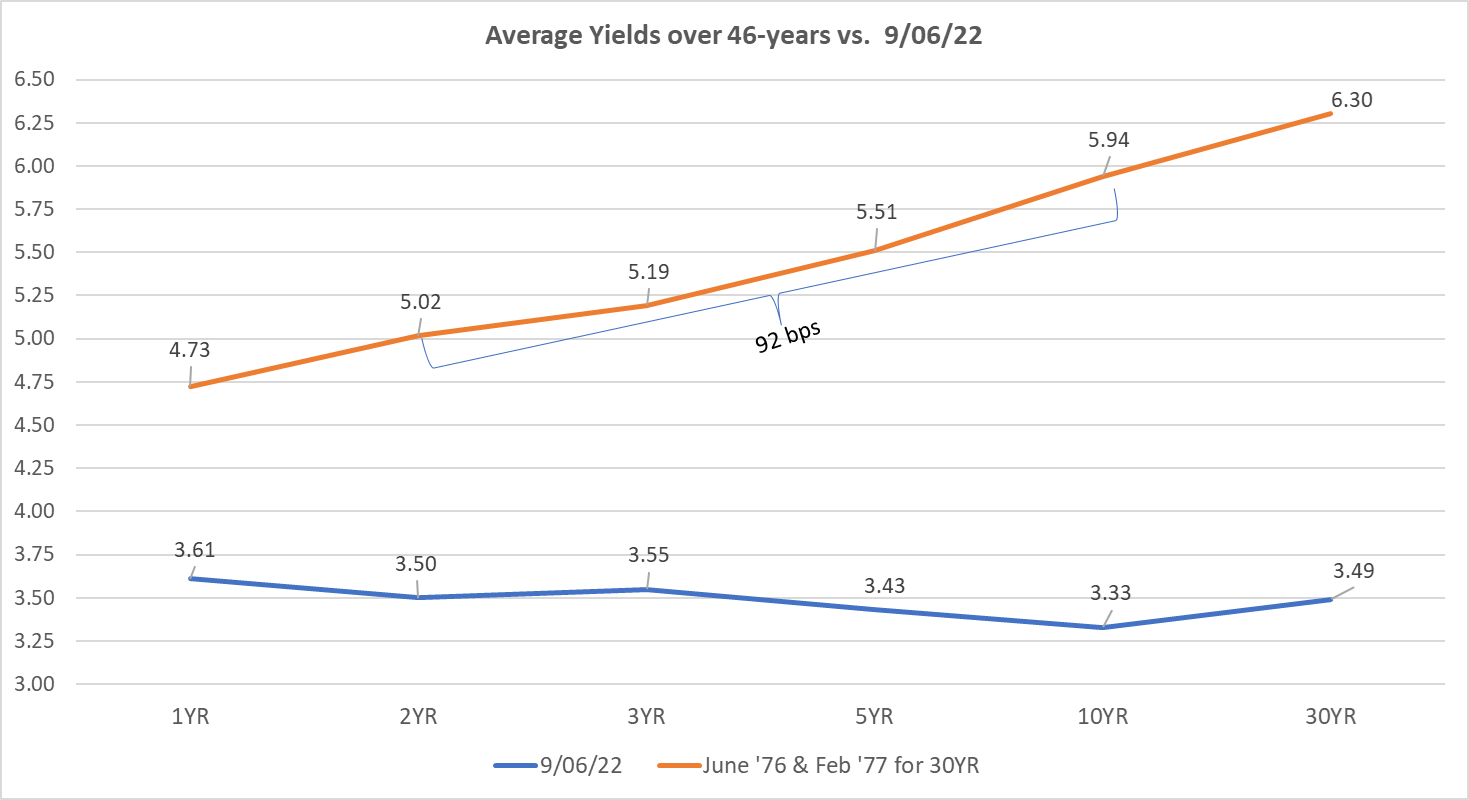
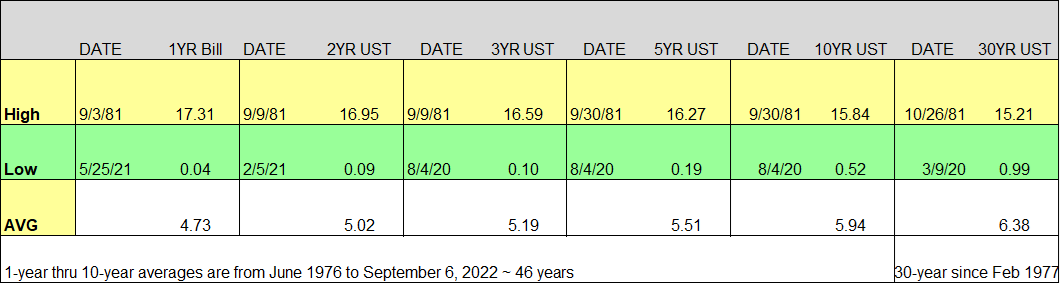
Despite the significant move in rates, we believe that there is much more for the Fed to do, as real rates remain dramatically negative (-5.23% versus today’s yield on the US 10-year Treasury Note). Furthermore, the move up in rates has Treasury yields still positioned substantially below the averages for the last 46 years. The chart below was produced by Ryan ALM’s Head Trader, Steve DeVito. The data is from 11,564 daily observations.  All Federal bank holidays and weekends during the 46 years were removed as the markets were closed and the daily yields over long holidays were just repeated from the last day the bond market was open.

Rates remain well below historic averages

As one can clearly see, both the flatness of the curve and the low level of rates indicate a very different environment for the US Federal Reserve to try to use monetary tools to fight this inflation battle. The Fed has been consistent in its messaging despite many market participants not believing that rates must rise to a level that thwarts economic growth and drives down employment. Just getting the 10-year Treasury yield back to the last 46-year average would necessitate an increase of 260 bps from the current levels. Oh, my! As a reminder, a bond with a 10-year duration would suffer a -10% principal loss with every 1% rise in rates. That might be good for pension liabilities but it could be devastating to fixed income funds focused on achieving a return versus a generic index.

In order to provide some context, Steve also looked at the range of rates at each maturity bucket during this 46-year period. The highs and lows are extremely dramatic, and each reflects a point in time in which our economy was experiencing crisis conditions. The high levels were the result of incredible inflation during the late ’70s and early ’80s that make our current environment pale in comparison. It took extraordinary courage by Fed Chairman Volcker to crush that inflationary environment. Does this Fed possess the same resolve? The lows were the result of the closure of our economy during the initial reaction to the Covid-19 pandemic when roughly 30% of our workforce was temporarily sidelined.

The Ryan ALM crystal ball is no better than anyone else’s, but history does have a strange way of repeating itself. I’m certainly not comfortable stating that rates will follow a similar path to 1981’s peak, but in cases of great unknowns, falling back on the averages is a pretty good tool. In this case, the averages portend much more pain for the investment community. Are you prepared? Lastly, we believe that Ryan ALM produces the most complete data on the Treasury yield curve through the Ryan Indexes. Interested? Please let us know how we can assist you.

Past Performance is Not Indicative of Future Performance

By: Ron Ryan, CFA, CEO, Ryan ALM, Inc.

We are happy to share with you recent research published by Ron Ryan, CEO, Ryan ALM. The investment horizon of today is certainly different than the last 10, 20, or 30 years. We would have to go back to the late 1970s and early 1980s to revisit an inflationary environment like we have today. The Federal Reserve is acting in an aggressive fashion to tamp high inflation. This action has effectively ended the 39-year bull market for bonds. As a result, many strategies that have been tested and used only in a fallling rate environment coupled with low inflation may not achieve similar outcomes. We hope that you find Ron’s ideas beneficial.

For prior firm research, please go to RyanALM.com and click on Insights. You’ll find white papers, newsletters, and presentations. Reach out to us if we can answer any lingering questions.