PBGC Update as of January 6th, 2023

By: Russ Kamp, Managing Director, Ryan ALM, Inc.

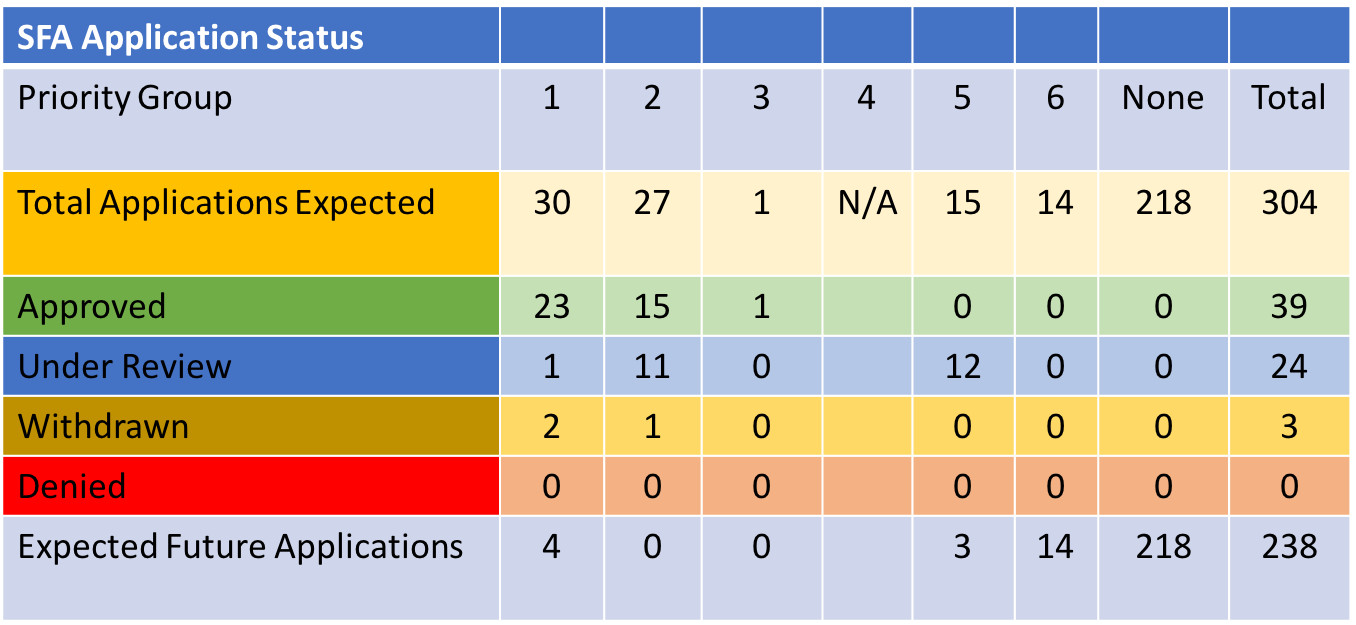
After some fairly intense activity for the PBGC to end 2022, the new year began with a much more measured pace! We are pleased to once again provide this weekly update regarding the ARPA legislation and the beneficiaries of the Special Financial Assistance (SFA). Last week, there were two supplemental applications filed by Priority Group 1 plans. The Cement Masons Local 783 Pension Plan and the Cement Masons Local Union #681 Pension Plan filed their respective applications on January 6th. They are seeking a relatively insignificant combined sum ($61,070) in addition to what they originally received earlier this year. The two plans cover 246 participants, who likely feel that every $ received is significant.

In addition to these two filings, there was an application withdrawn on January 5th. The Ironworkers Local Union No. 16 Pension Plan, a priority group 2 plan (MPRA Suspension), withdrew its initial application seeking $74 million for the 996 plan participants. They submitted the application in late September. Hopefully, they will resubmit a revised application shortly allowing them to get on the PBGC’s radar soon.

Fortunately, there were no applications that were denied during the last week. But, there were also no applications approved. As the chart below reflects, there is still much more activity to come!

Fighting the Fed – What’s the Implication?

By: Russ Kamp, Managing Director, Ryan ALM, Inc.

Four decades of falling rates and easy (supportive) monetary policy certainly have combined to create an expectation among US investors that US interest rates will be low forever and that the Fed will step in at the first sign of weakness. This assumption has led investors to the idea that a great pivot will soon occur or that at the very least, the Fed will engineer a “soft” landing in which employment isn’t harmed, wages fall back to <2% annual growth, inflation quickly evaporates, and stocks can once again resume their upward trajectory. In fact, they so believe this theory that they have driven long-term US interest rates down to levels not seen in months. In the process, they have created a more challenging environment for the Fed to actually accomplish its principal objective of thwarting inflation.

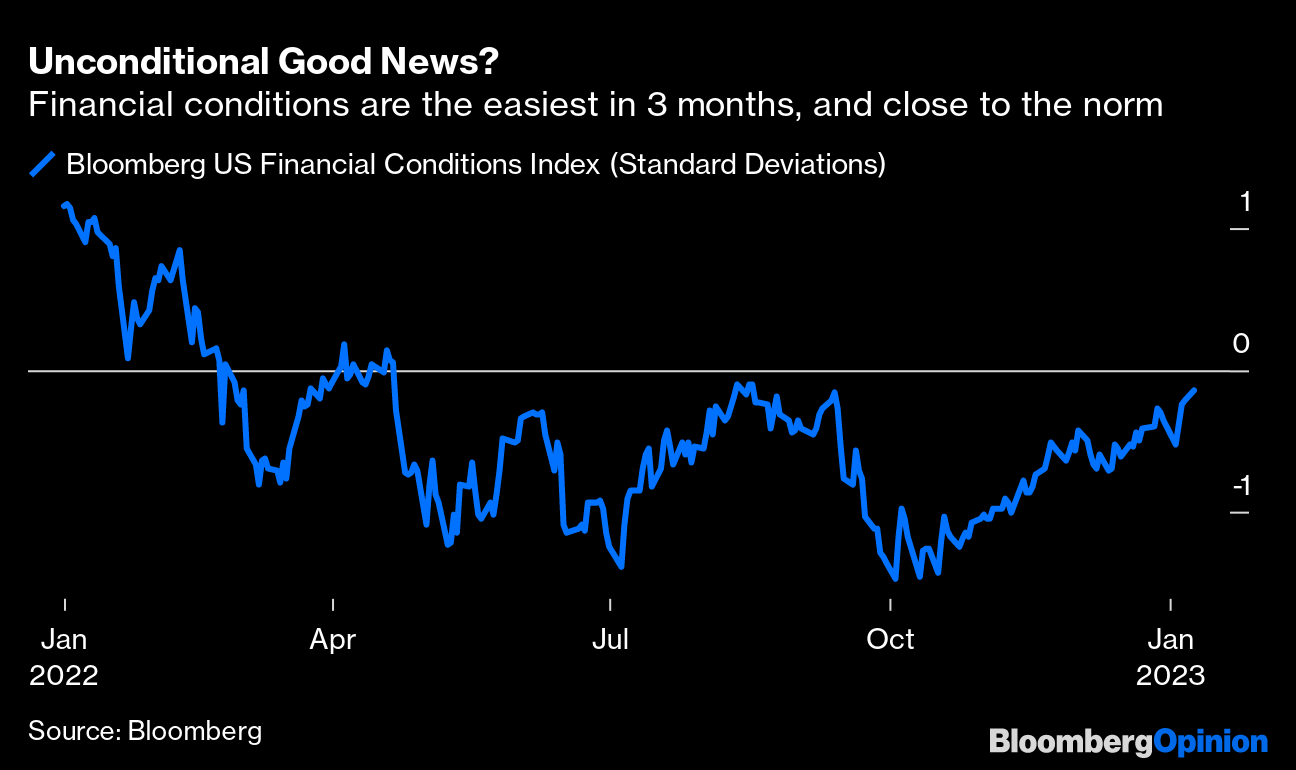
Despite the Fed’s aggressive action during the past 10 months, financial conditions appear to be “normal” as depicted in the chart above. Where is the tightness? For all the handwringing regarding the massive upswing in rates, it certainly doesn’t appear to me that the Fed has actually accomplished much of anything, yet! Sure, inflation, as measured by the CPI, and fallen from the current peak of 9.1% to 7.1%, but that is still 7% inflation!! Employment remains strong, as we’ve recently seen as unemployment is now at 3.5%, job openings remain at 1.7/for every unemployed individual, initial unemployment claims have once again fallen, and wage growth is still >4% annually, despite some recent moderation. These all paint an incredibly healthy economic environment in which demand for goods and services will remain strong.

The Fed Governors have all been singing from the same hymnal, as they expect the Fed Funds Rate to continue to rise above 5%. None of the Governors expect any “pivot” in 2023. Where’s the disconnect? Again, most investors have not lived through a period of sustained inflation and rising rates. Recent aggressive Fed action has been undertaken from a base of historically low rates that were fueled by the pandemic. That level of rates was neither sustainable nor fundamentally driven. It was an action that needed to be taken given the circumstances. Getting to the current level of rates is more of a reset to where we were than a terminal point in the Fed’s war on inflation. As investors continue to fight the Fed, they are only making the Fed’s battle more challenging, which will likely lead to an even more aggressive Fed policy action. This battle has implications for US pension plan sponsors and their advisors. Should they stick with the status quo once again and hope that the Fed is wrong and that investors are right, or should they adopt a different approach that maximizes liquidity while buying time for the fund’s alpha assets to grow? I know what I’d do.

UK Pension Market Seems Quiet – Will that Last?

By: Russ Kamp, Managing Director, Ryan ALM, Inc.

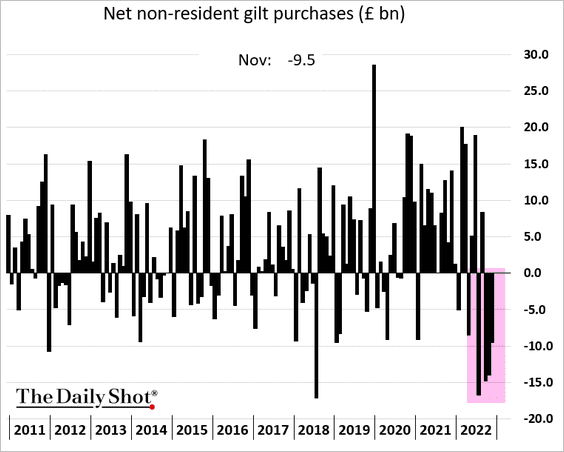
September’s wild ride within the UK pension market has been replaced by relatively calm seas since. But is that situation an illusion? The following chart highlights some major concerns, as UK Gilts are being sold at record levels by foreign investors.

As a reminder, failed policy decisions by the former UK Prime Minister led to a vicious cycle of rising UK interest rates and Gilts sales. Those actions combined to nearly cripple the UK pension system as levered, and in some cases HIGHLY levered, duration strategies utilizing derivatives forced plan sponsors to seek liquidity to meet nearly daily margin calls. The collateral for the most part was Gilts, and the forced selling was only stopped when the UK’s Bank of England stepped into the fray by buying multiple billions of Gilts. That action certainly worked in the short term, but where are we today?

The continuing selling of Gilts (estimated at 38 billion Pounds for the three months from September through November) represents the greatest monthly average sum since the BOE started keeping records of such transactions in 1982. Foreign investors own nearly 30% of the UK debt. This selling pressure comes at a challenging time, as the UK Treasury is facing one of its largest Gilts funding needs in the next financial year at nearly $300 billion, while the BOE simultaneously tries to unwind more than 40 billion Pounds in Gilts under its October QE program. I’m not yet sure how this impacts the UK pension system. Have they sufficiently unwound highly levered LDI duration strategies utilizing derivatives or are they continuing to sit with those positions? Perhaps one or more of our readers could share some insights with us based on specific knowledge of the current UK pension market.

In any case, 2023 may be another challenging year for UK markets and the pension systems that operate within them. Clearly, there is much more to the story, and we will bring it to you as it unfolds. Stay tuned!

Ryan ALM Q4’22 Pension Monitor

By: Russ Kamp, Managing Director, Ryan ALM, Inc.

We are pleased to present the Ryan ALM Pension Monitor for Q4’22. We once again highlight for our readers the returns for both assets and liabilities for the calendar year 2022 for Private, Public, and Multiemployer (union) plans. The asset allocations highlighted in the monitor are based on the annual study by P&I, while the liability data is derived through Ryan ALM’s work in this space. I would encourage you to also review Ron Ryan’s post, “Was 2022 a GOOD or BAD year for Pensions?” which dives more deeply into the question that he poses, especially how one’s perception of 2022 is very much driven by the accounting rules.

As always, please don’t hesitate to reach out to us with any comments, questions, and/or concerns. We stand ready to assist. You can also go to RyanALM.Com to find significant published work on a variety of ALM and pension issues. Thank you for your continuing interest in and support of Ryan ALM.

Was 2022 a GOOD year or a BAD year for Pensions?

By: Ronald J. Ryan, CEO, Ryan ALM, Inc.

Well, assets had a BAD year with negative growth rates for the major asset classes:

S&P 500              -18.1%                       

BB Aggregate     -13.0% 

According to the Ryan ALM Pension Monitor, pension assets had a 2022 return of -8.7% (corporations), -7.2% (Publics), -8.7% (Unions) using the P&I asset allocation weights, which are updated annually.

But to answer the question posed above… it all depends on how a plan sponsor accounts for liabilities. FASB and IASB (International Accounting Standards Board) use market value (MV) accounting. Under ASC 715 (FASB) accounting rules, corporations are required to price liabilities using an AA corporate zero-coupon yield curve. Ryan ALM is one of the few vendors that provide these ASC 715 discount rates. Since interest rates rose significantly in 2022, Ryan ALM calculates that a 12-year duration liability schedule priced at ASC 715 discount rates would show a growth rate of -26.6%.

GASB is the accounting standard for Public pensions. GASB allows for the ROA to be chosen as the discount rate. Multiemployer pension plans use the ROA as their discount rate under ASC 960 accounting rules. The ROA is a forecast of future asset growth… and not a very good one at that. How this applies to liability growth bewilders me. How could you have a constant positive return? The ROA is certainly not an interest rate and it further ignores market conditions and volatility. Furthermore, you cannot buy the ROA to defease liabilities.

Currently, most Public and Multiemployer pensions have a ROA of 7.00% so they see liability growth at 7.00% for 2022. The differences in liability growth calculations are astounding:

                                    ASC 715 = -26.6%                 ROA = 7.00%

So, to answer the question… corporate pensions had a GREAT year where assets outgrew liabilities by 17.9% based on the Ryan ALM Pension Monitor. This should result in pension INCOME which enhances EPS as well as reduce contribution costs in 2023. But Public pensions and Multiemployer pensions had a HORRIFIC year where assets underperformed liabilities by -14% to -16%. This will result in higher contribution costs in 2023.

Why do we have (allow) such a different approach to pricing liabilities? To understand the true economic reality of your funded status, it would be wise to use MV accounting just like you do on the asset side so you can compare apples to apples. This was the message from the Society of Actuaries in 2004 in their research paper titled “Principles Underlying Asset Liability Management (ALM)”. 

Ryan ALM provides a Custom Liability Index (CLI) that prices liabilities at both the ROA and ASC 715 so plan sponsors, their consultants, and ALM can understand the true economic reality of liability growth and compare it to accounting valuations. The CLI should be the proper benchmark for any pension and the focus of asset allocation and ALM. Using the ROA creates confusion and results in a comparison of apples to oranges and not the desired assets to liabilities.

The Fed Isn’t Blinking

By: Russ Kamp, Managing Director, Ryan ALM, Inc.

Happy New Year! At least it was for some US equity investors prior to this afternoon’s release of the December FOMC meeting notes, which once again highlighted the fact that there is no interest rate pivot in anyone’s near-term future, and according to the Fed, we are unlikely to see one for all of 2023. The Fed cited “considerable uncertainty around the consumer spending outlook”. Based on the chart below, I’d say that consumers are not taking their collective feet off the gas peddle.

Sure, we’ve witnessed a rotation from durable goods to services, but pandemic constraints certainly contributed to the greater focus on durables during the last couple of years. Folks are tired of looking at their home’s four walls and are just itching to get back outside, even if it means having to deal with US aviation and all of its travails! Individuals have been working through their significant stimulus-induced excess savings, but with the labor market still humming along, spending can be maintained for quite some time. In fact, some Fed participants “…commented that labor supply appeared to be constrained by structural factors such as early retirements, reduced availability or increased cost of childcare, more costly transportation, and reduced immigration.” As a result, wage growth is likely to remain elevated for the foreseeable future, and demand for goods and services, too.

But, What about the Future?

By: Russ Kamp, Managing Director, Ryan ALM, Inc.

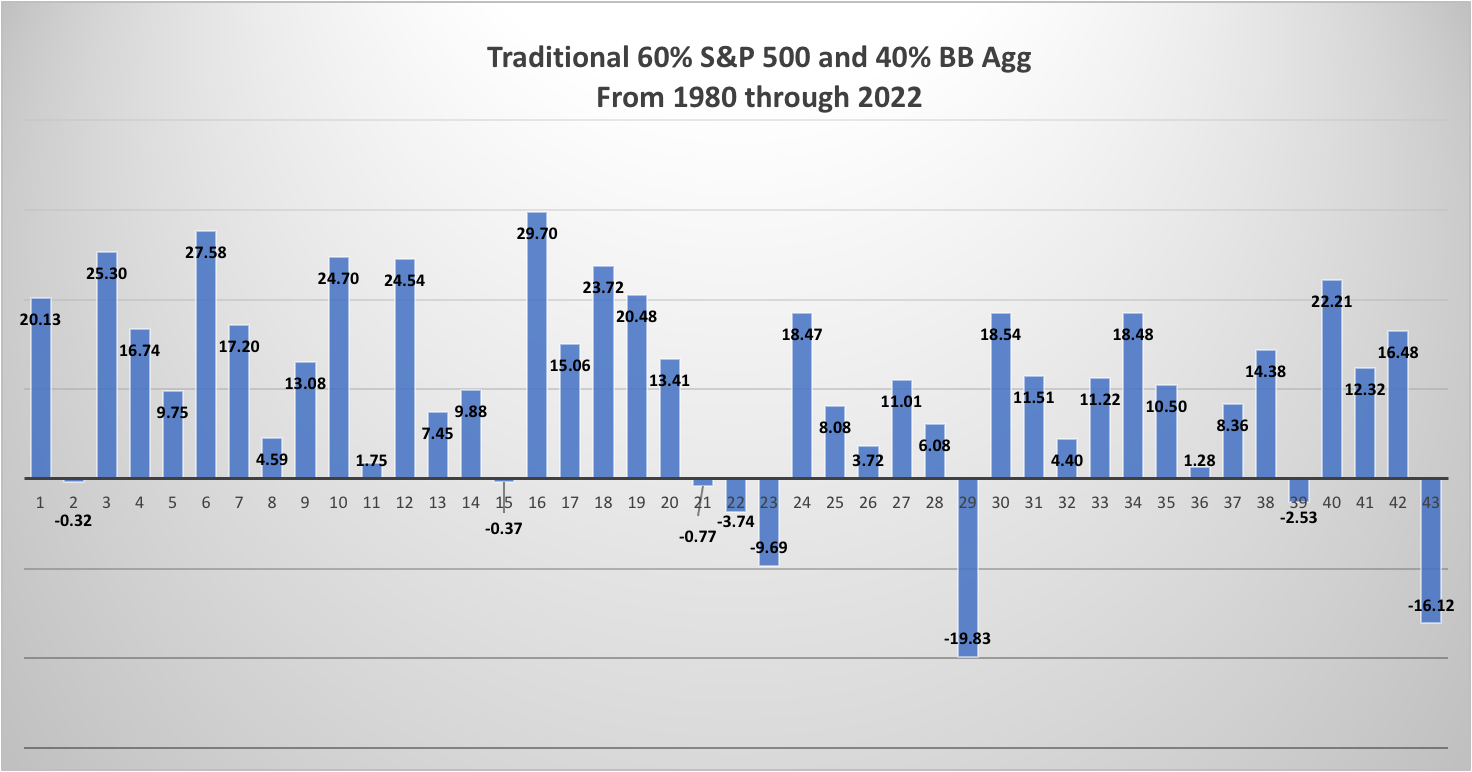
The last 43 years have been an extraordinary time for both bonds and stocks. Including the calendar year 1980, a 60% S&P 500 and 40% BB Aggregate asset allocation produced an incredible 10.44% annualized return, with only 8 down years during that period. This average return far exceeded the average ROA for pension America. The consistency of the equity and fixed income returns is what is most shocking, as there have only been 5 negative calendar years for bonds and 8 negative calendar years for equities. Furthermore, there has only been one year, 2022, in which both indices produced a negative return in the same calendar year. Is it a prelude of things to come or just an anomaly in a continuing extraordinary performance period for US markets?

What was unique about the last four decades that isn’t present today? First and foremost, we had the US 10-year Treasury Note yield finishing in 1980 at 12.4%. It would subsequently climb to 14% during 1981 before beginning its long descent to 0.7% at the end of 2020. At the same time, the Fed Funds Rate would hit 20% in 1980 and rise to 21% by June 1981 before beginning its fall to a zero interest rate policy (ZIRP) by 2021. That amazing interest rate change was done in an environment of 3% core inflation during those 43 years. Clearly, this scenario isn’t repeatable given where US rates are today. We find it somewhat humorous that investors are wringing their collective hands with a 10-year Treasury yield at 3.8% today.

Given our current employment situation (3.7% unemployment), wage growth averaging 6% annual growth, core inflation (PCE) at 5.5%, and a Fed that wants inflation @ 2% with real rates, we don’t see the Fed “pivoting” back to an easy money policy anytime soon. Without the incredible tailwind of falling rates enjoyed by market participants for 40+ years, we don’t expect the next 10 years to produce returns anywhere close to the annualized return of 10.44% produced by a 60%/40% asset allocation. Given this likely scenario, it becomes incredibly important to ensure that adequate liquidity is available to meet benefits and expenses. Adopting a cash flow matching strategy for the fixed income portion of the assets ensures liquidity while also “buying time” for the growth (alpha) assets to grow unencumbered. Given that 40 years of easy Fed policy is off the table, adopting a different approach, one that has worked for decades, should be considered before markets get even more challenging should a recession unfold.

ARPA Update as of December 30, 2022

By: Russ Kamp, Managing Director, Ryan ALM, Inc.

The PBGC was flooded with applications for Special Financial Assistance (SFA) last week with the submission of 13 filings, including 8 Priority Group 5 initial applications, 3 Priority Group 2 (PG2) initial applications, 1 PG2 revised filing, and 1 PG2 supplemental application. Of the 5 Priority Group 2 plans, 3 were MPRA Suspension plans, while the other 2 were designated as Critical and Declining. In total, these 13 multiemployer funds were seeking SFA in the amount of $2.2 billion.

There were no applications approved, denied, or withdrawn last week. There was a resubmission of one withdrawn application. The United Furniture Workers Pension Fund A had withdrawn its initial application on 12/22 and resubmitted a revised filing on 12/29. They are seeking financial assistance of $214 million for its 11,302 participants. As the chart below highlights, only about 21% of the potential 304 applications have been filed. Once the last priority group (6) files (2/11/23), the remaining roughly 220 plans can begin to submit applications for SFA. It might very well become a free-for-all.

The Middle is Being Squeezed

By: Russ Kamp, Managing Director, Ryan ALM, Inc.

I suspect that most Americans wouldn’t be surprised to read that the US Middle Class continues to be impacted most negatively by four decades high inflation. According to a WSJ article, “purchasing power from paychecks fell 2.9% for middle-income households in 2022 compared with 2021”, as food and energy price increases impacted this cohort to a greater extent than those at both the top and bottom of the income spectrum. The median household income was $70,784 in 2021. However, increases in costs associated with housing, childcare, food, energy (household utilities), medical insurance, etc. are crushing the average American. Yes, inflation may have fallen from peak levels established this past Summer, but it is still running at levels that exceed both wage growth and the Fed’s 2% target. What have those most impacted done? Not surprisingly, they have withdrawn money from their “retirement” funds.

A new survey from Betterment which polled 1,000 full-time U.S. employees, found that 28% tapped into their 401(k) plans to help cover increasing expenditures in the last year. Incredibly, 71% of those polled are feeling more anxious about their retirement prospects, with 88% of those claiming that inflation and an increased cost of living have increased their financial anxiety. Regrettably, 24% of respondents indicated that they had reduced contributions to their retirement accounts. Another 41% said that they don’t have any funds saved for emergency purposes, which tells me that an unexpected major expense will have that subset tapping their “retirement” assets, too.

Let’s hope that the recent passage of the Secure Act 2.0 which includes the creation of emergency side pockets will help stabilize some of these financial conditions. No one knows how 2023 will play out, but it is critically important for all Americans, especially those in the Middle Class to see inflation near the Fed’s target. Let’s hope that the Fed’s forecast of US unemployment increasing from the current 3.7% level to an estimated 4.6% in 2023 doesn’t materialize or worse, exceed that estimate.

Kamp on Dakota Live Podcast

By: Russ Kamp, Managing Director, Ryan ALM, Inc.

I was recently provided an opportunity to join Robert Morier and Dan DiDomenico on a Dakota Live Podcast. It was great fun to share insights with these two highly experienced investment professionals. There was so much to discuss regarding the current state of Pension America. The American worker is counting on us to ensure that they have the opportunity for a dignified retirement. Regrettably, many of these folks aren’t in a position to accomplish that objective. I hope that you find our insights beneficial. As always, please don’t hesitate to reach out to me with comments and questions. Always happy to respond.