Don’t Let History Repeat Itself

The Great Financial Crisis dealt a serious blow to the funded status of most public and multi-employer pension systems as well as many private plans, too.  However, many private systems have done something about the volatility in pension funding by engaging in de-risking strategies to secure the funded ratio and stabilize contribution costs since the GFC. Isn’t it about time that the others follow suit?

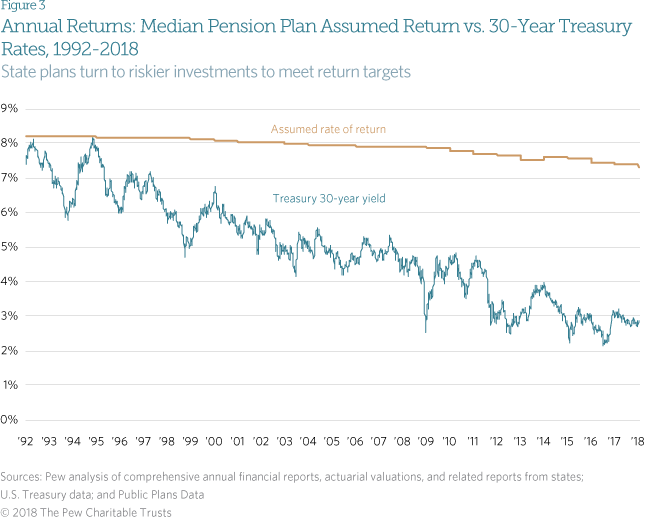
We are on the record as stating that the objective for any pension plan is that plan’s specific and unique liabilities. It is not the return on asset assumption (ROA), yet most non-private systems continue to inject more and more volatility into their asset allocation decisions because they continue to believe that achieving the ROA is the only thing that matters. Given projected returns in this environment, it will be difficult to generate the results necessary to meet the 7.5% annual objective.

The good news – you don’t need to! Asset growth only needs to eclipse a plan’s liability growth in order to achieve success and improve the funded status. However, given that GASB allows for liabilities to be discounted at a flat ROA rate, plan sponsors never appreciate the fact that liability growth, when liabilities are marked to market, can be negative. In that situation, a 4% return would look quite heroic should liability growth be negative 3%. Given that that average pension system has a liability duration of roughly 12-15 years, a 50 basis point rise in rates (not extreme) would result in a -3% to -4% “growth” in liabilities.

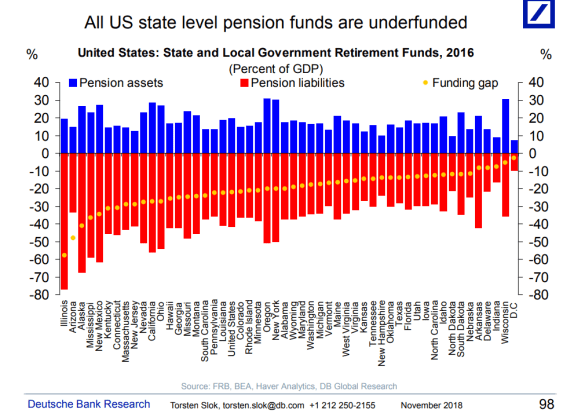
Pension funding expenses have risen rapidly in the last couple of decades, and most states and municipalities cannot afford further stresses that would negatively impact their plan’s funding. We are seeing the negative effects of this already in states like Illinois and New Jersey, where huge budget gaps exist and spending cuts can’t make up the difference. Raising taxes in this environment, particularly in “Blue” states, is impractical given federal tax changes that will impact deductibility of state and local taxes, yet it seems to be what is being proposed. New Jersey’s government may be shut down effective 12:01 am on Sunday if Governor Murphy and the NJ Legislature can’t come to an agreement on the budget.

Don’t allow the markets to dictate success or failure. Take a new path to manage your plans and improve the odds of achieving funding success.


The Failed St. Joseph’s Pension Fund

As many of you know, the St. Joseph’s Health Services pension fund failed. The innocent victims are once again the plan participants who were counting on that benefit to get them through their golden years.

Fortunately, action has been taken by the Governor and the Rhode Island legislature to expedite claims, which will hopefully provide a path for participants to get most of what they were expecting. According to an article in the Providence Journal, the legislation “provides that defendants entering good faith, judicially-approved settlements would not be liable for claims from co-defendants. … The finality of the settlement without fear of a contribution claim from a co-defendant provides an incentive to settle.”

KCS’s effort to support the Butch Lewis Act legislation is our attempt to mitigate the risk of insolvency for the 114 “critical and declining” multiemployer plans before they can no longer meet their promises. We certainly don’t want the millions of beneficiaries in those plans to experience the anxiety and heartache suffered by those participants in the St. Joseph’s pension system.

Time is no longer on our side, and action is needed today!


Wait, The Cavalry May Just Be Around The Bend!

According to a recent article in Pensions and Investments, Western States Office and Professional Employees Pension Fund, Portland, OR, has filed for benefit relief for the third time.  Previous applications have been withdrawn.  The Treasury Department has 225 days to respond to this application.

According to the article, Western States has $336 million in assets and $525 million in projected liabilities. For a funded ratio of 64%. Heck, this looks to be pretty well-funded compared to many in the space. If nothing were to be done at this time, the plan is projected to become insolvent in 2036.

However, regular readers of this blog will know that proposed legislation to help Critical and Declining multiemployer plans is currently before a Joint Select Committee addressing solvency issues. We believe that it is premature for plans such as the Western States to be filing for benefit relief when there exists a real solution to this funding issue.

I have a real tough time accepting as a “solution” a benefit reduction of 30% for retirees less than 80 years old!! If you are over 80 – your benefits are protected.  In addition, current actives and terminated vested workers will also see significant reductions in their projected benefits to the tune of 30%. How many 79 year-olds do you know that could go back into the workforce and makeup that 30% reduction in wages?

Waiting for the cavalry (Butch Lewis Act legislation (BLA)) is far more appealing than jumping into a benefit reduction process, especially since the Joint Committee is tasked with coming up with legislation by September 30th that will be fast-tracked before this session ends.

In the modeling that was done to support the BLA, 111 of 114 “critical and declining” plans were able to survive with just the loan from the Treasury Department (30-year balloon payment). The three that couldn’t survive on their own got assistance from the PBGC, including some plans that are forecast to go belly up by 2027.

We would recommend that this plan and any other considering benefit reductions wait until the Fall to see what emanates from this 115th Congress.  They may just be surprised that real solutions to the funding crisis are currently being considered.


Raising Taxes Won’t Help You, Mr. Murphy!

New Jersey Governor Phil Murphy is trying to convince both parties that what NJ needs is more taxes as if we aren’t taxed enough! However, to Murphy’s credit, he’s not leaving anyone out in his quest for additional revenue as his proposal includes an increase in state sales, income, and business taxes.  Good luck!

Of course, this tax increase comes at us just after the “benefits” of federal tax changes that adversely impacted any NJ resident that has more than $10,000 in combined state and local taxes, which likely includes most everybody.  Given this development, we cannot raise taxes without likely driving businesses and individuals (usually the well-heeled) from the Garden State. But, we have a massively underfunded defined benefit plan that needs to be addressed before it places an even greater burden on the social safety net that must be protected and funded, too. What to do?

We believe that New Jersey would improve its economic lot if they would direct those running the pension system to refocus their attention from trying to generate a return in excess of the 7.5% return on asset assumption (ROA) to one focused on the promise (benefits) that has been made to the plan participants. It was the focus on the ROA that lead them to move a significant chunk of assets into hedge funds at the bottom of the market in 2009, instead of buying cheap beta at a 50% discount. Not surprising at all that the results have been less than stellar.

To help close the significant funding gap NJ should look into the process that supports the Butch Lewis Act legislation that is currently under review by the Joint Select Committee on Solvency of Multiemployer plans.  Long-term interest rates haven’t risen nearly as fast as feared, and as a result, the interest rate environment is still providing opportunities to borrow at these levels. NJ would be wise to issue a pension obligation bond (POB) and then use the proceeds to cash flow match the retired lives, which would help reduce plan volatility and provide a longer investing horizon for the balance of the assets to meet future plan liabilities.

Permitting the current asset base to swing with the mood of the market is foolish when strategies exist that could help the pension system stabilize the funded status and contribution expense in a challenging funding environment. Raising taxes in this environment will likely cause much more economic harm than good. Real pension reform is the answer.


Funded Ratios Under Renewed Pressure

The following is courtesy of Mark Grant and the FT:

(FT) The escalating trade fight between the US and its allies sent investors scurrying for the relative safety of government debt and pushed the difference between short- and long-dated bonds to its flattest level since mid-2007.

The yield on the benchmark 10-year US Treasury was down 2.7 basis points at 2.873 percent, while that on the more policy-sensitive two-year Treasury was down 2.1 bps at 2.5287 percent. Bond prices rise as yields fall.

That pushed the difference between the two Treasuries to 34.242 bps, which is the flattest level for the so-called yield curve since late August 2007.

At a low of 33.411 basis points earlier this morning, it was the narrowest the gap had been on an intraday basis since August 31 of that year.

While not there yet, an inverted yield curve, where short-term yields trade above their long-term counterparts, is typically seen as a strong predictor of economic recession.

Couple declining long-term interest rates with a U.S. equity market that has fallen in 8 of the past 9 trading sessions (and today is ugly, too), and you have a combination of inputs that don’t support improvement in defined benefit funded ratios when marking both assets (always done) and liabilities (rarely done) to market.

Many corporate plans have already de-risked by managing their assets to the plan’s liabilities. Unfortunately, Public and Multiemployer plans have, for the most part, not engaged in this activity preferring to focus on the ROA as their plan’s primary objective.

I would much prefer (if I were a plan sponsor) to know that my near-term “promise” to my beneficiaries has been taken care of which buys time for the remaining assets to fund future liabilities. Volatility will always be a part of pension management but putting into place a de-risking strategy helps both the plan sponsor and beneficiary sleep well at night knowing that the assets are already set aside for the next benefit payment.


Older Workers Left Out In The Cold?

A colleague recently passed to me an interesting article from Forbes, titled “Is There A War Being Waged Against Older Workers In The Workplace?” The article raises a number of viable arguments in support of such a claim, including specific job screening criteria for candidates with 3-7 or 7-10 years of relevant experience.  The article’s author contemplates the last time one saw a job opening posted for someone possessing 20-30 years of experience.

Based on the chart below it certainly appears that opportunities have weakened for workers aged 25-54 years-old.

fredgraph-3

It is actually a bleaker picture if one focuses exclusively on the male population in that age category, as there are roughly 2 million fewer males 25-54 working today since the start of the GFC. I suspect that most of those former employees are not sitting on the sidelines because they are independently wealthy.

fredgraph-1

Given that focus, it leads companies to a population well south of 40 years-old and definitely neglects those viable candidates in the 40+-year-old category.  What it also does is damage one’s ability to save for retirement, which is why I am particularly interested in this subject matter. As the private sector has moved from defined benefit to defined contribution retirement plans, the emphasis on funding and managing such a vehicle has fallen squarely on the shoulders of the employee, who in many cases have neither the financial resources nor the investment capability to handle this responsibility.

Given that individuals rarely save outside of an employer’s sponsored plan, losing a job in one’s 40s or 50s has a profound impact on that employee’s ability to generate a retirement balance that will help them live through retirement. Furthermore, it is often the case that older employees finally have other major expenses (children, house, college, etc.) behind them and they are counting on the last 15-20 years of employment to pad their retirement balances. The government even recognizes this phenomenon by allowing “catch-up” contributions into defined contribution accounts after age 50.

Regrettably, DC balances are often used as employment bridge loans (almost like an unemployment benefit) when a worker has been displaced. Given this scenario, contributions cease to be made, while balances weaken as opposed to growing through the benefits of compounding. For workers experiencing extended periods of unemployment, their ability to generate a retirement benefit is impaired tremendously.

We read the financial papers and listen to the rosy employment scenarios on the TV and radio, but don’t believe for one minute that our current labor conditions are appropriately captured in the published unemployment statistics. There are too many older Americans that have been displaced from the labor force whose prospects for reentry are slim, at best!

Active ETFs – Where’s The Beef?

In April 2008, I was thrilled to be part of the launch of the industry’s first active ETFs. Invesco’s quant group (IQS) created an ETF in conjunction with Invesco PowerShares that was managed actively versus the Russell 200 Mega Cap index (ticker PRA). We were very excited about the prospects of managing an Active ETF given the explosion in the use of ETFs generally.  Unfortunately, the Great Financial Crisis was wreaking havoc on markets at that time and PRA never really took off.

Fast forward 10 years and the market for Active ETFs has certainly grown, but it still represents an extremely small segment of the ETF market.  According to an article by Lara Crigger, ETF.com, Active ETFs (225 funds) represent only 2% of ETF AUM ($59 billion in total). Fixed income active ETFs are the most common (81) and the largest, as 8 of the top 10 active ETFs are fixed-income related. It shouldn’t be surprising to anyone that fixed income active ETFs dominate the universe of active strategies given how difficult it is to “index” the bond market. Furthermore, there have been 59 active funds launched in the last year, representing a 27% increase in the number of active ETFs.

Why such little exposure? Could it be the fact that active ETF performance has been spotty at best? According to ETF.com, only 31 of 166 active ETFs with track records greater than 1-year outperformed.  Within the fixed income universe, only 16 of 81 funds have track records longer than 5 years, and performance has been weak on a relative basis. That means that only 18.7% of funds outperformed in 2017. That actually seems worse than the percentage of active products in institutional separate accounts that have beaten their passive benchmark.

Fees for active ETFs are also an issue, as active fixed income ETFs (as an example) have an average fee of 0.53%, which is considerably greater than what a fixed income manager running a separate account would charge and certainly greater than a “passive” offering in the space. Now, to be fair, active ETF fees are certainly lower than those offered by mutual funds.

Finally, active alpha is not achieved overnight. The forecasted or expected annual excess return is built up over the course of the year. Active ETFs should not be trading vehicles. These products offer smaller investors the opportunity to participate in an asset class or style category that they might not have been able to given the size of their allocation, but they also need to have patience when investing so that the excess return can be realized.

Remember 130/30 Strategies?

I saw this headline from P&I:

“84% of Investors Apply or are Considering, ESG” – Morgan Stanley survey claims

To say that I’m skeptical would be a major understatement.

I couldn’t help but think about the “excitement” surrounding 130/30 products back in the 2005-2007 era when Merrill Lynch and others were predicting $1 trillion in these products within a relatively short timeframe. We know what happened once the Great Financial Crisis hit.  Is there a 130/30 strategy still being utilized?

As we’ve said many, many times, managing a pension plan is not about the return (the ROA is not the Holy Grail), but about meeting the promised benefit at the lowest cost.  How does ESG help a plan sponsor achieve that goal? There are a lot of claims as to the success of these programs, but I hear similar praise being hyped on OCIO offerings, too, with very little proof that there is consistent value added.

During my 37 years in this industry, I’ve witnessed many cycles, which always seem to come with the next “greatest” product offering.  Wouldn’t it be refreshing if we just got back to basics within the retirement industry by securing the promise without playing games with the employee, employer, and taxpayer money?


No, It Doesn’t!

The U.S. Government does not have a spending problem just because recent outlays have eclipsed receipts and the U.S. Federal deficit is projected to be close to $1 trillion in 2018! Several U.S. states do have a spending problem, as well as many (most?) Americans, but trying to equate the federal government’s ability to meet its debt obligations with those other entities is just wrong! The only difference that matters is that the U.S. Government has a fiat currency, while the others do not. Can you imagine New Jersey issuing its own currency? As my friend and former Invesco colleague, Charles DuBois, recently noted, our current fiscal stimulus should be greeted with shouts of “Happy Days are Here Again!”.

According to the Monthly Treasury Statement, budget results for the month of May have been in deficit for the 63 of the last 64 fiscal years since 1955. Yet, the sky hasn’t fallen, and our economy is certainly much larger today than it was back then. What’s up?

We’ve mentioned in previous KCS blog posts that a large part of the deficit increase feeds right into business profits. When the private sector (both corporations and individuals) are incapable of generating economic activity, we need the government to step into the fray, as they did so wonderfully in 2009 and beyond. According to Charles, this increased fiscal stimulus is why the stock market is proving to be resilient despite numerous “risks”, including interest rates, tariffs, investigations, etc.

Most Wall Street analysts are concerned with the wrong elements of the U.S. Government debt.  For instance, the fear of rising interest expense is misplaced, as the cost to the government is actually the private sector’s interest income.

They also worry excessively about the crowding out myth – believing that higher Treasury issuance will push up rates.  This is false, as all the selling of Treasuries does is mop up the reserves created by deficit spending – so there are no such upward pressures on rates.

As we have shared, the potential problem is none of these referenced above, but rather too much of a good thing (happy days…).  If private sector income is too high because of the deficit spending, inflation could become a problem.  That is if our economy was already at full capacity.  However, according to Bill Mitchell, and other MMT disciples, the U.S. economy still has excess capacity providing further room to grow.

Anyway, if the government is spending more into the economy than it is taking away through taxes, that’s “obviously” a good thing.  No one seems to get the basic accounting that the public sector deficit = the private sector surplus.  It is about time that they did!

Will Long Bond Demand Weaken?

We sincerely appreciate when friends share with us meaningful graphs/charts/articles – thanks, Chris, for the chart below!

According to Deutsche Bank Research, demand for stripped securities has been very strong from pension plans. Despite this increased appetite, long rates have been rising.  Come September, corporate plans will no longer be able to deduct pension contributions at the previous 35% rate. As a result, have pension plans accelerated their contributions? We think so, as they try to beat the 9/15/18 deadline. A $1 billion defined benefit contribution would save the company $350 million under the old tax laws, but only $210 million beginning later this summer.

bondstripping

Will long interest rates rise as a result of likely lower demand for long bonds?  Again, we believe that they just might. Couple the lower demand from pension systems and the stronger US economic growth, and you have a formula for rising rates.

We’d be happy to discuss our strategy to cash flow match near-term liabilities chronologically, which we believe is a much more cost-effective strategy in a rising rate environment.