Extremely Grim and Troubling

The Center for Disease Control and Prevention has reported that the U.S. has suffered a declining life expectancy again, and it marks three consecutive years for this terrible trend. Life expectancy in the U.S. has fallen 0.3 years since 2014, which is incredible given the trend to longer lives witnessed by most developed nations.  As a point of comparison, Japan leads in life expectancy at slightly more than 84 years. The U.S. has fallen to 29th place in the world rankings.

According to the CDC&P and the WSJ, which reported on the release of this data, the main culprits are suicides and overdoses (deaths from synthetic opioids rose 45% in 2017), both impacted by the state of mind of many Americans (despair).  Incredibly, this is occurring during a supposed period of economic expansion and prosperity, but we all know that the economic benefits have not trickled down to many.   In fact, suicides have increased by more than 33% since 1999. Furthermore, the data suggest that significant differences exist based on where one lives, with rural Americans suffering to a far greater extent than those living in cities.

There is some hope expressed in the data that opioid and suicide deaths may be plateauing, but the evaluation period (first few months of 2018) is certainly not long enough to get one too excited.  Furthermore, despite advances in mental healthcare, drug treatment, improved opioid prescriptions monitoring, and the greater availability of medication to reverse opioid overdoses, root causes for this heightened despair must be addressed.

The U.S. labor force has undergone significant change with a greater emphasis being placed on as needed employment. In addition, we do have a significant percentage of our workforce that are underemployed and for those, not in the workforce, a significant mismatch exists between desired skills and current capability, with little ability to retrain many of our more mature workers. It is a dangerous combination for many of our displaced workers.

There really is no excuse that the United States with its abundant wealth and superior medical capability should have a declining life expectancy.  None!

Boomers Retiring Later

As I’ve mentioned many times, I am a huge fan of the work being done by the folks at the Center for Retirement Research at Boston College.  Their reports and blog posts are always insightful and tremendously helpful to me in my work.  However, the most recent one has me scratching my head a bit as the title is “Boomers Find Reason To Retire Later”, and the gist of the post suggests that this is a good thing primarily because remaining in the labor force should improve one’s retirement security – work longer, have to save less.

They go on to suggest that there are many drivers, including Social Security changes, the demise of DB plans and greater reliance on defined contribution programs, the loss of post healthcare retirement benefits, etc.  I don’t know about you, but those seem to be negative developments that are forcing workers to remain in the labor force longer than they might want to.

Fine, the shift to more of a service economy, which they reference, from one heavily dependent on manufacturing does mean that one could conceivably do the work for longer, but we’ve read studies suggesting that more than 1/3 of Americans over 65 would like to remain actively engaged, but that only about 14% are still working.  In addition, they cite the fact that there are many more college graduates today than years ago and that those with college degrees tend to stay in the workforce longer.  Could it be that the tremendous growth in student loan debt is forcing this behavior, as the ability to set aside assets for retirement is postponed until much later as student loan debt is serviced?  This is particularly relevant especially for those dependent solely on retirement benefits from a DC plan?

Lastly, they highlight the effect of more women being in the labor force, and that married couples tend to retire at the roughly the same time.  Given that the “average” couple has a male partner that is 3 years older than their wife, this helps with retirement, too.  However, marriage trends have turned negative in the U.S. with only about 50% of adults married, which is down from a peak of 72.4% in 1960 and off by about 9% in the last decade.

I believe that Americans are remaining in the workforce longer (when they have control of that decision) because of significant changes that make retiring earlier almost a thing of the past. The demise of DB plans and loss of post healthcare benefits has played a significant role. Social Security changes for those born after 1959 are also impacting the decision to exit the workforce.  Furthermore, the explosion in student loans and use of 401(k)-type plans will continue to drive this trend upward.  Problem: our 62.9% labor participation rate is down substantially from 2007 and may not grow much in the future due to numerous factors including the greater impact from technology.


Caveat Emptor – Revisited

Regular readers of the KCS blog may recall a post that we produced on July 30, 2018, regarding cryptocurrencies. We had discovered a chart that highlighted the fact that most cryptos had failed as of that date, and we were concerned based on comments that we had heard at various industry conferences that DB plan sponsors and their consultants might be contemplating a potential investment into one or more of these instruments.  Let’s hope that they didn’t!

Earlier today, Bitcoin’s price was at $3,729 down from $6,404 one month ago and more than 80% off the high established on December 16, 2017 ($19,650) – oh, my. Based on the chart that we presented, Bitcoin was one of the few “success” stories, while more than 1,000 other cryptos had failed already.

In a challenging environment for most asset classes and products, it isn’t surprising that gimmicky investments, such as cryptos, capture the imagination.  However, as we’ve mentioned many times, the focus should be on the promise that was made to participants and use that insight to drive asset allocation and investment structure decisions. You’ll get a very different answer to the difficult question of how do I secure those liabilities.

Happy Thanksgiving!

I want to wish you and yours a Happy Thanksgiving holiday from my family and me. May the beginning of this holiday season be truly memorable!

089fe4564a32b38edd44b8f5f50565cb-xlarge

We are blessed in so many ways, but there are many among us who are in need of assistance at this time. During this holiday season, let us all strive to do just a little more to help our family members, friends, and neighbors during their time of need.

In 1863, President Abraham Lincoln proclaimed that a day should be set aside to reflect on all our blessings. Lincoln saw reason for thanks despite trying times (the country was in the grip of the Civil War). Given the trying times that many in our country have faced this year (fires, floods, hurricanes, poverty, etc.), a day such as Thanksgiving is critically important for all of us.

42%

The number of Seniors living within 200% of the Supplemental Poverty Measure (SPM) is staggering (currently 42%), but remember that many of those currently 65-years or older have been participating in a traditional defined benefit plan. As more of the younger Boomers and Gen-Xers begin to retire with only a defined contribution plan and/or IRA, the numbers will likely escalate.

The. U.S. Census Bureau reports two different measures of poverty: the official poverty measure (2017 $11,756) and the Supplemental Poverty Measure (SPM), which produces various thresholds based on one’s geographic area and homeownership status, and also an individual’s financial resources and liabilities, including taxes, the value of in-kind benefits (e.g., food stamps), and out-of-pocket medical spending. Based on the analysis, there are more than 21 million older adults with incomes less than 200% of the SPM.


Follow The Money!

Given the market action in US equities generally and technology-related securities specifically, I suspect that many investors are quite concerned that a “major” bear market may be evolving, especially given the duration of the current equity bull market.  US equities (S&P 500) have just today retested the previous lows established on October 29th.

But, what has changed? The macro environment hasn’t deteriorated in the past month, and may actually be improving. Just last week, Federal Reserve Vice Chair Clarida said the Fed was “close” to neutral, and they would need to be data dependent on further rate increases.  That’s a significant shift from the more Hawkish tone that we’ve been hearing from other Federal Reserve members.

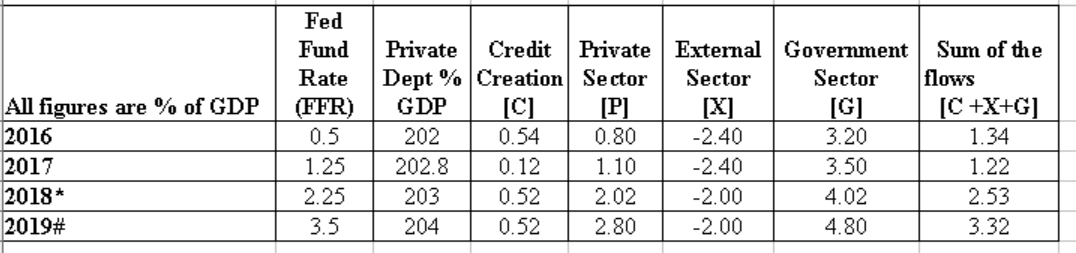
Furthermore, and most importantly, the economy continues to be provided with significant stimulus. I’ve highlighted the work from my former Invesco colleague, Charles DuBois, who has a very unique view of macro economics.  He has shared the following with me:

As most of you know, since all spending = all income (an identity no one disagrees with), when the government is spending more than its income (a deficit), the private sector must be earning more than it is spending (a surplus), simply as a matter of accounting and as a point of logic.
As long as private debt creation is increasing, it provides a boost to the economy and profits.  But when private debt creation turns down – look out as that is usually trouble – especially if the government’s deficit is declining at the same time.
Basically, by taking the money created by government deficits and adding the money created by private credit (debt) creation and subtracting the outflow of money from the trade deficit – you get an excellent picture as to whether money is flowing into or out of the overall economy.  If the latter, then a recession is likely around the corner. 
On this score, the table on the “sectoral balances” is key.  As long as the right hand column is reasonably positive, economic conditions should be OK.  Right now money is flowing in – so the current market downdrafts should not develop into a major bear market.  Separately, it is useful, as confirmation, to follow leading indicators of the economy – which are also in good shape.
  
The few economists, to my knowledge, who saw the 2008-09 collapse coming
were using this type of framework. 
Over the long run, growth is a function of labor force growth and productivity.
On a more cyclical basis, growth is importantly related to money flows..
Thank you, Charles!
As a further point of reference, and according to Alan Longbon, “the US budget deficit is $100 billion in October 2018; this is a net expansion of income and savings in the private sector. The good news is that dollars are being added to the economy by the Federal government, allowing the private sector to post a $100 billion surplus.

Private credit growth has rebounded this month and made a $17B contribution to aggregate demand and fiscal flows.”

Will They Fall Short?

The Center For Retirement Research at Boston College continues to do an excellent job of elevating concerns about the current state of the “average” American worker and their ability to survive, if not thrive, in retirement.  In their most recent brief, titled “How Much Income Do Retirees Actually Have?” they set out to determine what percentage of Americans will fall short of the goal to have 75% of pre-retirement income available on a yearly basis. The paper looks at 4 different measures of pre-retirement income, including final-year average, last 5-years, CPI career-average, and AWI career-average (AWI is average-wage-index career average earnings).

Whatever measure is used to determine financial solvency (preparedness), we are struggling as a nation, as each of these measures indicate that at least 42% (final-year average) of our population will fall short of their income target in retirement, with three of these measures indicating that from 52% to 60% of workers will not save enough. Wow!

Importantly, this report also set out to determine if the data sources truly capture the current state of affairs or are they underestimating how much has been set aside. Through their analysis, they are comfortable that 4 of the 5 primary sources of retirement income are doing a very good job, which is unfortunate since the data support the notion that there is a retirement crisis unfolding. The only source that falls short is the Current Population Survey, which has been reported previously.


Spending Cuts?

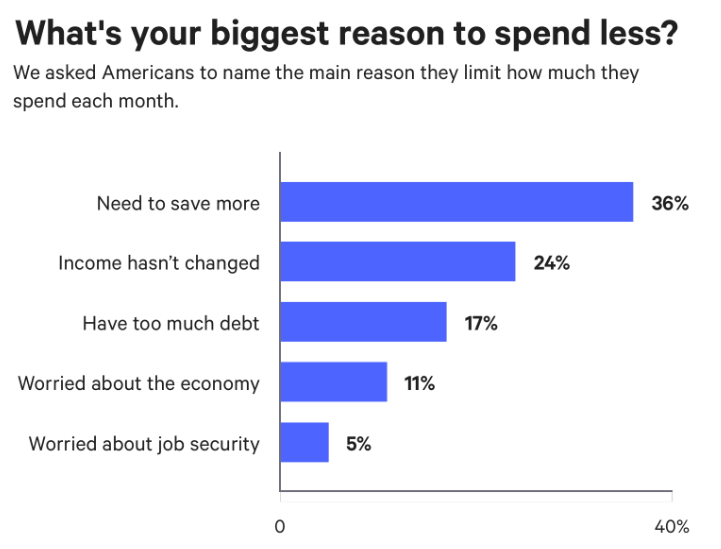
According to a Bankrate study, nearly 70% of American adults are trying to reduce their monthly spending, and saving isn’t the only reason.

Bankrate reports that stagnant wages and growing debt burdens are more to blame for the intended spending reduction than the need to save. What are the long-term implications for our economy that is still driven by personal consumption? Furthermore, the need to save for both emergencies and retirement is still very much necessary. According to two recent studies, retirement readiness is lacking for a significant percentage of American workers.

Northwestern Mutual found that roughly one-third of Americans had saved less than $5,000 for retirement, while a GOBankingRates survey concluded that almost 42% of Americans have saved less than $10,000 for their golden years.  Alarmingly, more than 60% of Americans still couldn’t meet a $1,000 emergency expense through savings.

With regard to stagnant wages, GOBankingRates found that American middle-class families are making less money in every state, but two (Indiana and Vermont) since 1999.  The study was inflation adjusted.


Questionable Analysis

Critique of MEPSIM By Ronald J. Ryan, CFA, and Russell D. Kamp

The paper has several misleading, if not erroneous assumptions and facts.

You do NOT want to fund the deficit at a discount rate of 7% for several reasons:

  • 7% discount rate is not a market rate and undervalues liabilities and the deficit significantly.
  • Using a market rate yield curve of AA corporates (i.e. like FAS 158/ASC 715) would calculate @ roughly a 4.00% discount rate. This difference of 3.00% equates to a PV difference of 30% to 45% higher liabilities such that a 40% deficit would now jump to a 58% deficit.
  • You want to fund and defease Retired Lives not the deficit. This produces certainty and transparency that these liabilities are fully funded. The Butch Lewis Act ONLY contemplates the loan being used to defease Retired Lives.
  • Funding a deficit does not provide any evidence of where the deficit is (short, long?) or how to allocate funds to where the deficit is. Can’t cash flow match a single deficit number, as you need to understand where in the liability term structure is within this deficit.

The loan should be at the interest rate the Treasury can finance (even a little higher for a profit margin). You don’t want to create more of a Treasury deficit. If the loan rate was 15 to 25 bps higher than the Treasury financing rate this new government agency (PRA) could operate at a profit. Fifteen basis points on $100 billion in loans produces $150 million a year in revenue, which is more than enough to operate this agency at a profit.

You want time to cure the problem. The Treasury does not issue 20-year bonds. Let the Treasury issue its normal 30-year bond auction. According to historical facts, the average return on the S&P 500 over a rolling 30-year period is over 8%. If you buy time (extend the investing horizon), the odds of success dramatically improve.

Since this is an asset / liability objective running 500 iterations of a Stochastic model without running liabilities is not very helpful.

They calculate that the loan is expensive costing $56b defined as PV of loan plan repayments? We don’t understand this math. Why won’t the loans be repaid?

It is true that these plans currently invest in risky assets. If through our work a lower ROA can be used than the plan’s asset allocation should respond and switch to a less risky profile.

NO, NO, NO… you never want to cut benefits. This is certainly a last resort. Our approach buys time, lowers the hurdle rate (ROA), and fully funds Retired Lives. There should be no benefit cuts for Retired Lives.

The PBGC is not a solution because it has a very low cap (guarantee) for the payment of benefits (max of $17,160 for 40 years of service) and it is not currently solvent given the forecast of future needs.  You want a loan to fully fund your Retired Lives. The PBGC could never fully fund Retired Lives given its current funding.

A 6% average return seems conservative over a long-time horizon (30 years). Only when an Asset Exhaustion Test (AET) is run will we know the true economic ROA needed to meet future plan obligations.

We recommend that the loan proceeds are used 100% to defease Retired Lives with investment grade bonds. This leaves the current assets in tact. The output from the AET will help us determine the economic ROA needed to fully fund residual liabilities. The asset allocation here could be heavily skewed to non-bond assets instead of the 40% allocation in the MEPSIM forecasts. Remember the loan is new money and does not affect current assets and/or contributions.

The Butch Lewis Act – The ONLY Solution

The loan from the government should be 30-years at the Treasury financing rate with a small premium (15 to 25 bps) to pay for this new agency’s (PRA) operating budget.

The loan proceeds should be mandated to fully fund Retired Lives through a defeasance process so there is no risk of default here or lack of funding resources.

The amount of the loan must be based on what it costs to defease Retired Lives with Treasury STRIPS. If a cash flow matching strategy is used on the loan proceeds (mainly investment-grade corporate bonds) it should fully fund Retired Lives at a cost savings of roughly 8%+.

This cost savings could be held in escrow or transferred over to current assets to help fund residual liabilities. If transferred over to current assets these savings will reduce the economic ROA hurdle rate to fully fund residual liabilities.

Moreover, we have replaced the actuarial ROA rate (@ 7.50%) on Retired Lives with a Treasury loan rate (@ approximately 3.25%), which lowers the economic ROA needed to fully fund residual liabilities.

The loan program’s (BLA) success must be predicated on work done on an economic basis (economic truth) and not actuarial forecasts and assumptions.


And The Answer Is?

The Joint Select Committee on Solvency of Multiemployer Pension Plans has been meeting since April.  They were tasked with producing bi-partisan legislation to help protect and preserve the defined benefit plans for the 114 (now 121) “critical and declining” multiemployer pension systems.  As we’ve mentioned in multiple blog posts, the committee consisted of 8 senators and 8 congressmen with equal representation among Democrats and Republicans.

There were several proposals that were reviewed including the Butch Lewis Act (BLA) legislation that had been filed with Congress in November 2017. The BLA had strong support among the Democratic members of the committee but lacked similar support from the Republican side. Unfortunately, this process is getting down to the wire with the November 30th deadline fast approaching.  Without support from a minimum of 5 Republicans and 5 Democrats, there will not be legislation put forward for consideration during this Congressional session.

It will be truly unfortunate if nothing comes from this Joint Select Committee because as they debate the merits of any proposed legislation, the number of critical and declining plans is expanding and the need for government support is growing, too, in both urgency and magnitude! The markets and normal contributions will not save these pension systems. Only through the support of the federal government will these plans survive. More than one million Americans are counting on Congress to do something!

As we’ve mentioned before. The BLA is proposing a loan program, which includes a relatively small sum of federal assistance through the PBGC for a few plans. These loans will be paid back in 30 years. This is not a government bailout. By extending the life of many of these troubled plans, we are eliminating the need for the US government to expand the social safety net that would have to be used to support those participants who would be losing a substantial percentage of their monthly benefit. Furthermore, it keeps them as active participants in our economy supporting both business and the government through additional tax revenue. It is a win-win!

If nothing comes from the JSC that can be supported by the two parties, a battle will have been lost, but the war will rage on. A war that has lasted much longer than it should have given the consequences that will result from the failure to legislate positive reform. It is increasingly imperative that members of both parties and both chambers of Congress hear from you regarding the need to support legislation to repair and protect these critical retirement plans.