Will Economic Growth Be Thwarted at These Rates?

By: Russ Kamp, Managing Director, Ryan ALM, Inc.

It is time for market participants to be real! I’m not referring to the social media app BeReal that has captured the attention of both young and old. I’m talking about the investment community that is lamenting the rise in US rates as if they are approaching historic levels. Be Real! The current yield on the US 10-year Treasury Note is ONLY 3.40% (10:57 am EST). This yield is certainly up from the historic depths experienced during the onset of Covid-19, but it is certainly nowhere near levels that would be economically crushing!

A bit of history is needed. Following the inflationary decade of the 1970s, the US Federal Reserve drove the FFR target to an unprecedented 22.36% on January 19, 1981. As a result, the 10-year Treasury reached a peak yield in excess of 15%. As I’ve mentioned previously, the yield was 14.9% on 10/13/81 which was the day I entered this industry. 14.90%!!! Now, that was economically crushing, and those higher rates led to a recession that ran through 1982.

For the nearly next four decades, US interest rates plummeted to historically low and unsustainable levels. The Fed’s “aggressive” action during the last 9 FOMC meetings has elevated the FFR all the way back to… 4.75%-5% as the target, or less than 25% of the peak yield reached in 1981. While the FFR sits at roughly 5%, the 10-year Treasury note’s yield has only moved up by 57 bps. That doesn’t seem like it would be significant enough to crush much economic activity. Yet, the hand-wringing by the investment community is incessant. It certainly appears to me that most of the market participants, who haven’t been in the industry for 40+ years or who haven’t experienced significantly higher rates are anchored on the idea that our economy can only function if real rates are around zero.

Again, a little history may be needed. The average nominal yield on the US 10-year treasury note since 1941 is 5.1% or 1.7% higher than what the 10-year is trading at today. During that roughly 70-year period of “higher” average yields, the US GDP annual growth rate was 3.1%! Higher rates and relatively strong growth. You would think that wasn’t possible given all of the whining.

US interest rates remain low relative to history. Employment remains full despite the announced layoffs. Economic activity continues to defy forecasts. Are we really going to see a Federal Reserve cave in a similar fashion to what they did in 1975? Hardly. Our economy is just fine at the present time. For plan sponsors of defined benefit plans, use this period of higher (not high) yielding bonds to improve your liquidity management while securing your promises to participants. Bonds are back and it is a wonderful thing!
ARPA Update as of April 21, 2023

By: Russ Kamp, Managing Director, Ryan ALM, Inc.

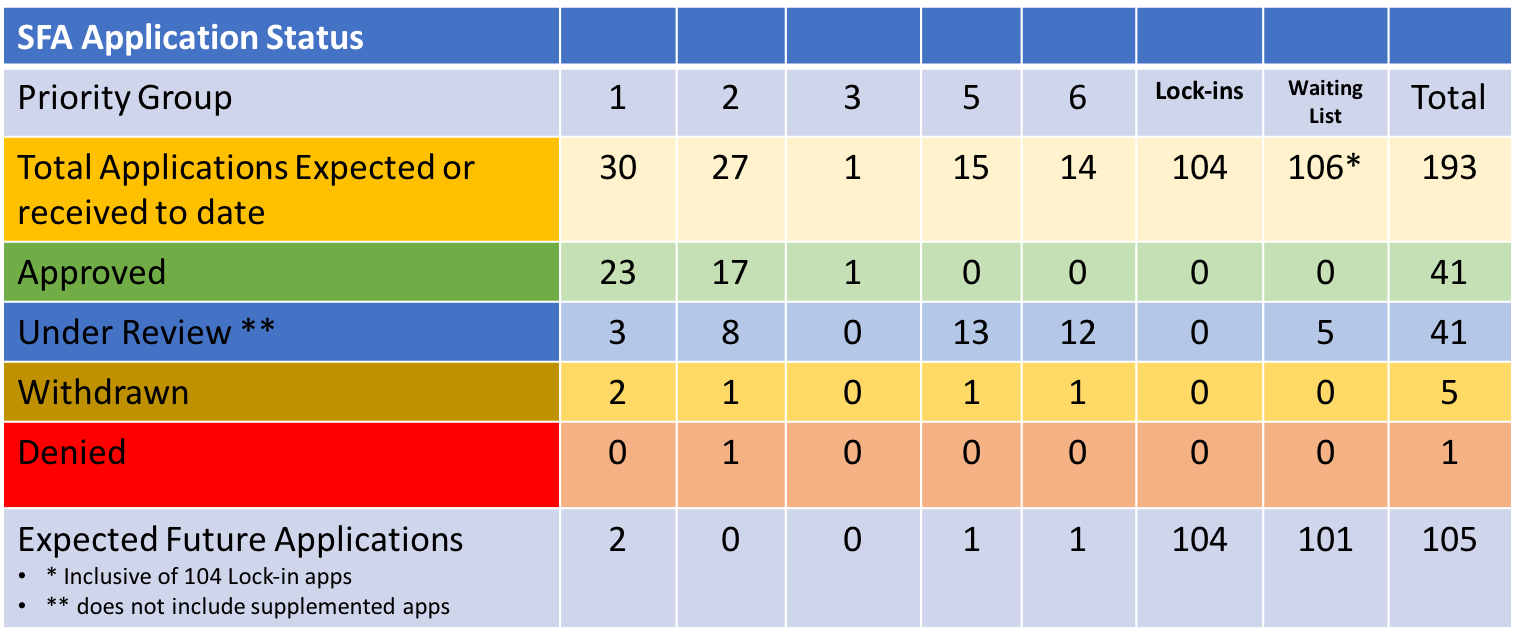
We are pleased to provide you with an update on the PBGC’s yeoman effort to implement the ARPA legislation. The process has been underway since July 2021, when the PBGC issued its interim final rules and began taking SFA applications. To date, 41 plans have received the SFA, and in some cases, supplemented awards. This represents a small subset of the plans still in the queue to receive these grants. This implementation will likely stretch well into 2024, if not beyond.

The current activity includes 5 applications from non-Priority Group members and 36 pension plans that were among the initial 6 priority groups. During the previous week, there were no applications approved or denied. No SFA grant money was wired out either. However, there was an application filed. Priority Group 5 member, UFCW Local One Pension Plan, filed a revised application seeking $764.4 million in SFA grant money for its 19,177 participants. The PBGC has until 8/16/23 to act on the application.

In addition to the activity above, Priority Group 2 member, Pension Plan for Employees of United Furniture Workers of America and Related Organizations, withdrew its application. They’d been seeking $8.8 million for its 95 members. Lastly, the Local 1814 Riggers Pension Fund became the most recent non-Priority Group member to be added to the waitlist. They have not chosen to lock in a valuation date at this time. There are currently 101 non-priority plans waiting to file SFA applications. The PBGC has indicated that they will open the e-filing portal in an orderly fashion so as not to overwhelm their ability to review and approve applications within the mandated 120-day window. There is much more to come.

ARPA Update as of April 14, 2023

By: Russ Kamp, Managing Director, Ryan ALM, Inc.

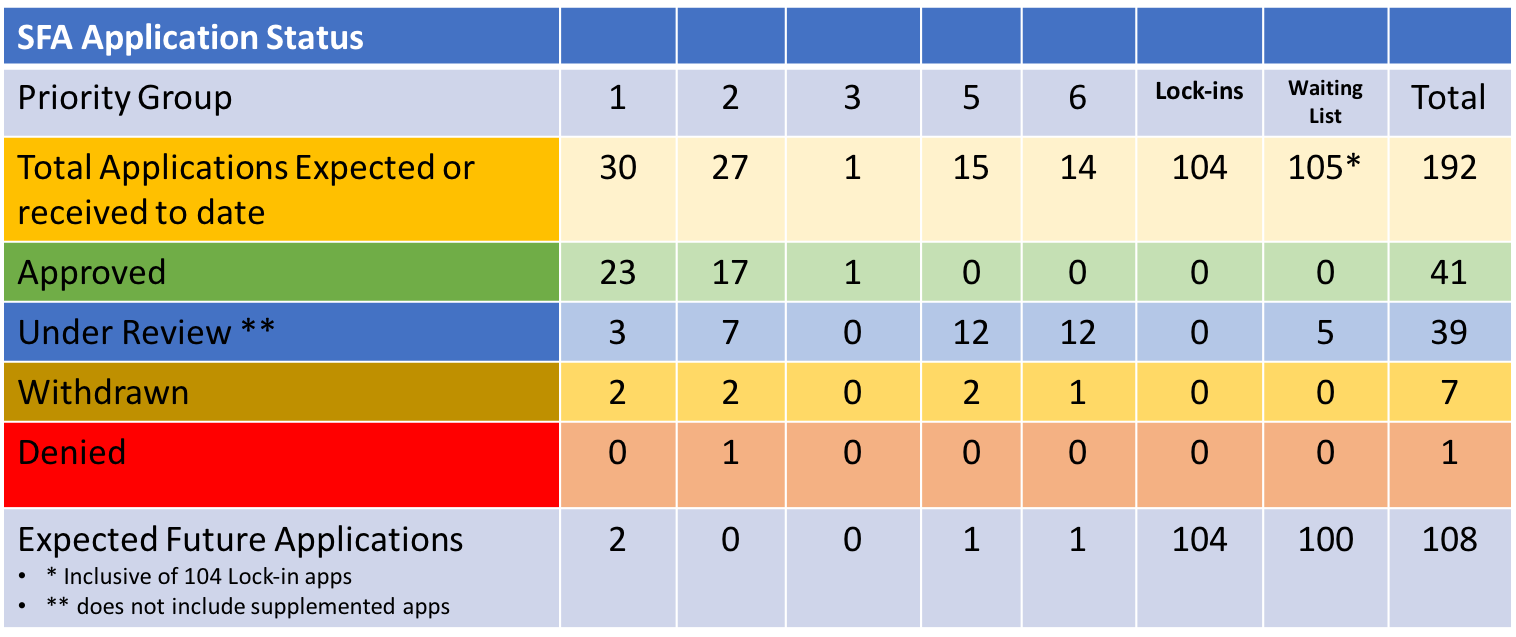
We are pleased to be able to provide you with this ARPA update through April 14, 2023. I am able to provide these summaries of the week’s activity for you thanks to the PBGC which continues to provide its weekly update. As we’ve recently reported, the general level of activity has slowed. To that point, there were no new applications accepted by the PBGC in the latest week. In addition, there were no applications for SFA (initial or supplemental) that were approved, denied, or paid out.

There was, however, one pension fund, the International Association of Bridge, Structural, Ornamental & Reinforcing Ironworkers L.U. No. 79 Pension Fund, which was placed on the waiting list. There are 105 non-priority plans (Groups 1-6) that made it to the waiting list. Of those 105, five applications are currently being reviewed by the PBGC. They’ve indicated that they will open the e-filing portal at a pace that allows for an orderly review to be completed on each application within the legislation’s 120-day window.

It will be interesting to see if the pace of activity can be increased given that more than 140 applications are left to review before other pension funds are possibly added to the waitlist. Remember, it was estimated by the PBGC that as many as 218 non-priority plans could potentially file. We’ve seen fewer than half of those get placed on the waiting list at this time. Lastly, of all the plans that have locked in a valuation date, there remains only one with a January 31, 2023 date. All of the others have chosen 12/31/22.

The Gap Is Narrowing

By: Russ Kamp, Managing Director, Ryan ALM, Inc.

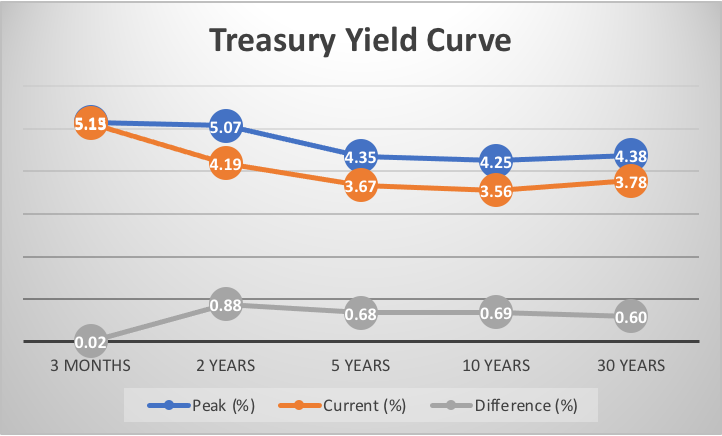
US Treasury Yields mostly peaked during the fourth quarter of 2022. However, they did stage a brief rally in February, but in no case did they reach the peak yield established during this recent interest rate regime change. Following the collapse of SVB and Signature Bank and the take-over of CS by UBS, US Treasury yields plummeted, as the fear of a broad-based banking crisis drove investors to the safety of US Treasuries. Fortunately, the feared banking contagion didn’t materialize and as a result, Treasury yields are once again reflecting the economic environment. Rates have been rising modestly during the last couple of weeks.

As my chart above highlights, Treasury yields are still below the peak yields of last year, but they are closing the gap as uncertainty persists as to the interest rate path that the FOMC will take in May and beyond. Has inflation been contained? Do we have enough weakness in the US labor force to no longer be concerned about wage growth/pressures? The manufacturing sector activity seems to be collapsing. What about the US service sector since it is by far the largest contributor to US GDP growth?

Despite those many questions, members of the Fed still seem to feel that inflation is too high. In recent days, Federal Reserve Governor Christopher Waller commented that he favored more monetary tightening. “Because financial conditions have not significantly tightened, the labor market continues to be strong and quite tight, and inflation is far above target, so monetary policy needs to be tightened further,” Waller said Friday in a speech in San Antonio, Texas.

We, at Ryan ALM, Inc. have felt that US investors were too focused on the Fed easing, and as a result, artificially drove Treasury yields to unsustainably low levels. The Fed has been very consistent in its communications. Waller is no different, as he “would welcome signs of moderating demand, but until they appear and I see inflation moving meaningfully and persistently down toward our 2% target, I believe there is still work to do.” No ambiguity there!

Bond investors have been willing to hold US Treasuries with yields at significant negative real rates. That isn’t a good long-term strategy. Rates are likely to continue rising. At the very least, it doesn’t appear that the Fed has any appetite to begin easing. Will rates achieve a level across the curve that exceeds the previous peak in this interest rate cycle? In MHO, I think that they will. That result would not be good for total-return-focused fixed-income products, but higher rates and more interest income are great for Cash Flow Matching (CFM) strategies.

Ryan ALM, Inc. 1Q’23 Newsletter

By: Russ Kamp, Managing Director, Ryan ALM, Inc.

We are pleased to share with you the Ryan ALM, Inc. 1Q’23 Newsletter. We hope that you find our insights useful.

As you will see, first quarter asset performance was certainly a big improvement following 2022’s struggles. However, asset growth didn’t exceed liability growth during the quarter if you valued plan liabilities using FASB accounting, as the fall in US interest rates propelled liability growth. Plans operating under GASB that use the return on asset (ROA) assumption witnessed assets exceeding liabilities.

The newsletter also contains a number of research articles and blog posts that were produced during the first quarter. The article that was written by Ron Ryan discussing ASOP 4’s new guidance on valuing pension liabilities using more market-based discount rates is particularly timely given that these changes are in effect for actuarial valuations after February 2023.

As always, we welcome your feedback and questions. Please don’t hesitate to reach out to us. Have a wonderful day.

Not Much of a Brain Teaser

By: Russ Kamp, Managing Director, Ryan ALM, Inc.

Given this opportunity, what would you do? You can continue to strive to achieve a 7% annual return through a traditional asset allocation strategy that is accompanied by significant annual volatility of >10% or you could match a portion of the plan’s liabilities through a Cash Flow Matching (CFM) strategy that carefully matches asset cash flows to liability cash flows effectively ensuring that assets and liabilities move in lock-step with one another. Need more input?

The recent rise in US interest rates is providing Plan Sponsors of defined benefit pension plans with a unique opportunity that hasn’t occurred in decades. Working with their advisors, Plan Sponsors can now SECURE near-term benefits and expenses (meeting all of the liquidity needs) as far into the future as the allocation to a Cash Flow Matching (CFM) strategy will take them. In doing so, a pension fund may generate through an investment-grade corporate bond portfolio a YTM of roughly 5.5% to 6%.

We haven’t seen yields like this from IG corporate bonds since the early ’00s. Why is this an attractive option when the plan may be striving for 7%? First, the “return” as measured by the YTM is locked in on the day that the portfolio is built, since this is a mostly buy-and-hold endeavor. By defeasing pension liabilities through the cash flows of principal and interest from the bonds, the YTM becomes the portfolio’s expected return (barring a default). Furthermore, a carefully matched portfolio will insulate the bonds from interest rate risk as benefits owed are future values, which are not interest rate sensitive. That is a critical attribute given the great uncertainty surrounding Fed policy and the future direction of rates.

In addition, creating a liquidity bucket allows the alpha or growth assets not invested in the CFM portfolio an opportunity to grow unencumbered since they are no longer a source of liquidity. We know from previous studies (Guinness Asset Management) that sweeping cash dividends from equity accounts can dramatically reduce long-term returns, as dividends and dividends reinvested represent nearly 50% of the return of the S&P 500 over rolling 10-year periods dating back to 1940. It is even more beneficial for 20-year periods (57%). Do you still need more info? You are a tough one to convince!

The strategy that I’m highlighting is how most insurance companies and lottery systems are managed. Those entities know what that future promise looks like (as do pension plans). They take a present value (PV) calculation of what it would take to fund that future value (FV) commitment and they invest that sum of money in investment-grade corporate bonds through an optimization strategy – not a laddered bond portfolio. We refer to this implementation as a SWAN strategy (Sleep Well At Night). Wouldn’t it be great to announce to your plan participants that no matter what transpires in the markets the promised benefits have been secured?

So, I ask again, wouldn’t it be the prudent exercise to invest a portion of your plan’s assets into a liquidity bucket that secures the promised benefits at a reasonable cost and with prudent risk as opposed to hoping that the aggregate exposure to a variety of asset classes and products can produce a return close to the 7% return target on an annual basis? I’m not a gambler, so maybe it is just me, but I know what I would do if I was put in the position to manage a pension plan that is responsible for a group of participants planning on a dignified retirement.

Another CPI Posting and Another Strange Reaction

By: Russ Kamp, Managing Director, Ryan ALM, Inc.

Well, Wednesday, April 12th marked another release of a CPI data point. As predicted, headline inflation as measured by the CPI showed a reduction in the annual rate that was slightly better than forecast. As a result, both equity and fixed-income markets rallied rather dramatically at the open. If the headline was all you read, your response to the news would have been understandable, but if you took the time to dig a little deeper, it wouldn’t have taken long to read that the “core” inflation reading had actually risen to 5.6%. I’m not sure that I could do the “new math” being taught to fourth graders, but I do appreciate the fact that 5.6% is well above the Fed’s 2% target inflation rate.

You see, the US Federal Reserve continues to promote the idea that they are focused (singularly) on creating price stability. Furthermore, they have announced that they will NOT pause the increases in the Fed Fund’s Rate (FFR) until it is clear that inflation is on a meaningful path to that 2% level. So far, that evidence hasn’t presented itself. How long that takes is anyone’s guess?

I recently attended the TexPERS conference in Austin. I had the pleasure of listening to Richard Bernstein, CEO/CIO, of Richard Bernstein Advisors, discuss the current economic environment. I think that Richard does a great job getting behind the numbers. The chart below was shown during his session. It is published by the Federal Reserve Bank of Atlanta. I found the information to be both dramatic and compelling. Again, if you are only focused on the headline CPI then this data is likely new to you. Most meaningful to me is the fact that 6 of 9 important inflation indicators are now higher than they were one year ago just before or concurrent with the FOMC’s first increase in the FFR. As you know, there have been an additional 8 increases bringing to 4.75%-5.0% the current level for the FFR.

Despite these facts, there was a euphoric response to the announcement of today’s CPI. Do market participants really think that they know more than the Fed? Do they think that the US Federal Reserve is kidding when they say that they don’t see an easing in rates this year? Have the last forty years of easy money and Fed support anytime there was a wobble in the markets really clouded judgment today? Fortunately, I am not in the game of forecasting interest rates. Our focus at Ryan ALM is taking the guessing risk out of investing by carefully matching asset cash flows through investment-grade bonds with a pension’s liability cash flows. Not having to guess how markets react is so comforting. Being able to tell your plan participants that their benefits are SECURE is equally, if not more, comforting. I highly recommend adopting a Cash Flow Matching strategy that gets you out of the game of guessing not only actions that are outside of your control but the market’s reaction to those events, which aren’t always logical.

The Ryan ALM Pension Monitor for Q1’23

By: Russ Kamp, Managing Director, Ryan ALM, Inc.

We are pleased to provide you with the Ryan ALM, Inc Pension Monitor for the first quarter of 2023. As you will note, Q1’23 witnessed positive market performance for nearly all asset classes, which was a significant departure from last year’s challenging environment. That said, declining US interest rates, especially following the banking crisis that saw several banks fail and Credit Suisse acquired, produced strong liability growth under FASB accounting rules. Liability growth was 7.2% for corporates, while public and multiemployer plans using GASB accounting saw liability growth of only 1.8% based on an annual ROA of 7.5%. As you may recall, the Federal Reserve’s action to raise rates beginning in March 2022, led to significant declines in pension liabilities for Corporate America in 2022. While it is unlikely that we will see a dramatic increase in US interest rates in 2023, the Fed has indicated that it doesn’t intend to begin easing monetary policy in 2023.

The history of Ryan ALM Pension Monitors and many other research items can be found at Ryan ALM, Inc. We hope that our insights provide a useful perspective related to asset/liability management.

ARPA Update as of April 7, 2023

By: Russ Kamp, Managing Director, Ryan ALM, Inc.

It is about to get wild! The PBGC’s e-filing portal is now open and four non-priority plans have submitted applications. The PBGC has stated that they will allow enough applications to be filed that allows for an orderly review and a decision within the legislation’s mandated 120-day window. The four funds that filed applications are the IUE-CWA Pension Plan, Laborers’ International Union of North America Local Union No. 1822 Pension Fund, Teamsters Local 11 Pension Plan, and The Newspaper Guild International Pension Plan. In total, they are seeking $370 million for the roughly 21,000 plan participants. Again, the PBGC has 120 days to take action on these applications.

In other news, the PBGC announced that four pension funds received approval, effective March 31st, for the supplemental applications. These plans include the New York State Teamsters Conference Pension and Retirement Fund, Teamsters Local Union No. 52 Pension Fund, the Cement Masons Local 783 Pension Plan, and the Cement Masons Local Union #681 Pension Plan. Collectively, they were awarded $450 million for just under 35,000 plan participants. The majority of this allocation was awarded to the New York State Teamsters Conference Pension and Retirement Fund, which will receive $438 million for its 33,643 members. Congrats to all of the grant recipients.

There were no applications denied or withdrawn during the prior week. However, there was some activity regarding the SFA lock-ins and waiting lists. The Pension Plan for Bricklayers and Stonemasons Union No. 2 of Norfolk, VA has locked in its valuation date for 1/31/23. They are the only fund of the more than 100 plans that have locked in a valuation date of January 31, 2023. There were no additional plans that were added to the waitlist, which remains at 104.

As a reminder, the numbers displayed above represent the initial or revised applications and do not include supplemental filings. As of today (04/10/23), the number of plans receiving SFA grants from the PBGC remains at 41. There is clearly a lot yet to be done given that 191 plans have been or will be filed, and there may be more than those.

Plummeting Rates – an Inflation Fight Challenger?

By: Russ Kamp, Managing Director, Ryan ALM, Inc.

Federal Reserve Bank of St. Louis President James Bullard spoke today at the Arkansas Bankers Association. Before I knew that this was happening, I produced the following graph:

I’ve been wondering how the massive shift down in the Treasury Yield Curve would impact the Fed’s action in its battle to control stubborn inflation. As you can see, despite massive “tightening” since March 17, 2022, long rates haven’t budged much. They had peaked at higher levels prior to Silicon Valley’s implosion and fear of a greater banking crisis drove market participants to seek a flight to safety. Incidentally, Bullard addressed this very issue in today’s talk. He stated that “financial stress can be harrowing, but one corresponding effect of note is that it tends to reduce the level of interest rates”. He continued, “Lower rates, in turn, tend to be a bullish factor for the macroeconomy”. In the four weeks since SVB’s demise, the 10-year US Treasury yield has declined by 50 bps, while the 2-year Treasury yield has declined by more than 100 bps.

Bullard also spoke about the macroprudential policy response which he described as “swift and appropriate”. For those of you like me, who might not have understood what macroprudential meant, it is “of or pertaining to systemic prudence, especially to the strengths and vulnerabilities of financial systems.” Obviously! He wanted to reassure everyone that the financial metrics of today remain low compared to levels that were observed during the GFC or during the beginning stages of Covid-19. That’s comforting!

However, he did go on to say that the US economy produced a stronger GDP in the second half of 2022 than was forecast, while 2023 looks to be relatively strong with the GDPNow forecast for the first quarter at 1.7%. Furthermore, inflation remains too high. Core PCE and the Dallas Fed’s trimmed mean inflation measures have declined, but by less than the headline measures. It appears to us that the Federal Reserve still has plenty to do to stabilize prices. The banking system may have scared many of us, but a strong labor force, decent wage growth, and falling US interest rates may just be keeping the current inflation environment stickier than the Fed wants to see.