“Just the Facts”

By: Russ Kamp, Managing Director, Ryan ALM, Inc.

Sgt. Joe Friday, Dragnet, is credited with saying, “Just the facts, Ma’am”, but he actually never uttered the phrase. However, that wording did appear in the movie starring Tom Hanks and Dan Aykroyd (1987). Why mention this? Well, investment management firms may be better at marketing/sales than they are at actually managing investment products. Spin wins! However, in this challenging investment environment, getting “just the facts” is incredibly important.

I’ve produced more than 1,300 blog posts and many, if not most, are focused on how plan sponsors and their advisors can secure the pension promise, reduce funding cost, while maintaining prudent levels of risk. Does this seem too good to be true? It’s not, especially today with US interest rates at nearly a two decade high. Securing the promises at a reasonable cost and with prudent risk is very achievable. Here are the facts based on a recent analysis that we completed for a large public pension system.

Their defined benefit fund has roughly $2.1 billion in AUM. The total estimated liabilities going out beyond 2100 have a future value (FV) of $8.8 billion, while the Retired Lives Liability (RLL) carries a FV of $3.7 billion.

As the table below highlights, we can defease all of the RLL at a present value (PV) cost of $972 million. This equates to a cost reduction of 73.6% or $2.7 billion. Yes, some will say that the “savings” are nothing more than the time value of money. However, when one defeases pension liabilities, the “savings” are realized immediately and generated with little risk through an investment grade bond portfolio, unlike a traditional asset allocation and the volatility associated with that process. Furthermore, we can tell you what the return will be on the portfolio on day 1! Is there any other strategy that can do that?

If securing all of the RLL is not a desired goal at this time, we can defease any series of years that you desire. Again, in the table below, we have defeased liabilities for 10- and 30-years. The cost savings reduction is quite meaningful. The cost savings will always be more robust the longer the maturity of the program. Bond math is very straightforward: the longer the maturity and higher the yield, the lower the cost.

As a plan sponsor, why wouldn’t you want to SECURE the promises made to your participants? Why wouldn’t you want to reduce funding costs significantly? Why would you want to continue investing in the capital markets with all of the uncertainty that brings? How comforting it would be for all involved in the process to know that the RLL has been fully defeased. The yields highlighted above are robust. Take advantage of those. Don’t let this opportunity pass as we’ve done on multiple occasions before.

I’ve presented the facts. We’d be happy to generate a similar analysis for you at no cost to complete the review. Call us.

AMEN!

By: Russ Kamp, Managing Director, Ryan ALM, Inc.

P&I recently interviewed Ronald Peyton, Executive Chairman, on his nearly 50 years at Callan, where he also served as CEO from 1990-2017. First, congratulations, Ron, on an impressive career. Your influence within the retirement industry will be felt forever. Second, thank you for sharing your thoughts with us through the P&I interview. It was refreshing to read many of your comments. Here is one exchange that had me applauding:

Q: Have clients changed much over the years in terms of what they are seeking?

A: Clients have always focused on generating maximized returns at an acceptable level of risk. Our job is to keep them focused on a longer-term perspective of achieving the returns they need with the least risk and to avoid focusing on short-term gains. We consistently advise clients that one of the most important elements of investing is minimizing risk in achieving the returns needed to fund their objectives, not always seeking the highest returns. When all you do is chase returns, you expose yourself to almost unlimited risks.

Yes, yes, and YES!

Our industry has migrated through the years from focusing on the promise and managing to that promise to trying to generate the greatest return. All we’ve done in the process is guarantee volatility in the funded status and contribution expenses and not success. Isn’t it time to get off the asset allocation rollercoaster? Isn’t it time to bring certainty to a very uncertain process due to the focus on return? The US interest rate environment is providing a wonderful opportunity through a cash flow matching (CFM) strategy to do what Mr. Peyton has suggested: Achieve the returns necessary to fund their objective, while not seeking the highest return! We couldn’t agree more.

ARPA Update as of October 23, 2023

By: Russ Kamp, Managing Director, Ryan ALM, Inc.

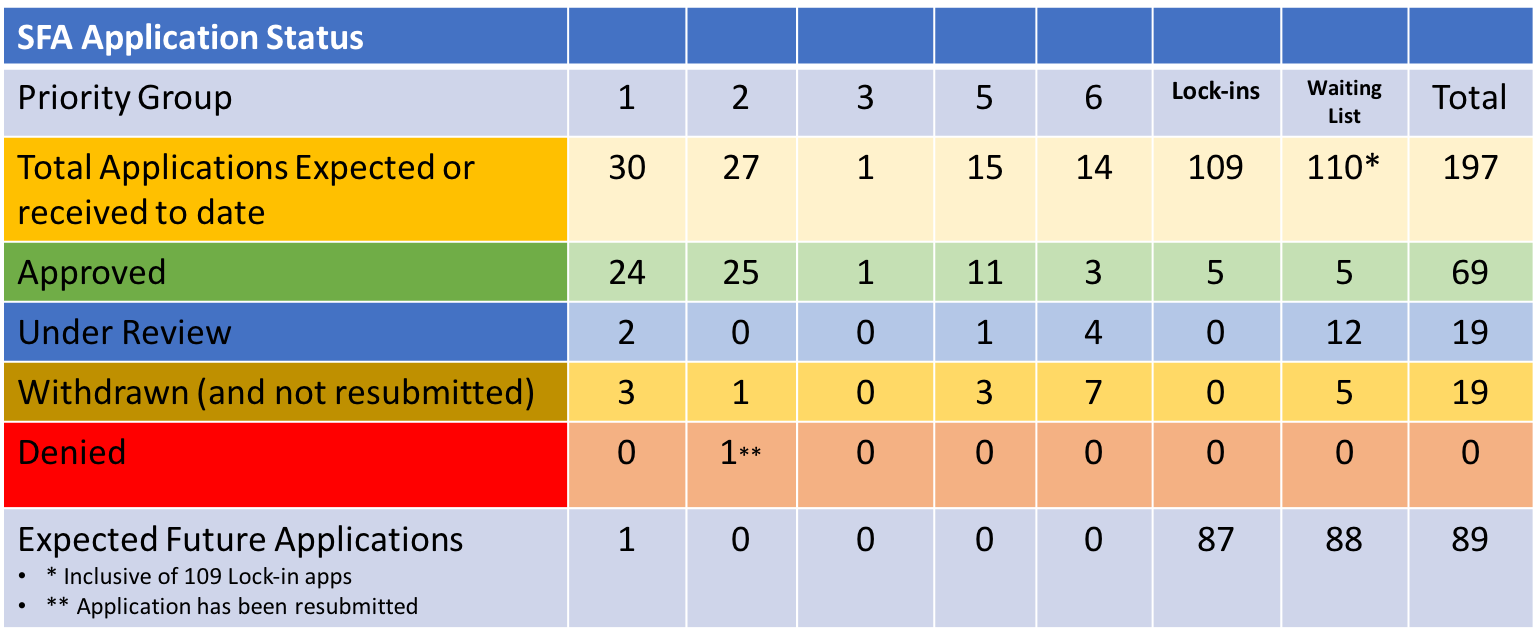
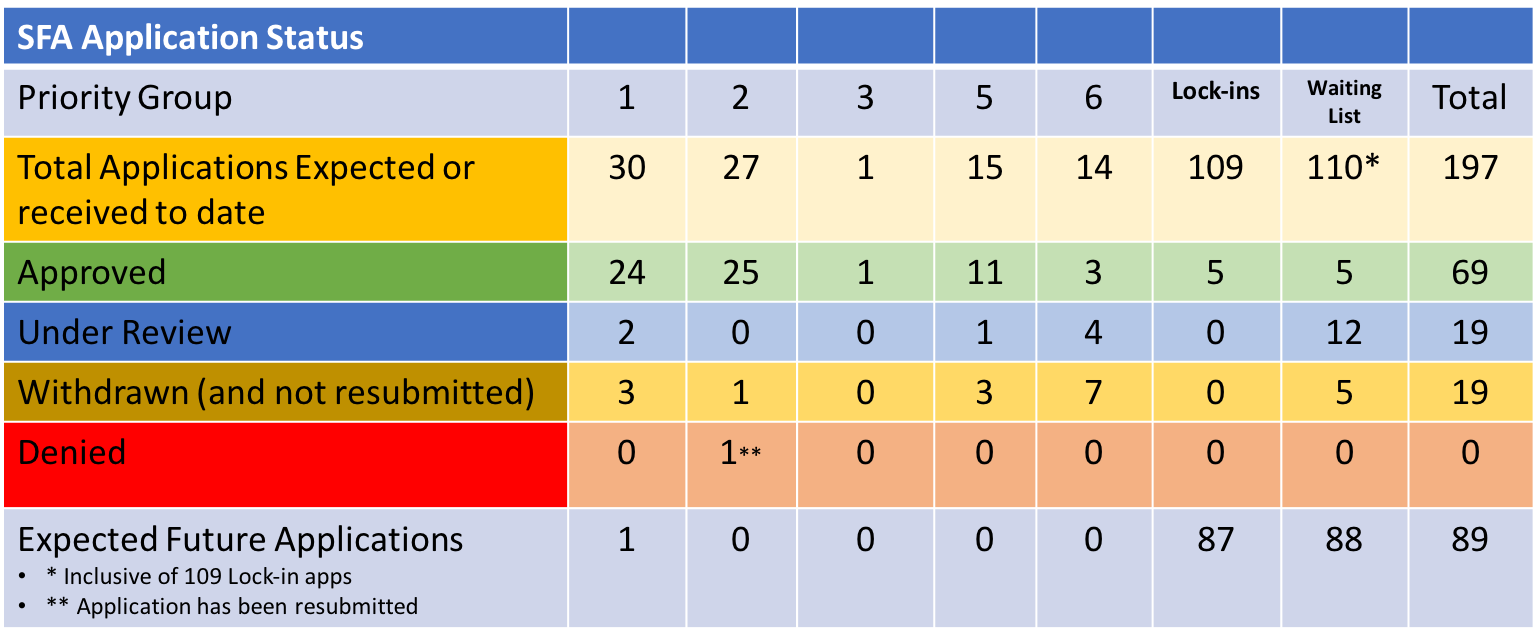
It is the week before Halloween, but things are already scary for the US capital markets, as rising US interest rates continue to create uncertainty for bonds, equities, real estate (particularly housing), and other investments. Fortunately, the implementation of the ARPA legislation continues unabated as the PBGC allowed for the submission of five more applications for Special Financial Assistance (SFA). Each of those applications came from the waiting list and included, CWA/ITU Negotiated Pension Plan, Local 1034 Pension Plan, Kansas Construction Trades Open End Pension Trust Fund, Local 945 I.B. of T. Pension Plan, and the Radio, Television and Recording Arts Pension Plan. These pension funds are collectively seeking $710 million for just over 37,000 plan participants. Presently, there are 27 applications under review by the PBGC.

In other news during the prior week, there were no applications approved or denied. Furthermore, there were no new additions to the waiting list. There were, however, 3 funds that withdrew the SFA applications, including, CWA/ITU Negotiated Pension Plan, UFCW – Northern California Employers Joint Pension Plan, and the Retail Food Employers and United Food and Commercial Workers Local 711 Pension Plan. In total, they are seeking $2.9 billion for roughly 188,000 participants. The largest of these by far is the UFCW plan of Northern California (seeking $2.3 B in SFA).

It is easy to get lost in the large $s associated with this legislation, but it is critically important to remember that 1,396,465 plan participants are in these pension plans that have either received the SFA (959,286) or are in the review queue, with many, many more to come. This legislation is truly life-saving in many cases. Please refer back to previous blog posts that highlighted Carol’s plight.

More Work May Be Needed!

By: Russ Kamp, Managing Director, Ryan ALM, Inc.

We’ve had a very exciting week in the US capital markets as a number of Fed officials, including Fed Chair Powell, had the opportunity to update us on the current inflationary environment and the outlook for US interest rates. US interest rates and equities have been bouncing around with each utterance. However, many market participants interpreted Powell’s comments that the Fed has accomplished its objective, as recent “core” inflation has moderated. But did he really close the door on a future further increase in rates?

Here’s what Powell shared, “Additional evidence of persistently above-trend growth, or that tightness in the labor market is no longer easing, could put further progress on inflation at risk and could warrant further tightening of monetary policy”. In my opinion, the door remains open and more than ajar. What does above-trend growth mean? Does the current forecast by the Atlanta Fed’s GDPNow model of 5.4% annualized real growth for Q3’23 warrant the label of above growth? It certainly seems so to me.

Furthermore, the job market continues to surprise. Near historic low unemployment levels persist and initial jobless claims seem to come in below forecast each and every week. The most recent data release revealed the lowest level (198K) in more than nine months. As we’ve mentioned in numerous blog posts, oil may prove to be the fly in the chardonnay, as the price of WTI has crept above $90/barrel once more. Oil and its byproducts are in more than 6,000 products.

Despite these facts, US Treasury bonds across the yield curve have rallied this morning, bringing the yields for 3- to 10-year Treasury Note maturities below or further away from the 5% level, while equities are once again down anywhere from 0.5% (DJIA) to 1.5% (NASDAQ). Clearly, there remains great uncertainty as to how the US economy will react to the Fed’s aggressive tightening first enacted in March 2022. Given this uncertainty, plan sponsors and their advisors should seek greater certainty through an investment in cash flow matching, which carefully matches asset cash flows to benefits and expenses. The elevated US interest rates are providing plan sponsors with a wonderful opportunity to significantly reduce risk while not sacrificing return, although managing a pension is truly not a return game.

What Letter Grade Would You Assign to a 63?

By: Russ Kamp, Managing Director, Ryan ALM, Inc.

The Mercer CFA Institute Global Pension Index 2023 report has been released. The United States was given a score of 63, which placed our retirement readiness at 22 of 47 countries that were evaluated. According to the Mercer CFA study, a 63 places us at roughly the average score (62.9) among those ranked and we were given a letter grade of C+. I don’t know about you but if I had scored a 63 (scale of 0-100) during my school days, my letter grade would have likely been an F. Based on how I feel that we are prepared as a nation, I think that an F is much more appropriate than a C+. What about you?

According to the survey, “the overall index value is based on three weighted sub-indices—adequacy (40%), sustainability (35%) and integrity (25%)—to measure each retirement income system. Adequacy looked at areas such as benefits, system design, savings and government support. Sustainability examined pension coverage, total assets, demography and other areas. Integrity encompassed regulation, governance and protection.”

The U.S. retirement system scored 66.7 on adequacy, 61.1 on sustainability and 59.5 on integrity, with Integrity being the poorest ranking as it trailed the worldwide average score by >12 points. Our retirement system was evaluated based on the Social Security system and voluntary private pensions, which may be job-related (DB or DC) or personal, such as an IRA. Other systems with comparable overall index values to the U.S. included Colombia (61.9), the United Arab Emirates (62.5) and Hong Kong (64.0). I don’t know about you, but being ranked among those countries doesn’t make me feel good about our effort or achievement. Systems scoring the highest were the Netherlands (85), Iceland (83.5), Denmark (81.3), and Israel (80.8) – they were given an ‘A’ grade.

We know that we can do better. The loss of DB pension plans within the private sector is a very harmful trend. Leakage within DC plans makes them more like glorified savings accounts rather than retirement vehicles, and Social Security provides small relief for a majority of recipients. Asking untrained individuals to fund, manage, and then disburse a “retirement benefit” without the financial means, investment skill, and crystal ball to forecast longevity is silly.

Mercer and the CFA institute recommended a series of potential reforms to improve the long-term success of the US retirement system. I just loved this one:

Promoting higher labor force participation at older ages, which will increase the savings available for retirement and limit the continuing increase in the length of retirement;

A truly amazing suggestion – if you never retire then you don’t have to worry about whether or not your system will provide an adequate benefit! Problem solved! Many Americans would welcome the opportunity to extend their careers/employment opportunities, but some jobs require physical labor not easily done at more mature ages, while many American companies are anxious to rid themselves of higher priced and experienced talent in favor of younger workers (ageism).

We can pray that the higher US interest rate environment will begin to improve outcomes for our workers whether their plans are a defined benefit or defined contribution offering.

ARPA Update as of October 13, 2023

By: Russ Kamp, Managing Director, Ryan ALM, Inc.

We hope that you had a great weekend. It is easy at this time of year to get distracted with college and pro football, baseball playoffs, the start of hockey season, and the turning of the leaves in the Northeast, not to mention the incessant rain that has been falling in New Jersey. I don’t know if any of these events/activities impacted the activity level at the PBGC, as they implement the ARPA legislation, but something must have slowed their progress.

According to the PBGC’s latest update (October 13th), there were no new applications filed, approved, denied, or withdrawn. This includes the 25 applications that were previously submitted and the 92 applications that remain on the waiting list (see below). Overseeing ARPA’s implementation has been a monumental task for the PBGC. I suspect that there is always a ton of work going on behind the scenes, but the visible output from that activity has slowed recently.

Only one plan of the 65 that have received approval for its SFA grant has yet to receive the money. Paper Handlers’ – Publishers’ Pension Plan received approval on September 21, 2023 for an award of $20.6 million that will support the 244 plan participants. With elevated interest rates currently available to plan sponsors, the investment of the SFA proceeds into a cash flow matching (CFM) strategy has never been more timely. Why take equity risk given the uncertainty of the economy? In addition, return-seeking fixed income products will potentially experience the third consecutive year of negative returns, as rising rates impact a bond’s principal. With a CFM strategy, the careful matching of bond cash flows of income and principal with the plan’s liability cash flows (benefits and expenses) eliminates interest rate risk, as benefits are future values that are not interest rate sensitive. Any questions? Contact us (ryanalm.com), as we are always available to help.

Social Security Administration (SSA) Announces 3.2% COLA for 2024

By: Russ Kamp, Managing Director, Ryan ALM, Inc.

Earlier this year, I published a post titled, “What You Might Expect From Social Security in 2024” that attempted to project the possible COLA in 2024 for recipients of Social Security benefits. At the time (8/11/23), it was looking as if the increase would be about 3%, as inflation had subsided to about 3.2%. With the passage of time, we have a concrete answer, as the SSA announced that the average monthly Social Security check would increase by 3.2% or $59 to $1,906 ($22,872 per year). This increase is certainly much smaller than those which SS recipients received for 2022 and 2023. Worse, it doesn’t match the current impact of inflation that touched 3.7% on an annual basis through September.

As I’ve discussed in posts related to Social Security through the years, the COLA is based on inflation for the 3 summer months. In addition, the CPI-U is used to measure the inflationary environment, which doesn’t truly reflect the inflation rate experienced by the more senior members in our country. The CPI-E would be a more appropriate index as healthcare costs carry a greater weight for those 62 years old and up. The CPI-E for the prior 12 months is 4.14%, while inflation measured using the CPI-U ran 3.69%. That 0.45% is meaningful when one is living on a fixed income.

Ryan ALM, Inc. Q3’23 Newsletter

By: Russ Kamp, Managing Director, Ryan ALM, Inc.

We are pleased to share with you the Ryan ALM, Inc. Q3’23 Newsletter. Inside you’ll find our unique insights on issues facing Pension America, especially how assets are performing versus liabilities. We also share research and a small selection of blog posts produced during the quarter. As a reminder, you can find this newsletter and all of our research at Ryanalm.com. Please don’t hesitate to reach out to us with any questions, as today’s market environment of higher US interest rates is so beneficial for pension plans looking to reduce the risk of a traditional asset allocation framework, while SECURING the promised benefits.

Ryan ALM – ASC 715 Discount Rates

By: Russ Kamp, Managing Director, Ryan ALM, Inc.

As we near the end of 2023 (how is that possible?), actuaries, accounting firms, and pension plan sponsors may begin reviewing their current discount rate relationship. If you are one of those, you may want to speak with us about the Ryan ALM discount rates. Since FAS 158 became effective December 15, 2006, Ryan ALM has created a series of discount rates in conformity to then FAS 158 (now ASC 715). Our initial and continuous client is a BIG 4 accounting firm, which hopefully testifies to the integrity of our data.

The benefits of the Ryan ALM ASC 715 Discount Rates are:

  1. Selection – we provide four yield curves: High End Select (top 10% yields), Top 1/3, Above Median (top 50%), Full Universe
  2. Transparency – we provide very detailed info for auditors to assess accuracy and acceptability of our rates
  3. Precision – precise and consistent reflection of current/changing market environment (more maturity range buckets, uses actual bond yields rather than spreads added to Treasury yield curve, no preconceived curve shape/slope bias relative to maturity/duration) than most other discount rate alternatives  
  4. Competitive Cost – our discount rates are quite competitive versus other vendors and can be purchased with a monthly, quarterly, or annual subscription
  5. Flexibility – we react monthly to market environment (downgrades, gaps at certain maturities) with flexibility in model parameters to better reflect changing environment through variable outlier exclusion rules, number of maturity range buckets, and minimum numbers of bonds in each maturity range bucket to better capture observed nuances in the shape of the curve, especially at/near the 30 year maturity point where the market is sparse or nonexistent at times.
  6. Clients – our rates are used by several actuarial and accounting firms including, as stated above, a Big 4 accounting firm
  7. Integration into Ryan ALM products – we use ASC 715 discount rates for our Custom Liability Index and Liability Beta Portfolio™ (cash flow matching) products

Development of our discount rates is the first step in our turnkey system to defease pension liabilities through a cash flow matching (CFM) implementation. Our Custom Liability Index (CLI) and Liability Beta Portfolio (LBP) are the other two critical elements in our de-risking process/capability. We’d be pleased to discuss with you our discount rates or any element of this state-of-the-art capability.

ARPA Update as of October 6, 2023

By: Russ Kamp, Managing Director, Ryan ALM, Inc.

Whether you celebrate Columbus Day or Indigenous People’s Day, we continue to celebrate the implementation of ARPA and the awarding of Special Financial Assistance (SFA) to eligible multiemployer pension plans. There isn’t a lot to review as far as activity from last week, but there is some.

Of great note, Bakery and Confectionery Union and Industry International Pension Fund, has submitted their revised application seeking $3.3 billion in SFA for the 103,056 plan participants. This Priority Group 6 member filed its initial application on March 1, 2023. The PBGC has until 2/3/24 to act on this submission.

In other news, there were no applications approved during the prior week, no additions to either the waiting list (still 111 plans to date) or the Lock-Ins list. There was one application withdrawn from consideration at this time. The Retirement Benefit Plan of the Newspaper and Magazine Drivers, Chauffeurs and Handlers Union Local 473, a non-priority plan, first submitted its application on July 5, 2023. They are seeking an SFA grant of $29.4 million for 804 plan members.

The SFA recipients going forward will have an incredible opportunity to invest the proceeds into a cash flow matching strategy that will have US interest rates at 6% or greater depending on the portion of the portfolio invested in IG corporate bonds. With yields at these levels it really doesn’t make any sense to assume risk through investments outside of investment grade bonds despite the PBGC allowing for 33% of the SFA to be invested in return-seeking investments. Tread carefully.