Own Bonds For One Reason Only!

By: Ronald J. Ryan, CFA, CEO, Ryan ALM, Inc.

Q: What is the Value of Bonds?

A:  The certainty of their Cash Flows!

Bonds are, perhaps, the only asset class with the certainty of their cash flows.

You know with near certainty (excluding any defaults) the semi-annual interest payments and the principal payment at maturity (for non-callable bonds). That is why non-callable bonds have a long and proven history of being chosen as the proper fit to defease and cash flow match liability cash flows. 

Ryan ALM urges pensions, OPEBs, and any other asset base with a liability-driven objective to use bonds for their intrinsic value. We do not view or recommend bonds as performance vehicles even though they can certainly outperform other asset classes when interest rates are going down as a secular trend (i.e. 1982 – 2021). We urge asset allocation models to separate liquidity (cash flow) assets from growth (alpha) assets. Use bonds as your liquidity assets to match and fund liability cash flows chronologically… especially with today’s inverse yield curve. This will BUY TIME for the alpha assets to grow unencumbered. Importantly, this will eliminate the CASH SWEEP of other asset classes that reduce their total returns (ROA). According to a Guinness Asset Management study, about 50% of the S&P 500 10-year rolling average returns since 1940 come from dividends and the reinvestment of those dividends. 

Since contributions are the first source to fund benefits and expenses (B+E), current assets need to fund NET liability cash flows. For many pensions, contribution costs are large so net liabilities are a much less onerous cash flow to fund. In many pensions, just a 15% allocation to bonds can fund 1-7 years of B+E. This is a better use for bonds than any performance target. The longer the period funded by bonds, the greater the probability of achieving high rates of returns on the growth assets. Liquidity and growth assets should be a synergistic team that when working together achieves the cash flow requirements and the ROA target and SECURES the promised benefits.

We haven’t had an interest rate environment as positive as this in a long time. Use the higher rates to your advantage by taking risks off the table through a defeasement strategy. Everyone will sleep much better.

What is Risk from a Pension Perspective?

By: Russ Kamp, Managing Director, Ryan ALM, Inc.

We, at Ryan ALM, believe that Risk is best defined as the uncertainty of achieving the objective. Any argument? What is the primary objective of managing a pension plan? Again, we believe that it is the funding and SECURING of the promised benefits in a cost-efficient manner and with prudent risk. The only reason that defined benefit pension plans exist is to pre-fund promised retirement benefits. Regrettably, our industry, at least for public and multiemployer plans, has adopted a very different primary objective… one that is focused on achieving a return on asset objective (ROA).

With a return focus, great uncertainty is introduced into the process. So if risk is defined as the uncertainty of achieving the objective, why would one want to adopt a strategy that only serves to create greater uncertainty? When pension systems were first introduced many decades ago, they were often managed in a similar fashion to insurance companies and lottery systems that took a present value (PV) calculation of the future promised benefits (FV) and funded the plan accordingly, and usually thru a cash flow matching strategy or defeasement. There was no need to subject precious fund assets to the whims of the market. There was no forecasting of asset class performance based on a historical perspective that might be achieved at some point in the future. No games!

Has the changing of the primary objective/focus led to better outcomes? Absolutely, not. As a result of all the volatility associated with a return focus, pension plan sponsors are saddled with greater contribution expenses, a more volatile funded status, the introduction of much more complicated products/structures, less liquidity, and far greater uncertainty as to the sustainability of these critically important plans.

Despite all this, there is some good news. After nearly four decades of falling US interest rates that created a bunch of unintended consequences, the current US interest rate environment is once again very positive for pension systems. Not only are allocations to fixed income producing wonderful cash flow, but the PV of pension liabilities is falling, too. With only a modest change in the asset allocation approach, one could significantly reduce the uncertainty of achieving the primary objective of securing the promised benefits at both a reasonable cost and with prudent risk.

Migrate your current core fixed income from a return-seeking focus to one that uses the fixed income cash flows to secure the promised benefits through a cash flow matching defeasement strategy. Your plan’s assets and liabilities will move in lock-step with one another for that portion of the plan that is defeased. Now that is certainty! Don’t continue to just ride the asset allocation rollercoaster hoping to achieve a ROA objective.

ARPA Update as of June 12, 2023

By: Russ Kamp, Managing Director, Ryan ALM, Inc.

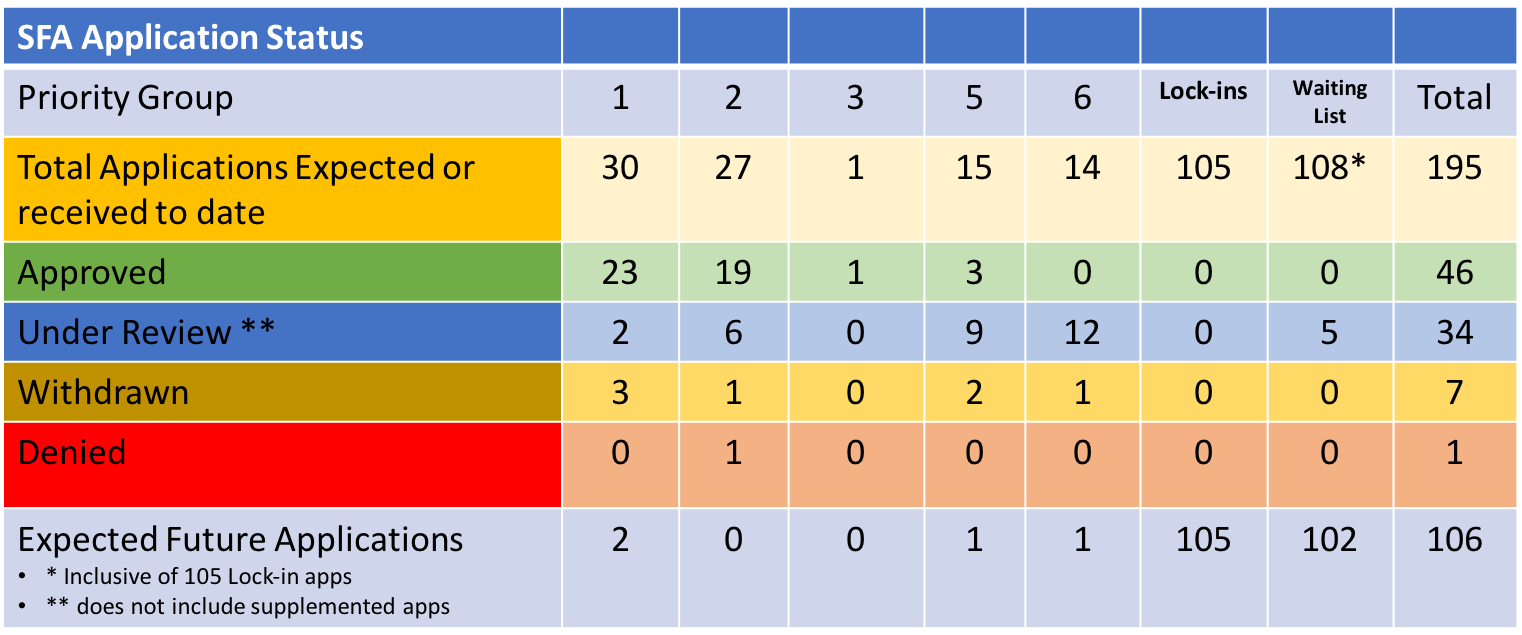
It appears that the “Summer doldrums” may have settled in as it relates to the PBGC and ARPA. The last couple of weeks have seen little action. Now, I don’t mean to be snarky toward the PBGC given the tremendous energy that has been expended to date (46 initial applications approved and $47.4 billion allocated), but there is little to show recently. In this most recent week, there were no new applications filed, approved, or denied (fortunately). There was, however, one application withdrawn. The Legacy Plan of the UNITE HERE Retirement Fund, a Priority Group 6 applicant, withdrew the initial application on June 8th seeking $1.025 billion in SFA for their 91,744 plan participants.

The only other notable event during the prior week was the addition of District Council 37 Local 389 Home Care and Professional Employees Pension Fund to the waiting list. This brings to 110 the number of multiemployer plans that now reside on this list hoping to have the opportunity to file an SFA application. This most recent addition did not “lock in” a valuation date, yet. With 110 plans sitting on this waitlist, there is no doubt that the PBGC still has a tremendous effort before them.

As always, we welcome your comments and questions. Please don’t hesitate to reach out to me if you have any questions related to how to appropriately invest the SFA proceeds to maximize the potential coverage of benefits and expenses. The higher US interest rate environment is a blessing for plans looking to defease their pension liabilities. Have a great week.

Milliman’s 2023 Corporate Funding Study

By: Russ Kamp, Managing Director, Ryan ALM, Inc.

I’ve had the great pleasure of speaking at a number of industry events so far in 2023. I usually begin my portion of the talk or panel discussion by asking a very simple question: Was 2022 a good or bad year for pensions? That question often generates a response from the audience that makes it appear that I have 3 eyes and have suddenly turned green. I say that because most people in the US pension industry, especially among public and multiemployer plans, focus almost exclusively on the asset side of the pension equation since the return on asset (ROA) assumption is their primary objective. They understand that rising US rates led to declining valuations for both stocks and bonds, and likely many if not all alternative investments, but since those don’t get marked-to-market one never really knows. They’ve seen that the S&P 500 was down -18%, while Bloomberg Barclays declined an unprecedented -13% for the year.

What they failed to understand is the impact of rising rates on the present value of the pension plan’s liabilities, which are bond-like in nature. In a rapidly rising rate environment, long-duration pension liabilities’ present values fell rather dramatically. In fact, the decline in the present value of those liabilities dwarfed the decline in assets. This relationship is more obvious in pension accounting for corporations, but it is still true for public and multiemployer pension plans despite the GASB accounting standards that permit the ROA to be used as a liability discounting mechanism.

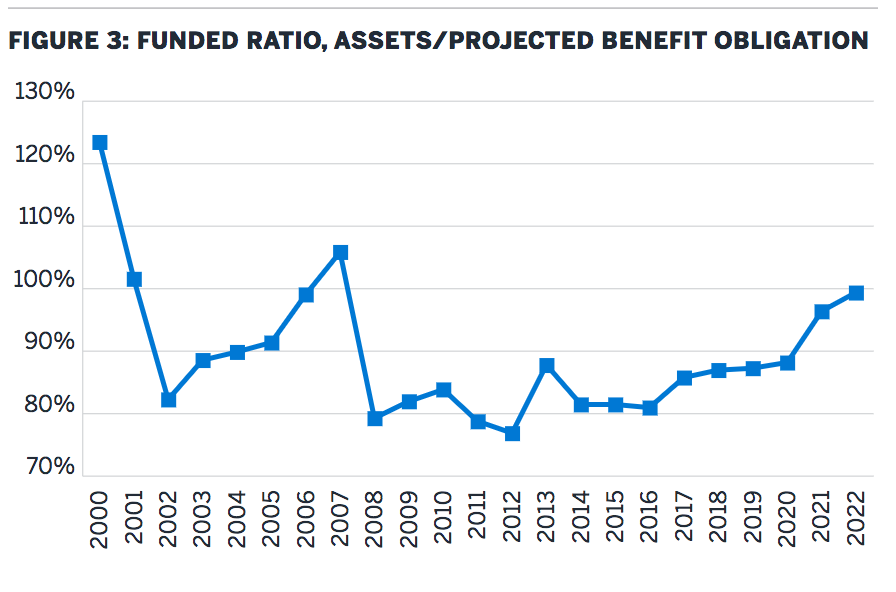
So how good was 2022 for Corporate America? According to the Milliman study (thanks to Zorast and team) “the funded ratio of the Milliman 100 pension plans increased during FY2022 to 99.3% from 96.3% at the end of FY2021.” Furthermore, “the 245 basis point increase in liability discount rates was sufficient to overcome the plans’ average -18.6% investment return, allowing the private single-employer DB plans of the Milliman 100 companies to reduce the multibillion-dollar pension deficits for the second straight year, falling just short of full funding in 2022.”

Corporate pension funding has only been in better shape twice before going back to 1999. Regrettably, Pension America failed in both cases to secure the promised benefits through a defeasement strategy preferring a gambler’s mentality of “let it ride”! Well, we know what followed previous funding peaks in 2000 and 2007. No one should be comfortable leaving chips on the table at this time. The current US interest rate environment is enabling Ryan ALM to produce investment-grade bond portfolios with a YTW of >5.5%. The present value of assets is able to secure substantial future value benefits and expenses. Our objective in managing pension assets has never been a return focus. It is our goal to SECURE the promised benefits at a reasonable cost and with prudent risk. Let us help you secure the promises that you’ve made to your employees. They will certainly appreciate your effort.

ARPA Update as of June 2, 2023

By: Russ Kamp, Managing Director, Ryan ALM, Inc.

We are pleased to provide the weekly update on the PBGC’s activity related to the ARPA legislation. There were no new applications submitted for review or approved for SFA payment. However, there was one plan, the New England Teamsters Pension Plan, a Priority Group 6 fund, that withdrew its initial application on May 30, 2023. They are seeking nearly $5.5 billion to help support the 72,141 plan participants.

In addition to the activity cited above, there was one new plan added to the waitlist for SFA consideration. The UFCW Local 23 and Giant Eagle Pension Fund was added to the list marking the 109th multiemployer pension system to be added at this time. They also decided to lock in a valuation date of April 30, 2023. Joining UFCW Local 23 were two other plans that decided to lock in 4/30/23 as their valuation date – Retail Food Employers & UFCW Local 711 Pension Trust Fund and the Communications Workers of America Local 1109 Pension Plan.

Generic Fixed Income Indexes Don’t Work for ALM

By: Ronald J. Ryan, CFA, CEO, Ryan ALM, Inc.

We are pleased to provide you with this ALM-related “pop quiz”.

Q: Can a Generic Bond Index Replicate Pension or OPEB Liabilities?

A:  NeverMission Impossible!

Pension and OPEB liabilities are unique to each plan sponsor. Each has a different labor force, salary structure, mortality profile, plan amendments, actuarial assumptions, etc. It is impossible for a generic bond index to replicate the unique liability cash flows and risk/reward behavior of any pension and OPEB liability for several additional reasons:

Problems:

  1. Generic bond indexes use coupon bonds while liabilities are to be priced and viewed as zero-coupon bonds. Coupon bonds are less interest rate sensitive than zero-coupon bonds with the same maturity as they have a shorter duration, especially on longer bonds. 
  2. Generic bond indexes have a maximum duration of about 15 years today vs. much longer liability cash flows.
  3. Pension and OPEB liabilities are a term structure or yield curve of monthly liability cash flows which tend to be rather linear through time.

A generic bond index is weighted based on corporate new issues which rarely, if ever, are issued as a term structure. This creates gaps between the index term structure.

  1. Long generic bond indexes usually have no maturities shorter than 10 years. This leaves out a major portion of liability cash flows.
  2. The Durations of generic bond indexes are interest rate sensitive and can change significantly through time. In the early 1980s, the longest duration bonds were around 8 years. After 1982, durations began to extend as interest rates were in a secular decline.

A 30-year maturity 20 years later (2002) had a duration of around 16 years or twice as long as in 1982. Liability durations do not change radically and tend to be rather stable for active plans and open groups. Even closed groups will have durations that change slowly.

Ryan ALM Solutions:

  1. Only a Custom Liability Index (CLI) could replicate liability cash flows and monitor their risk/reward behavior. The CLI is based on the unique actuarial projections of each plan sponsor. 

Since contributions are the initial source to fund benefits and expenses (B+E), current assets fund net liabilities after contributions. Moreover, B+E are monthly liability payments. The actuary does not calculate net and monthly B+E payments. The CLI will calculate net monthly liability payments. The CLI produces monthly reports that include summary statistics (yield, duration), liability growth rate, interest rate sensitivity, present value, and future value.

  1. Accounting rules require the pricing of liabilities at a AA corporate zero-coupon yield curve. Since these bonds do not exist in the marketplace, they have to be manufactured. Ryan ALM is one of few ASC 715 discount rate vendors providing four distinct yield curves (top 10% yielding, top 33% yielding, top 50% yielding, full curve). Such pricing determines all of the present value summary statistics and liability growth rate.
  2. The true objective of any pension and OPEB plan is to fund liabilities in a timely and cost-efficient manner with prudent risk. It is all about asset cash flows versus liability cash flows. The most prudent and efficient way to achieve this objective is through cash flow matching. The Ryan ALM model (Liability Beta Portfolio™ or LBP) is a cost optimization model that will fund and match liability cash flows monthly at a cost savings of about 2% per year. If Ryan ALM was your asset manager for the 1-7 year liabilities, we could reduce the cost to fund benefits and expenses by about 14%. This is a significant cost saving and allows plan sponsors time for their other assets to grow unencumbered without a cash sweep.

“Where is the knowledge we have lost in information” T.S. Eliot

What About Carol? She’s Doing Better!

By: Russ Kamp, Managing Director, Ryan ALM, Inc.

Regular readers of this blog will know to whom I am referring when I mention the name, Carol. I started following Carol’s saga from late 2017 to early 2018 and first wrote about her in June 2018, when I was asked to participate in the development of the Butch Lewis Act (BLA) Legislation (thanks, Ron). Getting involved in this effort has been one of the highlights of my career to date.

Unfortunately, Carol was a member of Local 805 that became victim to the legislation known as the Kline-Miller Multiemployer Pension Reform Act of 2014 (MPRA). Under MPRA, her plan was given permission to slash promised benefits, which had a horrendous impact on the lives of retirees through absolutely no fault of their own. Carol candidly shared how she was being impacted by the 61% cut to her benefits. She said, “I received a letter from the Teamsters in March stating their intention to cut my pension from $2,600.00 a month to $1,022.00 a month….that’s 61%. It is supposed to happen in January 2019. If they get away with this, I will lose my house. I am a 64-year-old widow who can hardly afford to pay my mortgage without the cut.” In addition, she shared that “I have been under doctor’s care for the past 18 years for depression and anxiety, and I was doing fine until 2 years ago. I was forced to give up my prescription plan because I could no longer afford it.” So tragic!

Regrettably, the BLA legislation was never taken up by the Senate following passage in the House in July 2019. However, soon after President Biden’s inauguration, a similar pension bill to that of BLA was attached to ARPA. Fortunately, that legislation was signed into law in March 2021, and it is being implemented by the PBGC. The Local 805 Pension and Retirement plan, a MPRA Suspension and Partition Priority Group 2 plan, had its initial application approved for $136 million in Special Financial Assistance on May 3, 2022, and paid out on May 31, 2022. These proceeds are to be used to reinstate the benefits as they were originally established and to make participants “WHOLE” for lost benefits following those onerous cuts. On January 9, 2023, Local 805 received a Supplemental payout of $40.3 million to further support the 2003 participants in the plan.

I recently reached out to Carol to see if she benefited as the legislation intended. Here is her update:

“Hi, Russ! So nice to hear from you. I hope you’re doing well. Regarding my pension and the reinstatement, everything went very smoothly. I got my 1st reinstated check on April 1, 2022, and Every month going forward on the same day. My retroactive check was sent around the same time as my 1st reinstated check. I was able to pay back some of the money I borrowed to get by which felt really good. Unfortunately, that couldn’t make up for the loss of my house and the stress on my mind and body, but with all the help I was given, my future is bright once again. Your articles really helped my voice be heard and I thank you for that. The first thing I wanted to do when I got my pension back was to go and see Karen Ferguson (Pension Rights Center). I wanted to thank her and Terry in person for all the help they gave me. Unfortunately, when I tried contacting her, I found out I was a month too late. A while before the reinstatement kicked in, I cut myself off the Facebook pages because the stress was really getting to me. For that reason, I wasn’t aware of Karen’s passing until I tried to email her. I will always remember the sadness I felt. She pulled me through many dark moments and introduced several people into my life whose help was absolutely priceless. Because of her, I survived. Anyway, I am getting my promised pension, Russ, but I have to admit, the fear of losing it again lingers in the back of my mind. Carol

I’ve produced more than 1,240 posts on my blog since I began writing in 2014. This one is one of my favorite posts to date. It is incredibly fulfilling to know that Ryan ALM played a small part in getting Carol’s and all the other MPRA plan participants their benefits reinstated and their lost benefits repaid. I have stated before that I thought that it was outrageous what was done to these hard-working union members who suffered for years with the stress and anxiety of not knowing if they were going to survive in retirement let alone enjoy a dignified retirement.

Ron and I continue to be crusaders for the preservation of defined benefit plans. Asking untrained individuals to fund, manage, and then disburse a “benefit” with little knowledge is criminal! The consequences will be quite negative and far-reaching. If you have a DB pension benefit, you are extremely lucky. Do everything that you can to protect it. It will keep your golden years from being tarnished.

ARPA Update as of May 26, 2023

By: Russ Kamp, Managing Director, Ryan ALM, Inc.

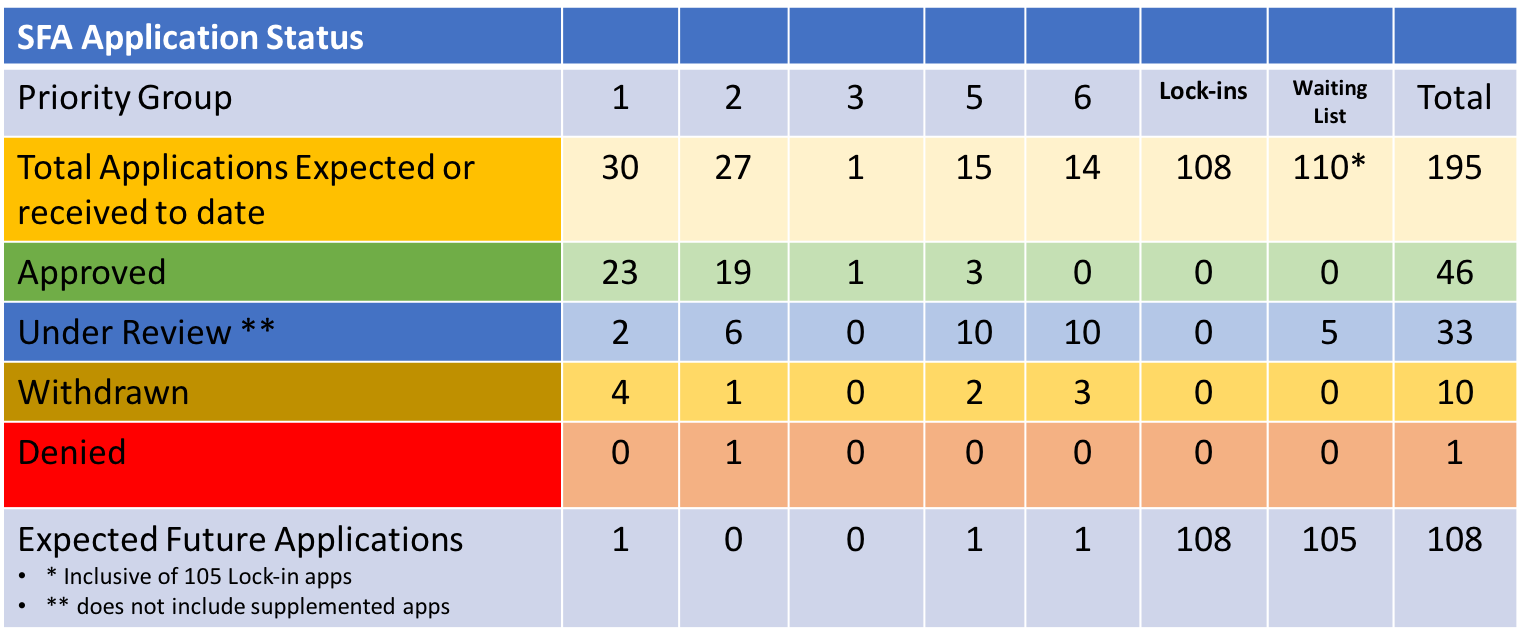
We hope that you enjoyed a nice long weekend. Here is the weekly ARPA legislative update. Despite the holiday weekend, the PBGC continued to focus on the task at hand. During the prior work week, one plan, the Paper Handlers’ – Publishers’ Pension Plan, submitted a revised application. This Priority Group 5 plan is seeking nearly $20 million to help secure the promised benefits to 244 plan participants. The PBGC has until September 22, 2023, to act on the application.

In addition to that action, two plans, the Bindery Industry Employers GCC/IBT Pension Plan and the Paper Handlers’ – Publishers’ Pension Plan each withdrew their initial applications seeking SFA support. The Bindery Industry Employers Fund is seeking $18.8 million for their 686 participants, while the Paper handlers would like to see the PBGC deliver $20.7 million for its 244 participants. There were no applications denied and no new filings approved during the last week. In addition, no plans were added to either the waiting list or requested a valuation date lock-in.

Generate Income and Minimize Risk!

By: Russ Kamp, Managing Director, Ryan ALM, Inc.

Just got an email with the above title. I was intrigued, as I suspect that you might be, too. It was for an upcoming webinar that was being conducted by a mega investment shop. The webinar will focus on a few primary points, including the attractive valuations of the risk factor Quality and non-US investments, pro- and counter-cyclical exposures, and a deep dive into a potential recession with a discussion as to the depth and duration of such an event. All of this leading eventually to a discussion on how to position your portfolio to “Generate Income and Minimize Risk!”

Boy, that all sounds nice, but how much will the performance needle be moved by adopting some or all of these investment ideas? Each one of these ideas comes with an annual standard deviation that in some cases is quite volatile (non-US investing). Are these long-term sustainable ideas or dynamic opportunities that must be acted on quickly in order to maximize the potential reward? Do US pension plans have the ability to move substantial assets around in an attempt to add incremental gains after transaction costs? I don’t believe that they do.

In addition, we know that “value” is in the eye of the beholder. We are witnessing that right now. What looks like an over-valued situation (mega-tech) may continue to see incredible momentum pushing share prices higher and higher despite valuations that are stretched. According to the folks at Glen Eagle Trading, Technology and other growth stocks without dividends have risen by 10% this year, while stocks with high dividend yields have decreased by 6%. Think valuation matters in this example?

Risk is best measured and defined as the uncertainty of achieving the objective. For DB pensions, the true objective is funding liabilities in a cost-efficient manner with prudent risk. As a result, pension risk is best defined and measured as the asset growth deviation from liability growth. This is best measured by a Custom Liability Index (CLI). Pensions should be all about cash flows. As a result, you want asset cash flows to match or exceed liability cash flows.

If you truly want to get off the asset allocation roller coaster, while pursuing a strategy that generates income and minimizes risk, convert your current core return-seeking fixed income into a cash flow matching portfolio that defeases pension liabilities through the cash flows created by interest and principal upon maturity. Your “savings” are locked-in on day one. Importantly, interest rate risk is eliminated as future values (benefit payments) are not interest rate sensitive, while “buying time” for those value stocks to finally become appreciated by the marketplace.

ARPA Update as of May 19, 2023

By: Russ Kamp, Managing Director, Ryan ALM, Inc.

Not sure if it was a case of Spring fever or the PGA golf event in Rochester, NY, (how about Michael Block?), or just an overwhelming array of applications to get through, but the week ending May 19th didn’t produce a lot of “results” for the PBGC and their implementation of the ARPA legislation. In fact, there were only two reported actions during the week and both involved the same pension plan, and I’m confused as to the actual events. Plasterers and Cement Masons Local No. 94 Pension Fund submitted and withdrew their application on the same day – May 15th. In somewhat of a chicken-and-egg scenario, did this fund submit and then withdraw its application or did it withdraw an application that had already been submitted, made the appropriate edits, and then resubmit? I’ll have to do some further research to see if I can determine the path that this application traveled.

In any case, this MPRA Suspension and Partition Priority Group 2 plan is only seeking $3.2 million for its 108 plan participants. Priority Group 2 plans began submitting applications way back at the end of 2021. It certainly has taken some time for this plan to get the application to a point that meets the PBGC’s needs. As a reminder, MPRA Suspension and Partition plans had seen benefits cut under 2014’s legislation. These plan participants have waited a long time to get the promised benefits reinstated, while also being made whole for the previously lost pension earnings. Let’s hope that their wait isn’t much longer.