
We are pleased to share with you the Ryan ALM quarterly newsletter for Q1’21. As you will read, a terrific quarter was logged for both private and public pension systems that benefited from rising rates (liabilities down) and strong markets (assets up). The combination lead to improved funded ratios and funded status. We hope that you find our insights beneficial. As always, please don’t hesitate to reach out to us at (561) 656-2014 or visit us at ryanalm.com or kampconsultingblog.com. Thank you for your on-going support.
Author Archives: russkamp
Confident or Irrational?
The WSJ has published an article today titled, “Corporate Bond Gauge Signals Dwindling Economic Risk”, in which they speculate that the narrowing of spreads for non-investment grade bonds (High Yield) relative to Treasuries reveals confidence in the economy’s rebound. But does it really?
“The average extra yield, or spread, investors demand to hold speculative-grade corporate bonds over U.S. Treasuries dropped below 3 percentage points this month to as low as 2.90 percentage points for the first time since 2007, when it set a record of 2.33 percentage points, according to Bloomberg Barclays data” (WSJ). As we mentioned the other day in our post, Private Pension Alert: Lock it in! Any reference to an event last accomplished in 2007 sends shivers down my spine.
I would say that there are a number of factors leading to this trend, including the need for yield in a low-interest-rate environment among retirees/pension plans. I would suggest that a spread this narrow signifies a market that has gotten ahead of itself from a fundamental perspective. Again, we are discussing non-investment grade bonds in this case. They are rated this way for a reason. Despite the fact that there has been a decline in the default rates recently, we live in an ever-changing landscape. According to S&P, “even though we expect very low funding costs through 2021, higher leverage and a large share of vulnerable corporates are likely to induce further defaults, resulting in the 12-month speculative-grade default rate rising to around 9% in the U.S.” Do you really want so little relative yield to navigate through such a challenging environment as the one described by S&P? I certainly don’t.
Again, we would suggest that one use investment grade fixed income for its cash flows and defease pension liabilities chronologically for the next 10 years. Don’t chase yield in when you aren’t getting paid to do so. This strategy will provide a longer investing horizon for the balance of your assets that will now have time to work through the uncertainties brought about by the global pandemic. 2007 may have started off on a strong footing, but we certainly know how it ended. Let’s not repeat the mistakes of the past.
Private Pension Alert: Lock it in!
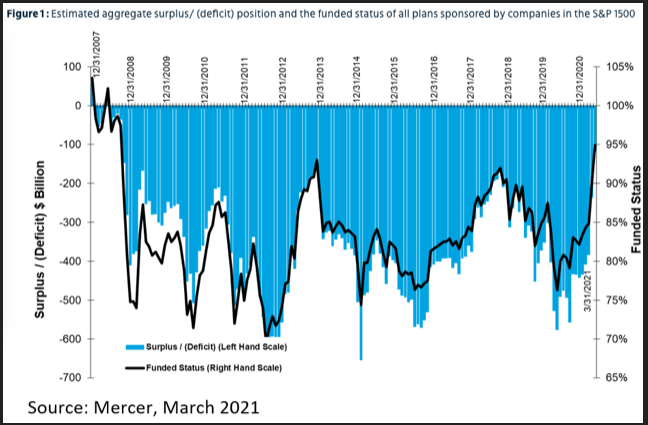
Great funding progress has been made by the average US private pension plan that has benefited during the last 12 months from rising equity values and rising bond yields. As the chart below suggests (thanks, Mercer), the funded status for corporate America now stands at 95%, having risen from a low of 70% in 2012 and 77% just 12-months ago. Given this great progress, now is not the time to sit on one’s laurels. With equity valuations at all-time highs, we believe that corporations would be best served by locking in these tremendous funding gains, even if the goal isn’t to freeze, terminate, and/or engage in a pension risk transfer for your specific pension plan.
Despite the fact that US interest rates continue to be near their lows, a cash flow matching strategy designed to defease the plan’s Retired Lives Liabilities will secure benefits chronologically and protect the funded status even in a rising rate environment, as assets AND liabilities will move in lock-step. Continuing with a traditional asset allocation potentially risks underperformance from both equities and core fixed income, given the latter’s interest rate sensitivity. Furthermore, a cash flow matching strategy can be accomplished with cash bonds and doesn’t need to involve more esoteric instruments, such as swaps and derivatives, which can introduce a different set of risks and provide no cash flows.
The last time that corporate America enjoyed a funding surplus was 2007. We know what soon transpired. It would be tragic if market declines once again sabotaged the funded status. We also got close to full-funding in 2013, but a significant decline in interest rates conspired to drive the collective funded status much lower. We don’t know when or by how much markets will move, but given their current valuations, there is likely less upside than downside. Secure your gains! Just like in Las Vegas, when you win BIG… take chips off the table!
8 in 10 – Oh, Boy!
Fidelity Investments is out with their 2021 State of Retirement Planning Study. Given the impact of Covid-19 on many Americans, in terms of health, employment, etc. it isn’t surprising to read that pre-pandemic retirement plans may have been altered. What is surprising is the percentage of responders that indicated a negative impact. In fact, Fidelity is reporting that 82% of Americans said that their retirement plans have been impacted, with 55% indicating that retirement was likely pushed back by at least 2 years, and another 33% indicated that the delay may be 3-years or more. Ouch!
Importantly, 79% of the survey responders indicated that they had re-evaluated their priorities, as a result of the pandemic and many (36%) remain stressed about their ability to maintain a retirement nest egg: and they should be given the low level of US interest rates and significantly inflated multiples for equities that have been fueled by the short-term benefits from stimulus. That combination doesn’t bode well for future returns. Couple the investment concerns with the lack of longevity protection and professional management, and you have the basis for a lot of STRESS.
The demise of the traditional DB plan has created a lot of issues for Americans hoping to retire one day. Sure, some higher earning Americans have been able to stash away “significant” sums of money in a DC retirement account, but that certainly isn’t the norm for a majority of American workers. Furthermore, that balance is subject to great risk should markets experience similar results as those realized in 2000-2002 and 2007-2009 when 401(k)s became 201(k)s seemingly overnight. DC plans were originally contemplated as supplemental retirement vehicles. They should once again assume that role allowing for defined benefit plans to be the true retirement plan that it is.
IFEBP Presentation – Rethinking POBs
I am pleased to share that I recently completed a webcast on behalf of the IFEBP. The topic was “Rethinking Pension Obligation Bonds”. POBs have gotten a bad reputation since their introduction in 1985, and several organizations, including the GFOA, continue to warn their members to steer clear. Given Ryan ALM’s unique implementation of the POB proceeds, we believe that our strategy increases the probability that the POB will be successful.
Important: Please note that the webcast is only available to members of the International Foundation. If you are a member, please log onto the IFEBP’s website and view the presentation there.
Please don’t hesitate to reach out to us at Ryan ALM if you’d like to learn more about our approach.
The ABCs of the Pension Crisis
I am pleased to share a terrific podcast brought to you by Traci Dority-Shanklin and the World of Multiemployer Benefit Funds. Traci has cobbled together comments from Jack Marco, John Elliott, Jason Russell, and me from previous podcasts. Our comments address the multiemployer retirement crisis that has been unfolding for years. The recent passage of the American Rescue Plan Act (APRA) addresses many of the extreme funding issues, but more work is necessary to ensure that causes that led to previous issues don’t once again surface.
I hope that you’ll take the time to listen, as the podcast is only 30 minutes long. I believe that you’ll appreciate the views expressed by some of the leading industry voices in Jack, John, and Jason. There are several other multiemployer-focused podcasts that would provide you with additional terrific insights. I encourage you to visit their website.
It May Be Time For A Re-think
Since the first use of Pension Obligation Bonds (POB) in 1985 (Oakland, CA), results have been checkered at best. Boston College Center for Retirement Research (CRR) has produced two studies related to POBs and neither shines a great light on the use of POBs to improve funding for public pension systems. Furthermore, the Government Finance Officers Association (GFOA) has come out strongly against the use of POBs “regardless of the economic cycle”, which I guess is a reference to the current environment of historically low-interest rates in the US. But are they thinking about the use of POBs in the right light?
As we know, states and municipalities have issued these securities “hoping” to capture the arbitrage between the ROA (plan’s asset return forecast plus the discount rate) and the interest payment on the bond. For most cases from 1992-2009, the bonds were issued and invested at the wrong time in the cycle leading to underperformance and an increase in the plan’s liabilities. In the 2014 study, CRR found that bonds issued in 2009 and later had shown improved results once again highlighting that timing is an important factor, and we all know how difficult it is to time the market, especially when the POB assets are injected into the plan’s traditional asset allocation, with all the gyrations that markets can create.
All that said, there is a strategy that can be used that can dramatically increase the probability of success. Sure, taking advantage of low interest rates is still an important consideration, but this prudent strategy significantly reduces the “timing” element of when the assets are invested. I think that the GFOA would appreciate a strategy that bifurcates a plan’s assets into two buckets – beta and alpha. The beta assets would use some of the POB’s proceeds to defease the plan’s retired lives liability chronologically for the next 10-years or so. This provides the remainder of the POB proceeds and the current plan assets to be managed more aggressively since they now have a longer investment horizon of 10 or greater years.
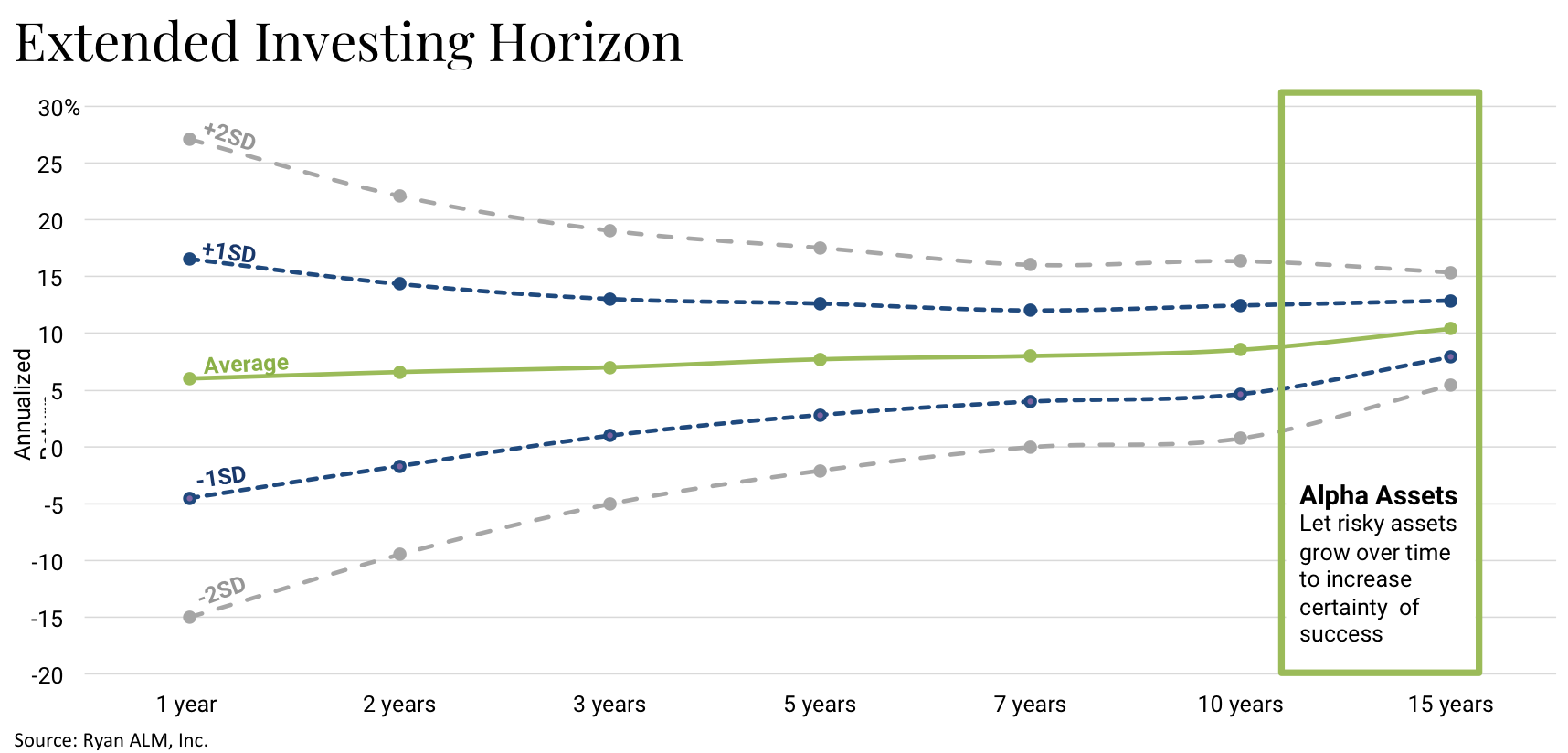
As the chart above reflects, a traditional asset allocation with a one-year investment horizon has a tremendous amount of volatility associated with it. By providing the portfolio with a 10-year investment horizon, the standard deviation declines dramatically increasing the probability of achieving one’s return objective. Furthermore, by defeasing the plan’s near-term liabilities, liquidity to meet benefit payments and expenses is enhanced allowing the alpha assets to grow unencumbered. Importantly this change in asset allocation converts fixed income from a performance-seeking investment to a cash-flow-producing investment, which is the true value in bonds, especially in this current environment.
But the proof is in the pudding. A recent analysis that we did for a struggling public pension plan showed that with the injection of a POB and the adoption of this implementation we could dramatically improve the Funded Ratio, freeze contributions at the current level (saving the plan >$10 billion in future contributions), reduce funding costs by >20%, and cover the debt-service while determining that the fund could accomplish all of this with a ROA that was 80 bps lower than their current objective. You may be thinking that this just seems too good to be true, but we would be glad to take you through both our process and this analysis. Call us, especially if you are affiliated with the GFOA.
What Would You do?
It has been reported that the American Federation of Musicians and Employers’ Pension Fund (AFM-EPF) has decided to pull the application for benefit reductions under MPRA and “bet” that the recently passed American Rescue Plan Act will provide a superior outcome. The latest MPRA application by AFM-EPF filed in December (the first application was rejected) called for an across-the-board 30.9% reduction of the multipliers used to calculate benefits for contributions earned before Jan. 1, 2010. Under ARPA, plans designated as Critical and Declining or Critical can file an application with the PBGC for a grant that would ensure that benefits would be paid through 2051 with no requirement that the grant is repaid.
It seems fairly obvious to me what I would do if I were responsible for that plan. But, there are outstanding issues that need to be resolved with regard to the legislation. This determination falls onto the PBGC, which is responsible for providing guidance on the legislation’s provisions, including how the Special Financial Assistance (SFA) is calculated in the first place. I’ve seen multiple interpretations as to how the SFA will be determined, and the size of the assistance varies tremendously under the most extreme differences.
Personally, I can’t imagine that it was the goal of Congress to have legislation passed that doesn’t accomplish the objective of securing the promised benefits for these struggling plans through 2051, especially given that there are roughly 1.4 million Americans in these plans who are expecting to get what was promised. So, what would you do? Would you cut benefits under MPRA, even if the pain is quite severe in order to extend the viability of these entities, or would you “roll the dice” on ARPA and the PBGC’s interpretation of how the SFA should be calculated? I firmly believe that the PBGC will produce guidelines that provide the necessary SFA to ensure that there is enough money in 2051 to meet the plan’s liabilities at that time.
Is It Just The Accounting Rules?
We know that the accounting rules differ quite significantly in the treatment of discount rates for public (GASB) and private pension plans (FASB). Do the differences manifest in asset allocation? According to the following two charts, the answer is yes, and it is quite significant!
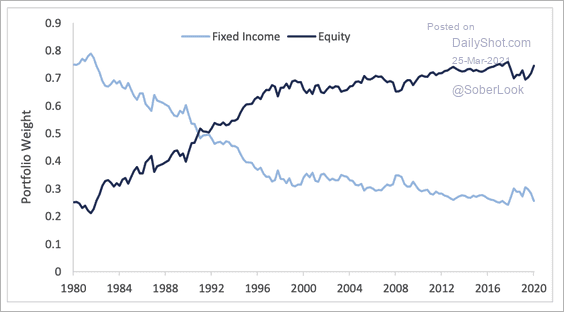
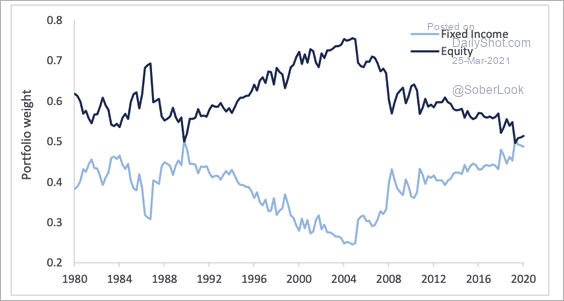
Chart 1 (thanks, Deutsche Bank) highlights the change in exposure to fixed income within public pension plans during the last 4 decades. While the second chart reflects the allocation to fixed income by private pensions. After a brief reduction to fixed income during the go go ’90s, private pension plans ramped up their exposure to fixed income and today sit at roughly a 50%/50% mix. But are these differences just the result of the accounting rules? We’d say, no!
Regrettably, private pension plans have been hell-bent on eliminating DB pensions ever since the advent of defined contribution plans (DC) and 1986 Tax Reform. This has driven plans to reduce risk, as they establish glide paths toward full funding and the possible transfer of pension liabilities to insurance companies. But every private plan has certainly not frozen, terminated, and/or transferred their pension liabilities. For those that haven’t, the market valuation pension rules under FASB have created an environment in which the average private pension plan is much better funded than the average public pension system.
With regard to public pension systems, there is the perception that these entities are perpetual. But is that perception reality? We’ve seen examples of DB plans being frozen and new employees being thrust into DC or hybrid offerings. I wrote a blog post several years ago in which I stated that perpetual doesn’t mean sustainable. I fear that we could be entering a time when we could see more examples of public pension systems seeking alternatives to traditional DB plans. A trend that will certainly not be favorable to future public employees. It is likely that burgeoning contributions will make some of these systems unsustainable. We’ve witnessed tremendous growth in contribution expenses throughout pension America since the 2000-2002 recession. This growth is becoming a significant burden for some to handle, as it takes a bigger slice each year from the social safety net. Some pension systems have made the full contribution, while others have not, further pressuring an already tenuous situation.
Given the perception that public pension systems are perpetual, they have embraced the idea that they can become much more aggressive in the allocation of assets to equity and equity-like products. But is that decision sound? The volatility that comes with a much more aggressive allocation has subjected these plans to massive swings as we’ve had to endure three significant market corrections in just the last 20 years. Given the 70+% return in the markets during the last 12-months, is there really that much more to gain before we finally see a pause or correction?
At Ryan ALM, we think that asset allocation should be driven by the plan’s funded status and not the accounting rules. Public pension systems can have a higher exposure to alpha assets (non-bonds), but they need to ensure that near-term liabilities are secured before ramping up the risk. With a greater focus on near-term liabilities through a cash-flow matching strategy, the pension fund has now bought time for the alpha assets to grow unencumbered. Furthermore, they are no longer a source of liquidity removing the possibility of being forced to sell assets at inappropriate times. We are huge supporters of DB plans, but there needs to be a change in how they are managed, or we may see their demise far sooner than expected.
Pay Them Now!
There are 18 multiemployer plans that “successfully” filed for benefit relief under MPRA. Benefit cuts in excess of 50% have occurred for some of the retirees bringing with them true hardship for the participant and their families. With the passage of the American Rescue Plan Act (ARPA) these participants and/or their beneficiaries will FINALLY get what was promised and earned. However, that repayment of lost benefits and the reinstatement of the original benefit payment may not come soon enough.
The Pension Benefit Guaranty Corporation (PBGC) has 120 days (roughly July 9th) since President Biden signed the legislation to provide guidelines on many aspects of the Act, including any prioritization for submission of applications for Special Financial Assistance (SFA). Fortunately, it appears that plans that initiated benefit suspensions are going to be given priority to file along with other entities based on the size of the SFA needed (> $1 billion), whether the plan may soon become insolvent (next 5 years) or based on other considerations (don’t you just love that language). However, there are estimated to be 61 Critical and Declining Plans, 112 plans in Critical status, and the 18 MEPPs that were granted relief. That is a heck of a lot of plans potentially filing between when the application process begins and December 31, 2025 when the filing window closes, except for those plans filing an amended application, which gives them until December 31, 2026.
Here is my concern. For those that have seen benefits slashed, they have to wait until the 120 days are up and the PBGC issues guidance, then they must wait for their plan to file an application. The PBGC has 120 days to approve the application from the time of receipt. If the application hasn’t been approved after 120 it is assumed to be accepted. Amazingly, the PBGC then has 1-year to provide the pension system with a lump sum distribution equal to the Special Financial Assistance. Once the plan receives the special financial assistance, they must restore the benefit cuts within the first month. Finally, they can reimburse lost benefit payments either within 3-months in a lump sum distribution or monthly for 5-years (no interest tacked on). Wow!
So, a plan participant who has lost a portion of their benefits for some time now (Iron Workers Local 17 Pension Fund had their application approved in March 2017), may have to wait 3+ years to finally get made whole? How is that fair? I say pay them now. We aren’t talking about a tremendous amount of money (although it is to the participant). When Super Storm Sandy hit Ortley, my insurance company paid me 40% of what they believed my claim would be on the day that they came to my home. As a result, I was able to begin the process of remediation right away. Why can’t we apply a similar process for the reinstatement of benefits? Legislation has been approved and the U.S. Treasury is on the hook to provide funding to the PBGC. Why not make a good faith deposit into the PBGC to begin the reimbursement process immediately? It wasn’t right that plan participants had their promised benefits slashed in the first place. Making them wait a considerable period now that legislation has passed is just pouring salt on their wounds. The hardship created by the cutting of benefits will not ease until restitution has been made.

