Powell Speaks…Does the Market Finally Listen?

By: Russ Kamp, Managing Director, Ryan ALM, Inc.

Federal Reserve Chairman Powell has spoken and his comments have impacted equity markets today. His remarks should also finally dissuade investors of the idea that the Fed has accomplished its intended objective of tamping down inflation with little destruction to the economy and employment. Powell stated, “we must keep at it until the job is done.” According to the WSJ, “while the central bank’s steps to slow the rate of investment, spending, and hiring ““will bring down inflation, they will also bring some pain to households and businesses,”” Mr. Powell said in a speech at the Kansas City Fed’s annual symposium in Wyoming. ““Those are the unfortunate costs of reducing inflation. But a failure to restore price stability would mean far greater pain.”” Echoing Powell, St. Louis Fed President, James Bullard, said in an interview this morning “we need to have higher rates for longer”.

As we wrote in yesterday’s post, the Fed is far from done, and getting to an inflation level of around 2% will take much longer than most market participants are currently believing. We certainly don’t want to see demand for goods and services reduced or unemployment elevated, but we do understand that in order to combat the onerous impact of inflation aggressive action on interest rates is necessary. US interest rates need to be elevated until there is an inflation premium embedded in rates. We are far from that occurring today.

Bostic on Inflation in today’s WSJ

By: Russ Kamp, Managing Director, Ryan ALM, Inc.

Let’s give a big thanks to the WSJ for today’s interview with Federal Reserve Bank of Atlanta President Raphael Bostic. It was a great conversation covering a number of important issues related to inflation and monetary policy while incorporating his views on where we are likely to go. As regular readers of our blog know, we’ve been addressing on a fairly regular basis inflation and the impact that it has on fixed income (bonds) and pension funding. There were two specific points raised during the WSJ conversation that echo our thoughts on the subject (confirmation bias in all its glory).

Bostic stated “but what I would say is I try to remind myself that for most people in our society, they don’t have any memories of living in a higher inflation environment, and so there really aren’t anchors of baselines for people to make—to focus on to have a sense of what a reasonable expectation of response will be over the longer run. So I just think there’s just a tremendous amount of uncertainty. People know there is going to be a response, but they don’t have any models in history to suggest that they know what that contour is going to look like. And so there’s just an unease that’s out there as we move forward.” He also said, “we have an imbalance between demand and supply. And as long as that persists, we’re going to have a higher inflation environment. So we’ve got to get that under control, and that’s going to involve some reduction in demand.”

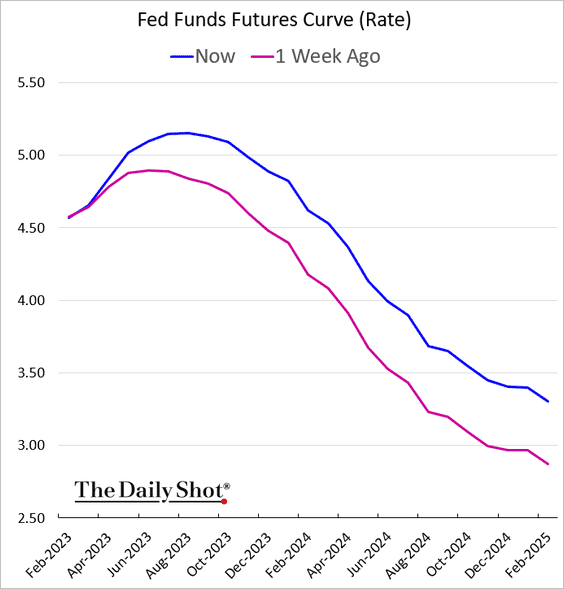
What continues to surprise us, and we recently published a post on this subject, is the expectation that the Fed will have to ease in the near term. That they’ve somehow accomplished its objective. We remain resolute in expecting the Fed to raise rates until they get to a level of positive real rates relative to inflation (an inflation premium). Bostic also cited the current strength of the labor market. He mentioned “the tremendous job growth. We’re averaging, what, more than 450,000 jobs a month per month for 2022? That’s a really big number, and you know, it gave me comfort that we weren’t—that those—we could look through those GDP numbers.” As we’ve stated, you don’t get recessions in an environment of labor strength such as the one that we are experiencing today.

The concept of anchoring at a number that feels comfortable based on one’s prior experience is critically important to understand. Unless you are a 40-year veteran in this industry, you’ve not experienced the negative effects of outsized inflation and interest rates. It is quite amusing to read about the negative impact on demand of a Fed Fund’s Rate at 2.25% when it was >14% the last time we experienced an inflation rate above 8%, which was 4 months into my career. Has housing demand appeared to stall at this time? Yes. But for how long? People need a residence. Rental inflation continues to persist at untenable levels. The demand for housing will adjust to the current environment at some point just as it did for my family and friends who bought their first homes at interest rates that exceeded 11% in the early to mid-’80s.

Lastly, Bostic sees the Fed eventually getting to a Fed Funds Rate above 3.5%. Personally, I don’t see that level diminishing demand and tamping down inflation to a great extent, especially given the strength of the US labor market. In any case, the Fed is far from done, and getting to an inflation level of around 2% will take much longer than most market participants are currently believing.

ARPA Update as of August 19, 2022 – updated

by: Russ Kamp, Managing Director, Ryan ALM, Inc.

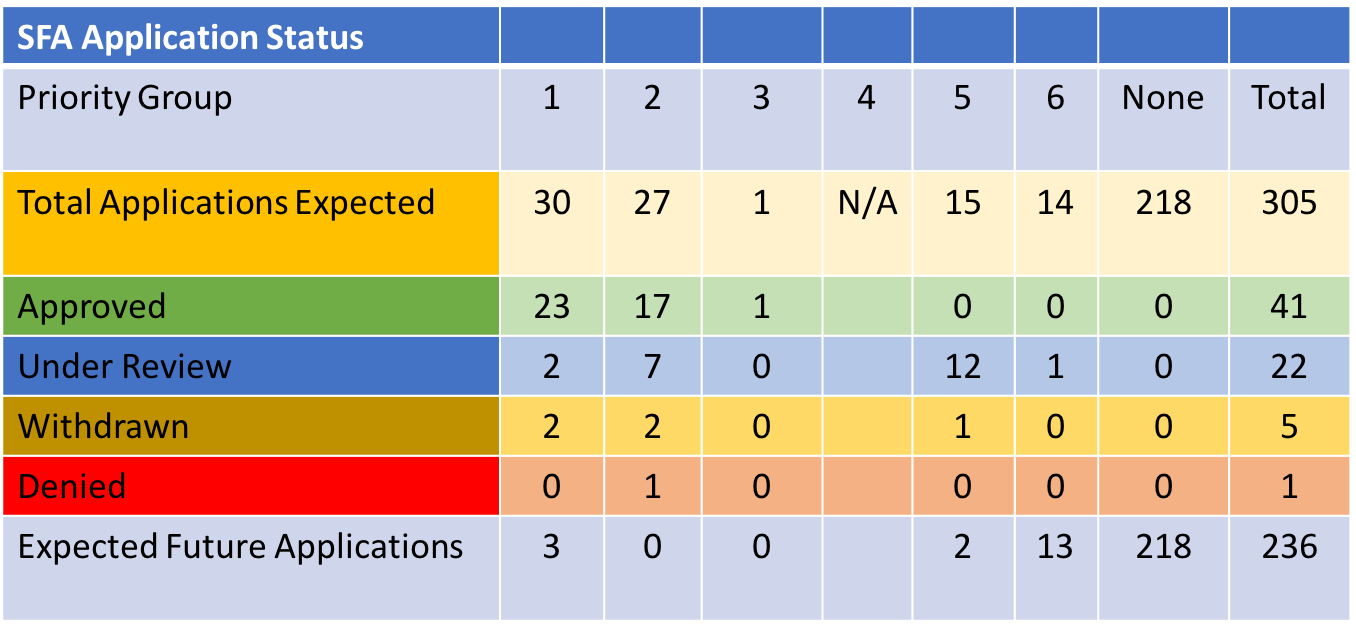
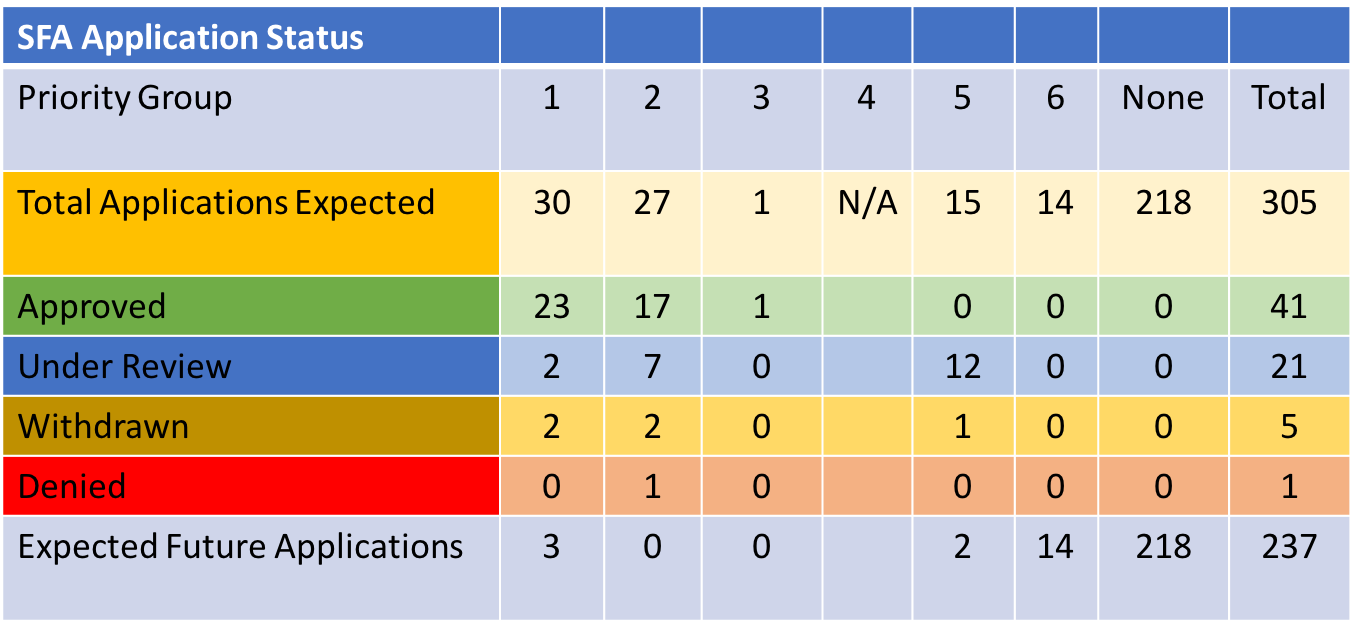
As we reported this morning, activity last week was limited to two plans that filed supplemented applications presumably in reaction to the PBGC’s Final Final Rules (FFR). Those two plans, the Graphic Arts Industry Joint Pension Plan and the Teamsters Local 617 Pension Plan, are seeking Special Financial assistance of $72.2 and $29.7 million, respectively in order to cover their combined 10,745 plan participants. As much as I’ve challenged the PBGC with regard to some of their FFR, they deserve a lot of credit for keeping the public informed of ARPA’s progress. Thank you!

Why DB Plans? Lesson # 237

By: Russ Kamp, Managing Director, Ryan ALM, Inc.

Few people in our industry are working as hard as Ron Surz, President, of Target Date Solutions, to raise concerns about one of the industry’s most frequently used default options – target date funds (TDFs). In his most recent article, he points out that current near-retirees are losing more than those in their 20s. This is both shocking and unacceptable, and it is one more reason why DB pensions must be preserved for the masses.

As the chart above highlights, those in their 20s (the retirement year 2060), have lost “only” -7.9% during the last 12 months, while those retiring now or hoping to, have suffered an unacceptable -11.6% loss. Since the median account balance for those 55-64 (according to Vanguard) is only $84,714, a loss of -11.6% equates to a nearly $10,000 reduction in an already very inadequate retirement account. Asking untrained individuals to fund, manage, and then disburse a “retirement” benefit with little knowledge is just poor policy. However, when relying on the pros (TDF architects) doesn’t provide a superior outcome, we need to rethink that entire operation! Anything short of a monthly benefit paid through a pension-like system will continue to prove inferior.

ARPA Update as of 8/19/22

By: Russ Kamp, Managing Director, Ryan ALM, Inc.

Welcome to another weekly update regarding the ARPA pension legislation. The PBGC has not updated its spreadsheet since August 12th, although it appears that two additional plans have filed a supplemental application following the release of the PBGC’s Final Final Rules (FFR). The two plans are the Graphic Arts Industry Joint Pension Plan and the Teamsters Local 617 Pension Plan. I’ll have more detail on these two plans once the PBGC updates its website.

No Priority Group 4 plans, those projected to become insolvent before 3/11/2023, have filed an application to receive the Special Financial Assistance (SFA) despite that window opening on July 1, 2022. I would have expected a plethora of activity once the FFR has been released.

We’ll be providing an additional update once the data becomes available. Until then, we wish you a great week. Let’s hope that our capital markets cooperate.

Get Real!

By: Ron Ryan, CEO, Ryan ALM, Inc. and Russ Kamp, Managing Director, Ryan ALM, Inc.

America’s investment community has enjoyed a history of real interest rates or an inflation premium on the 10-year Treasury nominal rates. As the chart below indicates, whenever real rates went negative (1975 and 1981, primarily), it proved temporary as it was followed by an increase in nominal yields until a real yield was achieved. The US Federal Reserve has indicated that they want a return to positive real rates with an inflation premium. We are shocked that “investors” aren’t demanding a real yield advantage in this environment given all of the uncertainty related to the significantly elevated inflation rate which has been brought about by a number of factors, including government stimulus, enhanced wages, full employment, war, Covid-19, production, and shipping delays, etc. Why?

Demand a real yield!

At the current level of inflation (July’s CPI-U # was 8.5%), one would expect the 10-year Treasury yield to be roughly 9.5%-10.5% given its long history of providing a real yield of 1-2%. However, the 10-year Treasury note currently has a yield of ONLY 2.78%! This yield provides the investors with a negative real yield of nearly 6%!

As everyone knows, the Fed has begun raising the Fed Funds Rate, which currently sits at 2.25%. They’ve indicated that further rate increases are necessary to help tame inflation. That said, even if these recent increases in the Fed Funds Rate somehow tamp down economic growth to the point that inflation falls to 3%, history suggests that the 10-year Treasury yield should be somewhere around 4% to 5%, which is a far cry from where we are today. Again, we ask, why are investors so complacent? Are they anchored in the idea of low-interest rates forever and always? Don’t they understand what transpired in the 1970s into the early 1980s?

For anyone who needs a history lesson, here is a conversation between Paul Volcker and Ray Dalio that was posted by Ray on his LinkedIn.com page. It is a wonderful reminder that true leadership is needed during periods of great uncertainty, even if it results in personal harm to one’s reputation. Increasing the Fed Funds Rate to only 2.25% is likely to do very little to reduce inflation, especially as we are at full employment with rising wages. The Fed is going to have to GET REAL if we as investors are to enjoy real yields.

Premature Reaction?

By: Russ Kamp, Managing Director, Ryan ALM, Inc.

Given our current economic environment, are investors acting prematurely that the US Federal Reserve has actually accomplished its objective of thwarting inflation? We believe so. As the graph below depicts, market participants have been driving longer-dated Treasury yields lower with each subsequent move up in the Fed Funds Rate anticipating that our economy will slow, and rates will need to fall as a result. In fact, this belief is so strong as to have longer-maturity 10- and 30-year Treasuries trading at yields lower than they were on May 1st.

The Fed has more to do!

As we wrote in Tuesday’s post, Can Inflation Be Contained at an FFR of 2.25%?, in February 1982 when we last had an annual inflation rate in excess of 8%, the Fed Funds Rate was at 14.8% and the 10-year Treasury was yielding 14.0%. Given that it took the Fed elevating the FFR to 6.8% above the prevailing inflation rate during that month, why would anyone believe that our current FFR of ONLY 2.25%, a full 6% below the CPI-U, would constrain inflation? Yet, every time the Fed raises the discount rate, long bond yields fall. Does this action seem premature to you?

It will be interesting to witness the reaction in September to the Fed’s next move. Will we see a similar pattern to recent activity in which an increase in the FFR immediately drives longer-dated bond yields lower or will investors realize that the Fed is going to have to do much more to finally tamp down economic activity and inflation? I certainly don’t want to see the FFR at >10%, but unless inflation comes down quickly, and today’s retail sales # (0.7% X gas and autos) certainly doesn’t support the premise that our economy is slipping into recession, we will likely see the Fed remain aggressive in pursuit of their primary objective… an inflation rate approaching 2% and positive real rates. We are far from those metrics today!

Are Bonds RSA or Not?

By: Russ Kamp, Managing Director, Ryan ALM, Inc.

There seems to be major confusion with regard to the investment of the APRA legislation’s Special Financial Assistance (SFA). When the PBGC released the Interim Final Rules in July 2021, potential investments of SFA grant proceeds were limited to investment-grade (IG) bonds with a maximum of 5% in “Fallen Angel” bonds that were now considered High Yield. There was no mention of the phrase return-seeking assets (RSA). However, in the PBGC’s Final Final Rules (might we still get a new category of Absolute Final Final Rules?), the phrase return-seeking asset was injected into the conversation. Return-seeking asset (RSA) investments were now going to be permitted, but only to a level equal to 33% of the total SFA segregated pool.

However, investment grade bonds are return-seeking investments unless they are specifically used to defease liabilities. One only needs to look at the YTD return for the Bloomberg Barclays Aggregate Index through 8/15/22 (-8.68%) to realize that there is downside risk, and potentially substantial risk if inflation isn’t tamed and interest rates rise substantially as a means to contain inflation. So, unless the PBGC states specifically that IG bonds are to be used to defease the plan’s liabilities , they are return-seeking…plain and simple! Thus, 100% of the SFA may in fact be RSA, which violates the PBGC’s guidance as to no more than 33% in RSA.

Why is it not understood that bonds are performance instruments when not used to secure liabilities? Is it the fact that in only 4 of the last 40 years have we witnessed a negative return for the Aggregate Index with -2.92% in 1994 being the worst performer? We have been in a falling rate environment for most of those four decades leading to this historic period for bonds. However, the 30 years prior to 1982 was a lengthy bear market. Might we be headed for a similar fate today?

If the PBGC truly intends to keep the RSA exposure to no more than 33% in any 12-month period, it MUST mandate that the IG exposure be used to defease pension liabilities chronologically from the first payment as far out as the SFA allocation will go. The remaining 33% may now be invested in RSA as approved in the Final Final Rules. Please remember that the legislation was passed with the expectation that promised benefits would be secured through 2051. By allowing a portion of the SFA assets to be invested in RSA, the securing of benefits becomes much more uncertain. It is truly an unfortunate development. The lack of understanding that bonds are also RSA is shocking!

Can Inflation Be Contained at an FFR of 2.25%?

By: Russ Kamp, Managing Director, Ryan ALM, Inc.

Ryan ALM’s Head Trader, Steve Devito, shared some extraordinary figures with the team last week. Thanks, Steve! We’ve been saying all along that the US Federal Reserve needs to tighten interest rates to a significantly greater extent in order to finally control inflation. We’ve produced blog post after blog post highlighting what we believe to be the reality of our current situation despite market action during the last month or so that would counter our observations. Let’s take a look at some of the numbers from the last period in which we observed inflation in excess of 8% (the latest CPI # posted was 8.5%). In February 1982 the CPI for the month was 0.3% and the annualized inflation # stood at 8.3%.

However, unlike today’s environment in which the Fed Funds Rate (FFR) stands at 2.25%-2.50%, the FFR during that month was a robust 14.8% representing a 6.5% premium to inflation. Not the -6% “premium” that exists in today’s environment. Furthermore, the 2-year Treasury Note was trading at a yield of 14.45% far outpacing today’s 3.17% yield. It seems extraordinary that today’s “investors” would actually believe that a 2.25% FFR would tamp down our significant inflation. Furthermore, why are they willing to hold bonds at such negative real rates? Skeptical that I may have cherry-picked a bond that was an outlier? For further proof of just how unbelievable today’s environment is, the 10-year US Treasury Note was yielding 14.03% in February 1982, which was -0.77% relative to the FFR, but a whopping +5.7% real rate when compared to inflation.

The 30-year Treasury Bond also showed similar results, as its yield was 13.8% for a real yield of 5.5%. Again, we ask, do you really believe that the Fed has accomplished its objective? How much economic activity do you really believe will be constrained by these incredibly modest levels of interest rates? Could it be that we have 2 generations of investors who have not experienced excessive inflation leading to significantly rising rates? Despite the double-digit FFR in 1982 (14.8%), inflation didn’t fall below 3% until July 1983 and it never touched 2% – the current Fed target – before rising again to 3.4% by year-end 1983.

With today’s robust employment and wage growth, is the average consumer more concerned about inflation or borrowing at slightly higher rates? My money is on inflation, as is the Feds. How many more times do we need to hear from a Fed Governor that inflation needs to be contained until rates can be stabilized? They’ve stated that they haven’t been dissuaded from raising the FFR based on newly released information. Not only are equity and bond investors giddy about inflation’s path, but they actually believe that the Fed may ease in the near term. However, Thomas Barkin, Fed Governor from the Richmond Fed, said on TV last weekend that the Fed needs to see real positive rates. Why the disconnect?

We aren’t suggesting that the Fed will raise the FFR to 14.8% in this environment, but 2.25%-2.5% seems like a small down payment on where rates will eventually need to go in order for this august governing body to have achieved its ultimate objective. Hoping that rates have peaked likely sets our markets up for massive disappointment leading to further declines. The greater the current euphoria the likely the bigger disappointment. Pension America has seen some nice recovery in markets. Let’s hope that they take some steps to reduce risk before everyone realizes that the Fed has much more to do. Securing benefits through enhanced liquidity and the buying of time – Ryan ALM specialties – may just be the necessary prescription for what lies ahead.

ARPA Update Through August 12, 2022

By: Russ Kamp, Managing Director, Ryan ALM, Inc.

The flood gates have been opened! From May 3rd to August 5th there had been 10 applications filed for Special Financial Assistance (SFA). During the week ending 8/12, 12 applications were submitted. The activity has been almost exclusively driven by the PBGC’s issuance of the legislation’s Final, Final Rules, as 11 applications were classified as supplemental. The only non-supplemental filing was the Central States, Southeast & Southwest Areas Pension Plan (a.k.a. 800-pound gorilla). The Central States plan withdrew the initial application that had been filed on April 28th and resubmitted an updated application on August 12th. As a reminder, this plan is seeking nearly $35 billion in SFA support for the 364,908 plan participants. To put that sum into perspective, the Central States’ request is nearly 5 times greater than the $7.5 billion that has been paid out to date to the 29 applications that have been approved.

Only the Central States plan withdrew an application last week. In addition, there were no applications that were either denied or approved. The PBGC has 120 days to act on the supplemental applications but given the fact that these entities have already received SFA from the previous submissions, it doesn’t seem likely that 120 days will be necessary for an adjustment to the original SFA to be approved and paid.

No new applications have been filed since June 30, 2022, despite the fact that Priority Group 4 plans (those projected to become insolvent before 3/11/2023) have been able to file since July 1st. To date, 41 plans have submitted applications to receive SFA. When Ron and I were involved in the Butch Lewis Act effort, Cheiron had produced an excellent analysis of 114 plans. I’ve read on numerous occasions that perhaps as many as 200 pension plans might be eligible to participate in the ARPA legislation. If that is the case, we’ve only seen about 20% of the applications filed or <50% if the number of eligible plans is closer to Cheiron’s initial study. Obviously, there is more to come. Stay tuned!