ARPA Update as of September 9, 2022

By: Russ Kamp, Managing Director, Ryan ALM, Inc.

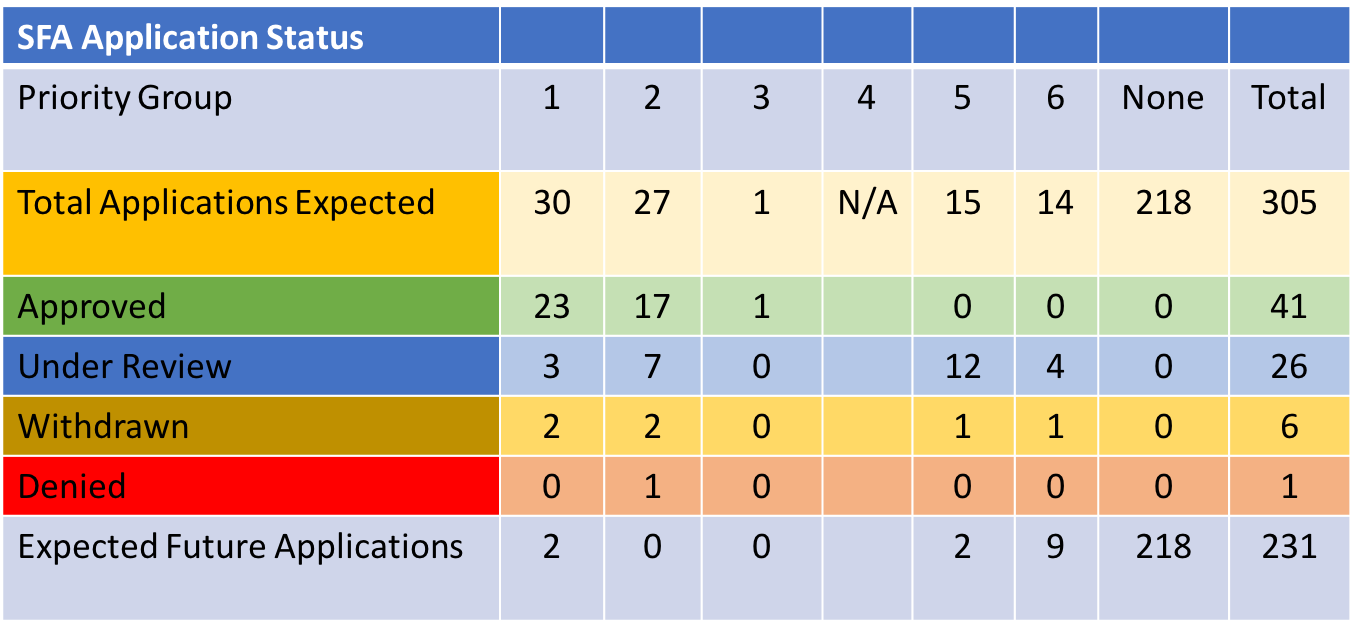
Welcome to the second week of September. I don’t know about you, but 2022 is flying along. That said, there really isn’t much to report on this week as no pension systems filed an application new or revised. No applications were approved, and only one plan that has received approval is left to be paid – Gastronomical Workers Union Local 610 and Metropolitan Hotel Association Pension Fund. They are waiting on a tidy morsel of $31.1 million for its 2,624 participants.

As a reminder, the window for Priority Group 4 plans, those projected to become insolvent before 3/11/2023, has been open since July 1st. However, no Group 4 applications have been filed as of yet. Priority Group 5 and 6 funds will be permitted to file effective February 11, 2023. Perhaps the pace of new applications will quicken as we move through the balance of 2022 into 2023.

Lastly, a big thanks to the PBGC for continuing to provide weekly updates on their website.

They Are Getting Their Comeuppance!

By: Russ Kamp, Managing Director, Ryan ALM, Inc.

We tried. Oh, we tried so hard! We begged, cajoled, reasoned, and pleaded with the plan sponsor community to take full advantage of the historically low US interest rates witnessed following the onset of Covid-19 by issuing a pension obligation bond (POB). We spoke at conferences, conducted webinars, wrote research and blog posts, and met individually with sponsors and their consultants, but we weren’t able to convince a significant majority that they had a wonderful opportunity to dramatically improve the long-term economics of their plan. What a waste!

Despite our frustration and lack of success, we do know that some public plans did issue POBs. In fact, more than 2Xs the $ amount of POBs had been issued by August 2021 ($6 B) than had been issued in 2020 for the full year ($3 B). We were very pleased to see that. However, our enthusiasm was quickly diminished by the fact that the POB proceeds were being invested in the plan’s asset allocation and not used to defease the plan’s liabilities. Once again, we attempted to educate those willing to listen that investing the proceeds into a traditional asset allocation came with a lot of risks, especially given equity valuations at that time.

One of the greatest concerns articulated by critics of POBs was the investing of the bonds’ proceeds into a “normal” asset allocation. Many rating agencies had voiced concerns about this practice. In fact, POBs often negatively impacted the sponsoring agency’s credit rating. We were on record trying to get plans to defease through a cash flow matching strategy as much of the plan’s retired lives liability as possible. Most importantly, this strategy wasn’t dependent on the timing of the investments. We suspect that most of the plans decided to stay the course and invest some of the money in equities, some in bonds, perhaps a little PE, and/or something else.

That is really too bad, as 2022 has been a complete disaster from an asset performance standpoint and it isn’t likely to get better soon as the Fed continues to raise rates. Both equities and fixed income are taking it on the chin. As of August 31, 2022, the S&P 500 was down -16.1%, small cap equities had fallen -17.2%, international stocks (MSCI) were down >-19%, and bonds, yes BONDS, were down more than -12%! If only! If only plan sponsors and their advisors had used the proceeds to defease pension liabilities, those assets would have SECURED the promised benefits, improved liquidity, and eliminated interest rate risk for that portion of the account that was defeased, while buying time for the alpha assets to grow unencumbered. What a wasted opportunity! Now the pension plan’s portfolio has to work extra hard to try and make up for the substantial principal losses experienced so far while simultaneously paying the ongoing interest on the bond. When will we learn?

Still Well Below Average

By: Russ Kamp, Managing Director, Ryan ALM, Inc.

US interest rates have risen dramatically from the historic lows achieved during the initial stages of the Covid-19 crisis. Interest rate moves, particularly among shorter Treasury maturities (5 years and less) have moved up by more than 300 basis points. For Treasuries longer than 5 years, the interest rate increases have been >240 bps. The US interest rate cycle that produced a nearly 40-year bond bull market has been squashed and it will likely be some time into the future before we see rates ease significantly, as the Federal Reserve continues to have as its primary objective the tamping down of our current excessive inflation.

Despite the significant move in rates, we believe that there is much more for the Fed to do, as real rates remain dramatically negative (-5.23% versus today’s yield on the US 10-year Treasury Note). Furthermore, the move up in rates has Treasury yields still positioned substantially below the averages for the last 46 years. The chart below was produced by Ryan ALM’s Head Trader, Steve DeVito. The data is from 11,564 daily observations.  All Federal bank holidays and weekends during the 46 years were removed as the markets were closed and the daily yields over long holidays were just repeated from the last day the bond market was open.

Rates remain well below historic averages

As one can clearly see, both the flatness of the curve and the low level of rates indicate a very different environment for the US Federal Reserve to try to use monetary tools to fight this inflation battle. The Fed has been consistent in its messaging despite many market participants not believing that rates must rise to a level that thwarts economic growth and drives down employment. Just getting the 10-year Treasury yield back to the last 46-year average would necessitate an increase of 260 bps from the current levels. Oh, my! As a reminder, a bond with a 10-year duration would suffer a -10% principal loss with every 1% rise in rates. That might be good for pension liabilities but it could be devastating to fixed income funds focused on achieving a return versus a generic index.

In order to provide some context, Steve also looked at the range of rates at each maturity bucket during this 46-year period. The highs and lows are extremely dramatic, and each reflects a point in time in which our economy was experiencing crisis conditions. The high levels were the result of incredible inflation during the late ’70s and early ’80s that make our current environment pale in comparison. It took extraordinary courage by Fed Chairman Volcker to crush that inflationary environment. Does this Fed possess the same resolve? The lows were the result of the closure of our economy during the initial reaction to the Covid-19 pandemic when roughly 30% of our workforce was temporarily sidelined.

The Ryan ALM crystal ball is no better than anyone else’s, but history does have a strange way of repeating itself. I’m certainly not comfortable stating that rates will follow a similar path to 1981’s peak, but in cases of great unknowns, falling back on the averages is a pretty good tool. In this case, the averages portend much more pain for the investment community. Are you prepared? Lastly, we believe that Ryan ALM produces the most complete data on the Treasury yield curve through the Ryan Indexes. Interested? Please let us know how we can assist you.

Past Performance is Not Indicative of Future Performance

By: Ron Ryan, CFA, CEO, Ryan ALM, Inc.

We are happy to share with you recent research published by Ron Ryan, CEO, Ryan ALM. The investment horizon of today is certainly different than the last 10, 20, or 30 years. We would have to go back to the late 1970s and early 1980s to revisit an inflationary environment like we have today. The Federal Reserve is acting in an aggressive fashion to tamp high inflation. This action has effectively ended the 39-year bull market for bonds. As a result, many strategies that have been tested and used only in a fallling rate environment coupled with low inflation may not achieve similar outcomes. We hope that you find Ron’s ideas beneficial.

For prior firm research, please go to RyanALM.com and click on Insights. You’ll find white papers, newsletters, and presentations. Reach out to us if we can answer any lingering questions.

ARPA Update as of September 3, 2022

By: Russ Kamp, Managing Director, Ryan ALM, Inc.

Despite the unofficial end of Summer (boy, that seemed fast), the PBGC was engaged in ARPA activity as we closed out August and gathered together to celebrate another Labor Day Weekend. We hope that yours was enjoyable and safe.

With regard to last week’s action, the Toledo Roofers Local No. 134 Pension Plan has joined the action by filing its initial application with the PBGC seeking Special Financial assistance (SFA). This Priority Group 2 plan (MPRA Suspension) is seeking $18.8 million for its 431 participants. As a reminder, the PBGC has 120 days in which to approve this application.

In other action, Gastronomical Workers Union Local 610 and Metropolitan Hotel Association Pension Fund were served a tasty morsel by the PBGC as its SFA application was approved. They have been awarded a grant of $31.1 million for the plan’s 2,624 participants. While the sponsors at Gastronomical Workers were devouring that news, we learned that Bricklayers Union Local No. 1 Pension Fund of Virginia had withdrawn its initial application. This Group 1 priority plan likely pulled the application given the updated rules provided by the PBGC last month. We’ll see what a refiling might mean in terms of additional SFA assets. The initial application was seeking an SFA grant of nearly $8.7 million to help support the plan’s 395 participants.

On the investing front, equities had a difficult week to end August continuing a challenging pattern that has been witnessed throughout 2022, while US interest rates continued to climb. Both of those developments would negatively impact the value of the SFA grant assets that weren’t defeased to meet benefits and expenses. September has historically been the most challenging investment month for equities. Let’s hope that history doesn’t repeat itself.

Place Your Bets!

By: Russ Kamp, Managing Director, Ryan ALM, Inc.

There are few things that provide fairly certain outcomes within financial markets, especially during this period of high inflation and rising rates. In fact, there is only one asset class (bonds) that has a certain cash flow of income + principal (terminal value) that is known. Given these positive attributes, we believe that bonds are the perfect instrument to use for asset/liability management in defined benefit pensions. By cash flow matching asset cash flows (interest and principal payments) with liability cash flows (benefits and expenses), one creates as certain an outcome as we have in pension management bearing a very low probability of default (especially when investing in investment grade bonds).

Cash flow matching aka cash flow driven investing (CDI) has been a tool used by pension professionals since basically the dawn of the DB pension plan. It is also the foundational investment for both lottery systems and insurance companies that understand the benefits of matching asset cash flows to liability cash flows. The ultimate benefit of utilizing a CDI program is the “funding cost savings” are locked in as soon as the portfolio is constructed. We at Ryan ALM believe that the difference between the present value (PV) of asset cash flows and the future value (FV) of benefit payments is funding cost savings. Others in our industry argue that the savings are created by the time value of money and that other assets can potentially achieve a greater return and thus greater savings. That potential exists, but at what level of volatility? …and what certainty?

When constructing a cash flow matched portfolio, the difference between the assets PV and the liabilities FV (savings or reduced cost) is locked in on day one given the certainty of a bond’s cash flows. Other asset classes that lack a known income stream + a terminal value can’t claim to have the same known FV outcome. Sure, we can roll the dice with other assets, but at what potential cost should those assets produce a result within a “normal” expected range? It should be quite comforting to the plan sponsor and their advisors to know how a portion of the plan’s portfolio will behave, especially since it is providing the liquidity necessary to meet those liabilities.

Most defined benefit plans, if not all, have exposure to fixed income (bonds), but they are likely using the fixed income assets to outperform a generic index such as the Bloomberg Barclays Aggregate Index. These mandates have benefited tremendously from a 39-year decline in US interest rates. That wonderful tailwind has shifted and the stiff breeze blowing in the faces of fixed income investors is producing steep losses as US interest rates rise steadily. The US Federal Reserve has indicated that interest rates will continue to be elevated for the foreseeable future as they combat excessive inflation. Sure, you can roll the dice once more and “hope” that rates will stabilize and then fall, or you can utilize a time-tested investment strategy (CDI) that will produce a known FV outcome while providing additional benefits such as improving the fund’s liquidity and buying time for the remainder of the assets to grow unencumbered.

In markets that produce unknown outcomes every day, bringing a little certainty to the process is a breath of fresh air. You can claim that the difference in the PV and FV of our portfolios is nothing more than the time value of money, but I prefer the certainty of a CDI outcome over the potential of investing in other asset classes with uncertain outcomes. As a proof statement, if you bought US STRIPS to fund college expenditures decades ago and as a result, the $50,000 investment helped fund $200,000 in college costs, didn’t you “save” $150,000?

Tough August For Bonds!

By: Russ Kamp, Managing Director, Ryan ALM, Inc.

Investors hoping to get a Fed pivot on its rate policy were dealt a disappointment in August, as rates rose substantially across the yield curve. Short rates had risen in dramatic fashion throughout 2022 eventually creating an inverted yield curve. August’s activity revealed nearly parallel shifts across the curve resulting in a loss for the Bloomberg Barclays Aggregate index of -3.5%. On a year-to-date basis, the BB Agg is down >-11% through August. As a reminder, the worse annual return since 1982 for the index is -2.9% in 1994.

The 39-year bond bull market is over!

Based on the current strong employment picture with 315,000 jobs created, 5.2% annual wage growth, and a labor participation rate that grew 0.3% in August (62.4%), it is likely that the Federal Reserve needs to continue to aggressively elevate rates until it accomplishes its primary objective of reducing inflation. This action will continue to weigh on the performance of the US bond market. Fed Chairman Powell has admitted that the Fed’s policy will inflict pain on American families as the strong labor market needs to be tamed. In order to impact the labor market, US rates must rise substantially. Are fixed-income managers and their clients prepared?

A Precious Resource – Protect it!

By: Russ Kamp, Managing Director, Ryan ALM, Inc.

It isn’t often that pension plans receive a gift, but that is exactly what happened with the passage of the ARPA legislation in March 2021. The Special Financial Assistance (SFA) that is granted to eligible multiemployer plans is an incredible lifeline for many plans that were already or soon to become insolvent. That SFA “gift” should be treated as the precious resource that it is.

It is days like today, weeks like this last one, and years, like we are currently going through, that should remind everyone that markets don’t experience volatility only in one direction. Squandering any of the SFA grant in an attempt to potentially enhance the return and size of the pool is fiduciarily imprudent. I don’t mean to be on my soapbox, but I keep thinking of the 28 multiemployer plans that have already received the SFA in 2022, and I wonder just how bad the returns must be so far this year given what is transpiring in both the equity and fixed income markets.

Plan sponsors and their advisors should be looking to take risks within the legacy portfolio as those assets will benefit from the passage of time. The SFA portfolio is a sinking fund intended to be used to secure benefits (and expenses) chronologically for as long as that pool of assets lasts. The sequencing of returns is critically important. There is no mandate from the PBGC to defease the plan’s liabilities to secure those promised benefits, but there should be! The original Butch Lewis Act (BLA) had such a mandate. Local 138 Pension Trust Fund and Idaho Signatory Employers-Laborers Pension Plan were the first two recipients of the SFA grants in January 2022. I’d be very interested to know how those assets were invested. If they were only invested in investment grade bonds, as was required by the PBGC under the Interim Final Rules, those assets could be down >10% so far. That loss of principal will reduce the payment of future benefit payments, as US rates will likely continue to rise for the foreseeable future and are not likely to reverse course anytime soon.

For those plans that have only received the SFA payouts since the PBGC issued its Final Final Rules in July, a portion of the grant money (<33%) has likely been invested in equities. Both bonds and equities faced challenging markets in August. Again, the available assets to meet those promised benefits have unfortunately been reduced. As payouts are made from the SFA, losses will be more difficult to overcome as both a smaller pool of resources and less time to overcome the deficit will impact the performance of the SFA and its future growth. Don’t play games with this incredible gift. SECURE those promised benefits through cash flow matching (defeasance).

In an analysis that we just completed for an SFA recipient, we reported that we can defease and secure more than 10 years of pension liabilities through a cash flow matching strategy at a current yield in excess of 4.7%. That 10-year horizon buys plenty of time for the plan’s legacy assets to grow unencumbered. The risk of not achieving one’s objectives is dramatically reduced given a 10-year investing horizon. So, I once again ask, why take a risk with a precious resource such as the SFA grant and potentially reduce the benefit of this amazing financial gift?

Let’s Get Realistic!

By: Russ Kamp, Managing Director, Ryan ALM, Inc.

I read the WSJ every day and have for most of my 40-year career. My reason for this post has less to do with the Journal than it has the subject matter. I am annoyed! Regular readers of this blog might respond by saying “what else is new, Kamp”! In this particular situation, the WSJ ran an article yesterday that questioned whether or not it was an appropriate time to retire. They mentioned the importance of the first 5 years (sequencing of returns) and the size of the annual distributions (4% rule), which were appropriate. But time after time writers use as an example $1 million in a retirement account. Who are we/they kidding? In the Journal article, the $1 million balance was associated with a 62-year-old who had just retired and they “wondered” whether this individual was going to be able to sustain their spending throughout a 30-year retirement. A dignified retirement – how pleasant!

Here’s my issue, most Americans don’t have access to a DB pension plan – very regrettable. Many Americans (roughly 30%) don’t have access to any employer-sponsored retirement vehicle including a defined contribution plan. For those that have access to one, the median balance according to Vanguard for a 55-64-year-old (as of June 2022) is a whopping $89,716. This is the median balance for participants in 1,700 vanguard plans covering 4.7 million workers. Where are all those millionaires? Remember, the median represents the 50th percentile, which means that 50% of those participants have less than $89,000. Furthermore, it does not include all the American workers who don’t have access to a retirement account.

It would be incredibly wonderful if the median 401(k) participant had $1 million in savings or for that matter net worth, but we know that the median net worth in this country is only $121,411. Why do we continue to play games using thresholds that aren’t close to being realistic? We have a retirement crisis that is only going to get worse, as the newer members of the Baby Boomer generation retire without a DB pension followed by all of the other cohorts. Instead of using the ink on unrealistic examples of retirement readiness, why don’t we invest the necessary time addressing our current failure to adequately prepare the American workforce for life during our golden years? Asking untrained individuals to fund, manage, and then disburse a retirement benefit without the appropriate skills is pure folly.

We don’t need 3 million greeters at Walmart, but that is what we are going to have when too few Americans can retire. Not being able to manage one’s workforce through a natural lifecycle creates another series of complications. The demise of the traditional DB plan is creating this mess! Too few Americans have the financial wherewithal to appropriately fund life after work. Growing burdens associated with housing, childcare, food/energy, education, healthcare, etc. are making it incredibly difficult for the average American to save. I am blessed with five children, who have each gotten wonderful educations and who are currently gainfully employed in good careers. Yet I witness often the struggles that they face trying to juggle the ridiculous cost of childcare, housing, etc. Something has to give! So, please stop showing examples of what retirement looks like with a $1 million balance. Let’s get realistic and highlight the fact that the 4% rule when applied to an $89,000 median account balance will provide the retiree with $3,560 per year. How dignified a retirement will that provide?

ARPA Update as of August 29, 2022

By: Russ Kamp, Managing Director, Ryan ALM, Inc.

We are pleased to provide our weekly update of plan activity related to the ARPA legislation. There were four developments last week, with three plans providing supplemental information to their applications following the PBGC’s release of the Final Final Rules. Those three plans were each a Priority Group 1 member including Local 365 UAW Pension Trust Fund, Management-Labor Pension Fund Local 1730 ILA Local, and 408 International Brotherhood of Teamsters, Chauffeurs, Warehousemen and Helpers of America Pension Plan. These three small funds were seeking to supplement their original SFA grants that totaled <$30 million for the roughly 5,200 plan participants.

Filing an initial application was Priority Group 2 member, International Association of Machinists Motor City Pension Plan, which seeks $64.8 million in SFA for their 953 plan participants. The PBGC has until 12/24/22 to render a decision on the application. Acceptance by the PBGC would provide a nice Christmas present under a lot of folks’ trees this year.

To date, 28 plans have received the SFA, with only one accepted application to be paid which is the Pension Plan of the Printers League – Graphic Communications International Union Local 119B, New York Pension Fund. That plan is expected to receive $90.6 million for its 1213 participants. It would be interesting to see how the 28 plans have invested the SFA proceeds to date. I imagine that several plans were keeping the assets in short-term securities while awaiting the PBGC’s final rules, but now that they’ve been released, investing activity should pick up. Given the Fed’s pronouncements last week, it continues to be an incredibly difficult environment for all asset classes.

We highly recommend that plans use fixed income cash flows (principal and income) to fund and cash flow match liability cash flows. Such a strategy will eliminate interest rate risk, as future values are not interest rate sensitive. Interest rate risk is by far the most prominent risk in today’s markets, and likely will be for quite some time as the Fed tries to tackle inflation. As a reminder, a fixed income strategy that isn’t used to defease pension liabilities is a total return-seeking strategy, which should be reserved for the 33% RSA bucket and not the 67% in investment-grade bonds.