ARPA Update as of November 10, 2022

By: Russ Kamp, Managing Director, Ryan ALM, Inc.

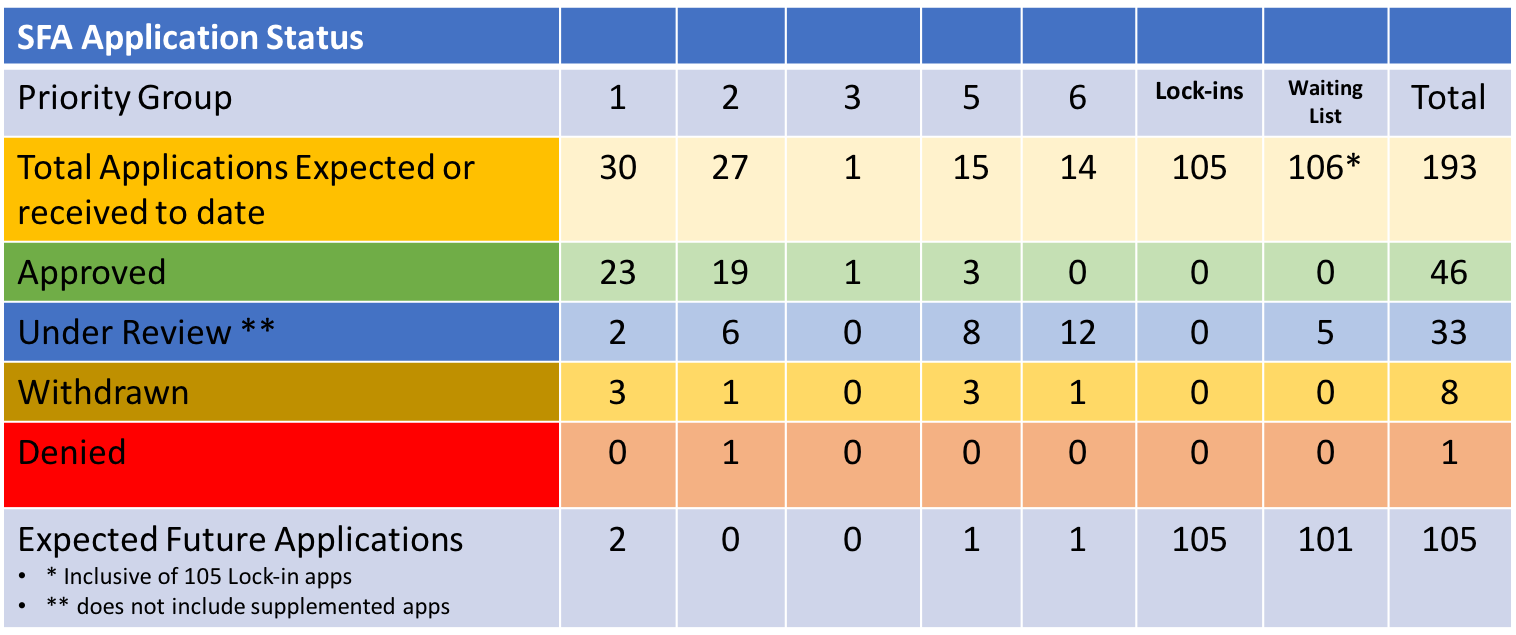
We are pleased to provide you with the latest update related to the ongoing implementation of ARPA’s pension legislation. As we’ve discussed in recent updates, we were in a quiet period as there was only 1 Priority Group 3 plans and no Priority Group 4 plans. However, relative calm is likely to end as Priority Group 5 plans will be permitted to submit initial applications beginning on November 15th. Despite the relative lull, there were two funds that submitted supplemental applications seeking additional Special Financial Assistance (SFA). Those two plans are the Freight Drivers and Helpers Local Union No. 557 Pension Plan and the Gastronomical Workers Union Local 610 and Metropolitan Hotel Association Pension Fund which are seeking  $12,383,121 and $2,065,531, respectively.

We are happy to report that the PBGC didn’t reject any current applications and no submissions were withdrawn. Finally, the Bricklayers and Allied Craftsmen Local 7 Pension Plan is the only fund with an approved application that is awaiting payment of the SFA. They are expected to receive just over $34 million in SFA. To date, the PBGC has doled out just about $7.8 billion in SFA proceeds.

SFA Application Status
Priority Group123456NoneTotal
Total Applications Expected30241N/A1514218302
Approved239000032
Under Review014100015
Withdrawn3000003
Denied0000000
Expected Future Applications4101514218252

* Total expected count is from PBGC’s Enrolled Actuary Meeting on May 2, 2022
Note: Chart details presented by Segal’s Jason Russell at the IFEBP annual conference in Las Vegas, NV

“I Don’t Get It”

By: Russ Kamp, Managing Director, Ryan ALM, Inc.

One of my favorite movies is “Big” starring Tom Hanks, John Heard, Elizabeth Perkins, and many others. You may recall that Tom Hanks is constantly challenging John Heard’s character (Paul) by stating “I don’t get it” whenever “Paul” is presenting an idea related to a new toy before senior management. As I reflect on last Thursday’s market activity, I feel very much like Tom Hanks’ character Josh. Sure, the CPI declined from 8.2% to 7.7% and Core inflation came in at 6.3%, which was below expectations, but the market’s reaction to this news would have had you believe that the Fed had accomplished its goal of driving inflation to 2%. I don’t get it! The rally in US Treasuries was nearly unprecedented. In fact, the move in the 5-year Treasury Note was the 6th greatest in the last few decades and the only one that didn’t involve central bank action.

The Federal Reserve has raised the Fed Funds Rate to a range of 3.75% to 4.00%. Given the stated objective to get to a point where there are “real rates”, the Fed will have to do more work. Based on yesterday’s inflation news, the probability of a 50bps increase in the FFR in December now stands at just over 80%. That is still a significant increase. Again, you would have thought that market participants had heard the Fed Governors proclaim that the “great pivot” was soon to begin. Yet, that is not what we heard. Dallas Fed President Lorie Logan said, “while I believe it may soon be appropriate to slow the pace of rate increases so we can better assess how financial and economic conditions are evolving, I also believe a slower pace should not be taken to represent easier policy.”

Former Treasury Secretary, Larry Summers, warned last month that “history indicates inflation will be slower to fall than Fed officials anticipate.” The concerted effort to rein inflation comes with the risk of driving the economy into a potential recession. However, based on the current strength in the US labor force and projections of strong 4th quarter GDP growth (Atlanta Fed’s GDPNow forecast of 4%), Fed action in 2022 has not shown much progress.

It was great to see markets rally, but the magnitude of the moves seems truly premature. We’ve seen myriad head fakes in 2022. This market action may prove to be just another in that series.

CFM – Interest Rate Neutral

By: Russ Kamp, Managing Director, Ryan ALM, Inc.

Yesterday, Ryan ALM was invited to participate in a “Lunch and Learn” event with a major asset/liability consulting firm. Our agenda was to provide education related to Cash Flow Matching (CFM), which this leading firm wasn’t actively using. It was a great opportunity for us, while hopefully opening some eyes as to the significant benefits of CFM. We received a lot of terrific questions from those in attendance, both in-person and virtually. One of the more important questions had to do with interest rate risk and the impact on CFM strategies in a rising rate environment. It was the perfect set-up question for our team and strategy.

Total return-focused fixed-income strategies are highly interest rate sensitive. These strategies have been beaten down significantly (BB Agg. -15.7% YTD through 10/31/22) in this current rising rate environment. Fortunately, CFM strategies are not interest rate sensitive. How’s that? The matching of asset cash flows (interest and principal) against liability cash flows focuses on their future values. A $5 million monthly benefit payment 10 years out is still $5 million no matter which way rates move. It is this characteristic, among other positive attributes, that makes this strategy so critically important to the success of managing a defined benefit pension plan.

It has been 40 years since we last had a prolonged bear market in bonds driven by changing monetary policy. In 2022, rates have risen dramatically across the Treasury yield curve and credit spreads have widened in the process. Both of these actions have been driven by Fed policy. Does anyone really know where future rates are going? Based on today’s market action you’d come to the conclusion that the US Federal Reserve has accomplished its objective. Have they? Core inflation remains elevated at 6.3% annually. The CPI is still at decades-high levels at 7.7%. Sure, the trend may be indicating some downward action on inflation, but with a Fed Fund’s rate at 4%, have they elevated rates significantly enough to tamp inflation to the Fed’s 2% target and a market with real rates?

Wouldn’t you want to use a strategy that doesn’t care where interest rates go? Wouldn’t it be comforting to know that asset cash flows are matched almost precisely with liability cash flows for some defined period of time? That this relationship doesn’t change if rates rise or fall? Wouldn’t it also be incredibly helpful to have bought time (considerable time?) for your plan’s growth/alpha assets to grow unencumbered? Oh, and by the way, CFM portfolios that utilize investment-grade corporate bonds are producing yields in the 6% range.

CFM strategies are the perfect “sleep well at night” offering, especially at the current level of rates. Unfortunately, duration-matching LDI strategies that used leverage were the impetus behind the near collapse of the UK’s pension system. Those strategies engaged in SWAPs are highly interest rate sensitive. That risk may have been acceptable during the last 40 years of accommodative Fed policy, but we are in a different ball game at this time.

Don’t create an asset allocation structure that is highly dependent on the direction of rates. Bifurcate the plan’s assets into two buckets – liquidity and growth. Use CFM for the liquidity bucket and build a robust growth portfolio that is no longer a source of liquidity.  Let a CFM strategy fund Benefits and Expenses which will allow the alpha assets to grow unencumbered. There is absolutely no need for a cash sweep of income from the growth assets to fund B+E. Let that income be reinvested in potentially higher-returning strategies. 

Being able to sleep better at night shouldn’t be discounted!

ARPA Update as of November 4, 2022

By: Russ Kamp, Managing Director, Ryan ALM, Inc.

A trip to visit my daughter in Copenhagen, Denmark kept me away from providing an update last week. I would highly recommend that you visit that city/country if you can as it provided myriad positive experiences. As you will soon read, you didn’t miss much while I was out of the office galivanting.

To the update, according to the PBGC’s website, there were no new applications filed, but the Retirement Plan of Local 1482 – Paint and Allied Products Manufacturers Retirement Fund submitted a supplemental application for additional SFA. They received approval for the initial application in December 2021. Fortunately, there were no applications rejected or withdrawn during the last couple of weeks. Lastly, Freight Drivers and Helpers Local Union No. 557 Pension Plan received their SFA of $192.8 million on November 3rd.

As we recently reported, Priority Group 5 plans, those funds that are projected to become insolvent before 3/11/2026, can begin filing an initial application starting on November 15th. It is estimated by the PBGC that 15 funds fall within this priority grouping.

SFA Application Status
Priority Group123456NoneTotal
Total Applications Expected30241N/A1514218302
Approved239000032
Under Review014100015
Withdrawn3000003
Denied0000000
Expected Future Applications4101514218252
update as of November 4, 2022

It will be interesting to see if the PBGC’s estimate of application filings (218) for pension funds that don’t fall into one of the 6 priority groupings comes to be. If so, we will have a lot of fun trying to stay on top of the comings and goings of that cluster of plans.

ARPA Update as of October 21, 2022

By: Russ Kamp, Managing Director, Ryan ALM, Inc.

Under the category of better late than never, I bring to you the ARPA update for multiemployer plans through last Friday evening. As regular readers of this blog know, I provide this update on Mondays. However, I, along with more than 5,000 of my closest multiemployer friends, was in Las Vegas for this year’s IFEBP Annual Conference. What an event! I think that it is important for multiemployer plan participants to know that there are many people who are fighting to protect and preserve your plans. I very much appreciated the opportunity to teach the investment class for the CAPPP program. I also had the chance to speak on Tuesday to the general audience.

But, I digress. With regard to the PBGC’s implementation of the ARPA legislation, there is little to update, as we seem to be in a quiet period. There were no new applications filed, no new applications approved or denied, and no applications withdrawn. There are still two plans, Local 557 and Sheet Metal Workers Local Pension Plan, that are awaiting payment of their SFA. I believe that as a result of this inactivity, the PBGC has announced that Priority Group 5 plans, those plans projected to become insolvent before March 11, 2026, will become eligible to file the initial application seeking Special Financial Assistance beginning November 15, 2022.

Given all the activity to date, it can become confusing as to where everything stands in terms of applications filed, approved, and SFA paid. Here is a scorecard of where everything stands as of today.

SFA Application Status
Priority Group123456NoneTotal
Total Applications Expected30241N/A1514218302
Approved239000032
Under Review014100015
Withdrawn3000003
Denied0000000
Expected Future Applications4101514218252
SFA Status as of October 27, 2002

The information above was presented by the PBGC at the Enrolled Actuary Meeting on May 2, 2022. The chart details were presented by Jason Russell, Segal, at the IFEBP Annual Conference in Las Vegas, NV.

The 300+ potential ARPA participants represent about 15% of the active multiemployer pension plan universe.

Cash Flow Matching =/= The UK Pensions Crisis

By: Russ Kamp, Managing Director, Ryan ALM, Inc.

I just returned from attending the IFEBP Annual Conference in Las Vegas, NV. First, it was great to have the IFEBP attendance back to pre-Covid-19 levels. There had to be more than 5,000 attendees. Congrats to the IFEBP for continuing to provide quality education to both the multiemployer and public pension trustees, administrators, and a host of other essential personnel.

I am always thankful for the opportunity to speak/teach at these events. During one of my sessions titled “Public Plan Investment Return Assumptions”, I was asked a question related to the UK and Cash Flow Matching and if the former was caused by the latter. Simply, the answer is NO. I did share that Cash Flow Matching (CFM) is but one arrow in the LDI quiver, but that it was a strategy known as duration matching and specifically duration matching using derivatives and leverage that nearly brought the UK’s pension industry to its collective knees.

As we’ve previously reported, leverage among UK pension plans was in far greater use than what we witnessed in the US. It was highlighted in numerous articles that plans were leveraged up to 7X. Duration strategies are primarily used within private corporate pension plans and levered exposure is used much more in the UK. As a reminder, duration strategies are trying to minimize (neutralize) interest rate movements between a plan’s assets and the plan’s liabilities. In duration-matching strategies, longer-dated bonds (primarily Treasury STRIPS) are used to accomplish this objective since the longest duration coupon bond is around 16 years. Key rate durations may also be used as a string or ladder of duration targets.

With regard to cash flow matching, corporate bond cash flows of principal and interest are optimized to match the plan’s liability cash flows chronologically. This strategy dramatically improves a pension plan’s liquidity to meet those monthly payments without having to force liquidity in asset classes that might not possess the necessary liquidity at that time. Furthermore, with cash flow matching a plan gets duration matching. With duration matching, you are not getting the necessary liquidity to meet benefits and expenses. In addition to the enhanced liquidity, a pension plan is mitigating interest rate risk for that portion of the portfolio using CFM, as future value benefits are not interest rate sensitive. There are other benefits from CFM, including the “buying of time” for the remaining assets (growth) that can now grow unencumbered.

The question of CFM’s role in the UK pension debacle was a good one. I was extremely pleased to be able to answer that there was no role for CFM. I’m also pleased to mention that rising US interest rates are creating an incredibly positive environment for CFM in which we at Ryan ALM are constructing portfolios that produce yields right around 6%. For more information on CFM, duration, and their differences please visit Ryan ALM.com/insights/whitepapers or call us at 201/675-8797.

Where’s the Hedge and the Yacht?

By: Russ Kamp, Managing Director, Ryan ALM, Inc.

I believe that we have overcomplicated the management of DB pension plans. If the primary objective is to fund the promised benefits in a cost-efficient manner and with prudent risk, why do we continue to waste so much energy buying complicated products and strategies that often come with ridiculously high fees and little alpha?

Case in point, the HFRI Composite index reveals a -6.7% year-to-date (9/30/22) return. Worse, the 10- and 20-year compounded returns are 4.6% and 5.7%, respectively. We know that we didn’t get those “robust” returns at either an efficient cost or with prudent risk. What are these products hedging other than returns? Why do we continue to invest in this collection of overpriced and underperforming products? Are they sexy? Does that make them more appealing? Do we think that we are getting a magic elixir that will solve all of our funding issues?

Sadly, the story is even worse when you take a gander at the returns associated with the HFRI Hedge Fund of Funds Composite Index. I shouldn’t have been surprised by the weaker performance given the extra layer of fees. According to HFRI, YTD returns show a -7.2% return, while 10- and 20-year annualized returns fall to 3.4% and 3.5%, respectively. UGH! For those two time frames, the S&P 500 produced returns of 11.7% and 9.8% respectively, and for a few basis points in fees.

While pension systems struggle under growing contribution expenses and plan participants worry about the viability of the pension promise, the hedge fund gurus get to buy sports franchises because of the outrageous fees that are charged and the incredible sums of assets that have been thrown at them? I suspect that the standard fee is no longer 2% plus 20%, but the fees probably haven’t fallen too far from those levels. As Fred Schwed asked with his famous publication in 1952 titled, “Where are the Customers’ Yachts?”, I haven’t been able to find them. Unfortunately, I think that the picture below is more representative of what plan sponsors and the participants have gotten for their investment.

Participant’s yacht

Don’t you think that it is time to get back to pension basics? Let’s focus on funding the promised benefits through an enhanced liquidity strategy (cash flow matching) while allowing the remainder of the portfolio’s assets to enjoy the benefit of time to grow unencumbered. This bifurcated approach is superior to placing all of your eggs (assets) into a ROA bucket and hoping that the combination will create a return commensurate with what is needed to meet those current Retired Lives Benefit promises and all future benefits and expenses.

Worried About Retirement? You’re Not Alone!

By: Russ Kamp, Managing Director, Ryan ALM, Inc.

Anyone of us can quote statistics from various surveys highlighting the fact that retirement is getting out of reach for many Americans. The Mind over Money survey by Capital One and The Decision Lab is the most recent one that I read. Their findings are pretty dire with 77% of Americans feeling anxious about their finances, with 68% worried about saving enough for retirement. I can’t say that I blame them! In an environment of spiraling inflation and deteriorating market performance for traditional asset classes, why would we think that individuals would be feeling anything other than uneasy?

Despite the fact that the US labor market continues to show incredible strength, decades of low real earnings growth have crushed the average American worker. We are witnessing some nominal growth in earnings at this point, but real wage growth continues to evade us by about 3%. If Americans aren’t saving in this environment, where is their income being spent? Look no further than housing costs. As the chart below reflects, being able to buy or finance a home has gotten incredibly challenging if not nearly impossible!

The Mortgage-to-income level has more than doubled since roughly 2013 and it is twice what it was at the Pandemic low. Furthermore, this study used a 20% down payment in the calculations. How realistic is a down payment of this magnitude for young couples who in many cases are still (and will be for the foreseeable future) burdened with student loan debt? According to the National Association of Realtors (NAR), the average down payment in 2022 is 13%. For those aged 23-41, the down payment drops to between 8-10%. Given that we are looking at a down payment that is roughly half of what was used in this analysis, we can quickly determine that the financial burden to buy a home is far worse than what is being reported at 42% of one’s median disposable income.

Asking untrained individuals to fund, manage, and then disburse a retirement benefit through a defined contribution plan is poor policy. Expecting those same individuals to have any “discretionary” income after paying for housing, education, food, energy, and healthcare is unrealistic! We have a broken retirement industry. Let’s hope that rising US interest rates will encourage corporate plan sponsors to once again provide a true retirement benefit to their financially anxious and struggling employees.

Ryan ALM Newsletter for 3Q’22

By: Russ Kamp, Managing Director, Ryan ALM, Inc.

We are happy to share with you the Ryan ALM, Inc. Newsletter for 3Q’22. The newsletter highlights the challenges faced by the plan sponsor community in 2022, while also pointing out the inconsistencies among the accounting rules for both GASB and FASB. Given these significant differences, Corporate plan sponsors are feeling much better than those pension sponsors for public and multiemployer plans, as the present value of future benefit payments falls to a greater extent than pension assets. These differences will likely impact asset allocation decisions and contributions.

As always, we welcome your feedback on the newsletter and look forward to responding to any questions that you might have regarding our current environment. We’d be happy to share with you our ideas on how best to structure an asset allocation framework.

ARPA Update as of October 14, 2022

By: Russ Kamp, Managing Director, Ryan ALM, Inc.

I hope that you had a great week since our last update. It certainly seems as if the PBGC did, as there is nothing to report regarding activity for the week ending 10/14. NOTHING! There were no new, revised, or supplemental applications filed. There were no payments made on the two approved applications. Fortunately, there were no applications that were denied. There was no activity. Let’s chalk it up to the baseball playoffs, where there certainly has been quite a bit of excitement, especially for the underdogs!

Many of these pension plans fell prey to government regulation. They too have become underdogs! The ARPA legislation is finally helping to reverse some of the onerous impacts of decades of failed policy. Let’s hope that these underdogs can secure the promises that were made to their plan participants. They and their families are counting on it!