Dignified Retirement? What A Pipe Dream!

By: Russ Kamp, Managing Director, Ryan ALM, Inc.

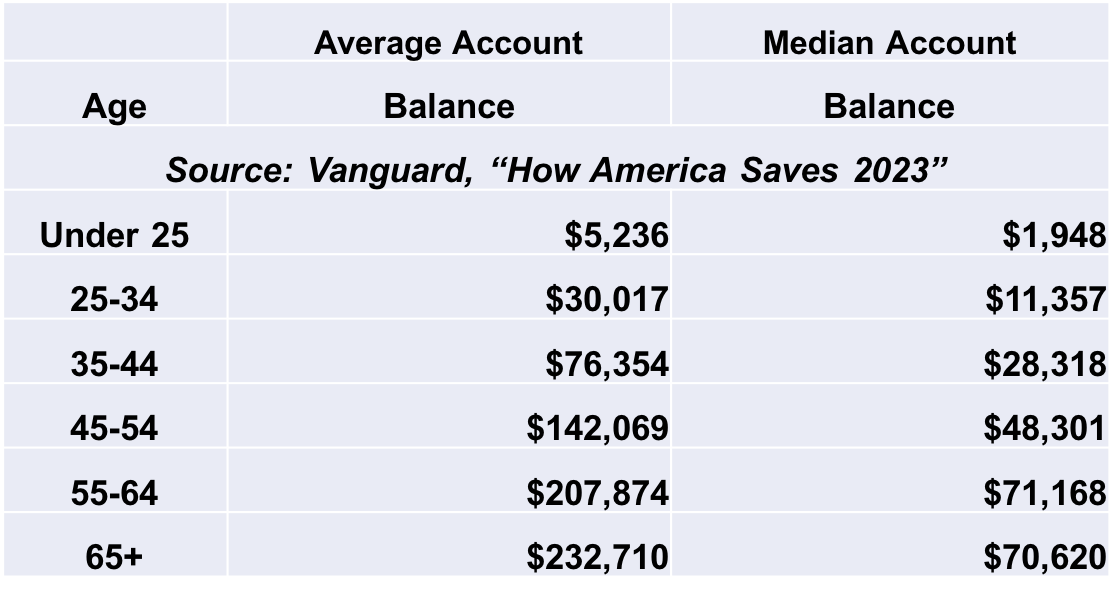
There has been much written during the last week about the current state of the US retirement industry. This follows testimony in Washington DC that highlighted many of the current issues related to retirement security or lack thereof. One of the statistics that grabbed my attention is the fact that >50% of Americans aged 65-years-old or older are “living” on <$30,000/year. That is as disheartening a fact as I’ve ever seen.

Where in the US can one afford to live on such a meager annual sum? Worse, without Social Security roughly 38% of the senior population would be living below the poverty line, that is currently (2024) defined by the Department of Health and Human services for all contiguous 48 states, Puerto Rico, the District of Columbia and all U.S. territories, at $15,060 (one-person household). It goes all the way up to a whopping $20,440 if you are fortunate to have a life partner living with you. Again, how can most live on this meager sum?

Social Security currently pays an average annual sum of just $21,384/year or just $1,782/month. Given that the average monthly housing rental is $1,372, that doesn’t leave one much for food, transportation, healthcare, insurance, or even TV viewing since everything these days is a pay-to-watch service, and that happens only after you’ve had to pay for the internet! One can almost forget about staying in their house, since property taxes continue to ratchet higher and higher, especially if you live almost anywhere on the East coast. For instance, the average property tax in NJ is now roughly $8,600/year with many communities seeing double and triple those rates.

This lack of income in retirement is forcing a larger percentage of those 65-years-old and up to seek employment in their “golden years”. According to AARP, some 20% of the Senior population is now gainfully employed. That figure was 10% in 1985. If you are fortunate to work in a white collar job, the opportunities are more plentiful. However, for those that have spent a lifetime engaged in more physical labor you can almost forget about participating during your sunset years.

I’ve written chapter and verse about the demise of defined benefit plans and the impact that trend was going to have on the average American worker. The use of DC plans in lieu of DB plans is poor policy. It isn’t working. The average American is not saving nearly enough to replace a meaningful portion of their income in retirement. This is and will continue to be a major source of concern as it has long-term implications for the states in which they reside. The social safety net that will be used to support these individuals with housing, medical, food, transportation, and other daily needs is already stretched. “A 2023 Pew Charitable Trusts study suggests that as more households with older Americans become financially vulnerable from 2021 to 2040, state governments will take a $1.3 trillion hit.” (Business Insider)

The retirement industry is in poor shape. Others will suggest that it isn’t, but the facts don’t lie. Too few Americans have access to a retirement account – there is not an age group that has participation at >60% – and for those that do, too many are not able to contribute a meaningful and appropriate sum. The lack of a crystal ball to help determine longevity and investment acumen combine to make managing one’s “retirement” more challenging. Please let’s stop pretending that it doesn’t.

ARPA Update as of March 1, 2024

By: Russ Kamp, Managing Director, Ryan ALM, Inc.

Welcome to March. It is said that the weather in the Northeast comes in like a lion and exits like a lamb. Is the same true for markets? Given a lot of the crosscurrents in the markets from geopolitical concerns, equity valuations, AI, interest rates, and Fed policy, who knows what is in store for us this month and beyond.

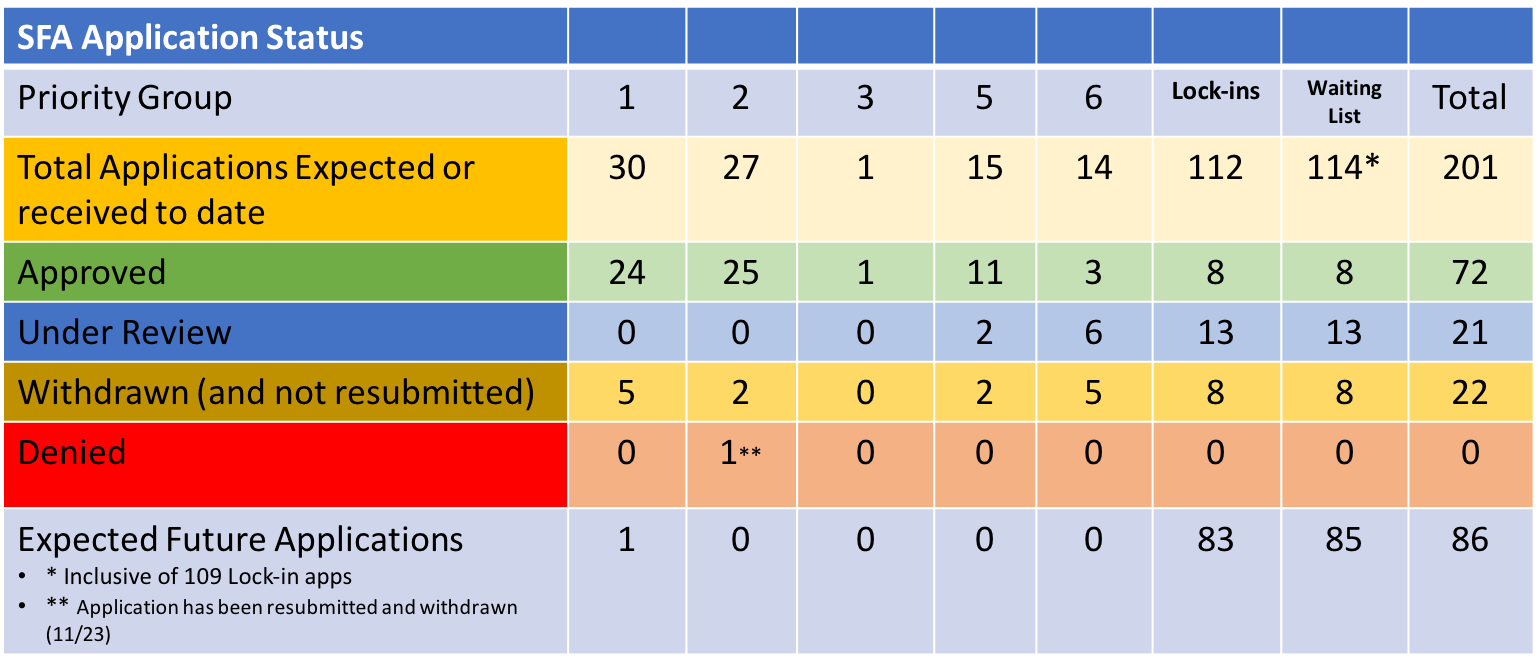
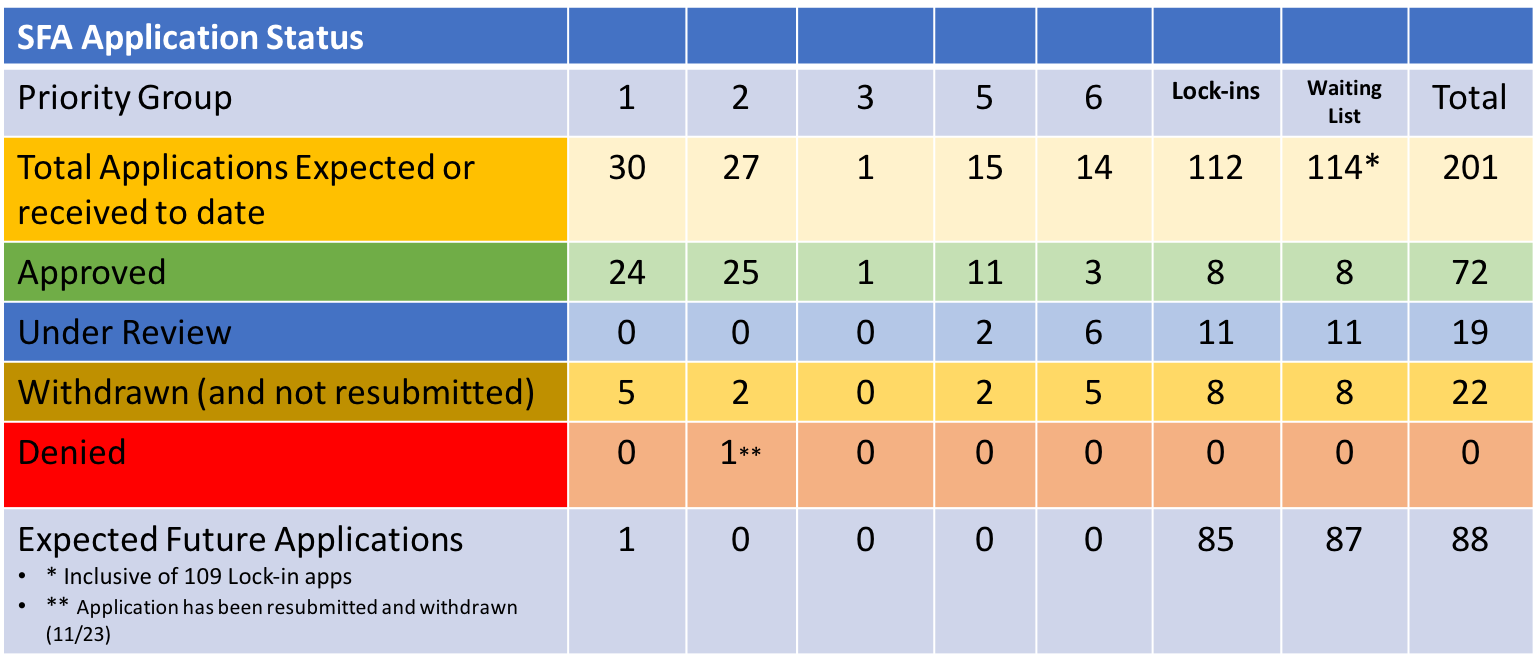
That said, we can with near certainty discuss what transpired during the last week as it relates to ARPA and the PBGC’s implementation of that critical legislation. I say with near certainty only because the weekly updated spreadsheet provided by the PBGC didn’t have a couple of actions from 2/23/24 that were only added in the March 1st update. Specifically, Union de Tronquistas de Puerto Rico Local 901 Pension Plan, a Priority Group 1 member, has once again withdrawn its application. They are seeking >$37 million for the 4,029 participants. In other delayed news, the American Federation of Musicians and Employers’ Pension Plan, a much larger fund and a Priority Group 6 member, has also withdrawn its revised application. They are in pursuit of an SFA grant that would provide the fund with $1.44 billion in SFA plus interest for more than 49k participants.

Now that we are caught up, this past week (ending 3/1/24) saw some activity, too. Two members from the waiting list entered their applications through the PBGC’s portal, including the Kansas Construction Trades Open End Pension Trust Fund and the Pacific Coast Shipyards Pension Plan. Both plans have submitted revised applications. Kansas Construction is seeking $40.7 million for its 8,145 participants, while the Shipyards plan is striving for $17.8 million for 507 participants, which is 35,108/participant compared to the roughly $5,000/participant for the Kansas plan.

In other ARPA news, there were no applications approved or denied during the previous week. There was one application withdrawn (2/26), but the Pacific Coast Shipyards quickly resubmitted the application by 3/1. In somewhat surprising news, there is a late arrival to the waitlist – # 113! Plasterers Local Union No. 1 Pension Plan joined the list on 2/26/24. They have also locked in the valuation date of November 30, 2023.

Have a great week. In the meantime, please don’t hesitate to reach out to us if we can be of any assistance to you as it relates to this legislation.

Sustainable?

By: Russ Kamp, Managing Director, Ryan ALM, Inc.

ESG, short for environmental, social, and governance, are considerations alongside financial investment insights used in investment decision making. ESG considerations have been around for a long time, and in most instances, they were prohibitions on the purchase of a particular investment. I recall early in my career a social issue not to invest in South Africa. This was followed by tobacco-free, sin stock-free, and many other imposed limitations on a variety of industries and sectors.

Today, the primary motivation in considering ESG factors is the idea of sustainability. What initiatives should a company take to ensure that their business will not only survive, but thrive, in the future. I’m not going to get into the politics surrounding ESG, but I do agree that sustainability should be a consideration in any investment. However, it shouldn’t be limited to the investment management community. Defined benefit pension plans should operate with the goal of being sustainable. I produced a post many years ago (01/2017) titled, “Perpetual Doesn’t Mean Sustainable in which I implored Pension America to rethink the approach to pension management.

Most, if not all, states, cities, and municipalities believe that they are perpetual, and they are correct, but it doesn’t mean that the funding of their public pension fund is sustainable, if the cost to administer the plan becomes onerous for the sponsoring entity. We’ve certainly witnessed the freezing of DB plans within the public sector, and it could continue to happen if changes aren’t adopted. I frequently rail about the traditional approach to asset allocation that has 100% of DB plan asset bases on a rollercoaster ride to reach an ROA target in which they ride markets up and then down only to basically stay in place from a funding standpoint – but contribution expenses certainly don’t!

If plans really want to become sustainable, and we certainly need them to be, they need to adopt as their primary objective the securing of the promises that have been given to their plan participants. Riding the rollercoaster in pursuit of a return objective has only ensured volatility of the funded ratio and contribution expenses. It hasn’t guaranteed success in meeting the objective, which is the securing of the benefits at a reasonable cost and with prudent risk. Why do plan sponsors continue to pursue a return objective and all the volatility surrounding that pursuit when there are strategies that can be used, for at least a portion, if not all, of the assets, that would bring certainty to the process of managing pension plans. A sustainable approach, I might add.

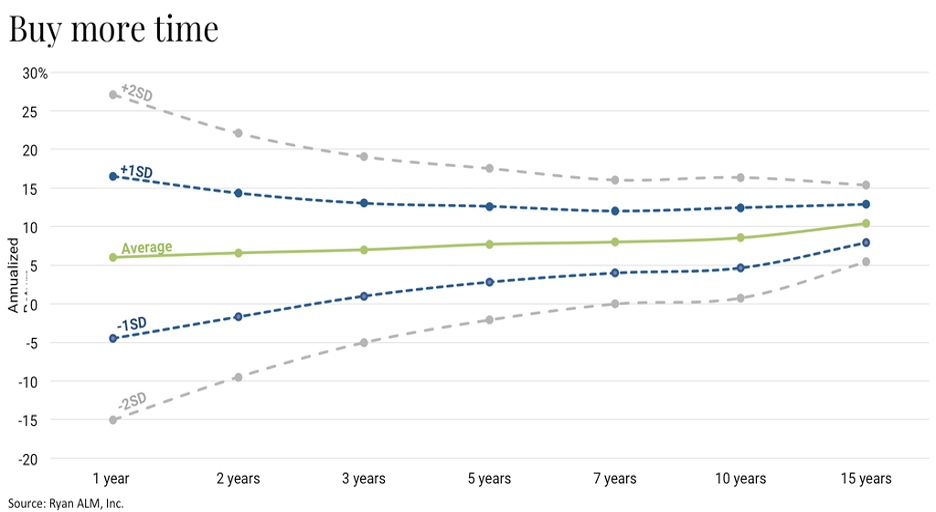
I read a post from a friend of mine yesterday (thanks, Chris), in which he showed a chart from BofA Research that looked at the price to normalized EPS for the S&P 500 over 10-year periods. BofA is forecasting a 3% per annum return for the 10-years ending 2034. Oh, wow! That isn’t going to help pension funding if it is anywhere close to reality. As the chart below suggests, the reality hasn’t been much different from the forecast.

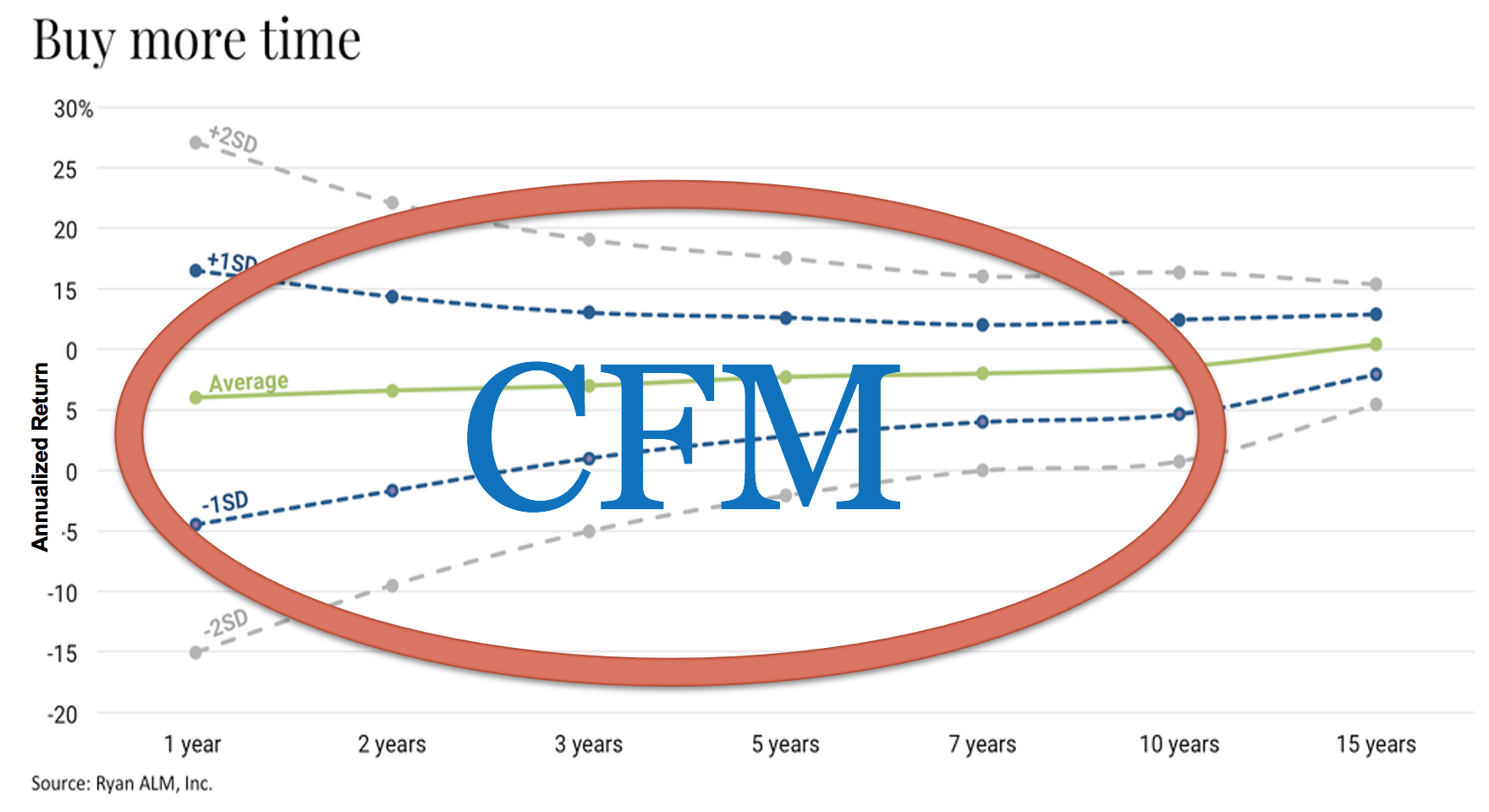
So, what can plan sponsors do to make up for the potential shortfall? There is some great news. If you desire a more attractive return than a potential 3% per annum for the S&P 500, with all of the corresponding annual volatility, you can reallocate your bond exposure from a ROA return focus to a cash flow matching (CFM) mandate that will fund and match the plan’s liability cash flows. By securing the liabilities chronologically, you buy time for the residual (alpha) assets to grow unencumbered as they are no longer a source of liquidity. Importantly, once you match the asset cash flows (interest and principal) with the benefits (and expenses) you mitigate interest rate risk, while working to stabilize the funded status and contribution expenses.

Bringing some certainty to a very uncertain process is the ultimate in sustainability. Given how challenging many American workers are finding the management of a defined contribution offering, protecting and preserving defined benefit plans should be in everyone’s best interest.

Willingness and Ability to Customize

By: Russ Kamp, Managing Director, Ryan ALM, Inc.

Coalition Greenwich, a division of CRISIL, has released a report on the top trends in asset management for 2024. Among the categories discussed was the establishment of “Strategic Partnerships” among one’s clients. There were four categories in which 499 respondents to the survey were asked to rate from most influential when hiring an investment management organization to least influential. The categories included willingness to provide customization, fees, commitment to knowledge transfer, and finally brand recognition.

Not surprising, the willingness to provide customization achieved the top ranking in importance, with 72% indicating that it was either the most or very influential in the decision to bring on a manager and that product. We often read about a manager’s willingness to customize a solution, but what does that mean in reality? Ironically, Ron Ryan produced, just today, an article on the importance of creating custom liability indexes for LDI assignments. This was written primarily in response to a series of LDI-related research pieces that discussed “custom benchmarks” but used generic indexes.

In order to successfully implement an LDI strategy, especially one using Cash Flow Matching (CFM), the benchmark needs to be a custom solution that uses the client’s specific liabilities, as each pension plan has a unique set of liabilities, like snowflakes. The liabilities are future values that need to be priced at some discount rate(s) into present values (market values) similar to the plan’s assets. It is only then that an appropriate LDI strategy can be implemented.

Every client of Ryan ALM, Inc. gets a custom solution. There are no “off the shelf” products. Fees, which received the second highest ranking in importance, had 68% of the respondents rating this category as most or very influential. Despite the highly customized products, we at Ryan ALM, Inc. provide our services at low fees. We believe that the primary objective in managing a defined benefit plan is to SECURE the promised benefits at a reasonable cost and with prudent risk. Everything that we do as an investment firm is focused on that belief. Custom solutions and low fees – that doesn’t seem like the norm in our industry. We are proud to be different!

Public Pension Funded Ratio Dips in January – But Did It?

By: Russ Kamp, Managing Director, Ryan ALM, Inc.

Milliman has once again provided perspective on the “average” public pension system with the release of the Public Pension Funding Index (PPFI), which analyzes data from the nation’s 100 largest public defined benefit plans. January’s result has the Milliman 100 PPFI funded ratio declining slightly from 78.2% at the end of 2023 to 77.7% as of January 31, 2024.

They attribute the decline to flat investment gains (-$11 million in market value), -$9 in net negative cash flow, and a slight increase (?) in the value of plan liabilities resulting in a change in funding by $33 million. The current funding gap of the index constituents is now -$1.4 trillion. But is that really what took place in January? We know that pension liabilities are bond-like in nature and move up and down with changes in US interest rates. The US rate environment changed quite a bit in January as yields moved higher across the US Treasury yield curve. Unfortunately, because most public plans are using their return on asset assumption (roughly 7%) to discount the plan’s liabilities, changes in interest rates are not reflected in the calculation of a plan’s liabilities.

How meaningful can the difference in accounting rules be among corporate and public plans? Just take a look at the Ryan ALM Pension Monitor for calendar year 2022, and you’ll note that the difference was substantial. In fact, both types of pension plans investing in the same markets, with reasonably similar asset allocations, had starkly different outcomes (a 32.1% difference!) as a result of the accounting rules used. Furthermore, Milliman reported that corporate plans actually showed improved fund ratios in January as a result of the discount rate change on plan liabilities. “The PFI projected benefit obligation, or pension liabilities, decreased to $1.316 trillion at the end of January 2024 from $1.337 trillion at the end of December 2023. The change resulted from an increase of 14 basis points in the monthly discount rate, to 5.14% for January from 5.00% for December 2023.” (Milliman)

Ron Ryan wrote an incredibly insightful book titled, “The US Pension Crisis” in which he placed appropriate blame on the accounting rules and the differences in how pension liabilities are calculated between FASB (corporate) and GASB (public) methodologies. Why these differences exist is beyond me, especially when one also understands that there exists a third methodology (IASB) that uses an even more conservative standard to measure a plan’s liabilities. Managing a pension plan is not easy, especially when the true value of a pension plan’s liabilities is unknown.

So, January was good for Corporate America’s pension funding, but bad for Public pension plans. With US interest rates having risen sharply since March 2022, the value of plan liabilities is closer to reality, but there still exists a gap today. It would be wonderful if the actuarial profession could agree on one methodology so that we didn’t get conflicting outcomes on an ongoing basis.

83%!

By: Russ Kamp, Managing Director, Ryan ALM, Inc.

In a country as divided as ours, it is incredibly rare when one sees such unanimity as 83% of Americans believing that all workers should have access to a pension plan. This result is according to a recent study conducted by the National Institute on Retirement Security (NIRS). According to the survey, the American worker is not confident in the least that they will enjoy a dignified retirement given the current state of affairs.

According to NIRS, “Eighty-three percent of Americans say that all workers should have a pension so they can be independent and self-reliant in retirement, and more than three-fourths of Americans agree that those with pensions are more likely to have a secure retirement.” Imagine that, a super majority of American workers want access to a pension plan so that they can be independent and self-reliant! They aren’t looking for a handout from the federal government, but that is what they’ll be forced to incur should our retirement industry continue to fail our workers.

Furthermore, “79 percent of Americans agree there indeed is a retirement crisis, up from 67 percent in 2020More than half of Americans (55 percent) are concerned that they cannot achieve financial security in retirement.” Not shocking that a majority of Americans are concerned about achieving financial security. A good chunk of our working population doesn’t have access to an employee-sponsored plan and when they do, most workers can’t put in nearly enough to achieve the financial independence that they desire. These findings are detailed in a new report from the National Institute on Retirement Security (NIRS), Retirement Insecurity 2024: Americans’ Views of Retirement. The report findings are based upon a national survey of working age Americans conducted by Greenwald Research.

There is also great anxiousness involving the securing of Social Security. More than 90% of the respondents to the survey believe that securing SS needs to be a priority for the next administration. SS is a critical benefit that currently supports >67 million Americans. In many cases, SS is the only source of funds for older Americans. I am incredibly concerned about the lack of retirement progress in this country. DB plans need to be the backbone of any retirement system, as asking untrained individuals to fund, manage, and disburse a “benefit” is just poor policy.

I’m less concerned about our government’s ability to continue to fund SS given our fiat currency. I am concerned that those in Congress don’t necessarily understand our monetary system and will enact unnecessary changes in order to fix something that isn’t broken.

Defined benefit plans were once used effectively by corporate America to attract and retain talent. They were a tool to manage a workforce from the initial hire to retirement. By migrating from DB to DC plans, corporate America has lost that ability, as the American worker now goes up and down the elevator with their “retirement” benefit in their back pocket. There are investment strategies that can be deployed to reduce the volatility of the funded status and contribution expenses that worked against retaining DB plans. Will DB plan asset allocations finally take advantage of these investment ideas to get off the performance rollercoaster? I significant majority of Americans sure hope so!

ARPA Update as of February 23, 2024

By: Russ Kamp, Managing Director, Ryan ALM, Inc.

Good morning, and welcome to the last week of February. Wow, this month seems to have flown by.

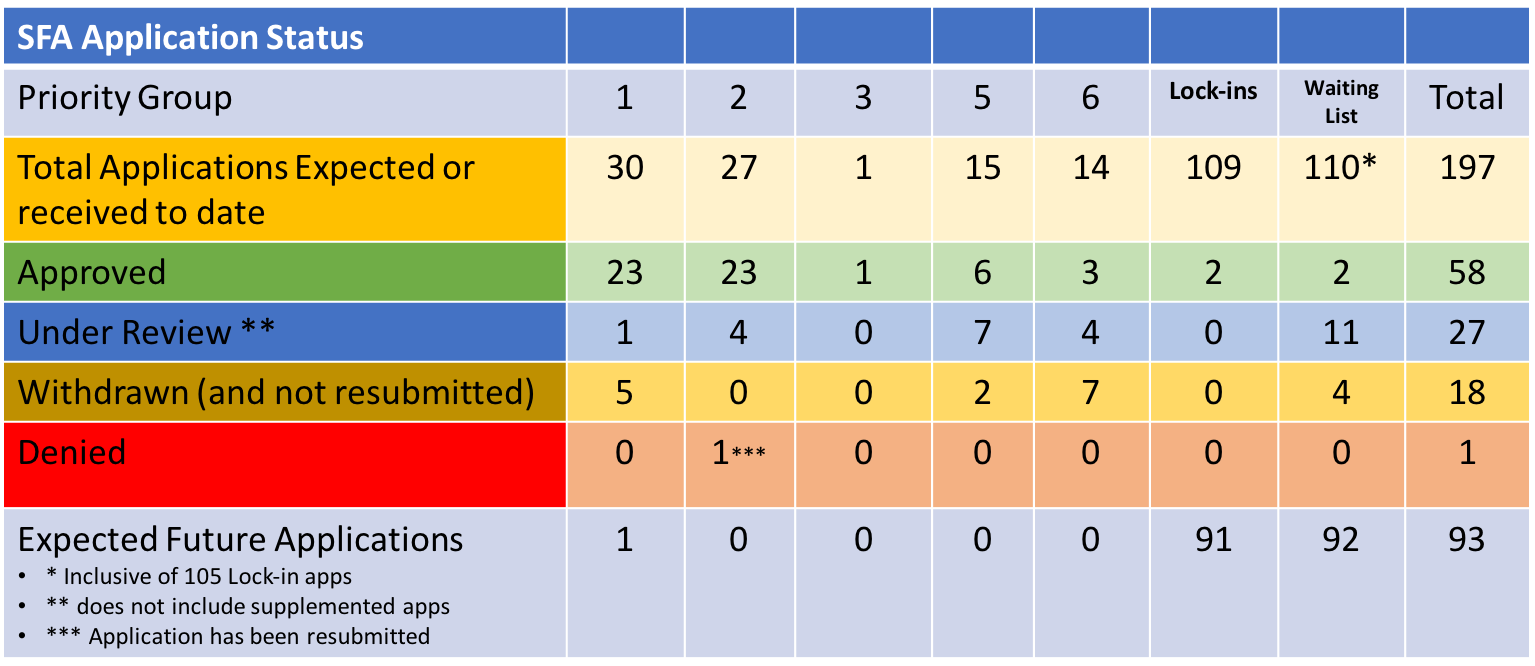
With regard to the PBGC’s implementation of the ARPA legislation, activity is picking up. There were five applications submitted through the PBGC’s portal. These included 3 Priority Group 6 members and two funds without a priority designation. The five funds are the Retail, Wholesale and Department Store International Union and Industry Pension Plan (the initial application), the Bakery and Confectionery Union and Industry International Pension Fund, United Food and Commercial Workers Unions and Employers Midwest Pension Plan, the Radio, Television and Recording Arts Pension Plan, and the GCIU-Employer Retirement Benefit Plan.

The five plans are seeking $5.5 billion in SFA for slightly more than 200k plan participants. The Bakery and Confectionery Union is seeking nearly 60% of the $5.5 billion in SFA grant money. The Bakery and Confectionery Union cooked up applications in March 2023, October 2023, and again in February 2024. Hopefully, they have the right recipe this time.

In other news, there were no applications approved, but the Laborers’ International Union of North America Local Union No. 1822 Pension Fund did receive the SFA payment of nearly $16 million for its 525 participants. Fortunately, there were no applications denied and none were withdrawn.

The US interest rate environment continues to be favorable for plans receiving SFA grants, as higher rates mean that the future benefit payments can be defeased at lower cost. Given the strength of the economy and labor force, it is less likely that the US will experience a recession keeping the current rate environment higher for longer.

Concepts in Advanced Asset Allocation

By: Russ Kamp, Managing Director, Ryan ALM, Inc.

I’ve been asked to speak to this topic on many occasions. In one such case, the IFEBP conference in October 2017, I returned to New Jersey and penned a post on the subject. In reviewing what I wrote that day and where we are today, I have to ask: What has changed? We are nearly 6 1/2 years removed from that event, but one needs to ask have pension asset allocations truly evolved.

For most plan sponsors and their consultants, the concept of “Advanced Asset Allocation” has to do with altering exposures to one asset class or style category (growth vs value) versus another. The adjustments often result in token shifts of 2-3% from one asset class to another. Is that really an advanced asset allocation discussion? Does the inclusion of private debt or equity really support the concept of a dramatic improvement in asset allocation, especially when one contemplates that these strategies come with higher fees, a lack of transparency, and poor (non-existent) liquidity? NO!

The problem with most asset allocation frameworks is that they focus attention on returns and not nearly enough on the benefit promise that has been given to the plan participant. With a focus on the return on asset assumption (ROA), volatility of the funded status and contribution expenses is assured, but the full funding of the plan is not, as we continue to ride the asset allocation rollercoaster up and down. Currently, the cars on that rollercoaster are making their way up, but who knows when the peak will be breeched and the cars will once again plummet, leading to further funding shortfalls and the need to get more aggressive with the return target and composition of the portfolio.

I don’t believe that approaches to pension asset allocations have changed much, especially among public pension systems. Sure, there have been moves among the asset classes, especially from public markets to private, but does that highlight an advancement? I suggest that it doesn’t. However, we have witnessed the markets change quite dramatically. We currently have a US interest rate environment that we haven’t experienced in two or more decades. In addition, we have a US equity market that is experiencing an “unprecedented” concentration in leadership (Tech) that is leading to persistent underperformance by active managers trying to eclipse the S&P 500’s return. Furthermore, we’ve had significant assets moving into private debt (>$3 T) at a time when higher rates may create problems for the companies trying to cover their interest expenses. Do you want to discuss real estate or private equity that have their own issues at this time? Does shifting marginally among these asset classes protect the funded status of the pension plans?

An advanced asset allocation framework would be one that gets the pension system off the performance rollercoaster. It is one that SECURES the promised benefits at both a reasonable cost and with prudent risk. It is one that stabilizes the funded status and contribution expenses. It is one that creates a liquidity profile that ensures that monthly benefit payments and expenses are met without having to liquidate assets, perhaps during periods of market disruption. Importantly, having an enhanced liquidity profile buys time for the remainder of the assets – presumably the fund’s alpha assets – to now grow unencumbered, as they are no longer funding monthly payments for several years or more.

Furthermore, an advanced asset allocation strategy understands that a pension plan’s liabilities need to be the focus of any asset allocation framework. Those liabilities need to be measured, monitored, and managed. A once per year, at best, review of the plan’s liabilities doesn’t accomplish the objective. Could you play a football game without knowing how many points your opponent has scored? Of course not! Then how can you manage a pension plan without knowing how the plan’s promises (liabilities) are behaving?

Having an advanced asset allocation that factors into the equation both liabilities and risk doesn’t mean that 100% of your assets have a new mandate. The funded status and the sponsoring entity’s ability to contribute will provide guidance on just what percentage of your assets will be impacted. There is no excuse for a plan with a 60% funded status to have the same asset allocation and ROA as one that is 90% funded. Yet, we see this all the time when both plans are striving for the same or similar ROA.

We, at Ryan ALM, Inc. understand and preach advanced asset allocation strategies. Our cash flow matching (CFM) capabilities become the backbone of the new asset allocation framework. CFM provides the necessary liquidity, while buying time for the alpha assets (non-bonds) to meet future liabilities. Our approach actually secures the promised benefits. This is a “sleep well at night” process that brings certainty to a very uncertain environment. We’d be happy to do a free analysis for you to highlight what can be done to truly create an advanced asset allocation framework.

Proof in the Pudding!

By: Russ Kamp, Managing Director, Ryan ALM, Inc.

The Milliman organization has just released its year-end “results of its Multiemployer Pension Funding Study (MPFS), which analyzes the funded status of all multiemployer defined benefit pension plans in the United States, based on data and assumptions from these plans’ latest Form 5500 filings.” The analysis covers 1,207 multiemployer plans. 

It is not surprising to see dramatic improvement in the aggregate funding of these plans given the strong performance of markets in 2023 and the continuation in providing Special Financial Assistance (SFA) grants under ARPA. How dramatic was the improved funding? According to the study, Milliman estimates that the aggregate funding is now at 89% up from 79% at the end of December 2022. As I report on a weekly basis, 70 multiemployer plans have now received more than $54 billion in SFA, with more than 120 plans still expecting to receive an SFA grant before the program ends in 2025. Without these grants, aggregate funding would fall to 83%. ARPA is proving to be such an incredible lifeline to these troubled plans and the participants that are counting on receiving their earned benefit.

According to the analysis by Milliman, 37% of the plans are at 100% funded or greater, while 78% have a funded status at or >80%. Given that there are still more than 100 pension systems expecting to file for SFA, it isn’t surprising that a small subset of multiemployer plans (9% are at <60%) are still struggling.

Just as we have suggested for those plans receiving SFA grants, we’d say the same thing to those plans with a funded status >100%. Now is NOT the time to take risk given so many cross-currents in the economy and markets. Multiemployer plans receiving the SFA can secure the promised benefits within the segregated bucket by using a cash flow matching (CFM) strategy to defease those promises as far into the future as the grant goes.

For those plans enjoying a fully funded status, bifurcate the plan’s assets into liquidity and growth buckets. The liquidity bucket will also be a defeased bond strategy that secures the promises as far into the future as the allocation goes. The remaining assets now have the benefit of an extended investing horizon. Should markets wobble once again, the growth assets will no longer be a source of liquidity to meet benefits and expenses, and as such, they can continue to grow unencumbered. Subjecting 100% of the assets to the performance rollercoaster created by traditional asset allocation strategies is not prudent.

It’s Different This Time! Is it Really?

By: Russ Kamp, Managing Director, Ryan ALM, Inc.

Having spent more than four decades in the investment pension/industry, I’ve seen more than enough cycles to know that history does repeat. The specifics of the trend/cycle may be different from one event to the next, but the outcomes are normally quite similar. Nothing in our industry stays at equilibrium. Valuations matter and they move from one extreme to another on a fairly continuous basis. We may be nearing a peak once again within the S&P 500’s sector weightings. I’m specifically referring to the weighting of the tech sector (information processing to be more precise).

Source: @liamdenning, @opinion

As the above graphs highlight, we are once again witnessing tremendous exposure within the S&P 500 to information processing. The last time that this sector’s weight eclipsed 30% of the index was just before the Tech bubble burst. Again, it is different. Companies within this sector have great businesses and actual earnings but do they have valuations that can justify the current stock prices? Perhaps we’ll find out more this afternoon when Nvidia announces their latest results.

In any case, it seems a bit shocking to me that Nvidia’s capitalization is now greater than that of the entire S&P 500 Energy sector. Furthermore, only Energy and Utilities have a forward P/E multiple that resides below the average for the last 25-years as reflected in this FactSet chart.

We are all taught the importance of buying low and selling high, but most of us get caught up in the excitement of today’s “story” failing to realize that momentum is created by cash flows moving into that theme and that they will eventually peak. It is at that time that Momentum as a factor can reverse quickly. Need we remind you that the NASDAQ 100 declined by 83% from its peak in March of 2000.

The S&P 500 was the place to invest last year. It wasn’t that great the year before (2022). Where will 2024 take us? I wish that I knew. I can tell you that these rollercoaster events are not good for a pension plans funded status or contribution expenses. Adopting a focus on the ROA and not securing the promised benefits has created an asset allocation framework that guarantees volatility, but not necessarily a successful outcome. Securing the pension promise (benefits) at a reasonable cost and with prudent risk does! Why continue to ride the asset allocation rollercoaster for all of the plan’s assets? Given the valuations highlighted above, there doesn’t seem to be a lot of “value” investing in the S&P 500 at this time. Remove some risk and create greater certainty by defeasing a portion of your plan’s liabilities. Not only will you secure those benefits, but you will extend the investing horizon for the remainder of the assets so that they can successfully wade through potentially choppy markets. It is a “win/win”.