
By: Russ Kamp, CEO, Ryan ALM, Inc.
Or did it?
Actuarial firm, Milliman, has released the results for its monthly Public Pension Funding Index (PPFI). As a reminder, the index studies the data from the nation’s 100 largest public DB pension plans. They reported that September was challenging because of aggregate investment returns for the constituents reveal a -1.4% return for the month. That loss equates to a $112 billion hit to the collective funded status. Total assets for the index now stand at $6.067 trillion down from $6.162 trillion as of August 31, 2026.
They estimated that pension liabilities grew to $6.944 trillion causing the aggregate funded ratio to fall from 89.0% to 87.4% at month end. The funding gap is now at $877 billion. Ryan Falls, co-author of the Milliman PPFI, stated that “September’s challenging markets caused another decline in assets and funded status for the 100 largest public pension plans,” but “nearly half of the plans remain more than 90% funded, and only 11 are below the 60% funding mark, illustrating the underlying health of public pension systems.”
This is where having two different accounting standards, GASB and FASB, for pension funding gets confusing. Under GASB (public plans), the discount rate for measuring liabilities is the plan’s ROA, while FASB requires liabilities to be valued at a blended AA corporate rate. We reported earlier this month that the funded status of the Milliman 100 PFI plans (corporates) ROSE by $19 billion during September on the back of a 47 basis points (bps) rise in the discount rate, which now stands at 6.47%.
Given the significant increase in Treasury yields for the month of September (see below), liability growth would have been significantly negative if FASB accounting had been used and liabilities were valued on a market basis. Since GASB uses a fixed growth rate for liabilities, the higher rates that would have lowered future liabilities were not acknowledged. It remains a very silly concept.
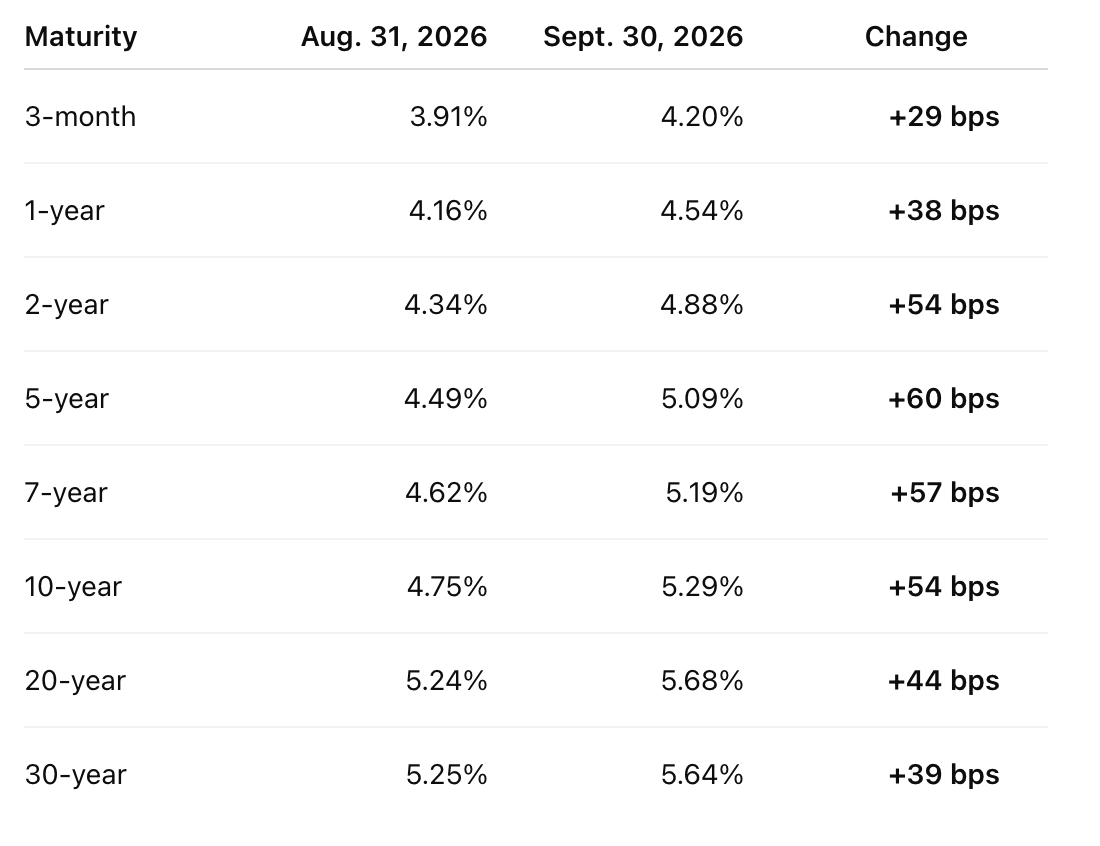
We’ve often reported that inappropriate decisions related to the management of DB pension plans can occur because of the conflicts created by these accounting differences. The pension industry needs to finally adopt one standard, and it should be market-based.


Russ:
Given the ROA-based “mis-valuation” of pension liabilities on the government side and their stated funding in the range of 42%, isn’t their true funded ratio closer to 25% (given the difference between an estimated 4% vs 7% discounting rate?) This makes the comparison about 85% funded (corporate) vs (25%) government.
This also shows the disparity between the slightly overfunded top 100 plans and the others.
Your thoughts? ________________________________