Ryan ALM Q1’22 Pension Monitor

We are pleased to share with you the Ryan ALM Q1’22 Pension Monitor. Despite the fact that pension assets had a challenging quarter, pension liabilities fell to a greater extent, as US interest rates rose rapidly in response to the US Federal Reserve’s intent to aggressively address the current inflationary environment. US corporate plans operating within a FASB construct appreciate this fact. Those plans – public and multiemployer pension systems – utilizing accounting methods under GASB are probably unaware that pension liabilities had substantial negative economic growth during the quarter, as they use the return on asset (ROA) assumption as the discount rate for their pension liabilities. Under this accounting framework, it appears that pension assets dramatically underperformed liability growth.

Given the significant differences produced by these two accounting methodologies, it is no wonder that inappropriate decisions with regard to contributions and benefits are made from time to time. An aggressive Fed may lead to significantly higher US interest rates. Will this action have a greater impact on pension assets or liabilities? Check-in with us at either ryanalm.com or kampconsultingblog.com to see how this story unfolds.

Not a Correlation of 1, But Certainly Strongly Positive

Bitcoin recently staged a strong recovery bringing the price back to nearly $47,000 after having tested the $32,000 level. Was this “recovery” driven by the currency’s own fundamentals or was it the result of the Nasdaq 100, which also enjoyed a strong rally in March? I’ve mentioned on several occasions that I believed that Bitcoin was trading more like a meme stock than an inflation hedge. Here’s a recent chart highlighting the correlation of Bitcoin with Nasdaq’s performance, which indicates an all-time high correlation of 0.695. I’m not surprised.

ARPA Update as of April 8, 2022

By: Russ Kamp, Managing Director, Ryan ALM, Inc.

The PBGC has provided its most recent update on the filing of SFA applications and approvals. Since August 2021, 36 multiemployer pension plans have filed for Special Financial Assistance (SFA) under ARPA. To date, 10 plans have received approval from the PBGC totaling $2.04 billion of which $1.1 billion has been paid. All of the pension plans that have filed their applications have been in either Priority Group 1 or Priority Group 2. Priority Group 3 plans (those >350,000 participants) were eligible to begin filing as of April 1st. Fortunately, none of the plans that have filed applications have had their potential award rejected.

Given the estimated $95 billion in potential cost assigned to this legislation, there is much activity remaining, as only 2.1% of the estimated cost of the legislation has been awarded to date. Recent 2022 market performance for assets may help plans that have yet to file. A lower starting asset base will enhance the potential grant award. Lastly, we are still awaiting word from the PBGC on their Final, Final Rules. It has been nearly 9 months since the PBGC announced its Interim Final Rules.

Ryan ALM, Inc. Q1’22 Newsletter

We are pleased to share with you the Ryan ALM, Inc. Newsletter for the first quarter of 2022. Despite a very rough start to the year for the capital markets, the present value of pension liabilities (based on an average 12-year duration) underperformed the “average” asset allocation, by roughly 4.4%. As a result, Pension America once again witnessed an improving funded status. For pension plans that use GASB for their accounting standard, this outperformance on the part of plan assets versus plan liabilities may be hidden from view.

It’s the Magnitude That Has My Attention

By: Russ Kamp, Managing Director, Ryan ALM, Inc.

The first quarter 2022 performance returns are rolling in and as we’ve been reporting they aren’t good. They aren’t good for equities, VC, BONDS, and likely other segments of our capital markets! With regard to fixed income, the Bloomberg Barclays Aggregate Index (formerly the Lehman Aggregate) posted its weakest quarter since 1980. In fact, the -5.9% return during the first three months is nearly twice as bad as any quarterly result since the bond bull market took hold in 1981’s third quarter. The Aggregate index has posted negative quarterly results in 19% of the 162 quarters since the fourth quarter of 1981, so a negative result isn’t rare by any stretch of the imagination. However, the largest negative quarterly result during that entire time was only -3.37% registered during Q1’21.

Given the US Federal Reserve’s recent comments regarding their singular focus on nipping inflation in the bud, this result may become a trend. For comparative purposes, there have not been more than two consecutive quarterly losses in the last 40+ years. Will the likelihood of 6 more Fed rate increases to come lead to a string of negative results? Are pension sponsors prepared for this potential event? Remember: what might be quite negative for pension assets may in fact be beneficial from a pension liability perspective. Are you monitoring your plan’s liabilities regularly in order to carefully match pension assets with those liabilities? Call us. We will show you how it is done.

You Should Believe the Fed

I penned the original post on 3/17. Why did it take this long for investors to realize that the Fed wasn’t kidding? US interest rates, particularly on the backend of the curve, have moved massively over the last two days. This move up in rates is far from done. The impact on our capital markets is just being felt. The first quarter for bonds was the worst one we’ve experienced since 1981. Total return bond programs will continue to get hurt. It is time to do something different or Pension America will suffer severe consequences.

Pushing the Envelope

By: Russ Kamp, Managing Director, Ryan ALM, Inc.

We’ve written about the asset allocation rollercoaster to uncertainty (ruin) and discussed the massive shift away from bonds toward riskier, less liquid assets that has transpired during the last 4+ decades and questioned frequently whether these moves have paid off for Pension America. We do know that contribution costs have risen and the volatility of returns has increased but we don’t truly know if the absolute returns generated have warranted this action.

While most of Pension America believes that the goal of a pension system is to achieve a return on asset target (ROA), we remain steadfast in believing that the primary goal must be the securing of the promised benefits in a cost-efficient manner and with prudent risk. Migrating a ton of assets into the alternative bucket certainly doesn’t meet the “in a cost-efficient and with prudent risk” smell test, let alone the securing of the promised benefits. The last decade of S&P 500 performance, which has been terrific, has likely masked some of what has been going on within alternatives, but the first quarter of 2022 is about to deliver a kidney punch the likes we haven’t felt in roughly 20 years.

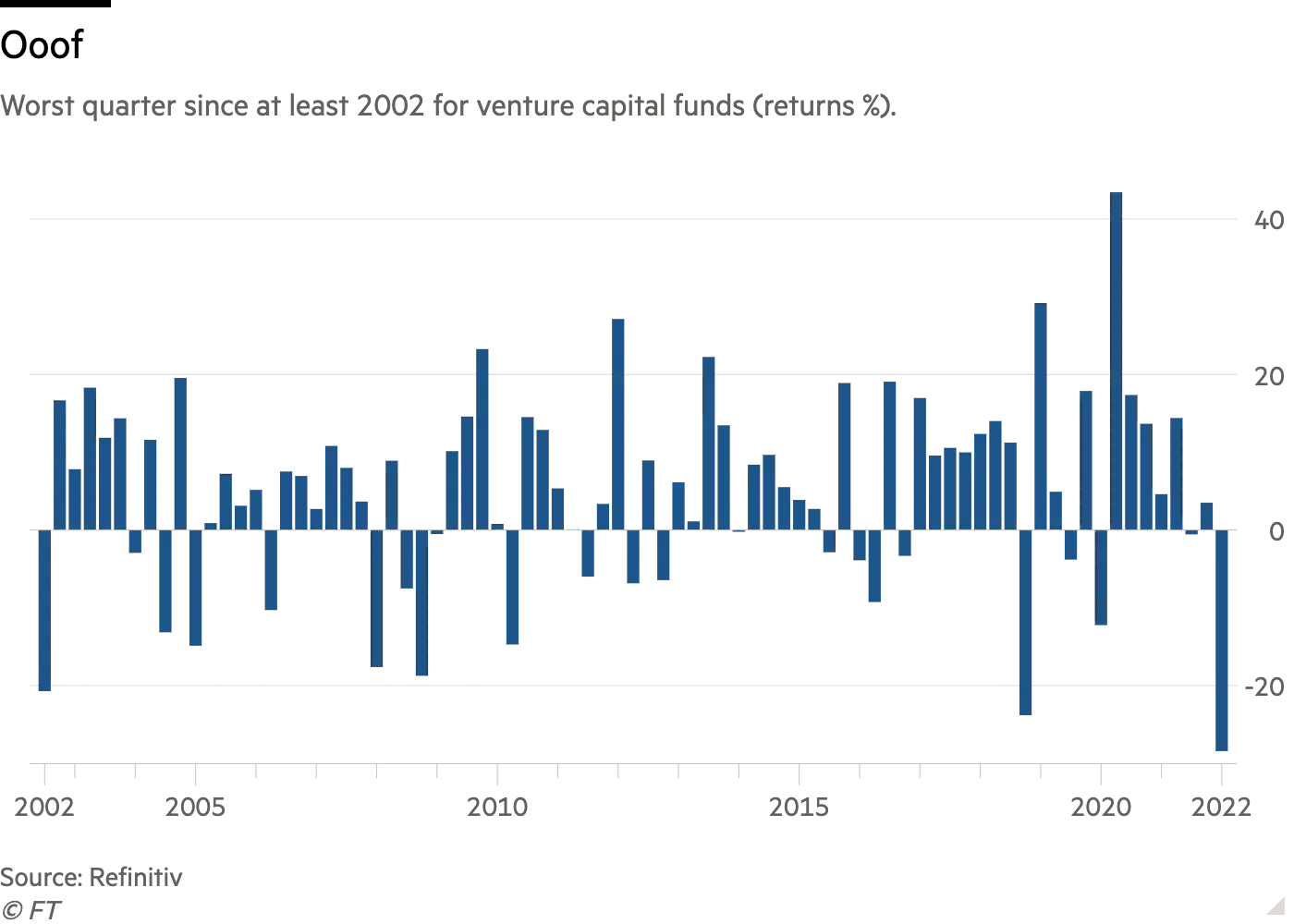
The FT has published the following chart that was produced by Refinitiv.

Ooof is such a great word to describe what has just transpired. Most followers of the markets knew that Q1’22 was challenging for public equity markets, especially growth-oriented stocks, and of course bonds, as the Federal Reserve finally got serious about addressing our runaway inflation, but who really knew what was going on under the radar of private markets? I certainly didn’t. The first quarter return for Venture Capital (VC) is atrocious. Furthermore, according to the FT “at the end of last year, 70 percent of so-called growth investors — in between early-stage venture capital funds and private equity investors that target mature companies — said they expected valuations to hold steady or rise, according to a survey of the top 25 investors in the field by Numis. Now, 95 percent of investors anticipate offering lower valuations in the coming 12 months — an abrupt shift for the fastest-growing corner of the private capital industry.” Lower than what has already been witnessed? WOW!

We’ve been encouraging plan sponsors to adopt a bi-furcated asset allocation (liquidity and growth buckets) for this very reason. Most alternative investments need time in order to meet their long-term expectations, but at the same time plan sponsors need liquidity to meet the monthly benefits and expenses. Separating the plan’s assets into two buckets improves the plan’s liquidity to meet the Retired Lives Liability, while the growth portfolio generates the necessary return to meet the plan’s future liabilities. Putting too many eggs in the growth portfolio without addressing the plan’s need for liquidity could exacerbate any downward price movements for assets during periods of dislocation.

Rising interest rates, outsized inflation, stretched valuations, supply chain disruptions, and a war whose outcome is far from known is not a great combination for the asset side of the pension ledger. Now is the time to pay much more attention to the plan’s liabilities. Measure, monitor, and manage plan liabilities with the aim of SECURING them, and your plan’s economic future is more certain.

It Has the Potential, but it Isn’t All Bad News!

By: Russ Kamp, Managing Director, Ryan ALM, Inc.

“The Lost Decade”, a phrase originally used to describe Japan’s economic performance during the 1990s, has been recently showing up in story after story in the financial press. In fact, Stifel’s chief equity strategist, Barry Bannister, has said that investors should prepare for the likelihood of a lost decade ahead with returns of 0% in the US stock market from the end of 2021 through the end of 2031. This of course follows a decade when the S&P 500’s compounded annual rate of return was more than 13% during the 2010s. We’ve had a number of booms and busts for decades which isn’t surprising given that regression to the mean tendencies is very prevalent in our markets.

Furthermore, with the prospect of an aggressive US Federal Reserve raising interest rates to combat the current unrelenting inflation you have the potential to have the US bond market possibly generating similar results as those predicted by Bannister for US stocks. Given the focus of Pension America on the return on asset assumption (ROA), you have a formula for disaster when two major asset classes each have the possibility of generating annualized returns below long-term expectations. In addition, a rising rate environment has the potential to harm the US real estate market which has seen housing and rental costs soar since 2018.

Given this potential scenario, are pension plans soon to witness funded ratios that plummet, and contribution expenses accelerate upwards? Quite possibly. Is there anything that can be done to mitigate these potential outcomes? Sure! First, let us share some possibly good news. Given the US accounting rules (GASB) that permit plan sponsors (and their actuaries) to use the plan’s ROA as the liability discount rate, changes in the economic or market present value of a public pension plan’s future liabilities are hidden from view. The 39-year bull market in bonds that may have recently come to an end crushed pension funding, as liability growth far outpaced asset growth during that timeframe. If we are to experience a rising rate environment, the economic or market present value of those future promises will fall. Given the average duration of pension liabilities of roughly 12 years and you have the potential for “returns or growth rate” to be quite negative for pension liabilities. 

In a rising rate environment that has the economic present value of future liability payments falling, asset growth doesn’t have to achieve the ROA. For every 1% rise in US rates, the impact on the average pension plan (with a 12-year duration) would have liability economic growth fall 12% before the yield is added back in. A zero percent return on the plan’s total asset portfolio would look amazingly good relative to negative liability economic growth. However, this potential scenario doesn’t mean that plan sponsors should do nothing. In fact, restructuring one’s asset allocation in anticipation of a potential lost decade is a must. We highly recommend bifurcating the plan’s assets into liquidity (beta) and growth (alpha) buckets. 

The liquidity bucket is going to be the plan’s bond exposure. In a rising rate environment, traditional return-focused bond programs with long maturities are going to get hurt. Convert return-seeking fixed income into a cash flow matching strategy that uses bonds for their cash flow generating capability (both principal, income, and cash flow reinvestments). These asset cash flows should be optimized to match and fund the plan’s liability cash flows. Importantly, this strategy will eliminate interest rate risk (since it is matching liability future values) for that portion of the portfolio that is optimized. Once that step has been completed, your pension plan’s alpha bucket will enjoy an investing horizon that has been extended. 

This buying of time is an important investment tenet. Allowing the alpha bucket (non-bonds) to grow unencumbered is critical, as market performance may be quite choppy as we look 10-years out. One doesn’t want to force liquidity where it may not naturally exist, especially given that America’s public pension systems have moved significant assets into private markets during the last couple of decades. This strategy is like a bridge over troubled waters. We witnessed very challenging equity markets during the first decade of this century. Unfortunately, the equity market declines were coupled with a significant fall in US interest rates. This combination proved to be crushing for Pension America’s funded status. Perhaps our pension systems will suffer less of a hit in this next environment if rates rise substantially and liability growth falls. Don’t close your eyes to this potential reality. Measure, monitor, and manage your plan’s liabilities much more frequently than the current practice of seeing those promises only once per year, at most.

Misleading Indicators

By: Ronald J. Ryan, CFA, CEO, Ryan ALM, Inc.

The Commerce Department reports with some glee that sales and income figures show an easing up of the rate at which business is easing off, which is taken as proof that there is a slow down as well as a noticeable slowing up of a slowdown.


In order to clarify the cautious terminology of the experts, it should be noted that a slowing up of the slowdown is not as good as an upturn in the down curve, but it is a good deal better than either a speedup of the slowdown or a deepening of the down curve, and it does suggest that the climate is about right for an adjustment to the readjustment.

Turning to unemployment, we find a definite decrease in the rate of increase, which clearly shows that there is a letting up of the letdown. Of course, if the slowdown should speed up, the decrease in the rate of increase of unemployment would turn into an increase in the rate of decrease of unemployment. In other words, the deceleration would be accelerated.

But the indicators suggest a leveling off, referred to on Wall Street as a bumping along rock bottom. This will be followed by a gentle pickup, then a faster pickup, a slowdown of the pickup, and finally a leveling off again.

It is hard to tell before the slowdown is completed, whether a particular pickup is going to be fast. At any rate, the climate is right for a pickup this season, especially if you are about twenty-five, unmarried, and driving a red convertible.

It’s April 1… don’t be fooled!

ARPA Update as of 3/31/22

By: Russ Kamp, Managing Director, Ryan ALM, Inc.

I’m pleased to report that the PBGC yesterday announced that another pension system’s SFA application has been approved. Teamsters Local 641 Pension Plan, which originally filed for the SFA on September 9, 2021, only to have to withdraw and resubmit another application on December 1st, will receive $503.9 million. The plan, based in Union, New Jersey, covers 3,610 participants in the transportation industry.

According to the PBGC’s press release, “Local 641 Plan became insolvent in March 2021. At that time, PBGC started providing financial assistance to the plan. As required by law, the Local 641 Plan reduced participants’ benefits to the PBGC guarantee levels, which was roughly 55 percent (my emphasis) below the benefits payable under the terms of the plan. PBGC’s approval of the SFA application enables the plan to restore all benefit reductions caused by the plan’s insolvency and to make payments to retirees to cover prior benefit reductions.” This development is sure to put a smile on the faces of the 3,610 participants who have been forced to “live” with a benefit that was roughly half of that with which they were entitled.

In other SFA news, there have been NO additional applications filed since March 16th, only two applications were filed last month, and only three have been submitted since January. That pace is comparable to the number of plans that have received SFA approval from the PBGC which stands at three since January 24th. At this point, not all of the eligible Priority Group 1 and 2 plans have filed the SFA application. Priority Group 3 plans (plans with >350,000 participants) are eligible beginning today (4/1) and that’s no April Fool’s joke. Perhaps we’ll get the Final, Final Rules from the PBGC before Priority Group 4 candidates are slated to file beginning on 7/1/22.