The Difference between Ryan ALM and Ryan Labs

Founder Ronald J. Ryan explains: In answer to several requests and obvious confusion, I would like to clarify the difference between Ryan ALM, Inc. and Ryan Labs, Inc.

I was the Director of Fixed Income Research and Strategy at Lehman Bros. from 1977 thru 1982. There I designed the popular Lehman bond indexes, which became the industry benchmarks (and still are as Bloomberg Barclay indexes). In 1983, I started my first company Ryan Financial Strategy Group (RFSG) to continue doing fixed income research and helping investment advisors understand the Lehman indexes and bond math. We created an on-line research system called The Knowledge Network which analyzed the bond market thoroughly. RFSG was sold to Sanwa Bank in 1987.

In 1988 I founded Ryan Labs as a fixed income investment advisor specializing in bond index fund management. We did quite well and when I left in 2004, we had nearly $19 billion in fixed income assets under management. Ryan Labs was dear to my heart but overtime I knew that my future was in asset liability management. I strongly believe that the true objective of a pension is asset cash flows versus liability cash flows. Given our great success I knew it would be difficult and not fair to our investors to change the focus of our firm.

So, I left Ryan Labs and started on June 15, 2004 Ryan ALM, Inc. which as the name implies is dedicated to asset liability management (ALM). Our mission is to fund liabilities and secure benefits in a cost-efficient manner. We have built a series of innovative products to become a turnkey system to best achieve the true client liability objective. Our Liability Beta Portfolio (LBP) is a cost optimization model that will cash flow match liabilities at low cost and low risk. Our Custom Liability Index (CLI) will calculate all of the data needed for the LBP to work effectively. The CLI is truly the proper benchmark for any liability objective. The Ryan ALM web site is full of our topical research and newsletters to better explain how we solve many of the issues facing pensions and endowments & foundations today.

Sincerely,

Ronald J. Ryan, CFA    

WHY TIPS? They Don’t Hedge Pension Inflation!

Ryan ALM has written a lot on the subject of pension inflation and why it doesn’t make sense to have an allocation to TIPS in your pension plan since they don’t hedge pension inflation. Our extensive research on this subject can be found at Ryan ALM.com. That said, I wanted to highlight why in this environment it makes absolutely no sense to have an allocation to TIPS. Presently, TIPS at all maturities are offering a negative yield. For the 30-year maturity the yield is -0.36%. So, a plan is paying to own these bonds, as opposed to owning an investment grade corporate credit (BBB) that would pay roughly 3.11%, which is based on our universe of BBB bonds with maturities between 28-30 years.

Steve DeVito, Ryan ALM’s Head Trader, stated “it’s a gamble that inflation will rise significantly enough to provide a positive yield.” Furthermore, “after X number of years earning a negative yield how big of a positive yield and for how many years will an investor need to make up for lost income and do better than just breakeven?” Good question, Steve!

We’ve written a lot on the subject of maximizing the efficiency of the plan’s asset allocation. In all honesty, there is nothing efficient in allocating <3% to any strategy and thinking that it will provide value-added to 100% of a pension plan. In the case of TIPS, a <3% allocation is just creating opportunity cost, while becoming a drag on achieving the ROA or any other goal for that matter.

2020 – The Year Of The Long-bond – Again!

It won’t come as a surprise to many pension investors that Bonds have enjoyed an historic run. In fact, for most of my career, which now spans 39+ years, bonds have enjoyed a significant tailwind of falling interest rates. Unfortunately, this tremendous bull market run coincided with a significant decline in exposure to fixed income within both public and multiemployer pension plans, while corporate plans have increased their exposure as de-risking strategies ramped up. What may come as a surprise is the fact that 2020 has once again proven to be the year of the bond, not James, but the long bond and specifically, 30-year STRIPS.

Ron Ryan and his team were the first to create a U.S. Treasury yield curve index series back in 1983. When STRIPS were born in 1985, the Ryan team were again the first to create a U.S. Treasury STRIPS yield curve index series. According to our analysis at Ryan ALM, the U.S. 30-year Treasury auction index and the 30-year Treasury STRIPS index both outperformed the S&P 500 for calendar year 2020. The Treasury 30-year index gained 19.7% and 30-year STRIPS index was up 25.4% versus the S&P 500 at 18.4%. The return for the S&P 500 was quite impressive given the significant market correction experienced during the first quarter, but it once again paled in comparison to long-bonds.

Do you think that this was a one-off result? Hardly. For the 20-year period ending December 31, 2020, the 30-year Treasury index outperformed the S&P 500 by 0.7% / annum (8.0% vs. 7.3%). Given the historically low level of interest rates, long bonds may not continue to be the performance drivers that they have been historically. But we believe that the intrinsic value in bonds is the certainty of their cash flow. We highly recommend bonds as the “core portfolio” to cash flow match liabilities chronologically. In addition, equities may be overvalued given the historic high P/E multiples that they currently carry.

Most defined benefit pension plans are in significant negative cash flow situations in which benefit payments dwarf contributions. These mature plans need liquidity and forcing liquidity to meet those monthly payments may result in a pension plan trying to raise liquidity through the sale of equities and other performance assets. As a solution, a cash flow driven investing (CDI) bond strategy is just the right prescription for your liquidity needs that will buy time for your performance assets to grow unencumbered. Please don’t hesitate to reach out to us to learn more about improving liquidity in your plan

CDI: Growing Momentum, But Confusion still Reigns

There recently appeared on the Global Banking and Finance Review website an article on cash flow-driven investing (YES!), titled “How Can DB pension Schemes Make Effective use of Cashflow-driven investing?” The article summarized a whitepaper from CAMRADATA based on insights shared by industry experts that attended a virtual conference in October.

Sean Thompson, Managing Director, CAMRADATA said, “Cashflow Driven Investing (CDI) is predominantly a bond-focused approach which can be used to try and generate cashflows and increase returns. It can also help reduce funding volatility.” We agree with most of what Mr. Thompson shared. Where we differ relates to his comment about “increase returns.” CDI is all about generating cash flows used to match pension liability payments. A plan sponsor engages in this activity to secure the promised benefit while reducing the funding volatility. The use of CDI should not be driven by the hope of enhanced returns.

In addition to Mr. Thompson’s thoughts expressed above, other key takeaways are listed below. I’ve included the Ryan ALM thoughts on these points in bold, and as you’ll read, we do have a differing opinion on several of these insights. 

               • As many defined benefit pension schemes are now cash flow negative CDI has become much more important. (We couldn’t agree more.)

               • The primary benefit of CDI is the increased certainty of the outcome. (Absolutely) One guest emphasized that for most of their clients, managing short term cash flows was not a challenge. The big uncertainties instead lie five years out and beyond. (We recommend using a CDI approach to cash flow match the next 1-10 years of benefits and expenses. Liquidity is not always available during market disruptions. Why exacerbate a potential loss by forcing liquidity where it may not exist?)

               • The breadth of research from managers is important because it brings diversification into the portfolio. (I don’t really know what this means?)

               • One guest thought that there would be new developments in CDI pooled products and noted that they were working on new pooled CDI products for smaller schemes that would be well diversified by combining public and private debt, next year. (We disagree… a CDI approach is tailored specifically to a plan’s liabilities, and every liability stream is as unique as a snowflake. It makes little sense to commingle assets when each client has very different liability cash flows.)

               • Allocation to illiquid private assets might not suit schemes that are very close (say two years) to the endgame of buyout, but for many other smaller schemes that are further from such an endgame, private assets could be very helpful. (We agree! The use of a CDI approach makes for a more efficient asset allocation by buying time for the alpha or growth assets to grow unencumbered.)

               • They pointed out that the probability of default has gone up. This is relevant to CDI and brought the conversation back to credit research and having the expertise to properly stock pick. Credit researchers these days are gold dust: adding that portfolio managers need real-time updates. (Ryan ALM uses mostly corporate bonds in its CDI portfolios providing for enhanced yields and lower cost. However, it does require a commitment to on-going credit research, which is important in any market environment. Ryan ALM puts corporate bonds through a series of solvency filters to determine an approved list of credits.)

               • A final point was made on collaborations, with one panelist pointing out that they had been working with a range of pension fund consultancies, to provide more than just fund management to help clients with their de-risking journey towards the endgame. CDI is one path to that ultimate destination. (CDI is the most prudent and appropriate strategy for de-risking a pension since it creates the certainty of asset cash flows with a focus on future value matching of liability cash flows. Duration matching strategies focus on present value matching, which creates an uncertain future value to MATCH benefit payments chronologically.)

As I stated earlier, we are very pleased to see the growing interest in CDI, but there are as many different approaches as there are managers implementing them. As with any investment idea, the strategy is only as good as the firm that implements it. Ron Ryan, and now Ryan ALM, has been engaged in this activity for 4+ decades. We’d be happy to share with you our thoughts on the subject and our unique skills.


The Latest Senate Proposal

You have to love our “leaders” in Washington, DC. After years and years and years of hoping and praying that the multiemployer retirement crisis would finally be resolved, the 1.4 million American workers in Critical and Declining pension plans are left with a proposal (here it is in all its glory) that is so cumbersome and unnecessarily complicated (ridiculously so) as to make your teeth hurt. Why? Who writes this stuff? There are so many moving parts in this proposed legislation that I’m afraid many plans will fail before they can even figure out what to do.

Instead of propping up the Critical and Declining plans with low interest-rate loans during this period of historically low rates, we have Senators Grassley and Alexander pushing aside the Butch Lewis Act (BLA) that has passed the House in favor of trying to rescue multiemployer plans despite the fact that a significant majority of the pension plans are in fine shape. As a reminder, there are roughly 125 C and D plans from a universe of more than 1,300 multiemployer systems. The legislation is proposing to increase PBGC fees, penalize participants with an excise tax, reduce discount rates thus inflating plan liabilities, partitioning orphan participants by creating new plans to house these orphans, etc. There is no discussion on how the assets should be managed, but plenty of stuff to go around so that they get their “shared sacrifice”.

Maybe I’m too close to the situation regarding the BLA, but that legislation was very clean and clear. A pension plan in C&D status could file for a loan. If approved, the loan proceeds would be mandated to cash flow match the plan’s Retired Lives benefit payments ensuring that those promised benefits would be secure and paid. Plans couldn’t cut future benefits, they had to restore benefits to previous levels if they already gone through the process of reducing them, and all contributions would have to be paid for the 30-year life of the Treasury loans as required. No games! I believe in the math behind the BLA legislation, which indicated that all but three plans would be able to pay back the loan, while meeting future plan liabilities. It didn’t needlessly involve the roughly 90% of plans that are not in C&D shape.

I’m pleased to see that the multiemployer pension crisis is getting the attention it deserves, but at the end of the day I would be much more confident if the Senate would just take up the BLA legislation instead of mucking up the waters with the weaker and unclear Chris Allen Multiemployer Recapitalization and Reform Act.


Outspoken? You bet!

Just a quick post today to share with you an article written by John Manganaro, PlanSponsor, that followed a conversation that we had on Tuesday. We touched on a number of issues, but focused a great deal of attention on the need to get the Butch Lewis Act (BLA) passed. We also discussed the Ryan ALM Pension Obligation Bond (POB) strategy to support public pension systems. I hope that you find my insights to be useful. As always, please don’t hesitate to reach out to us with any questions/comments.

We Need More Than Acknowledgement

It is wonderful that everyone and their sister acknowledges that the US is facing a pension crisis within the multiemployer community, if not more broadly to include public and private plans, as well. As anyone who regularly reads this blog knows, we have been highlighting this situation for years. But, as Congress fiddles, more and more plans fall into Critical and Declining status. A significant percentage of Americans continue to struggle with the fallout from Covid-19. This certainly includes the 1.5 million American pensioners who were promised a benefit only to have that benefit either slashed through the poorly designed MPRA legislation or find themselves in a plan that may become insolvent at some point within the next 15 years. Compounding the issue is the fact that the PBGC insurance pool designed to protect these plans is forecast to become insolvent by 2026 – how comforting!

Since the Butch Lewis (BLA) Act passed the House of Representatives in July 2019, I’ve been cautiously optimistic that we were finally seeing progress that would address this untenable situation. Regrettably, as Covid-19 hit, other funding priorities rose to the top of the agenda. Where was the support for these men and women who worked with the understanding that they would have a pension upon retirement? These workers often deferred salary increases to further support that promise. Yet, they continue to wait and wait and wait! As we’ve mentioned before, the BLA is terrific legislation, and the price tag is estimated to be about only $40 billion over 10-years. That is a drop in the bucket compared to the trillions being handed out by Congress for stimulus 1 and 2.

Furthermore, the economic activity and subsequent tax revenue produced through these benefit payments dwarfs any of the costs associated with this legislation. It makes absolutely no sense to me why Congress continues to treat these American workers with such little regard. Again, it is great to acknowledge that there exists a problem, but that is only the first step in the process and certainly not the last. Regrettably, a December 14th press release by Senators Grassley and Alexander announced that despite very good intentions from representatives on both sides of the aisle, pension legislation would not be included in the year-end spending bill because they had run out of time to score the cost of the legislation, etc. Come on! We’ve heard this same story for years. We know the cost of the BLA legislation. Instead of trying to ram through a proposal that forces partitioning, higher premium costs per participant paid to the PBGC, and a lower discount rate that would weaken the financial position of EVERY multiemployer plan… pass the BLA!

Our multiemployer plans cover industries that are getting crushed by this virus. As an example, just look at what it has done to Broadway and all of the folks whose livelihoods have been shuttered. Do you think that these plans will be helped by reducing the discount rate and increasing PBGC fees? Absolutely not, but that is what is creating the stalemate in this fight. Sure, if we were designing a defined benefit system from scratch, we would consider some of the elements in the competing legislation to the BLA. But we aren’t! We live with these legacy plans and all of their foibles. We must address the current situation at hand before 1.5 million Americans get mere pennies from that promise that was made decades before.

Too much time has been wasted trying to solve this problem. The answer is the BLA! Let’s get this legislation passed before more plans fail and more retirees receive a letter announcing that their pension plan has filed for benefit relief under MPRA and that their new “benefit” will be 50% or so lower. That just isn’t right!

Yesterday’s Implementation

I frequently read many of our industry’s publications. I often find the articles to be spot on. However, there is one area where I continue to question the reporting, as it is based on yesterday’s approach. I am specifically referring to pension obligation bonds (POBs). I’ve reported on POBs many times in this blog during the last few years. I believe that they can be effective tools for public pension systems, similar to Ryan ALM’s input, which became a critical part of the Butch Lewis Act (multiemployer legislation). However, our appreciation for POBs is predicated on the fact that the proceeds from the bonds must be used appropriately.

Now, to be fair, POBs have had a checkered history, as many of these instruments have been issued at the peaks of market cycles. Compounding the problem has been the fact that the proceeds have been invested in a “traditional” asset allocation. The thinking was that there exists an arbitrage between the cost of the bond (it’s yield) and the return on asset (ROA) assumption. By investing the assets that cost 4-5% in an asset allocation with an assumed 7.25% ROA, the plan would “capture” this differential. But, as I mentioned previously, these instruments were often brought to market at the peak of an investing cycle dooming the implementation from the start. Instead of capturing that arbitrage, the POB proceeds had a negative return that the plan had to make up as well as fund the debt service on the POB. It is no wonder why POBs get a bad wrap in some circles.

Why are we hearing more about POBs at this time than we have for many years? First, interest rates are at historic lows, and the old arbitrage crowd is salivating at the possibility of finally achieving the promised reward of a major spread between the ROA and the interest payment. Second, many public pension systems are poorly funded, and in this current covid-19 environment additional contributions are not likely, as states and municipalities deal with troubled budgets because revenues have fallen, while expenses have escalated. Making the annual required contribution may not be possible without dramatically impacting other critical spending needs. Given this situation, POBs seem a logical funding solution. Third, high equity P/E valuations and historically low interest rates make achieving the ROA less likely in the near-term.

So, why do we like POBs? Well, it isn’t for the interest rate spread and it certainly isn’t because I believe that injecting the bond proceeds into a traditional asset allocation at these valuations makes sense. I like POBs because public pension systems need liquidity to meet the promised benefits and expenses, and they can meet that need by issuing a POB at this time. However, we are not going to take the proceeds and inject them into the plan’s current asset allocation. Hell no! We are going to calculate what it would cost the plan to defease the Retired Lives Liability (RLL). Once that is determined by the plan’s actuary, that becomes the amount that should be borrowed in the bond offering.

When the proceeds from the POB become available, the plan should immediately (don’t pass go, don’t collect your $200.00) use those funds to defease the RLL through a cash flow matching bond portfolio. This action will ensure that the promised benefits are paid. The current assets in the fund and any future contributions can now be invested in a more aggressive implementation, as they are no longer a source of liquidity. Asset allocation can now reduce or eliminate their exposure to fixed income since the POB is providing the bond funds. Furthermore, the current assets now have a long runway of time to grow unencumbered. Their objective is to beat future liability growth.

The benefits are numerous: 1) dramatically improved funded status, 2) enhanced liquidity to meet benefit payments, 3) a likely greater allocation to risk assets, 4) a longer investing period that protects the fund during choppy markets, and 5) more stable contribution expenses, among other benefits. Does this sound to good to be true? We recently did a project for a municipality that was interested in possibly issuing a POB. Our analysis indicated that this very poorly funded plan could save roughly $10.2 billion in future contributions, reduce the ROA needed to fully-fund the plan from 7.75% to 6.75%, stabilized contributions at $800 million per year as opposed to the forecast of increases to >$1.4 billion, and repay the $5 billion POB back to the city in 30 years. It isn’t magic – just math! Furthermore, it isn’t gambling, as our process isn’t betting on the markets outperforming the cost of the bond, as plans and their advisors have done for years. We think that you should consider POBs. Just don’t rely on yesterday’s implementation!

Why Buying Time Is Important

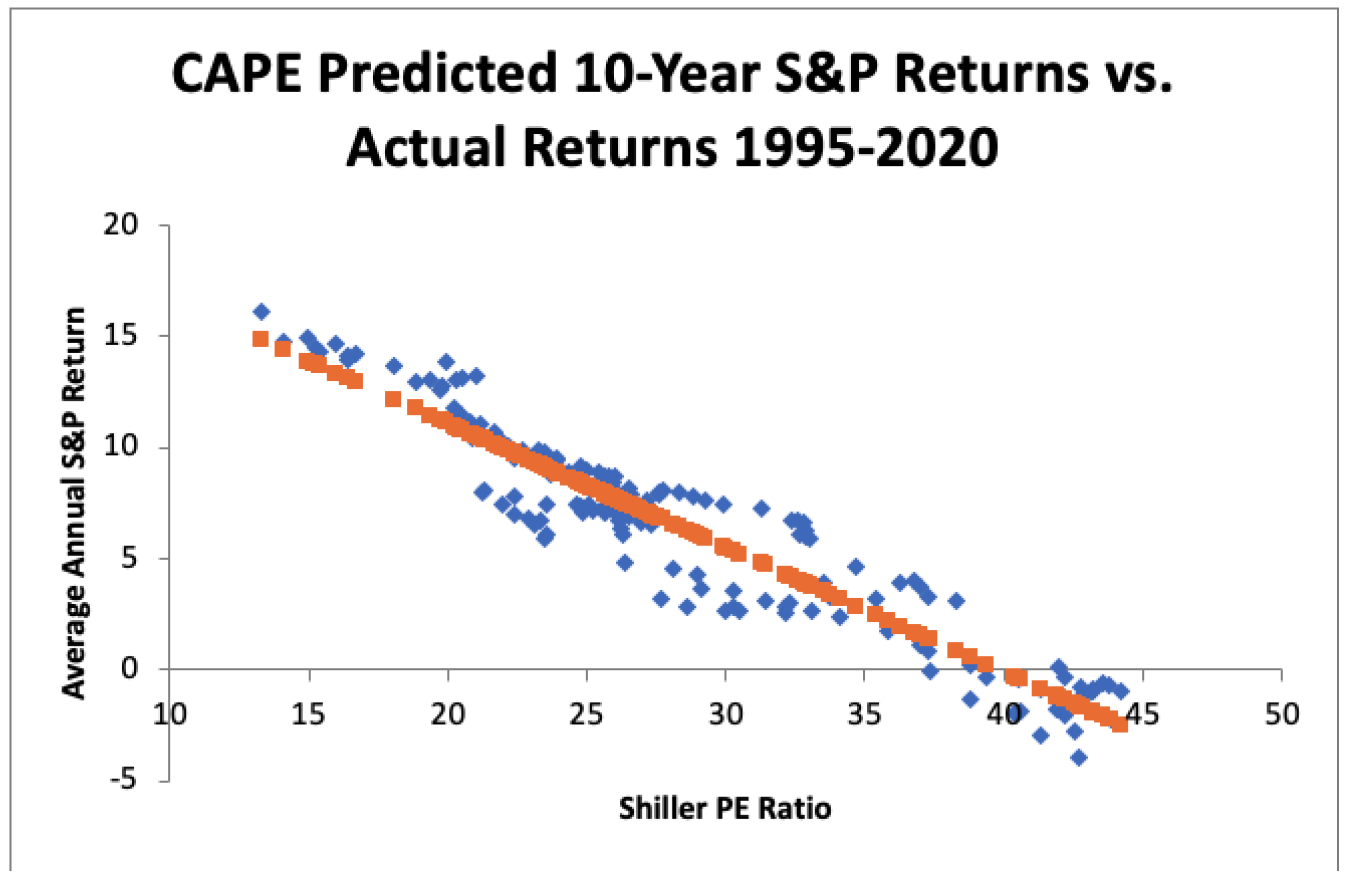
In our December 3rd blog post, “Tough Sledding Ahead?”, we highlighted the CAPE index while raising concerns that equity valuations appeared stretched based on this metric. As you may recall, the forecast equity return was -2.3%, including dividends. As a follow-up to that post, we would like to highlight this sobering chart:

John Authers, Senior Editor at Bloomberg, published this chart in his daily Point of Return newsletter. He got the chart from a Michael Finke article that was published by Advisor Perspectives in July 2020. The chart shows that the CAPE has been incredibly accurate in predicting future 10-year equity returns even without taking bond yields into account. According to Finke, a higher CAPE meant a lower subsequent 10-year return, and vice versa. The R-squared was a phenomenally high 0.9, which explained 90% of stocks’ subsequent performance over a decade and the standard deviation was ONLY 1.37%. This 25-year period has been a roller coaster for markets, as we’ve witnessed an equity bubble (’90s), a credit bubble (’07-’08), two epic bear markets (it feels like we’ve had more than two), and a decade-long bull market that recently went pop!

As if that isn’t enough to possibly shake the confidence of your favorite pension plan sponsor in being able to achieve the return on asset assumption (ROA), we also wanted to mention that the Buffett Indicator, which is the ratio of the total market capitalization of the US equity market ($45.2 T)/US GDP ($21.7 T) is currently at 203%. This is 71% above the long-term average. The only other time that had this level of richness was the top of the technology bubble in March 2000 (also at 71% above average).

Market Value to GDP

So, why is buying time important? If in fact the US equity market is peaking, the next 10-years could be quite troubling. If equities are a source of funds to meet future benefit payments, being a forced seller in this environment may create further downward pressure on your holdings. By implementing a cash flow driven investing (CDI) approach that insulates your fund by defeasing the Retired Lives liabilities with bond cash flows (next 1-10 years), your alpha or growth assets, including US stocks, now have significant time to wade through the periods of poor performance. They are allowed to grow unencumbered, as they are no longer a source to fund benefits and expenses. We believe that adopting a new asset allocation framework that consists of beta (CDI) and alpha (growth) assets is the most prudent approach to managing pension assets. Given the current environment any delay in adopting this structure may prove detrimental to the long-term health of your pension plan.

Liquidity Management – The Third Pillar?

We’ve reported previously on output from the annual Amundi–CREATE series that started in 2014. There is always a plethora of great insights that are shared from among leading pension voices from multiple pension markets. This year’s survey included 158 plan sponsors (74% private) from 17 markets representing nearly $2 trillion in pension assets. I think that this year’s survey took on an element of greater urgency given the impact that Covid-19 is having on markets and economies, and thus pension systems. Obviously, there remains great uncertainty as to the duration of this crisis and the long-term implications for every aspect of our society.

As one would suspect, there were many asset allocation questions posed in this survey, including expectations for returns during the next decade and one that asked whether markets would once again reflect underlying valuations. But the one that caught my attention the most was the one about liquidity. I was pleasantly surprised that 57% of respondents felt that liquidity management will become the third pillar of asset allocation after risk and return. We couldn’t agree more that managing liquidity in this environment will prove to be absolutely critical. As proponents of cash flow driven investing (CDI), we believe that plans MUST secure their benefits and expenses in the near-term providing a longer-term runway for the plan’s growth/alpha assets to perform. This is especially true in this environment as plans have been aggressively building alternative portfolios in an attempt to add some juice to their returns.

In addition to having a greater exposure to alternative investments with lock-up periods, which reduces available liquidity, plans of all kinds are likely to see little to no increase in contributions given the impact on business, union hours, and state and municipal budgets. Having to “make do” with what they currently have, plans will need to restructure their asset allocation and investment structure to reflect this new reality. By dividing the asset base into beta and alpha assets, plan sponsors and their consultants can dedicate a portion of their portfolio to liquidity assets (Beta assets) to fund near-term benefits and expenses (i.e. 1-10 years). This allows the Alpha assets to grow unencumbered, as the last thing one should want is to be forced to raise liquidity from assets that are growth assets and might not have natural liquidity. We refer to this as “maximizing the efficiency of the asset allocation”. You can read about our thoughts on this subject in the July 21, 2020 Ryan ALM blog post.

Protecting and preserving defined benefit systems is critical to the US having a retirement system that will actually allow workers to retire with dignity. Conducting business as usual, especially in this environment is not a winning formula. It is time to get back to basics by focusing on plan liabilities and the generation of cash (liquidity) to meet those promises. Are you ready?