The Possible Revision is Misplaced

The passage of the American Rescue Plan Act (ARPA) earlier this year was wonderful news for struggling multiemployer pension systems. For those Tier one plans eligible to file for Special Financial Assistance (SFA) immediately (July 2021) it was the life preserver needed to keep these plans afloat. For Tier 2 filers (beginning December 27, 2021) it is an opportunity to reinstate previously cut benefits under MPRA making whole participants who have struggled under the unfair economic burden brought on by sometimes massive reductions. Given these developments, I hesitate to once again raise concerns about the legislation and possible PBGC rule changes.

The PBGC was tasked with providing ARPA implementation rules. They presented their “Interim Final Rules” this past July. Those rules were met with a lot of industry blowback, especially as it related to the discount rate used to value plan liabilities, potential investments in the segregated SFA bucket, and the calculations used to determine the possible SFA allocation in the first place. Both Ron Ryan and I submitted comments to the PBGC during the feedback period. I won’t rehash those now. That said, I am very concerned about one possible revision that I am hearing may be included in the PBGC’s “Final Final Rules” that might be released as soon as January 2022.

The original intent of this legislation was to provide funding that would “ensure” benefits and expenses were paid for 30-years or until the end of the plan year 2051. Based on how the SFA is to be determined that “goal” is nothing more than a pipe dream. Based on our analysis and those of other industry experts, we believe that most plans won’t receive enough SFA funding to be able to protect benefits beyond 8-10 years. The disconnect is startling!

Currently, the SFA assets are only permitted to be invested in investment-grade (IG) bonds, with a maximum of 5% held in high yield securities, but only if they were originally purchased as IG bonds. There is also a provision within the legislation that allows for the PBGC to determine potentially other investments as being acceptable, too. In their Interim Rules, they did not expand the list of permitted investments, but we are hearing rumors that the January Final Rules may include an expanded list. This is where I am most concerned.

If the original intent of the legislation was to “SECURE” the promised benefits, how does expanding the list of acceptable investments to include equities (my guess) do anything to secure those promises? The PBGC was right in limiting the original list of permissible investments to only IG bonds. Bonds are the only asset with a known terminal value and cash flows that have been used for decades to defease liabilities (lottery systems, insurance companies, and yes, pension plans). The SFA assets should be used to defease the plan’s liabilities as far out as possible. This is a “sleep well at night” strategy that ensures those promises will be met for as long as the SFA assets exist. While the segregated SFA portfolio is paying benefits (and expenses), the legacy assets and future contributions can grow unencumbered. It is in this portfolio (alpha/growth) where the list of acceptable investments should be as broad as possible.

One can debate all they want about the current valuations for US equities, but the fact remains that equities are much more volatile than bonds. Given that the SFA assets are likely much smaller than needed to ensure 30-years of benefit payments, why does a plan, their consultant/actuary, or the PBGC want to inject more risk into the process potentially reducing further the timeframe to meet benefits? One doesn’t have to go back too far in history to know that we’ve experienced two shocking market corrections in the last two decades. Do we really want 8-10 years of “guaranteed” benefits to become 4-5 years or worse?

If the PBGC does anything to “improve” the Interim Rules they should address the discount rate embedded in the legislation. It is the use of the 3rd segment (PPA) plus 200 basis points that is having the greatest negative impact on the amount of the SFA to be received by these troubled plans. The use of an appropriate discount rate of all three segments under PPA with no added kicker would dramatically increase the size of the SFA and guarantee many more years of benefit coverage. But we know that the cost of this legislation (roughly $95 billion) is a source of “great concern” despite the government spending trillions of $s on other projects. Expanding the list of permissible investments does very little to secure more benefits, but it would dramatically increase the uncertainty regarding how many years of benefits are actually protected. More to come!
Idaho Signatory Gets Early Gift

Christmas came early for participants in the Idaho Signatory plan. The Pension Benefit Guaranty Corporation (PBGC) announced on Thursday, December 23rd that it had approved the plan application for the Idaho Signatory Employers-Laborers Pension Plan (Idaho Signatory) in Portland, Ore. The plan covers 682 participants in the construction industry and will receive $13.9 million in special financial assistance (SFA), including interest to the expected date of payment to the plan.

The plan, like the other 19 that have filed for the SFA in tier one, was expected to run out of money in 2022. In their announcement, the PBGC indicated that as a result of this grant the benefits paid to participants would average about 15% more than the PBGC “guarantee” had the application been denied and the plan been absorbed by the PBGC’s insurance pool. This accepted application is the second to be approved in the last week. Hopefully, we’ll continue to see grants approved for all the plans filing for this absolutely necessary support.

SFA For Local 138 Approved

In yesterday’s post, we speculated that we might hear something by the end of the day regarding the acceptance or rejection of Local 138’s ARPA application for Special Financial Assistance (SFA). I’m thrilled to report that the PBGC sent out a press release yesterday afternoon announcing that Local 138’s application had been supported. According to the release the “Local 138 Pension Plan based in Baldwin, N.Y., which covers 1,723 participants in the transportation industry, will receive $112.6 million in special financial assistance, including interest to the expected date of payment to the plan.”

As we also mentioned in recent posts, “Final, Final Rules” on how to invest the proceeds have not been announced. In their release, the PBGC stated that they are reviewing the feedback received following the release of the “Interim Final Rules” in July and that the Final Rules “MAY” reflect some of the input. What seems apparent to me is the fact that the discount rate won’t be adjusted given that the SFA that has been approved for Local 138 would reflect the current discount rate of the 3rd Segment (PPA) plus 200 basis points. That is truly unfortunate, as the use of this rate dramatically reduces the potential SFA payment.

Any assistance that these struggling multiemployer plans get is terrific, but the thought that 30-years of future benefit payments would be secured is nothing but a pipe dream at this time. Let’s hope that those plans receiving the SFA can secure the benefit payments for the next 8-10 years, which would buy time for not only the legacy assets to grow unencumbered but perhaps a few tweaks to the current legislation should the PBGC’s “Final Rules” not meaningfully change. The next plan up is Idaho Signatory Employers-Laborers Pension Plan. More to come!

Now How Long Will It Take?

As we recently reported, Local 138’s ARPA application reaches its 120th day under review at the PBGC today (December 21st). No news is good news with regard to this Special Financial Assistance (SFA) application, as the PBGC is required to notify a plan only if the application has been rejected for one of a plethora of reasons. The fact that 138 has not been notified suggests to me that their application has been accepted despite the fact that the PBGC’s website still says that the application is under review. Perhaps will see an update later today.

Now the waiting to receive the SFA funds begins. Unfortunately, I sometimes feel as if the multiemployer pension system is playing a massive game of red light, green light that you and I played as kids, except that there is too much at stake for the participants in these plans. According to the ARPA legislation, the “Special financial assistance issued by the corporation shall be effective on a date determined by the corporation, but no later than 1-year after a plan’s special financial assistance application is approved by the corporation or deemed approved.” Why one year? It doesn’t seem possible that it would take one year from the time that the SFA application has been approved to the point that a single lump-sum payment can be wired to the plan’s custodian.

Here’s my greatest concern: markets (equity) are near or at historic levels. A traditional asset allocation will have significant exposure to equities and equity-like asset classes. Negative cash flow from these Critical and Declining pension systems on a monthly basis is difficult to manage. Not getting the SFA proceeds for a year opens these plans to unnecessary liquidity risk. Why? If SFA assets were received promptly the proceeds would be invested in investment-grade bonds per the legislation’s mandate and the SFA assets would be used to meet the monthly benefit payments. We would prefer that the SFA assets be used to defease (cash flow match or CDI) the current Retired Lives Liability as far out as possible (likely around 8-10 years depending on the plan). This action ensures that the plan has the liquidity necessary to meet those monthly flows without having to force liquidity from the equity managers that might be under stress as the markets turn. Furthermore, should the US equity markets experience another major decline, the availability of SFA assets to meet benefit payments means that the investment horizon has been extended for equities allowing for them to grow unencumbered while allowing for recovery of those potential losses.

There are enough documented issues with regard to this ARPA rescue plan. Imposing unnecessary delays on pension plans that have gotten approval for their SFA applications is just further salt in the wounds inflicted by previous failed attempts at improving the soundness of these struggling multiemployer systems. Get the SFA money to these plans ASAP. They can then secure the promised benefits for at least some period of time despite the fact that the 30-year “guarantee” is nowhere close to being a reality.

SFA Approval: Within Days of First Applications reaching 120 days

The ARPA legislation states the following: DETERMINATIONS ON APPLICATIONS.—A plan’s application for special financial assistance under this section that is timely filed in accordance with the regulations or guidance issued under subsection (c) shall be deemed approved unless the corporation notifies the plan within 120 days of the filing of the application that the application is incomplete, any proposed change or assumption is unreasonable, or the plan is not eligible under this section. Such notice shall specify the reasons the plan is ineligible for special financial assistance, any proposed change or assumption is unreasonable, or information is needed to complete the application. If a plan is denied assistance under this subsection, the plan may submit a revised application under this section. Any revised application for special financial assistance submitted by a plan shall be deemed approved unless the corporation notifies the plan within 120 days of the filing of the revised application that the application is incomplete, any proposed change or assumption is unreasonable, or the plan is not eligible under this section.

Given the above wording, we are now within days of having the first applications either approved or rejected. Local 138 Pension Trust Fund filed their application on August 23rd, which means that their 120 days are up on December 20th. Furthermore, “Special financial assistance issued by the corporation shall be effective on a date determined by the corporation, but no later than 1 year after a plan’s special financial assistance application is approved by the corporation or deemed approved.” There are several other plans that filed their initial application in September meaning that January is going to be a fairly busy time for the PBGC, which also has the second priority tier eligible plans filing their initial applications, too.

Unfortunately, these plans may be receiving their Special Financial Assistance (SFA) without knowledge of the PBGC’s “Final Final Rules”. As you may recall, the PBGC published its “Initial Final Rules” in July. Many plans and their asset consultants/actuaries are waiting to see if any changes will be made that would impact the size of the government grant or how the SFA assets may be invested. As of now, the SFA assets must be segregated from the plan’s legacy assets and be invested only in investment-grade bonds. There is a provision allowing for a 5% bucket of high yield bonds, but only if they are “Fallen Angels”.

For plan participants in Critical and Declining plans that were granted “relief” under MPRA, the waiting is particularly burdensome. Many of these participants have been struggling with financial hardship due to the draconian cuts to their earned benefits. The expectation was that benefits would be restored to previous levels once the legislation passed. But the waiting continues. Will the PBGC take the full 1-year to provide the grant? I sure hope not! Stay tuned.

How is the ARPA Rescue Going So Far?

March 2021 was an exciting time for many multiemployer pension plans and their participants with news that the American Rescue Plan Act (ARPA) had been signed into law and a “rescue” of some roughly 130 struggling multiemployer pension systems was right around the corner. But was it? Following the March passage, we all waited for the PBGC to produce their interim “final” rules, which they did in early July. Those guidelines laid out a schedule – a priority pecking order – for funds that qualify for the Special Financial Assistance (grant).

According to the PBGC’s website, there have been 20 applications for the Special Financial Assistance (SFA) filed to date, with one plan, Road Carriers Local 707 Pension Plan, submitting their first application on August 13th and a revised application on November 12th. To date, no applications have either been approved or rejected. The PBGC has 120 days from receipt of the application to either approve the SFA request or send it back to the plan for an amended application. Furthermore, we continue to wait for the PBGC’s “Final, Final Rules”.

As a reminder, roughly 100 letters were received by the PBGC following the publication of the Interim Final Rules in July. These comments covered various aspects of the legislation and represented feedback from individual participants, pension systems, actuaries, asset consultants, money managers, and more. It is anyone’s guess at this point whether the PBGC will, in fact, listen to the industry participants and amend any of their initial guidance. The key request by industry participants is to change the discount rate used to calculate the SFA grant from a PPA 3rd segment rate + 200 basis points to the PPA three segment rates currently used. The higher discount rate required by the legislation significantly reduces the SFA grant.  I am not confident that they will further amend their guidelines, despite the fact that several leading voices in Congress are not pleased with how the legislation was interpreted.

It remains to be seen whether the goal to secure the next 30-years of benefits and expenses will be achieved, but initial analysis suggests that few if any, plans will, in fact, be able to secure the promised benefits, reinstitute cuts that had previously been made to benefits (18 plans under MPRA), and maintain sufficient assets to meet future benefits. Despite the possible shortfall, what we should be focused on is the fact that these struggling plans are getting a grant, and in some cases, a substantial one, to help improve funding, at least in the near term. Importantly, the SFA assets received should be used to secure the promised benefits as far out into the future as possible. This action will buy time for the current assets to grow unencumbered, and if necessary, allow for future amendments to this legislation to be enacted. Actions that don’t secure the promised benefits only act to increase the likelihood that assets received through ARPA will not be sufficient to meet the promises that are supposed to be secured until 2051. More to come.

Is Your Head Spinning yet?

The market action over the last week or so has been so crazy that many participants are likely suffering from seasickness. It has given me the feeling that I’ve been on a monstrous roller coaster of just ups and downs with no extended straightaways. How about you? There are so many inputs that need to be factored into the decision to buy or sell the US equity market, but have things really changed that significantly since Thanksgiving let alone every day? Sure, we have the new Covid-19 strain called Omicron, but as of today we really don’t know how much we will be impacted by it. Yet, with each piece of “information”, the markets rapidly adjust (overreact). Is it rational behavior? Given underlying valuations for US stocks… are holders of equities just looking for a reason to sell or are we seeing long-term investors using every opportunity to buy dips? I guess that only time will tell.

However, if your head is spinning and you aren’t sure about the near-term direction of your equity exposure I would encourage you to look to your Investment Policy Statement (IPS) for guidance. Take advantage of the tremendous gains created during the last 18 months to rebalance your pension asset allocation back to policy normal targets. It is never a bad time to take profits! Furthermore, if you believe, as we do, that US interest rates need to eventually reflect the current economic environment, you may also want to change the composition of your fixed-income allocation.

A rising US interest rate environment will create significant headwinds for your total return-oriented manager. It doesn’t take much of an interest rate move upward to create a negative annual return for your manager. In fact, at these low-interest rates, only a 30 basis point move up in rates would have a 7-year duration portfolio producing a negative annual return for your bond manager. That can happen in a week or less! Consider adopting a cash flow matching fixed income (CDI) implementation that matches asset cash flows from bonds (interest and principal) with liability cash flows. A CDI strategy will ensure that your plan’s liquidity is enhanced, interest rate risk on that portion of the portfolio is mitigated, and importantly, the investing horizon for your growth assets is extended allowing for those assets to grow unencumbered.

Adopting this approach will likely reduce the seasickness that you may be experiencing at this time. Securing the plan’s liabilities (the promise to participants) should be the primary objective, which can be accomplished at a reasonable cost and with prudent risk. Save the ups and downs for your next visit to Six Flags.

Remember… trends don’t wait for the end of the year to happen!

Disappointing, but not Shocking

According to the U.S. Census Bureau, 59% of Americans have access to a 401(k) plan through their employer, but only 32% actually invest in one. Some people would find that shocking, but I don’t. We have a significant percentage of Americans living within 200% of the poverty line in an era of escalating costs for housing, insurance, education, food, etc. Funding a retirement account, although important, isn’t the first order of business for the average American when it comes to allocating their very finite disposable income.

What is worse to me is the fact that only 16% of the private sector workforce (26% if you include public employees) has exposure to a defined benefit pension plan. For many of these participants, their plans have unfortunately become frozen meaning that they are no longer accruing benefits. There is a reason why the US labor force is witnessing tremendous growth in the number of workers 65-years-old or older continuing to work and it’s not because they all aspire to want to be greeters at Walmart. For a majority of this cohort they just can’t afford not to work. Where other age segments of the U.S. labor force have remained stable or declined, this cohort is witnessing annual growth rates in excess of 5%.

The loss of a true retirement vehicle (DB Pensions) in favor of defined contribution (DC) plans is further exacerbating this trend. The uncertainty for individuals in DC plans related to when to retire, what asset allocation to use, and how much to disburse annually from one’s retirement account are incredibly difficult problems to “solve”. DC plans would be great if they were truly supplemental to a DB plan, which was their original intended use. The “great resignation” which we are experiencing today might not have been as robust had DB plans been maintained. The fact that DC participants can jump around from one job to another (provided that they offer a DC plan) is likely one very big unintended consequence brought about by the demise of DB plans. Let’s hope that as DC participants jump around that they don’t actually take premature withdrawals from their previous employer’s offering.

It’s Okay To Peek!

Private pension plans operate under different accounting standards than those in the public sector (FASB versus GASB). As a consequence, private plans are “forced” to use market discount rates (ASC 715 = AA corporate yield curve), as opposed to a static discount rate (the ROA) permitted under GASB. Why is this important? Well, for one, using a static (non-market rate) masks the plan’s true liability. Unfortunately, in this environment of near-historically low-interest rates, that means that the plan’s liabilities are likely severely understated and the funded ratio overstated. as opposed to a static discount rate (the ROA) permitted under GASB. Why is this important? Well, for one, using a static (non-market rate) masks the plan’s true liability. Unfortunately, in this environment of near-historically low-interest rates, that means that the plan’s liabilities are likely severely understated and the funded ratio overstated.

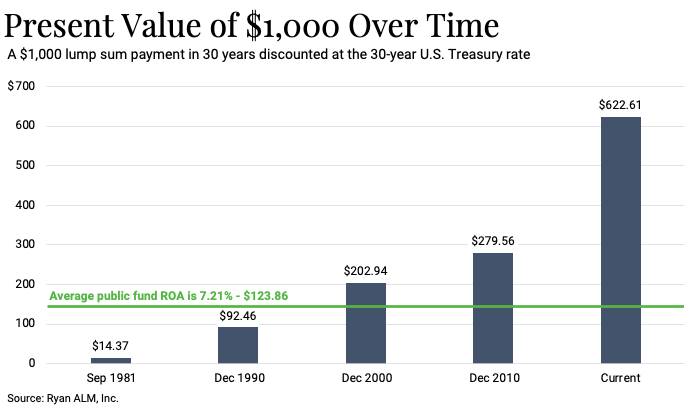
I entered the pension industry in 1981, and interest rates have basically been falling ever since. This has created a huge headwind for defined benefit pension plans, as lower rates not only make it difficult for plans to achieve their return objectives, but it makes it much more expensive to try and defease pension liabilities. As the following chart depicts, it would have cost a plan sponsor only $14.37 to defease a $1,000 30-year liability in September 1981. Today, that same liability costs a plan more than $622! Oh, my!

Oh, how we wish for the days of double-digit interest rates (at least if you are a retiree or a pension plan sponsor) where winning the retirement game would consist of nothing more than understanding your liability and managing to it (i.e. defeasance or dedication)! So simple. But, again, when forced to operate under accounting rules that provide for static measurement of a plan’s liabilities (GASB), changes in interest rates are not understood to have any impact on pension liabilities. Yet, they do, and it can be significant. Despite the decades of falling rates, there is some good news to share. U.S. interest rates have moved steadily higher since touching all-time lows last year. This provides some relief for pension funds that have been crushed by falling rates. Given the current inflationary environment (transitory or not?) one should expect that US interest rates will move higher. As a reminder, the US bond market has provided a “real return” from bonds that is >2% longer-term but currently provides investors a negative return when adjusting for inflation. This situation is not sustainable.

Unfortunately, investing in a traditional return-oriented bond program will likely generate negative returns for the foreseeable future, as the 39-year bull market in bonds likely comes to a close. How high US rates go is anyone’s guess, but it would only take about a 30 basis point move upward in rates to create a negative annual return for a portfolio with a 7-year duration. A move of that magnitude could happen in a blink of an eye. Instead of using a core fixed income manager as a performance generator, use bonds for the certainty of their cash flows to match assets versus liability cash flows. You’ll be happy that you did!

Lastly, get a more frequent view of your plan’s liabilities. We, at Ryan ALM, produce a Custom Liability Index (CLI) that uses your plan’s unique actuarially projected benefits, expenses, and contributions that are produced by your actuary to monitor monthly your plan’s liabilities using multiple discount rates. Managing pension assets to pension liabilities ensures that asset allocation decisions are being done with all of the information necessary to be successful. Not only is it okay to peek at the promises (liabilities) that have been made to your participants… it is absolutely imperative!


Not a Correlation of 1, But Certainly Strongly Positive

We recently produced a post on the investment into Bitcoin and Ethereum by a large public pension system. One of the points stressed by this plan’s CIO was the fact that “this is another tool to manage my risk,” that “has a positive expected return… and a low correlation to every other asset class.” Having observed the pattern of performance during the last couple of years, it doesn’t appear to me that Bitcoin has a low correlation to equities. In fact, the Bloomberg chart below that was published by the Daily Shot appears to highlight a meaningful correlation to US equities.

Given current valuations for the US equity market… is Bitcoin or any other cryptocurrency truly a hedge against a significant market decline? As we discussed in the previous post published on October 29th, Bitcoin has only been around for about 11 years. It is much too short of a timeframe to make any real determination as to whether or not it will be a good hedge against inflation and/or a risk diversifying “investment” during periods of market dislocation when everything seems to correlate towards 1 with the exception of long-term US Treasuries, which have exhibited true diversifying tendencies.

If you want an appropriate investment that will protect your plan during significant down markets, convert your fixed-income core portfolio to a defeased bond portfolio that matches bond cashflows versus plan benefits and expenses (i.e. liability cash flows). Whether interest rates rise or fall, the value of your bonds will move in lockstep with the plan’s liabilities. This will provide the plan with the necessary liquidity to meet all of your short-term needs while extending the investing horizon for your growth (alpha) assets to rebound from the negative impact of any market correction. This is a tried and true investment approach used for many, many decades. Who needs another new-fangled product that might not produce the desired outcome?