ARPA Update as of 3/31/22

By: Russ Kamp, Managing Director, Ryan ALM, Inc.

I’m pleased to report that the PBGC yesterday announced that another pension system’s SFA application has been approved. Teamsters Local 641 Pension Plan, which originally filed for the SFA on September 9, 2021, only to have to withdraw and resubmit another application on December 1st, will receive $503.9 million. The plan, based in Union, New Jersey, covers 3,610 participants in the transportation industry.

According to the PBGC’s press release, “Local 641 Plan became insolvent in March 2021. At that time, PBGC started providing financial assistance to the plan. As required by law, the Local 641 Plan reduced participants’ benefits to the PBGC guarantee levels, which was roughly 55 percent (my emphasis) below the benefits payable under the terms of the plan. PBGC’s approval of the SFA application enables the plan to restore all benefit reductions caused by the plan’s insolvency and to make payments to retirees to cover prior benefit reductions.” This development is sure to put a smile on the faces of the 3,610 participants who have been forced to “live” with a benefit that was roughly half of that with which they were entitled.

In other SFA news, there have been NO additional applications filed since March 16th, only two applications were filed last month, and only three have been submitted since January. That pace is comparable to the number of plans that have received SFA approval from the PBGC which stands at three since January 24th. At this point, not all of the eligible Priority Group 1 and 2 plans have filed the SFA application. Priority Group 3 plans (plans with >350,000 participants) are eligible beginning today (4/1) and that’s no April Fool’s joke. Perhaps we’ll get the Final, Final Rules from the PBGC before Priority Group 4 candidates are slated to file beginning on 7/1/22.
How Ugly? Quite!

By: Russ Kamp, Managing Director, Ryan ALM, Inc.

The inflationary environment and the impact of Federal Reserve tightening are combining to create a challenging environment for traditional fixed income core mandates – the significant majority of fixed income exposure among public and multiemployer pension systems. The year-to-date performance for the Bloomberg Barclays Aggregate index reveals a -6.3% return through yesterday’s market close (3/29). As we’ve pointed out on several occasions, fixed income market participants have enjoyed quite the run during the last 39-year bull market. But the party may have just received the final call. So, just how bad is the nearly completed first-quarter return? It is ugly.

Since 1980, the Aggregate index has declined only 4 times on an annual basis. Four times in 42 years! The most significant annual decline was only -2.92% (1994), or <50% of the decline observed during the first three months of 2022. The worst quarter during this extraordinary period was -4.1% (quarter ending 9/81). This shouldn’t come as a major surprise to anyone who regularly reads this blog, as we’ve been saying for quite some time that the current inflationary environment would lead to Fed tightening AND that this action would also be quite bad for traditional bond management. Given that the US Federal Reserve has indicated future interest rate increases at each of the remaining FOMC meetings for 2022, the interest rate rise witnessed to date is only a small deposit of what’s to come.

We strongly encourage plan sponsors and their advisors to refocus their plan’s fixed-income away from a return-seeking mandate to one that uses bond cash flows to match and fund the plan’s liability cash flows (benefits and expenses). This action will ensure that the portion of assets used to defease the plan’s liabilities will move in lockstep. We don’t know the magnitude or duration of a potential interest rate increase, but we certainly have history to guide us. Prior to the astonishing 39-year bull market, we suffered through a 30-year bear market that was accompanied by high inflation, oil shocks, political instability, and significantly rising US interest rates. Sound familiar?

It Should Have Been A Warning!

By: Russ Kamp, Managing Director, Ryan ALM, Inc.

A former colleague has for years provided me with an excellent monthly performance report from a terrific regional asset consulting firm. What had been a 7-8 page document of equity and fixed income indexes became a 5-page document in the middle of 2021. I was taken aback by the absence of the fixed income index section. I reached out to my former colleague and was told that “no one” was interested in fixed income so those indexes were removed by the consulting firm. Wow! I was shocked given the role that bonds play in all types of investment programs, especially corporate DB plans. I remember saying to myself that those that aren’t interested today might certainly be in a few months when interest rates start to rise.

Well, that period is upon us and the returns to a variety of fixed income benchmarks YTD are painful, and likely to get even more so if the US Federal Reserve can’t successfully navigate through this inflationary environment. After 39-years of a bond bull market, it is time to pay the piper. This benign neglect had me recall all of the “talk” in the late 1990s about a new paradigm. As you may recall, Value investing was dead and the only play in town was to invest in high momentum growth stocks. We all know what soon followed. Sound reminiscent of today’s environment?

Our markets move in cycles, such as Value versus Growth, large-capitalization stocks versus small caps, the US versus non-US, and on and on. Some of the cycles are longer than others, such as the US interest rate bull market cycle of nearly 40 years others are much shorter. These cycles are driven by market sentiment and cash flow. The building or unwinding of positions/strategies leads to strong or weak performance. This is how it has always been, and it will remain so. When it becomes so painful to maintain an exposure it is usually the time to double down not abandon ship.

Because of the nearly singular focus on return (ROA) as the primary objective in managing a DB pension plan, sponsors and their advisors have for years significantly expanded their use of equity and equity-like products. What this has done is increase both the cost of managing a plan and the volatility surrounding the potential outcomes. It has done very little to ensure success. If a pension system achieves the targeted ROA but fails to beat liability growth has the plan won? Of course not. But given that many sponsors (and their advisors) don’t know how their plan’s liabilities are behaving on a daily, monthly, or quarterly basis they are blind to whether or not their fund is meeting the primary pension objective of SECURING the promised benefits at a reasonable cost and with prudent risk.

I would suggest that now IS NOT THE TIME to close a blind eye as to how the fixed income market is performing. Traditional return-focused fixed income products are going to get hammered if the Fed isn’t successful in migrating through this inflationary environment. Use bonds for their cash flows and carefully (skillfully) match those asset cash flows with the plan’s liability cash flows to secure the promised benefits. There are many benefits from restructuring the fixed income allocation including improving the plan’s liquidity profile, removing interest rate risk from that portion of the pension plan, while also extending the investing horizon (buy time) for the plan’s other assets to now grow unencumbered. Many in our industry haven’t had to manage through a rising interest rate environment that lasted more than a few quarters. It is a new day! Are you prepared?

ARPA update as of March 25th

Here’s the latest from the PBGC through March 25th. Last week witnessed zero new applications, zero new approvals, zero disbursements of the SFA, and zero applications withdrawn. So much for progress! But who can blame the PBGC, as March Madness has clearly gripped everyone? Perhaps the folks at the PBGC are a bunch of St. Peter’s alum?

So, we remain at seven approved applications with five having received their SFA ($1.1 B). Total applications still in review remain at 26, with U.T.W.A. – N.J. Union – Employer Pension Plan having been the last application submitted on March 16th. As a reminder, the big boys, those plans with >350,000 participants, are eligible to begin filing under Priority Group 3 status beginning April 1st.

There have been only four of the 18 MPRA suspension plans filing an application for the SFA. Priority Group 2 candidates became eligible on December 31, 2021. Are they waiting for the “Final, Final Rules” from the PBGC, or are there other extenuating circumstances that have created this delay? Only time will tell, but I can only imagine the angst that this further delay is giving to participants in those plans. Stay tuned!

This Doesn’t Make Sense – Now What?

By: Russ Kamp, Managing Director, Ryan ALM, Inc.

Earlier today I published a post titled, “This Doesn’t Make Sense”, in which I questioned the current market action for US equities (especially large-cap growth stocks) given the great uncertainty associated with the Russian invasion of Ukraine, rising interest rates, decades high inflation, oil prices exceeding $113/barrel, supply chain issues that continue to cause delays, and equity valuations that remain stretched. Several regular readers of this blog provided positive feedback on the post (thank you), but many others asked the question: “Now what?” It is a great question that deserves an appropriate response.

As Ron Ryan and I have stated on many occasions, the primary objective in managing a DB pension plan is to SECURE the promised benefits in a cost-efficient manner and with prudent risk. It is NOT a return objective (ROA). Given this goal and the current economic environment, it would behoove plan sponsors and their consultants to quickly migrate from traditional total return focused fixed income into a cash flow matching strategy in which bonds are used for the certainty of their cash flows (income and principal) to match and fund liability cash flows (Liability Beta Portfolio™). In a rising rate environment, total return bond programs will generate negative returns. If a 1% real return were to be achieved (historically bonds produce 1-2% real returns above inflation) in this current fixed income environment, a 6-year duration bond would generate a return of -35% or worst.

Once a cash flow matching strategy has been implemented, your bond allocation will move in lock-step with the fund’s Retired Lives Liability. This strategy eliminates interest rate risk, as you are now defeasing a future value that is not interest-rate sensitive. Ideally, the allocation should provide 10-years of benefits and expenses coverage (improved liquidity management). If achieved, you have now built an expanded investing horizon (a bridge over troubled waters), for the remainder of your assets (Alpha assets) to grow unencumbered.

Most public pension systems (and multiemployer plans) have dramatically increased their plan’s exposure to risky assets during the last couple of decades as bond yields fell. That strategy has certainly created the potential for more return, but it has guaranteed more volatility and higher costs. In addition, it has impacted liquidity as many of these strategies are locked up in funds that have 10-12 year lives. Creating a bifurcated asset allocation of liquidity assets (Beta)  and growth assets (Alpha) that secures the promised benefits, improves liquidity to meet those benefits, extends the investing horizon for the plan’s alpha assets to work through choppy markets, while also eliminating interest rate risk for the portion of assets that are defeased seems like a most prudent strategy to adopt given all of the uncertainty within our capital markets. This recommendation isn’t knee-jerk! It is an asset allocation model with a long and successful history! Putting in place an asset allocation structure that provides the necessary protections WHEN markets go awry is fundamental to the success of DB pension systems. For too long we’ve played the return game. Very few plans are well-funded. Isn’t it time for a return to pension basics?

This Doesn’t Make Sense!

By: Russ Kamp, Managing Director, Ryan ALM, Inc.

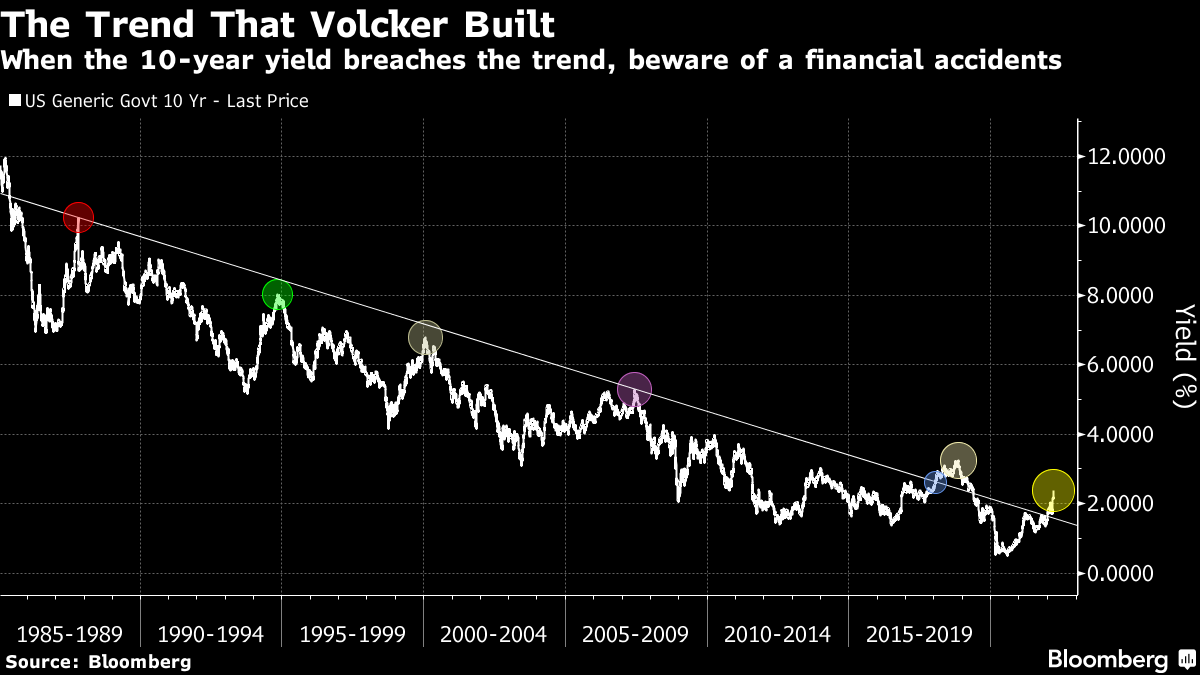
I’ve witnessed quite a lot during my forty years in this business, but I’ve never seen anything quite like that which I’ve seen during the last couple of weeks. Given the current economic backdrop (high inflation and rising rates) coupled with the great uncertainty regarding the Russian invasion of Ukraine, stocks should not be rallying to the extent that they have relative to the performance of US Treasuries. I’ve previously referenced John Authers, Bloomberg, for the great work that he does in bringing clarity to confusing times through the presentation of impressive charts and graphs (some his and some borrowed). I’m borrowing one of his today to highlight the inconsistency in the equity market performance.

Something has to give!

As John highlights and as we’ve pointed out on numerous occasions, our equity markets have been benefiting tremendously from the accommodative monetary policy since Volcker was the Fed Chair. The circles on the chart above highlight points in time when it looked like the downward trend in rates (10-year US Treasury note yield) was about to be reversed through Fed tightening. In each case, something dramatic occurred in the markets, such as the 1987, 2000, 2018 stock market crashes that forced the US Federal Reserve to once again provide easy money. The Fed was able to accommodate markets during those extraordinary occurrences because inflation was well-contained.

Today, we have consumer inflation at nearly 8% and producer inflation at almost 10%. There is little opportunity for the Fed to provide additional stimulus without seeing our current inflationary environment further spiral out of control. Given that the Fed has already indicated that it will move aggressively (potentially 6 more Fed Funds increases) to contain inflation providing stimulus should equity markets break is a non-starter. We know that rising interest rates will harm the performance of bonds, but as we witnessed during the 1970s, equities will also have great difficulty providing a real return in a high inflationary environment.

Most public pension systems are underwater from a funding standpoint despite strong equity markets since the Great Financial Crisis. We cannot allow the funded status to deteriorate further, which will lead to greater contributions, especially if the higher interest rates eventually lead to a recession. Asking taxpayers to provide additional funding for these plans during an economic downturn may just be the death knell for public pensions.

Are We Looking at the 1970s?

By: Russ Kamp, Managing Director, Ryan ALM, Inc.

The 1970s were one of the most challenging times for our capital markets. The decade began somewhat harmlessly although equity valuations were inflated following incredibly strong equity markets during the 1960s. These stretched valuations would eventually produce the infamous “Nifty Fifty” stocks, including IBM, Xerox, Coca Cola, and other large-cap stocks whose P/E multiples approached levels not seen to that point with many reaching and exceeding 100 X earnings. The Nifty Fifty bubble burst in 1973 as the US grappled with political unrest (Nixon), an oil embargo, and rising inflation and interest rates. Increases that would eventually produce double-digit short- and long rates. Is it time to once again quote Yogi Berra? Is it “deja vu all over again”?

For those who have studied the 1970s, it was an incredibly painful decade, which some market historians describe as a “lost decade” from a performance standpoint. Pension plans that had adopted a more traditional 60%/40% mix of equities/bonds were particularly hit hard as bonds produced a negative return, while equities squeaked out marginal gains. As a result, most pension systems fell far short of their plan’s return on asset assumption (ROA) creating a situation in which escalating contribution expenses were needed to close the funding gap created by this exceptionally poor performance period.

Goldman Sachs has produced a very interesting chart highlighting 1-year and 10-year drawdowns for a 60/40 implementation.

I was not only shocked to see the magnitude of the performance shortfall during the decade of the ’70s but also the duration. From the mid-’70s to the early ’80s the standard 60/40 asset mix got crushed. Given our current economic and political landscape, is it too far-fetched to conclude that we may just be looking at the ’70s once again? Don’t we have massive inflation, a Fed that has telegraphed significant interest rate increases, oil trading at nearly $110/barrel, a war whose outcome is far from known, a speculative real estate market, and equity valuations that remain significantly elevated? What’s the difference?

Pension plans that don’t protect themselves are doomed to repeat the failures of the past. Why allow your current asset allocation to damage your plan’s funded status leading to significant growth in contributions? Now is the time to bifurcate your assets into two buckets – liquidity (Beta) and growth (Alpha). Convert your current fixed income from a return-seeking strategy to one that will use bonds for their cash flows to meet liability cash flows (benefit payments). Adopting this strategy allows the alpha assets to grow unencumbered for the period of time covered by the Beta assets. Buying time will enable the portfolio to work through unsettling market conditions. Public pension fund contributions have grown tremendously during the last two decades. Taxpayers, many of whom don’t have access to a traditional pension plan, may be opposed to seeing their tax $s continue to be used to fund retirement benefits that they themselves lack. We are in the early stages of the Fed’s interest rate increases. Now is the time to act before it is too late.

Just the Beginning?

By: Russ Kamp, Managing Director, Ryan ALM, Inc.

Last week the US Federal Reserve indicated that the discount rate increase of 25 bps was just the beginning of what might be 6 additional increases this year. Given the level of inflation – both consumer and producer – this move by the Federal Reserve was not a shocker. Furthermore, there are several members of the FMOC that have 3.75% in their target. This level would be a game-changer!

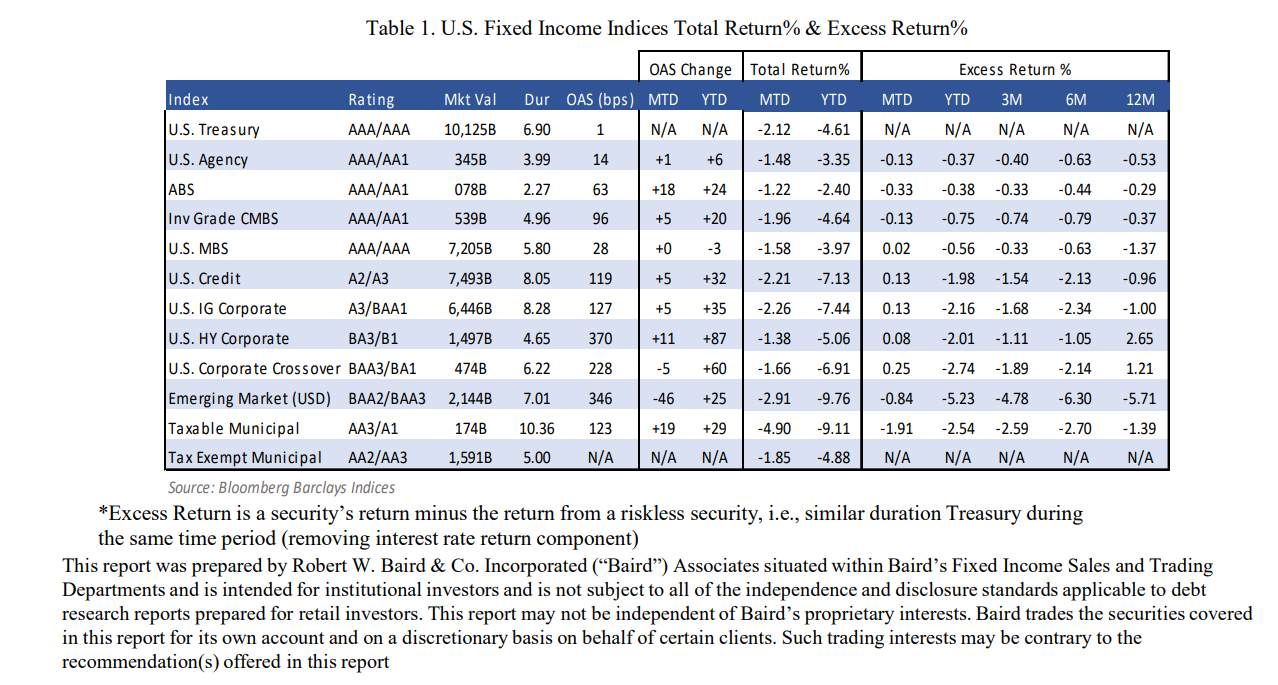
We at Ryan ALM have been suggesting for quite some time that a rising interest rate environment would be quite painful for total return bond programs. Given how early the Fed is in the process, we are a bit surprised by the magnitude of the underperformance by most segments of the US fixed income market year-to-date. The chart below was prepared by Robert W. Baird & Co. It supports our stance that a new day is dawning for US institutional investors who haven’t seen a protracted bear market in fixed income since 1981 and the impact that a lengthy period of sustained interest rate increases would have on fixed income portfolios focused on total return.

We once again implore you to convert your current fixed income from a return-seeking portfolio to one that uses fixed income cash flows (interest and principal) to match liability cash flows. A cash flow matching strategy will ensure that both assets and liabilities move in concert with each other mitigating the most significant bond risk, which is interest rate risk. It also buys time for the pension system’s alpha (growth) portfolio to grow unencumbered as it is no longer a source of liquidity. We’ve enjoyed a wonderful nearly 40-year bull market for bonds. The wind finally looks to have shifted from being at our backs to be blowing right in our face. Don’t let the markets drive your funded status. Take control and it starts now by addressing your fixed-income portfolio. Oh, and by the way, a significant increase in US interest rates will also negatively impact equities and real estate.

Two More Funds Get SFA Approval from the PBGC

By: Russ Kamp, Managing Director, Ryan ALM, Inc.

As reported in their March 18th update on the PBGC website, two more funds – Milk Industry Office Employees Pension Trust Fund and Local 584 Pension Trust Fund – received approval for their SFA applications bringing the number of approved applications to seven. These two funds will receive $224.2 million in federal grants to support the benefit payments for their 2,250 plan participants. The approvals last week were the first since Local 408 received their good news on January 24th. This reduces the current number of pending applications to 25, with an April 1st start date for Priority Group 3 plans looming.

Let’s hope that last week’s activity is a positive sign that the PBGC will ramp up the pace of acceptance for these outstanding applications. The plan participants shouldn’t be kept waiting, especially those from Priority Group 2 that had their benefits slashed under MPRA. Have a great week!

ARPA Weekly Update

By: Russ Kamp, Managing Director, Ryan ALM, Inc.

It must have been Spring Break for the members of the PBGC this past week, as there is nothing to update as it relates to the filing of applications or approval/payment of the Special Financial Assistance (SFA). There remain only five approved applications to date and each plan has received the SFA payment. As a reminder, the PBGC has handed out $1.1 billion in SFA to date covering 8,117 plan participants.

There are currently 27 applications from Priority Group one and two plans that have yet to be approved. The applications have filed for an estimated $7.1 billion in SFA and cover roughly 163,000 plan participants. Effective April 1, 2022 plans that have >350,000 plan participants are eligible to file their applications.

We continue to wait on the PBGC’s Final, Final Rules regarding elements of the ARPA legislation. What is likely to happen first, Congress’s approval of permanent Daylight Savings Time (which would become effective in November 2023) or the PBGC’s final guidance on the ARPA legislation? Perhaps the added daylight might contribute to some additional activity.