Have We Seen Negative Real Rates of This Magnitude?

By: Russ Kamp, Managing Director, Ryan ALM, Inc.

Following the publication of yesterday’s post, I received several good questions including the following: “Have real interest rates (nominal rate minus inflation) ever been below -5%, let alone the current -7%?” It is a terrific question and one that should be on the minds of all investors. The simple and not surprising answer is not since at least 1953. We came close during the turbulent ’70s, but nothing to this extreme. With the most recent rally in Treasuries, the real rate for the US 10-year Treasury Note is – 6.22% as of 8:20 am on August 3, 2022.
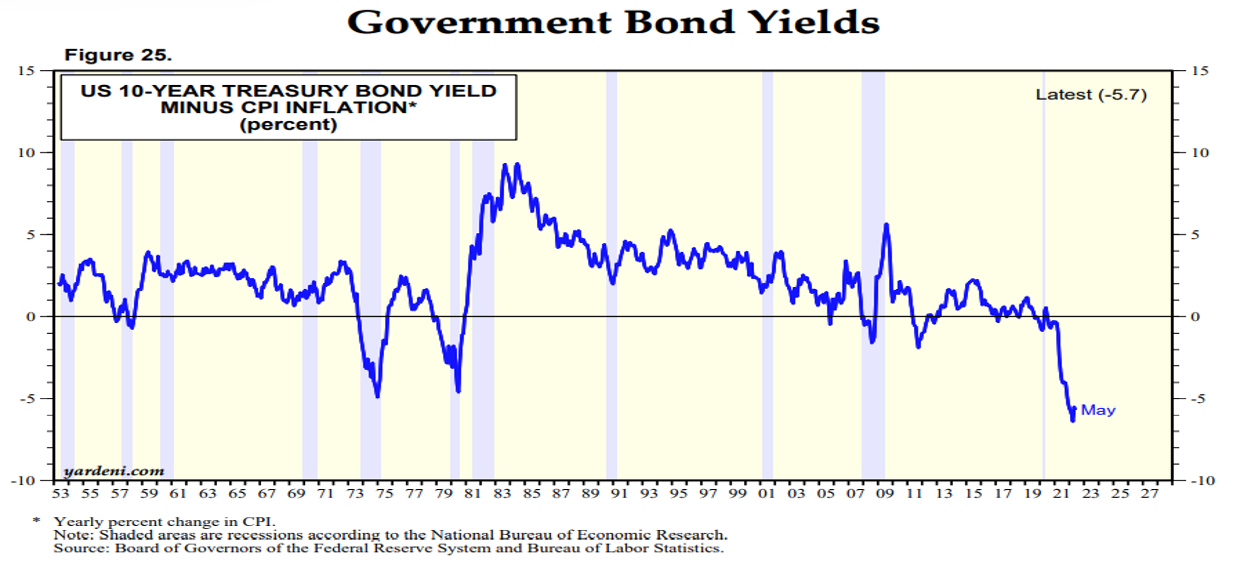
It makes no sense to me and many others why the investment community continues to accept such a ridiculously low return on US government bonds given the inflationary environment that won’t likely collapse as quickly as it rose. Again, my premise is that 4 decades of falling US interest rates that culminated in historically low rates associated with the Covid-19 crisis have clouded our judgment and anchored us to believe that interest rates will remain low forever and ever. All one needs to do is look at the yield on the US 10-year Treasury Note for the 30 years prior to 1982.
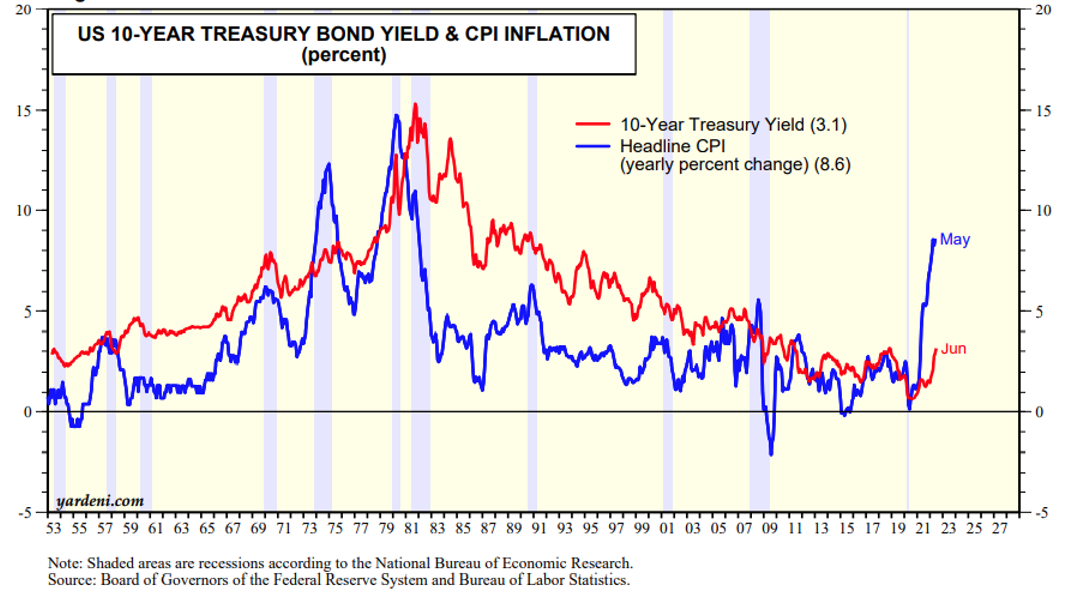
US interest rates historically provide a real return

One should also note that US rates kept rising into 1982 despite the fact that inflation peaked in 1980. Again, investors thinking that the US Fed has already accomplished its objective in curbing inflation by increasing the Fed Funds Rate to 2.25% – 2.5% are just kidding themselves. These rates remain near historic lows and likely remain stimulative to economic growth. Couple that fact with full employment and strong wage growth and it remains highly unlikely that the investment community will get their Christmas gift of a Fed providing easing early in 2023. As always, we encourage your questions and look forward to engaging with you in the near future.
Only In The Second Inning?

By: Russ Kamp, Managing Director, Ryan ALM, Inc.

We’ve been quite surprised by the magnitude of the moves in both US interest Rates (down) and US equities (up) since mid-June. In fact, July is one of only a handful of observations since WWII in which a -7.5% or worse monthly performance (June) was followed by a +7.5% or greater performance for US equities (as measured by the S&P 500). Those previous monthly gyrations have led to extraordinary returns 12 months out. But be careful not to jump with both feet into the water. False signals can be quite dangerous to one’s financial health, especially in light of the fact that each of those previous occurrences followed aggressive easing by the Fed. That isn’t about to happen anytime soon.

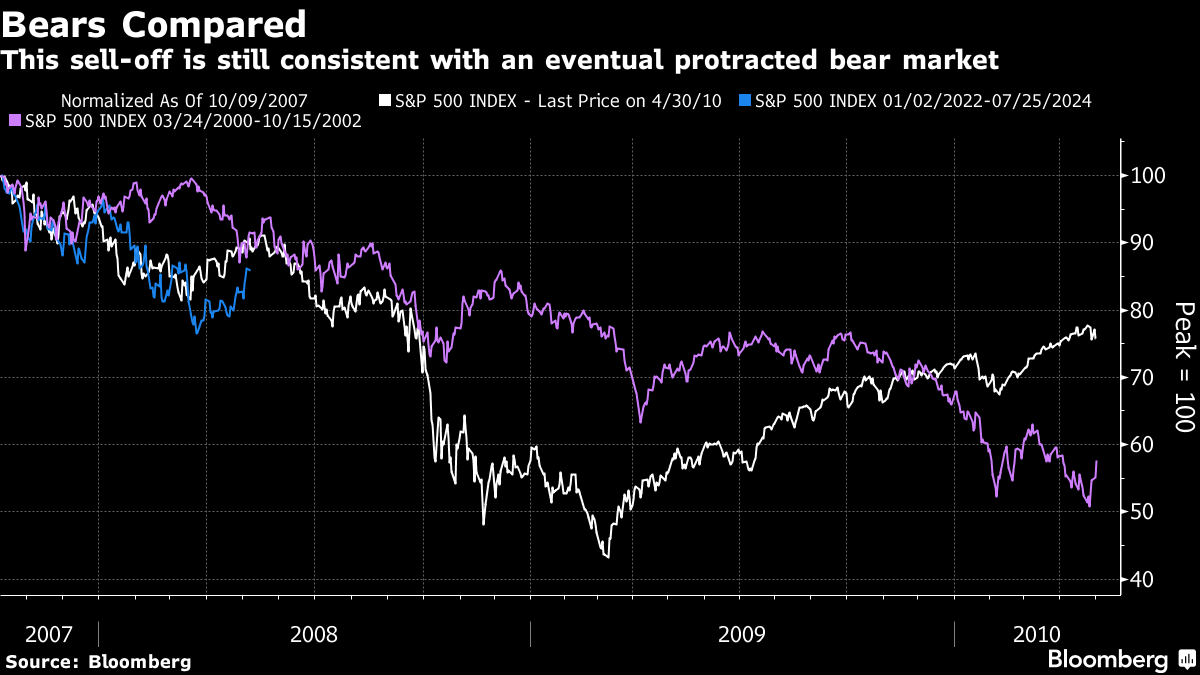
As the chart above highlights, 2022’s equity performance is revealing a pattern not too dissimilar from those of two recent significant market corrections earlier this century. In fact, the patterns are strikingly similar. It certainly seems to us that recent risk-off trades predicated on the belief that the Federal Reserve has actually accomplished its objective of taming inflation seem premature at best, if not just plain silly. The Fed has raised the Fed Funds Rate from effectively 0 to 2.25% at this time. They’ve indicated that another 0.75% increase in September is on the table, while not eliminating the possibility that additional increases might be necessary until they have tackled inflation. Yet, market participants are behaving as if we will see an immediate economic response to these recent increases off a historically low base causing the Fed to swiftly do an about-face. Do investors truly believe that the current interest rate environment is going to choke economic activity? Again, are we ALL collectively anchored with the concept of low rates forever?

In a blog post that we recently produced, the 1970s’ interest rate and inflationary environment took 10 years to unwind. Interest rates began that inflationary cycle in the low 3% range and it wasn’t until 1983 that they once again displayed a 3 before the decimal place. Today we started the day with all Treasury maturities with yields below 3% except for the 1-year T-Bill. That doesn’t seem like a level of rates that would keep most people on the sidelines. For those of us that remember buying our first homes with interest rates in the 11+% range of the early to mid-’80s that thought is almost laughable.

We’ve been encouraging the plan sponsor community to de-risk since last year’s fourth quarter. If you haven’t done so yet, the time is ripe to take profits now as we believe that this correction, due to significant inflationary pressures, is only in the second inning. We look forward to helping you accomplish this objective.

ARPA Update as of July 29, 2022

By: Russ Kamp, Managing Director, Ryan ALM, Inc.

If it’s Monday, it must but ARPA update day! We are pleased to report that there was some activity last week as reported by the PBGC. Teamsters Local Union No. 52 Pension Fund, a Priority Group 2 Critical and Declining plan, refiled an application for SFA. This application is seeking nearly $82 million in Special Financial Assistance (SFA) for the 769 plan participants. They will hear from the PBGC by November 25, 2022.

In other news, Western Pennsylvania Teamsters and Employers Pension Fund and its 21,110 participants have been awarded $715 million in SFA. Congratulations to those members who will now see the reinstatement of benefits that were previously cut under MPRA.

To date, 41 plans have filed an application with the PBGC for SFA. Of those 41, 28 have received approval, and all but one of those have received the award totaling $6.7 billion. This remains a small sample of the estimated 200 plans expecting to receive roughly $80+ billion in ARPA proceeds. As a reminder, Priority Group 4 members were eligible to file beginning on July 1, 2022. None of those have filed an application as of July 29th.

Another Pension Battle Nearing Resolution?

By: Russ Kamp, Managing Director, Ryan ALM, Inc.

We’ve recently gotten greater clarity from the PBGC in announcing their Final, Final Rules related to the ARPA multiemployer pension relief. Could we be getting closer to a resolution related to Delphi’s full-time employees and their pension benefits that were slashed as much as 70% following Delphi’s bankruptcy in 2009? Not all Delphi employees were treated similarly following the bankruptcy, as GM and the PBGC propped up the pensions of unions, but the full-time employees were subject to drastic cuts. The PBGC believed that they were following standard protocol in this matter, and subsequent court decisions supported those actions. However, the US House of Representatives in one of the recently rare examples of bipartisan support passed the Susan Muffley Act of 2022 by a vote of 254-175.

This Act would direct if passed by the Senate, the PBGC to recalculate and adjust each plan participant’s monthly benefits payment, apply the recalculation to previously made monthly payments, and make a lump-sum payment for any additional benefits based on the recalculation. These plan participants have been waiting a long time for a positive outcome. I suspect that many of these Delphi participants have unfortunately passed away during this lengthy process. Let’s hope that the Senate, which has a bipartisan companion bill, takes up the legislation soon so that these plan participants can once again or for the first time enjoy a dignified retirement.

Did They Not Get The Memo?

By: Russ Kamp, Managing Director, Ryan ALM, Inc.

The Great Resignation, aka the Big Quit or the Great Reshuffle, has been raging on since early 2021. We have witnessed a tremendous migration of workers from one job to another. Commentators have identified many factors as to why workers have voluntarily left their jobs, including stagnant wages, deep dissatisfaction with their current roles, safety concerns related to Covid-19, and a desire to work remotely/hybrid work week. These trends don’t seem to be easing at this time. One of the ways to retain staff and reduce the cost of training new employees is to expand/enhance benefits in addition to wages in an environment of significant inflation.

I’ve written in this blog about how I believe (hope) that the Great Resignation, coupled with rising rates and the creation of pension income (first time in aggregate for the past two decades), might be enough to encourage corporate plan sponsors to re-open frozen defined benefit (DB) pension plans. Define contribution plans which have become the dominant “retirement” savings vehicle are inferior to DB plans as they are dependent on the individual’s ability to fund, manage, and then disburse a benefit for the remainder of their lives – no easy task given the lack of financial resources/training/experience!

Well, it appears that at least one firm may not have gotten the message. Boeing Company is facing a possible August 1st strike involving roughly 2,500 St. Louis area union employees from District Lodge No. 837, International Association of Machinists and Aerospace Workers, AFL-CIO. This union saw its DB pension frozen in 2016 as a result of a 2014 contract negotiation. Boeing is willing to match up to 100% of the first 10% contributed by employees, but as part of the negotiation, they are REDUCING their automatic employer contribution from 4% to 2%. So, in an environment of high inflation where wages for many Americans fall short of covering their monthly expenses, Boeing is further reducing retirement benefits. Do they really believe that the average American worker has the financial wherewithal to take advantage of their “offer” to match greater contributions?

The hiring and training of new workers can be very expensive and time-consuming. Putting in place enhanced benefits, including retirement, that encourage valuable employees to remain at their current place of work seems like quite a reasonable trade-off. The fact that rising US interest rates make the present value of pension liabilities cheaper while also possibly producing pension income is a bonus. DC plans are a terrific supplemental retirement benefit. They were never intended to be anyone’s primary source of retirement income. Perhaps US employees, if not their employers, are finally waking up to this fact.

More Reasonable Expectations

By: Russ Kamp, Managing Director, Ryan ALM, Inc.

I was extremely pleased to read Bridgett Hickey’s recent FundFire article, “Pensions Return Expectations Fall Below 7% for First Time” in which she writes that the average public pension plan return on asset (ROA) assumption “has dropped below 7% this year for the first time in U.S. pension fund history.” I can’t speak to what ROAs looked like from the 1950s to 1981 when I first entered the industry, but it is the first time that I can recall seeing ROAs so reasonably low. I’m thrilled that most plans haven’t extrapolated linearly from the most recent performance period and projected those results well into the future. Given 2022’s results to date, it appears that public pension funds were quite prescient.

According to an Equable Institute survey of 167 statewide plans and 61 municipal plans, the average ROA is now 6.93%, which is down significantly when it was 8% as recently as 2001. This trend is further supported by data from the National Association of State Retirement Administrators that showed the average assumed rate of return was 6.99% in March. Despite the progress to reduce annual return expectations there remain 21 plans that have a 7.5% or greater objective according to Equable. It isn’t a seamless task to reduce the ROA as it impacts annual contributions (and budgets), which rise when the discount rate is reduced. But, contributing more, if possible, reduces the uncertainty around achieving a return target that comes with considerable volatility.

It would be wonderful if this lower return target also came with a rethinking related to asset allocation. We’d highly recommend bifurcating the plan’s assets into two buckets – liquidity and growth. The use of a cash flow matching bond program to meet liability cash flows enables the growth portfolio to grow unencumbered as it is no longer a source of liquidity. Having this extended investing horizon reduces the variability of returns longer-term and enhances the probability of success. As we migrate through a very uncertain investing horizon fraught with high inflation and rising rates, gaining a little certainty with regard to enhanced asset cash flows to meet liability cash flows is very comforting.

ARPA Update as of July 22, 2022

By: Russ Kamp, Managing Director, Ryan ALM, Inc.

We are pleased to provide you with the weekly update related to the ARPA pension legislation. However, once again there is little to report. We had one pension system submit their revised application. New York State Teamsters Conference Pension and Retirement Fund refiled their application on July 21, 2022. This Priority II (MPRA Suspension) plan originally submitted an application on January 28, 2022, which was subsequently withdrawn on May 26th. In the initial filing, they requested Special Financial Assistance (SFA) of $1.036 billion to help secure the benefits for their 33,643 plan participants. In this most recent filing, the pension system requested an adjusted $918.1 million to be used to cover the same population.

Based on the newly released PBGC Final, Final Rules (FFR), I would have expected the requested SFA to be greater than that of the initial filing. It will be interesting to see what they eventually receive once their application has been approved. Fortunately, there were no other plans that had their applications either rejected or withdrawn. In addition, there were no payments of SFA made to approved applications. Only one plan with an approved application, Local Union No. 466 Painters, Decorators, and Paperhangers Pension Plan, is waiting on its SFA payment. To date, there have been 27 applications approved and an additional 12 are in review. We are expecting much more activity based on the estimated cost of this legislation being roughly $80 billion.

The Greatest Asset of a Pension: Time!

By: Russ Kamp, Managing Director, Ryan ALM, Inc.

We have provided perspective within this blog on the importance of having a long time horizon. In fact, we have multiple blogs that discuss the idea of buying time. I’m pleased to add another post to our considerable inventory. The latest version was produced by Ron Ryan, CEO, of Ryan ALM, Inc. As you will read, Ron had the pleasure recently to speak at the FPPTA in Orlando. It was during the conference that he heard further endorsement of this important concept. Ron was thrilled to hear Mike Welker, CEO at AndCo, state the following: “the greatest asset of a pension is time.”

Buying time within a pension plan is critically important. However, a plan must have the correct structure in place from an asset allocation standpoint to accomplish the objective. Public pension systems have shifted significant assets into alternative investments in pursuit of potentially greater returns, but in doing so they have reduced liquidity to meet benefits and expenses (B + E). Ron astutely points out that bonds MUST be used for their cash flows and not as a return instrument to improve a plan’s liquidity. By carefully matching bond cash flows with liability cash flows (benefits and expenses), a plan can successfully extend the investing horizon (buy time!) for the balance of the pension system’s residual (growth) assets to grow unencumbered. I know that you’ll find Ron’s insights beneficial.

The Importance of Dividends – Updated

By: Russ Kamp, Managing Director, Ryan ALM, Inc.

We’ve shared with you on a couple of occasions the output from a report published by Guinness Asset Management. In our February 23, 2022 blog on this subject, we highlighted the fact that Guinness calculated the portion of the S&P 500’s return through time that came from dividends and dividends reinvested. That Guinness report was through December 31, 2011. Given the growth within the S&P 500 of non or low-paying companies (technology stocks), we wondered if the magnitude of the contribution to the S&P 500’s return from dividends had contracted. Good news: it hasn’t!

According to the Guinness study, which has been updated as of April 2020, the contribution to return of the S&P 500 from dividends and dividends reinvested for 10-year periods since 1940 was a robust 47% down insignificantly from 48% a decade ago. Extending the measurement period to 20 years from 1940 forward highlights an incredible 57% contribution to the total return of the S&P 500 from dividends. In the previous review, 20-year periods had revealed a 60% contribution to return. Furthermore, this study is on the entirety of the S&P 500, not just those companies that pay dividends. If the universe only included dividend payers this analysis would reveal strikingly greater contributions given the fact that as of March 31, 2022, there are currently 108 companies within the S&P 500, including GM, Disney, Amazon, Facebook, and Boeing that aren’t paying a dividend.

CalPERS Reported Performance: Congratulations!

By: Russ Kamp, Managing Director, Ryan ALM, Inc.

CalPERS, the roughly $440 billion public pension plan, has reported the plan’s preliminary fiscal performance results through June 30, 2022, at -6.1% or -$29 billion in AUM. I’m sure that there is tremendous handwringing going on throughout Sacramento, if not the whole of California, as those returns are well below their annual return on asset (ROA) objective of 6.8%. This “poor” result follows a spectacular performance year. We’ll not only see many stories about CalPERS, but we’ll soon get a plethora of performance updates from public pensions both large and small all lamenting a similar fate. But were the last 12 months so bad? After all, I was congratulating CalPERS within the title of this post. Was I just being obnoxious?

No, I wasn’t trying to embarrass anyone, but I may have been a little snarky given that a significant majority of folks in our industry would look at the result and say “WOW”, what a terrible return. However, we at Ryan ALM, Inc. look at -6.1% for the fiscal year in a very different light. You see, plan assets are but one piece of the pension puzzle. Sure, they are the piece that gets all the focus and press, but they remain just one part of a very important equation: Assets need to beat liability growth in order to maintain or improve a plan’s funded status. Toward the end of 2021 and into 2022, US interest rates rose rapidly. Those rising rates impacted both bonds and liabilities as they are highly interest rate sensitive. Rising rates will reduce the present value of future benefit payments and liability growth.

The good news for Pension America is the fact that the duration of pension liabilities is on average longer than the duration of the plan’s assets. For the prior 12 months ending June 30, 2022, liability growth for the average plan fell by -16.2% when using ASC 715 discount rates (FASB). As a result, CalPERS actually enjoyed a wonderful performance year as asset performance (despite being negative) far outpaced liability growth. Instead of fretting about a performance result that looked lousy, they should be celebrating the fact that their system actually saw improved funding when liabilities are valued using ASC 715 rates.

Please don’t hesitate to go to Ryanalm.com for additional information pertaining to discount rates and their impact on liabilities.