KCS Q1’17 Quarterly Update

We are pleased to share with you the KCS Q1’17 quarterly update.  As you will read, there was a lot going on for KCS in the quarter, as well as for Pension America.  Funded status improved, as assets advanced while liabilities were basically flat as interest rates remained fairly steady.

KCS continues to produce many articles and posts through our blog, Fireside Chat series, and occasionally as a guest writer for various newsletters.  In addition, we continue to participate in multiple conferences throughout the country, all with the goal of providing education on important pension-related topics.

As always, we hope that you will find our insights helpful.  Please don’t hesitate to reach out to us if we can be of further assistance to you.

Finally?

The following snippet was sent to me by an industry acquaintance – thank you, Chris – and I’m happy to share it with you. This quote was part of a Bloomberg interview with Larry Fink.

“We don’t spend enough time as a society understanding how bad the retirement system is in this country. I think so much of the anger in this past election is based on people’s fear of their future. People are frightened; they know they haven’t saved enough money for retirement. They’re going to be highly dependent on Social Security—which, if that’s the only source of income, means living in poverty. In addition, the bigger problem many of our cities and states are facing is that their retirement plans are defined benefit plans. Their liabilities are so large, and increasing, especially as we transform deadly diseases into chronic ones. That translates into greater longevity, and—you’re witnessing it every day as an American—underspending on our infrastructure. It’s a direct cause of the financial positions of state and local governments. And it’s only going to get worse.

I believe the recognition of our precarious retirement position is one of the most underappreciated future crises in this country. I think this crisis is going to be much bigger than health care. Health care is immediate. If you don’t have proper health care, it is today’s problem. But as you know—investing, the whole concept of compounding—if you’re not building your nest egg year after year after year, you’re not going to have enough savings to retire with dignity.”

It is refreshing to finally see some recognition of the crisis that is unfolding.  At KCS we’ve been highlighting the likelihood of profoundly negative social and economic consequences that will occur as a result of our failure to prepare our employees for retirement since our inception, nearly 6 years ago.

Where we depart from Mr. Fink is blaming defined benefit plans for the lack of financial resources within various U.S. states to meet social and infrastructure needs.  I blame the actuarial, investment management, and consulting industries for their focus on the wrong objective.  DB plans should be managed with a cost objective and not a return focus. Too much volatility has been injected into the process.

We need to start managing these critically important plans with the right focus, and if we can, we are likely to get more stable contribution costs and funded ratios.  As we’ve said before, we are one equity market crash away from absolute devastation of DB plans. How comfortable are you that this won’t happen after 8 years of a bull market combined with weak U.S. and global growth?  Remember, we already have examples of public DB plans being frozen. We can’t afford to have this “trend” become a tsunami.


Ryan ALM Q1’17 Pension Letter

We are always pleased to share the Ryan ALM quarterly Pension letter. 

Regular readers of the KCS quarterly piece will know that we highlight liability growth versus asset growth (borrowed from Ron Ryan) to indicate whether pension funding is improving or deteriorating. Fortunately, strong asset growth and flat yields propelled defined benefit plans to improved funding during the first three months of 2017.

However, don’t get too complacent, as yields have fallen fairly significantly so far in April, while assets have been flat to down.  The nice gains could be eroded fairly quickly.

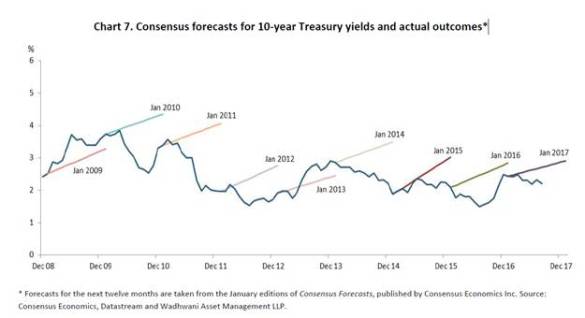
We, at KCS, are on record stating that we don’t believe that US interest rates are going to rise quickly, as we don’t see much growth in either the US or abroad.  Plan sponsors and their asset consultants that move aggressively to further reduce the fund’s fixed income exposure are deepening the asset/liability mismatch that is prevalent in most public and multi-employer plans.

Ron’s work to preserve and protect DB plans should be embraced.  You’ll get a feel for how unique his insights are through these quarterly letters – enjoy!

Why Italy?

Last night I had a wonderful opportunity to participate on a panel at Fordham University. The event was managed by the Fordham Graduate Finance Society (they did a great job), and our panel was to provide an outlook related to the “new” financial landscape.

There were several topics discussed that created a lot of good, healthy debate.  The moderator completed his line of questioning by asking each member of the panel what risk they feared that might not necessarily be a focal point for the financial press.  I volunteered that I was very concerned with Italy’s banking system because I believe that it has the potential to take down the Euro and Eurozone.

There is a terrific article/note that I want to share that addresses the current situation among Italy’s roughly 500 banks.  Basically, more than 20% of the Italian banks have Texas Ratios >100%, effectively rendering them failed.  Although many of the banks are small, several of Italy’s largest banks are struggling under the stresses of non-performing loans.

Brexit may have dinged the Eurozone’s armor, but the Euro remained unscathed.  A failure of Italy’s banking system will be a frontal assault on both the Eurozone and the Euro from which there may not be a recovery.  Remember how the markets reacted after the UK vote last June?  There was immediate global pain followed by a fairly quick recovery.  Should Italy not be able to rescue its banking system, we suggest that the pain will be more severe and recovery may take far longer to manage.


U.S. Fed Wants To Shrink The Balance Sheet – What Are The Implications?

There is a lot of hand-wringing surrounding the possible move by the U.S. Federal Reserve as it considers how and when to begin to unwind the $4.5 trillion in debt on the balance sheet.  The discussion centers around the speed of the unwinding and the potential consequences to the bond market under each scenario.

Well, we have good news for you.  Since the U.S. Government owns both the asset and liability, they could effectively “retire” the debt without any consequence to the private sector.  Will they do this?  We doubt it since we haven’t heard this discussed as a possible solution.

In order to effect this transaction, all that would have to happen would be for the Treasury to take a credit and the Fed a debit, and these securities would be gone with no impact on the private sector.  Nice and clean!  We’ll just have to wait and see what they decide to do, but let’s hope that their actions don’t create unnecessary volatility within the bond market.


KCS April 2017 Fireside Chat – “Sharing Is Caring”

It is our pleasure to provide you with the latest version of the KCS Fireside Chat series. In this article, we share the highlights from four of our most recent KCS blog posts. The common threads among these posts are the social and economic implications that our citizens are facing today and the likely impact that they will create on the funding of a defined contribution retirement program.

IMG_1237

Loose Lips Sink Ships, So Does 401(k) Leakage

The WSJ is reporting today on the onerous impact of “leakage” from defined contribution plans.  It’s about time!  We’ve referred to defined contribution plans as “glorified savings accounts” for the very reasons that individuals can borrow, initiate premature withdrawals, and eliminate or adjust funding (as can their employers). The impact from these activities can cripple the long-term growth potential of the account while leaving the plan participant broke in retirement.

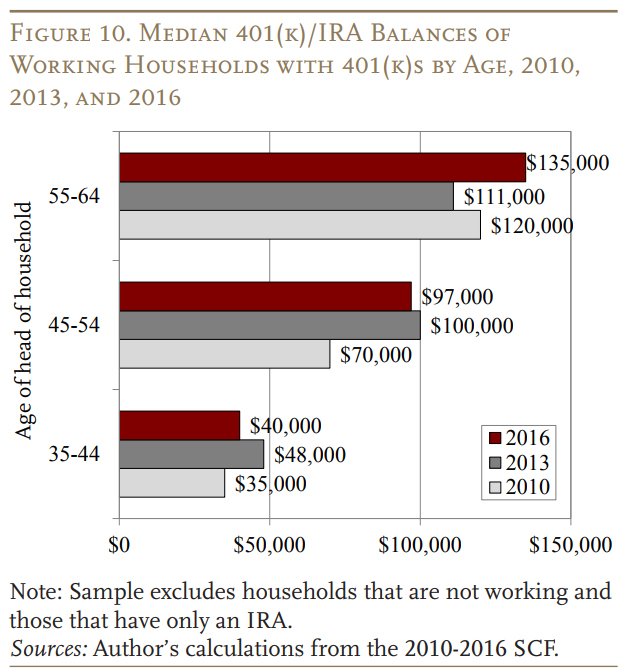
The demise of the traditional DB plan and the lack of financial literacy are combining to create a retirement crisis in this country.  The fact that the WSJ is just reporting on it today is frightening.  According to the National Institute on Retirement Security (NIRS) the median retirement balance for a US household is only $3,000.

The practice of tapping into one’s 401(k) plan is growing. “401(k) plan leakage amounts to a worryingly large sum of money that threatens to undermine retirement security,” says Jake Spiegel, senior research analyst at research firm Morningstar Inc. His calculations show that employees pulled $68 billion from their 401(k) accounts, taking loans and cashing out when changing jobs in 2013, up from $36 billion they withdrew in 2004.

The lack of wage growth since 1999 for the average worker and the growing number of potential workers no longer in the work force (estimated at >94 million) are exacerbating this issue.  Furthermore, as we reported last week, the cost of college education is leading many parents to borrow from their retirement accounts to help fund education for their children, who are also borrowing at record amounts so that they can pursue a degree.

There will be profoundly negative social and economic ramifications from these actions!


Things Aren’t Always As They Appear

We’ve all read recent reports on the U.S. real estate market, which appears to show great strength.  In fact, yesterday it was reported that The S&P CoreLogic CaseShiller Home Price Index for January increased by 5.7% year over year for the 20-city composite index.   On the surface that sounds quite positive.  However, I have a friend who is one of the country’s leading real estate analysts, who has been complaining about the current state of the U.S. real estate market.

However, I have a friend, Keith Jurow, who is one of the country’s leading real estate analysts, who has been relaying his concerns to me about the current state of the U.S. real estate market.  What in the numbers scare him?  As it turns out, it isn’t what is being reported, but what isn’t.  Keith feels that the index doesn’t appropriately capture the true economics of our market.

Given this concern, I asked him to write an article for the KCS Blog, which follows.  I hope that you find his insights useful – I certainly have.

Why the Case-Shiller Index Distorts Home Price Gains by Keith Jurow

For many years, the Case-Shiller Index has mesmerized pundits and Wall Street alike. It is the undisputed gold standard for assessing housing market price changes and its credibility has remained unchallenged. Who doesn’t believe that this Index truly depicts what is happening in major housing markets around the country?

Its former publisher — Standard & Poors – actually put out a 41-page explanation of the methodology behind the Index upon which this analysis is based.

The index uses what is known as a “repeat sales” model because it takes recent home sales and matches them with a previous sale of that same property. It is essential for you to understand that at the foundation of the index are certain key assumptions. The most important is that different weighting is assigned to matched pairs of home sales depending on certain criteria.

Paired sales are assigned a weight anywhere from zero to one depending on how far the pair differs from the “average price change for the entire market.” The purpose of this is to “smooth out” distortions which the Index creators believe are caused by extreme price changes that differ markedly from most of the other price changes in a given metro.

Here is an even more important weighting factor. A home which has a longer time interval between its two paired sales is given considerably less weight than one where the interval is much shorter. For example, a home in which the interval between sales is 10 years may be assigned a weight equal to only 80% of a paired sale with a six-month interval. An even longer time between paired sales could be given a weighting as low as 55%.

The S & P explanation describes the assumption behind the weighting given to different time intervals this way: “Over longer time intervals, the price changes for individual homes are more likely caused by non-market factors” (i.e., physical changes in the property such as a room addition).

As a result of this assumption, the paired sale of a house in any metro which composes the Index can be given a weighting significantly different from other paired sales in that metro.

Why is this assumption built into the Index? A sale is a sale, isn’t it? Shouldn’t all home sales be given the same weighting in compiling the Index? Apparently not, according to the economists who created this Index.

Why does this matter? The very different weighting of paired sales necessarily causes the index to grossly distort the raw sales data. To put it differently, the Case-Shiller Index is in no way an accurate measurement of what price changes are occurring in any major housing market of which the Index is composed.

Let me be crystal clear. The only way to get an accurate picture of any housing market is to take houses recently sold where there is data on the previous sale of that house. Then you can measure the actual gain or loss on that property over the specific time period between sales.

No index does this. The closest attempt actually made was a US Home Sales Report put out by RealtyTrac in April 2016. I wrote a detailed article on this a year ago. Let me explain briefly.

The report took 125 major metros which had at least 300 home sales each in March 2016 where they also had data on the previous sale of that home. The compilers of the report took an average of the net gain (or loss) for all the home sales in that metro. These were not annual price increases but gross gains over the entire period of ownership. For all the metros, homes were held for an average of 7 ½ years. The median gross profit (excluding sales commissions) for all these metros was 16%. After deducting the commission, the average net profit was barely 10%. Thirty metros had gross profits of between 1% and 10%.

For an average holding period of 7 ½ years, this average gross profit is really terrible. The property owners would have been better off with a portfolio of high-quality corporate bonds during that period.

In 15% of these markets, there was actually a loss for those who sold in March 2016. This included major metros such as Chicago, Cleveland, Milwaukee, and Birmingham. Take a look at this table showing the major metros with the highest and lowest price gains.

There is a reason why the top three markets are all in California. More than 40% of all outstanding bubble era non-prime loans have been modified. This percentage has steadily risen from only 17% in early 2011 and continues to increase.

Why is this important to know? Because so many delinquent bubble-era mortgages in California were brought current by these modifications, foreclosures have completely collapsed – from a peak of 30,000 in August 2008 to slightly more than 1,000 in December 2016. Had these seriously delinquent mortgages been foreclosed instead of modified, that would have dumped hundreds of thousands of properties onto the market at distressed prices. Because this did not occur, median sale prices, as well as the Case-Shiller Index for metros such as Los Angeles, have been artificially inflated.

Conclusion

When you re-read the latest Case-Shiller report, keep what I have explained in mind. Its distortions tell you very little about what is occurring in these major metros. To understand the reality of housing markets and where they are headed, following my upcoming articles might be a good place to start.

Keith Jurow is one of the nation’s leading real estate analysts. Many of his in-depth articles can be found at his website, http://www.keithjurow.com.

Back To The Future

I’ve just found a great article by Robert M. Ball, titled “Old-Age Retirement: Social and Economic Implications”.  For regular readers of the KCS blog, you know that we spend a lot of time trying to highlight and understand both the social and economic ramifications of our failure to provide a stable retirement benefit.  Many of the points discussed in Mr. Ball’s article echo topics that we’ve raised, including:

  • Over the next 15-20 years will we make the fundamental adjustments that are necessary if older persons are to make the economic contribution that they are capable of making?
  • For most workers today, retirement means inadequate food, clothing, housing and a sense of insecurity.
  • For those workers forced into retirement (lay-offs) the worker loses more than an income, as they are faced with emotional and spiritual problems equally as serious.
  • Work means recognition in our society, and it is largely through work that one gets a sense of being a useful participating member of society.
  • Our failure to give the aged a responsible role in the community is making them into a class apart.
  • The very technological improvements that increase labor productivity and make it possible to support the aged in retirement constitute a serious threat to the employability of the older worker.
  • The older workers who lose jobs are at a greater disadvantage in securing a new one.
  • The future will find us with a considerable number of job vacancies at the same time that we have a hard core of unemployed workers (review the current U6 and LPR data).
  • Individual savings for old age is extremely difficult for most wage earners.
  • What savings the worker generates is often used up during illness or unemployment, or is spent bringing up children.

The article concludes with the following, ” We cannot afford the separation of the aged from the community or the organization of the aged against the community. The aged need the secure place in our national community that can come only from the continued participation in the life of that community, and the national community needs the wisdom and the skill of older persons.”

I suspect that most of you agree with the points being made above.  Given that, you’ll probably be shocked to read that this article that I just “discovered” was written in 1950.  Mr. Ball was the Assistant Director, Bureau of Old-Age and Survivors Insurance.

I was particularly impressed by his statement regarding the tug of war between those that are unemployed and the significant number of vacancies that employers might have as a result of a skills mismatch.  He was quite prescient. Furthermore, he hits on a major issue regarding the transition from defined benefit plans to defined contribution plans, by highlighting how difficult it is for workers to generate enough savings, especially the low-wage earners.

The article is lengthy but well worth the read for anyone who wants to better understand what we are facing today nearly 70 years after Mr. Ball wrote his piece.

And Then There Are Student Loans…

As recently reported by the NY Post, a study of government data by the Consumer Federation of America found that the number of Americans in default on their student loans jumped by nearly a fifth last year.  According to the analysis, student loans in default, meaning that they haven’t made a payment in more than 270 days, jumped from 3.6 million to 4.2 million by the end of 2016.

The 4.2 million loans in default are roughly 10% of the number of student loans in the market.  Furthermore, Americans currently owe about $1.3 trillion in federal student loans.  Including private loans, the amount of debt grows to $1.4 trillion.  Shockingly, student loan debt has grown from just about $0.5 trillion in 2006 to $1.4 trillion in 2016.

As the article points out, “Defaulting on a federal student loan can be a financial disaster for the borrower. Unlike other types of debts, most federal student loans cannot be discharged in bankruptcy. Those who go into default face serious repercussions including wage garnishment, damaged credit scores and potentially added costs in fees, interest,  and legal fees.”

The significant increase in the cost of education and the greater use of student loans to meet this expense is placing an unfair burden on our younger generation.  This burden makes it nearly impossible for one to begin to fund a defined contribution retirement plan, but that is basically what we are left with at this stage.  The more it delays funding the less likely it is that one will generate a retirement account meaningful enough to accomplish one’s goal of retiring.

At KCS, we focus on issues related to one’s ability to retire, but the burden of greater educational costs impacts so much more from establishing family units, housing, and the general demand for goods and services.  It isn’t shocking to us that the US economy hasn’t generated a >3% GDP growth since 2005 when one looks at the significant growth in student loan debt since 2006.