A Regressive Tax?

Student Loan Debt

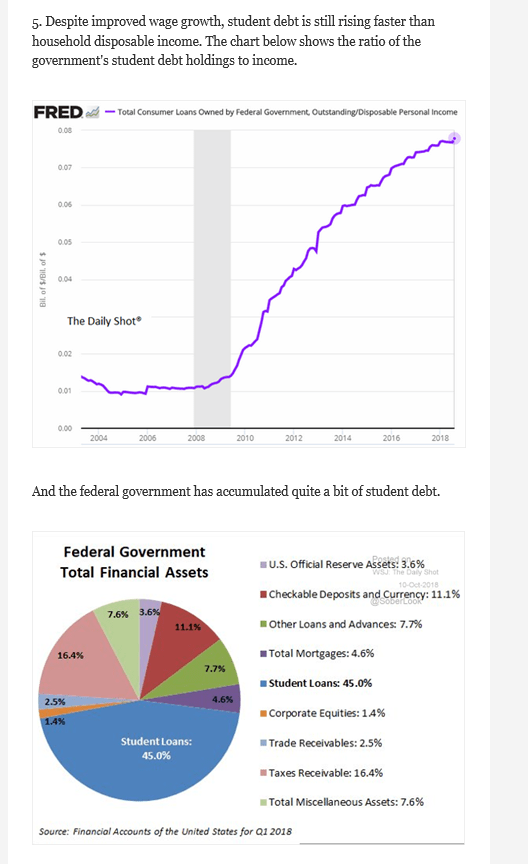
I’m much less concerned about the federal government accumulating debt as a result of the growth in student loans, as I am American households, especially those at or below median family wealth. The growth in student loan debt is crippling the financial future for many younger Americans, and it is impacting their ability to purchase first homes, start families, and save for retirement.

In this age of do-it-yourself retirements (DC plans) not having the financial means to fund one’s retirement at an early age will make it nearly impossible for these participants to ever create a pool of wealth to provide for a decent, let alone, dignified retirement.

No More Games!

Private equity firms and public pension systems have enjoyed a symbiotic relationship for years, with the latter providing the capital (about 35% of private equity capital comes from public pension systems) to the former to invest with the hope that significant returns can be achieved. However, this relationship may be changing as a result of the perceived mistreatment of workers through the actions of private equity firms.

The NY Times is reporting on how former workers for Toys “R” Us have rallied support from public pension systems when their demands from private equity firms went unheeded. Roughly 30,000 workers lost jobs when the former retailer went bankrupt last year, and worse, they did not receive any severance.

Participants in both public employee and union funds loath to see their pension assets used to harm other workers. Having failed in their quest to be heard by the private equity firms involved in the demise of their company, former employees took their case directly to the public pension systems that helped fund the acquisition. During a 3-month period, these former employees and their advocates (Rise Up Retail and the Private Equity Stakeholder Project) met with 14 public funds in 12 different states to begin to exert some control over just how these pension assets can be invested – it is about time!


Corporate Pension Plans Show Improved Funding

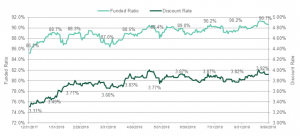
S&P 500 companies with defined benefit pension plans continued to show improved funded status in September, as assets were up marginally along with rising discount rates, which reduce the present value of the plans’ future liabilities. Given the improved funded status, will corporate pension plans take some risk off the table? They should continue to reduce equity exposure in favor of bonds that can more effectively mirror the plans’ liabilities.

For public and multiemployer plans that discount plan liabilities at the ROA, the notion that rising interest rates are reducing plan liabilities is a foreign concept, which is why plan sponsors in those pension systems need to get more transparency regarding plan liabilities. With this enhanced knowledge comes the ability to have a more responsive asset allocation policy.

Ryan ALM Pension Letter

We are happy to share with you the third quarter Ryan ALM Pension Letter. For public pension systems and multiemployer plans that continue to value plan liabilities under GASB using the ROA, liability growth using the return on asset assumption (ROA at 7.5%) is +5.92% year-to-date.  However, if you use ASC 715 (FAS  158) or a true mark-to-market rate to (US Treasury STRIPS) plan liabilities have actually fallen by -5.1% and -5.3%, respectively.

With negative growth rates for liabilities, funded ratios can improve rather dramatically with even modest asset growth. Think that US interest rates might continue to rise from these levels? If so, having a true (and better) understanding of liability growth will assist you in making more informed investment structure and asset allocation decisions.

Despite the recent outperformance of assets versus liabilities, liability growth has outperformed asset growth by more than 120% since 2000.

The Social Implications From a Failing Retirement System

The WSJ has produced an article in today’s edition addressing the impact of the retirement wealth gap that exists among Americans. We, at KCS, have been forecasting profoundly negative economic and social ramifications due to the retirement industry’s failure to adequately prepare our retirees.

I attribute much of this unfolding crisis to the demise of the traditional defined benefit plan, while others feel that since only about 40-50% of Americans were ever covered by these plans that can’t possibly be the reason. I strongly disagree. If only we were able to maintain that peak coverage, as today we have about 14% of the private sector in DB plans with many of those participants in frozen programs that are no longer accruing benefits. Furthermore, there are growing pressures on many of the remaining public and multiemployer DB plans that call into question their long-term viability.

The Journal article highlighted the impact that this wealth divide is having on retirement communities (they specifically focused on Oakmont Village in Santa Rosa, CA) where those living on fixed incomes are finding it very difficult to sustain their independence and maintain households in the face of growing monthly dues as well-heeled residents demand upgrades to facilities and more expensive amenities that many residents just can’t afford. It is shameful that residents are being driven from these communities that have become too expensive.

We believe that America needs to address this growing issue, and soon. From an investment standpoint, the absence of affordable senior housing needs to be tackled, which provides our institutional real estate managers a plethora of opportunities. With nearly 10,000 Baby-Boomers reaching age 65 daily and for the foreseeable future, the need appears to be only growing.

We are often criticized as we travel around the country speaking to the need to protect and preserve DB plans, but the migration to defined contribution plans is not working for the majority of American workers. It is poor policy to believe that the average American worker will be able to fund, manage, and disburse a retirement benefit without the financial and educational means to accomplish this objective.

Our support of the Butch Lewis Act, which attempts to preserve DB plans for the most challenged multiemployer pension systems, reflects our understanding of the social and economic implications for the millions of American workers who would see their promised benefits substantially reduced! It is about time that our “leaders” understand that we are going to pay to protect these individuals in one form or another. I suspect that most of those at-risk beneficiaries would much rather have their promised benefits than to fall onto the federal government’s social safety net.

An Important Note From CORPaTH

Here is a note that we received from Ron Auer, Executive Director, CORPaTH regarding the Joint Select Committee on Solvency of Multiemployer Pension Plans. As Ron says, we are entering a critical time. At Ryan ALM and KCS, we’d like to see the Butch Lewis Act (BLA) implemented, as is, but understand that everything is a negotiation.  Here is Ron’s letter:

Dear Russ:

Washington is listening, and CORPaTH urges you to ensure the message for pension security is heard loud and clear.
 
The Joint Select Committee on Pension Solvency represents a promising effort by both houses of the United States Congress to resolve the crisis which undermines the health of Defined Benefit plans and the ability of millions of Americans to retire with dignity. Co-chaired by Senators Orrin Hatch and Sherrod Brown, the committee is taking comments and suggestions from the pension community.
 
At CORPaTH, one suggestion stands out as especially promising: tax credits for employers who are funding existing defined-benefit pensions or are establishing new plans.
 
These credits would provide an incentive for employers to secure the future of their workers while benefitting their bottom lines and stabilizing a system which has served millions over the course of many decades. 
 
CORPaTH believes this is a historic opportunity for Americans to come together on a bipartisan basis to secure the economic strength of working families, employers and our country as a whole. 
 
We invite you to join the conversation by contacting the members of the Joint Committee and making your voice heard. You can find a list of committee members and their contact information by clicking here.
 
Thank you for stepping forward and speaking out on behalf of hard-working Americans who have earned the promise of a secure retirement.
Sincerely,

Ron Auer
Executive Director, CORPaTH

We agree that providing the right incentives is always important, but without low-interest rate loans from the Treasury Department to the 114 critical and declining pension systems, millions of Americans will suffer significant social and economic consequences. Please reach out to your representatives, even if they aren’t on the JSC, to lend support to getting the BLA passed in its entirety. Thank you.

Ryan ALM and KCS at FPPTA

There are many U.S. states that conduct on-going (and necessary) training for public fund trustees. I’ve been fortunate to speak at a number of these events since KCS was created.  The folks at the Florida Public Pension Trustees Association (FPPTA) do an especially good job as they also provide a test/certification program following the completion of required coursework and attendance.  Ron Ryan and I have just returned from speaking at FPPTA’s most recent event in Naples, FL.

Our presentation was titled, “How to Enhance the Funded Ratio”. We’ve given presentations touching on a similar subject matter at this event before, but never have we gotten the type of immediate and positive feedback that we received this time. For the last 6-7 years, both Ron and I have been trying to raise awareness regarding the need for defined benefit plans in both the private and public sectors to achieve a greater knowledge of their plan’s specific liabilities in order to manage their pension systems more effectively. OUR goal is to enhance the information that is available to these trustees in order to make more informed decisions.

As we’ve often articulated, managing a pension system without knowledge of the plan’s liabilities (the promise made to the participants) is similar to trying to play football without knowing how many points your opponent has scored. Obviously, it is not an easy task, if not impossible.

Our message to the folks attending this educational symposium was very simple and straightforward:

  • The primary pension objective is not about beating the return on asset assumption (ROA), but that plan’s specific liability growth, which of course can be negative in a rising interest rate environment.
  • EVERY DB pension system should be on a de-risking path toward full-funding no matter what the current funded status, as asset allocation will be driven by the funded ratio.
  • Lastly, running a single asset allocation strategy geared to the ROA is yesterday’s approach, which hasn’t worked and likely won’t going forward. Plans need to implement our bifurcated approach to asset allocation that separates de-risking assets (used to meet retired-lives benefit payments) and growth assets that are benchmarked to future liabilities.

This approach is one of three potential implementations in the Butch Lewis Act legislation that we’ve highlighted on many occasions in this blog. Please let us know if you would like a copy of the FPPTA presentation that we delivered, and thank you once again to the folks at FPPTA for giving us the opportunity to share our insights with many of the Florida public pension trustees.


Sponsors – Don’t Wait For The Butch Lewis Act to Pass – Act Now!

There is little question that passing the Butch Lewis Act is of paramount importance for the roughly 114 Critical and Declining multiemployer pension systems.  These plans are forecast to become insolvent within the next 15 years, and many much sooner, and without the benefit of a lifeline in the form of a low-interest rate loan, little can be done to rescue them at this time. It is incredibly unfortunate that plan participants are facing potentially catastrophic benefit cuts. Shameful, actually!

Hopefully, Republican and Democratic Senators and House of Representatives members will work together to overcome their philosophical differences to find a working solution to this unfolding pension crisis. Yesterday was actually too late in some cases.

However, while we wait, there are roughly 1,300 additional multiemployer plans not facing the prospect of imminent collapse. These plans have the luxury of more time to work through their funding shortfalls, but doing the same old, same old is not the answer. Why? Continued focus on the return on asset assumption (ROA) as the primary objective subjects these plans to the potential volatility associated with market corrections. As everyone realizes, we are currently participating in the longest U.S. equity bull market ever recorded (>9 1/2 years).

There is a way to protect the assets in these plans, but it will take a new approach to accomplish the objective.  Ryan ALM and KCS are presenting to the Florida Public Pension Trustees Association on Monday, October 1st. The topic is “How to Enhance the Funded Status” and we will be showcasing an alternative approach to asset allocation one in which the fund’s assets are bifurcated into de-risking assets and growth assets. The de-risking assets are fixed income securities used to cash flow match projected benefit payments net of contributions, while the growth assets get the benefit of a longer investment horizon to meet future liabilities.

We will be presenting what we believe is the MODEL on how pension systems should operate. It is a unique approach, but not different just to be different. Our system uses strategies employed when defined benefit systems were first introduced. Please remember that managing a DB plan is about meeting the promised benefit at the lowest cost and modest risk, and not at the highest return.  Unfortunately, asset allocation models are currently overweight equities. Does that truly make sense in this environment?

We need the BLA passed, but we also need the balance of multiemployer pension systems to adopt a more appropriate process before the markets sabotage current funded ratios and contribution expenses forcing many DB systems designated Critical into a worsening situation. We are happy to share our insights with you.

NIRS Warns That Retirement Is In Peril

Forbes is reporting on a new study conducted by the National Insitute on Retirement Security forecasting that a modest retirement for the “average” American Middle-class worker is in peril. The study, produced by Diane Oakley, NIRS Executive Director, claims that 4 in 5 American workers are falling short of conservative retirement savings goals, and the same 80% have less than one year’s income with 60% of those having virtually nothing put aside.

There are those in our industry that scoff at the idea that there is, in fact, a retirement crisis, but according to the NIRS, more than 100 million working Americans do not have an employer-sponsored retirement account (DC, DB, and/or individual account) – horrifying!

The typical American needs roughly 85% of their working income to maintain their lifestyle. According to the study, Social Security will only replace on average 35% of one’s income leaving a significant gap that has yet to be filled because of the absence of an employer-sponsored retirement option.


Another Supporter of the Butch Lewis Act

The fight to protect and preserve multiemployer defined benefit plans is happening on many fronts. As regular readers of the KCS Blog know, we have been at the forefront of bringing information to you regarding the crisis that is unfolding for the 114 critical and declining plans. The Joint Select Committee on the Solvency of Multiemployer Pension Plans continues to debate various “solutions” to this issue. Action is needed now and there is no place for politics as usual.

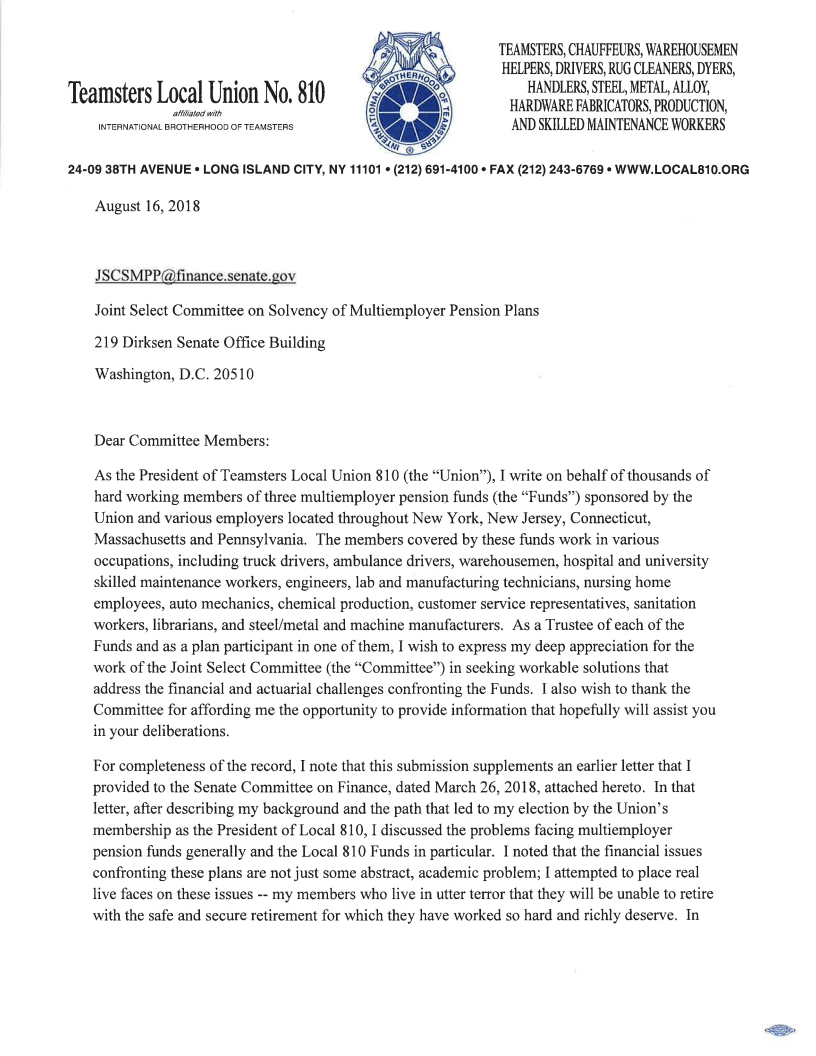
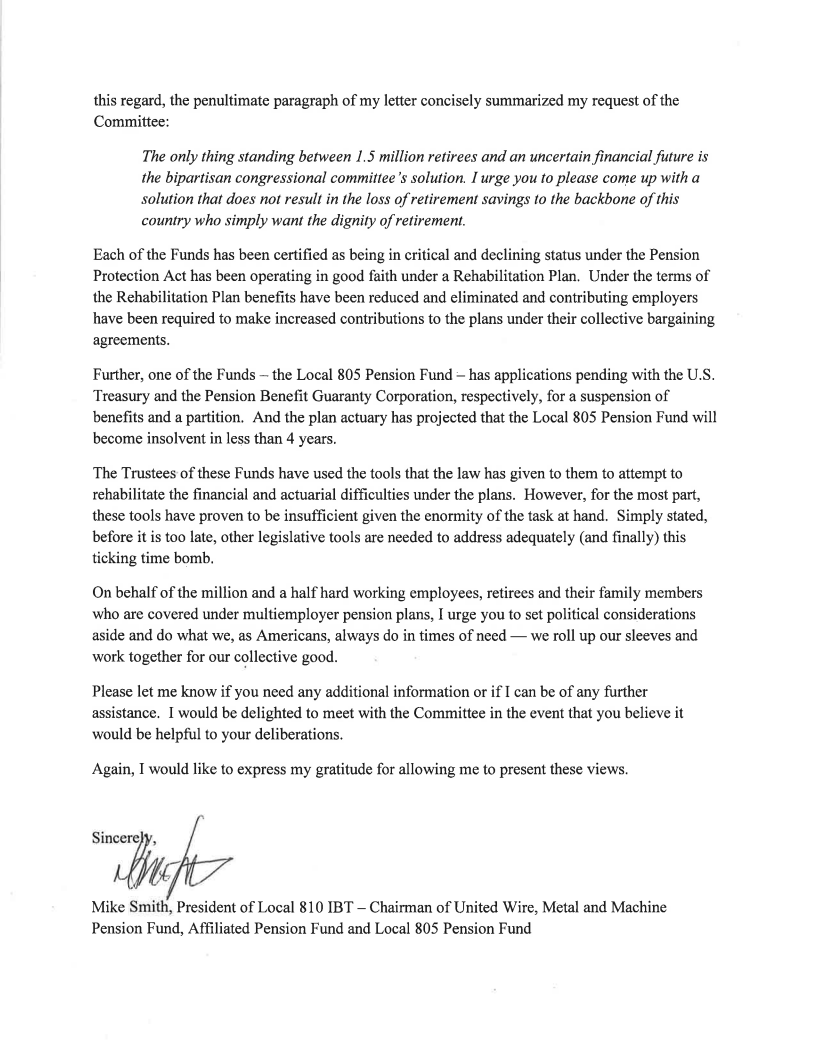
Here is a wonderfully written letter from Mike Smith, President, Teamsters Local Union No. 810.  It highlights the fact that 1.5 million retirees are facing a very uncertain (frightening) future as a result of the failure to protect the benefits for these hardworking Americans. This situation is unacceptable!

https://i0.wp.com/www.local810.org/wp-content/uploads/2018/08/page1.pnghttps://i0.wp.com/www.local810.org/wp-content/uploads/2018/08/page2.png