Do You Ever Wonder…?

By: Russ Kamp, Managing Director, Ryan ALM, Inc.

I recently published some info from a Vanguard 401(k) survey that indicated that the “average” account balance for a near-retirement participant (decade or less) was an anemic $71,000. Yesterday, there was an article on 401KSpecialistmag.com that highlighted output from Empower’s recent survey. Importantly, they focused on the likely impact on 401(k) contributions once federal student loan debt repayment began again. It shouldn’t be surprising that >40% of those surveyed indicated that they would likely divert contributions into their retirement accounts to fund the student loan debt payments. With one in three households expecting to pay more than $1,000 per month toward the student loan debt.

The Empower survey highlighted a number of other very frightening stats including the fact that 32% of those with student loan debt would likely increase credit card debt to be able to manage this burden. A significant number of responders discussed selling their car, moving back home, finding a roommate, finding a side hustle, cutting back on non-discretionary spending, etc. The one that had me scratching my head had 52% of responders claiming that they would look for a higher paying job, as if those are readily available. If they are, why haven’t they taken advantage of those opportunities already?

Then there is the Bloomberg story that referenced a Schwab national survey released this past Wednesday that asked 1,000 401(k) participants what their target balance was for retirement. Believe it or not, the answer was $1.8 million, an increase of 6% from last year’s survey. So, I ask, who are these survey participants, and do they truly reflect the average American worker’s views? I don’t understand how the average near-term retiree can have only $71,000 and yet, the target for another population of retirement “savers” can honestly say that $1.8 million is their goal. Inflation is impacting most Americans in terms of housing, transportation, food, childcare, medical expenditures, education, etc. 

With student loan repayments about to begin, is anyone surprised that 401(k)s will be the first victim of a finite pool of financial resources? Again, do we honestly believe that asking non-finance pros (the average American worker) to fund, manage, and then disburse a “retirement” benefit with little disposable income, knowledge of the capital markets and investment products, and no crystal ball to help determine longevity, an appropriate policy?

Great to See the Endorsement, but…

By: Russ Kamp, Managing Director, Ryan ALM, Inc.

We at Ryan ALM, Inc. have been preaching the benefits of Cash Flow Matching (CFM) for nearly two decades. So, when we see one of the big boys (large fixed income shop) writing about the benefits of CFM we get excited. However, just because they are big, doesn’t necessarily mean that their approach is correct, as all CFM strategies are not equal.

Specifically, CFM when done appropriately is NOT a laddered bond portfolio which is sub-optimal in any market environment. Bond math is very straightforward. The longer the maturity and higher the yield, the lower the cost, which is the ultimate goal. A positively shaped yield curve is wonderful for us because it reduces costs. Done correctly, funding costs can be reduced by 2% or more per year in this environment. Secure the pension promises for Retired Lives 1-30-years and the present value (PV) cost to fund those future value (FV) benefits and expenses can be reduced by 50% or more. Furthermore, the current environment of higher short-term rates (inverted yield curve) does not make the opportunity to use CFM a short-term phenomenon. That might be the case if one were to ladder bonds, but since Ryan ALM uses a cost optimization process that truly matches cash flows, we very much appreciate the benefits of a “normal” positively sloped yield curve.

Pension plans need liquidity on a constant basis. Creating a bifurcated approach to asset allocation in which two buckets are used – liquidity and growth – as opposed to having all of the pension assets focused on the ROA, provides the pension plan with enhanced liquidity and lower transaction costs associated with constantly rebalancing the assets. This will eliminate the common approach of a “Cash Sweep” which takes away income from growth assets. Studies prove that close to 50% of the S&P 500 total return on a rolling 10-year horizon since 1940 (Guinness Asset Management) comes from dividends reinvested. So why would you want to take away these dividends… let CFM fund liabilities chronologically. Pension systems do not need to be fully funded or close to fully funded to receive significant benefits from using CFM. Given the liquidity needs, every pension plan should use CFM to secure the promised benefits for some prescribed period of time. We normally suggest funding Retired Lives or 1 to 10-years of liabilities which creates a long investing horizon for the growth assets that can now grow unencumbered. 

We are so thankful to see others in our industry write about the benefits of CFM, but as I stated earlier, not all CFM is created equal. It requires a deeper understanding of the implementation which is measured by the efficiency of the model’s output. The more efficient, the lower the ultimate cost to SECURE those promises.

ARPA Update as of July 28, 2023

By: Russ Kamp, Managing Director, Ryan ALM, Inc.

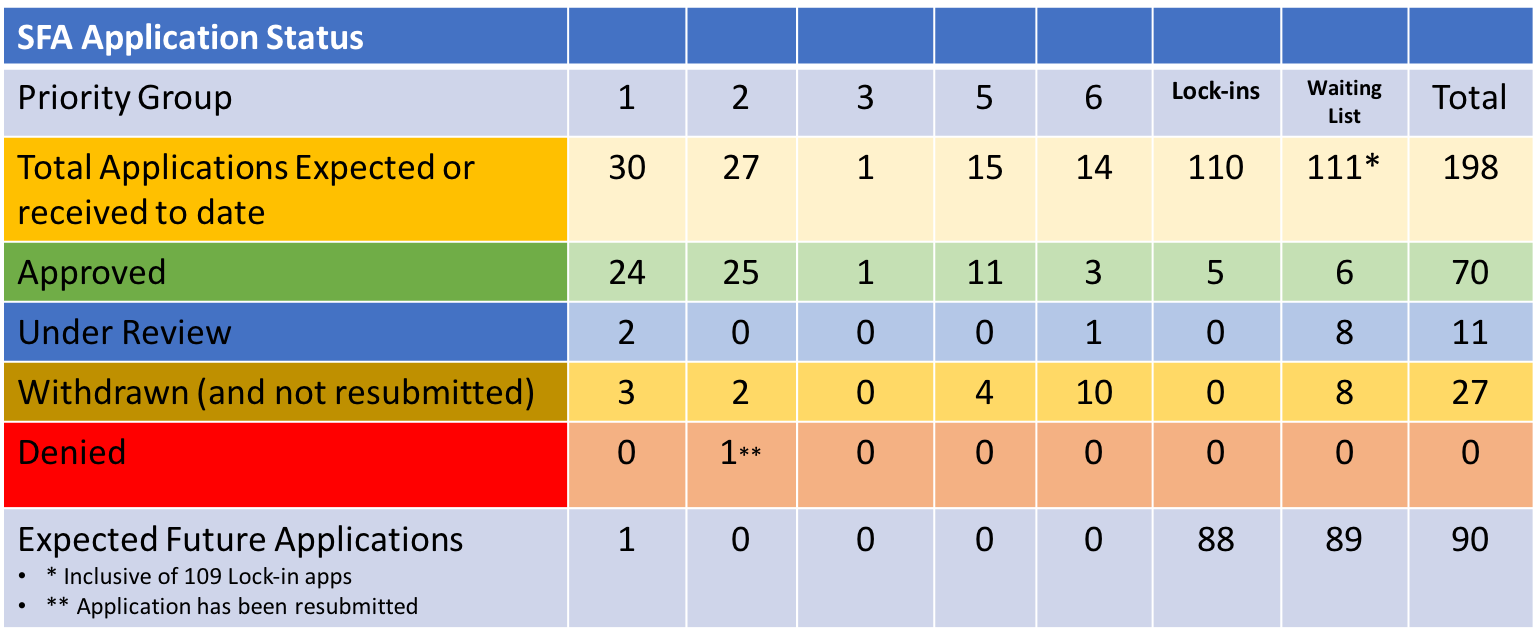
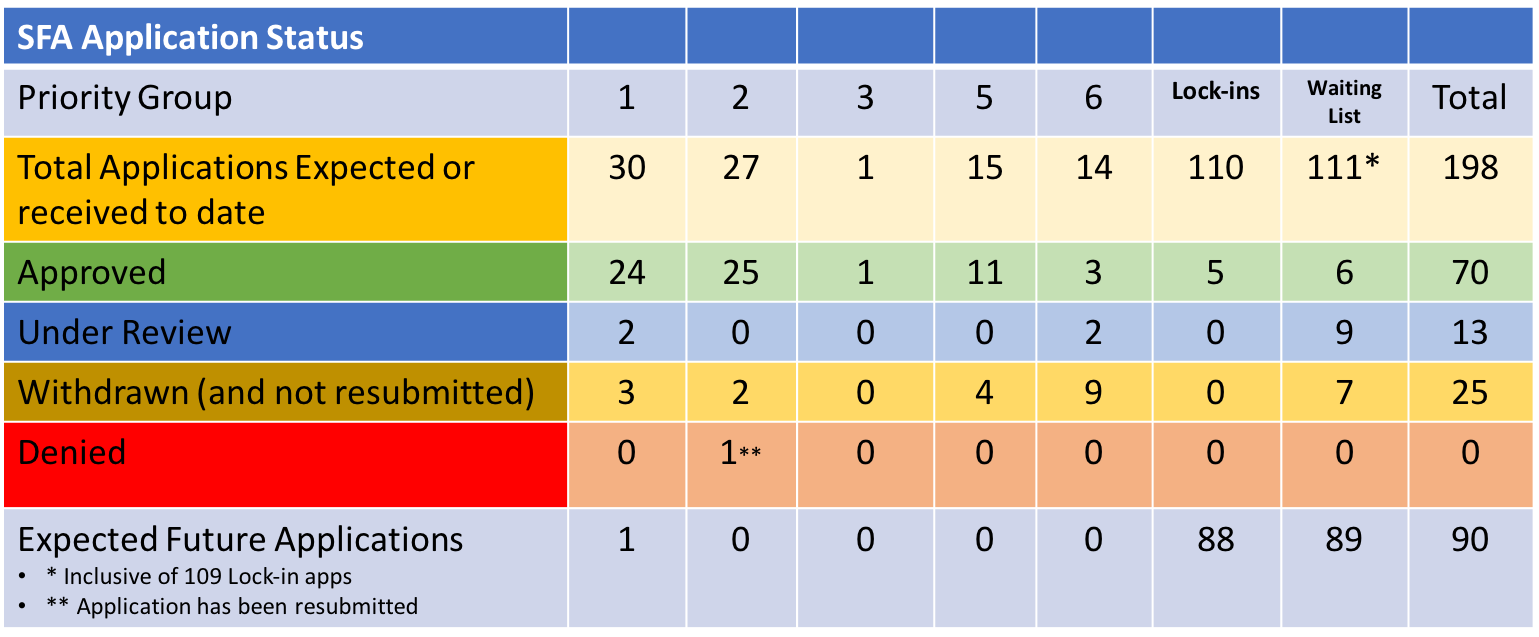
We are pleased to provide you with the weekly update on the PBGC’s progress implementing the ARPA legislation passed in March 2021. The program to distribute the Special Financial Assistance (SFA) has been under way since July 2021. To date, 53 funds have received SFA proceeds. There is still a lot more to do, but the PBGC continues to make good progress and this past week is no exception.

There were an additional four funds on the waiting list that had their window opened to submit applications. These funds are Local 360 Labor-Management Pension Plan, Twin Cities Bakery Drivers Pension Plan, United Association of Plumbers and Pipefitters Local 51 Pension Fund, and the United Food and Commercial Workers Union Local 152 Retail Meat Pension Plan. In addition, Priority Group 5 member, Pension Plan of the Moving Picture Machine Operators Union Local 306 submitted its revised application. In total, these plans are seeking $358.8 million for nearly 20,000 plan participants.

There were no applications approved last week and happily none denied. Furthermore, there were no additions to the waiting list, which continues to have 110 names listed, but there was one fund on the list, San Francisco Lithographers Pension Trust, that had its name crossed off, as it already received SFA back in 2021. Finally, there was one fund that secured its valuation date. Pension Plan of International Union of Bricklayers & Allied Craftworkers Local #15 PA has chosen April 30, 2023 for their SFA measurement date.

The current US interest rate environment is providing these plans and their advisors a wonderful opportunity to secure the promised benefits chronologically as the legislation intended. We produced a post last week that highlights the fact that most of a plans ROA could be covered by a defeased bond portfolio. The same is true for the SFA assets that can cover far more liabilities today than just 16 months ago prior to the Fed’s aggressive action to increase rates. There is no reason to take on equity risk within this segregated portfolio.

Don’t Delay! Spread Between Bond Yields and the ROA is the Narrowest in 20+ Years

By: Russ Kamp, Managing Director, Ryan ALM, Inc.

US interest Rate moves have certainly impacted the capital markets in the last 15 months. The impact during 2022 was mostly negative as both bonds and stocks saw major declines in valuations. However, the current US interest rate environment is providing plan sponsors and their advisors with the opportunity to take risk out of their plans without giving up significant return.

We, at Ryan ALM, have produced our latest Pension Alert, which highlights the fact that A and BBB rated bonds have yields that can provide most of the return needed to meet the ROA objective. In fact, A rated corporate bonds produce 78.6% of the return, while BBB bonds produce 85% of the ROA goal.

Given that the US Federal Reserve is likely to increase rates another 25 bps today, there is a good chance that US interest rates will continue to rise providing the plan sponsor with an opportunity not seen since the late ’90s. Don’t waste this opportunity by continuing an asset allocation framework that has too much uncertainty. Use bond cash flows of interest and principal to SECURE the promised benefits chronologically. This will help stabilize the plan’s funded status and contribution expenses.

ARPA Update as of July 21, 2023

By: Russ Kamp, Managing Director, Ryan ALM, Inc.

We are pleased to share with you an update on the PBGC’s implementation of the ARPA legislation. During the prior week, two more pension plans were permitted to submit applications from the “waiting list”. Teamsters Union Local No. 73 Pension Plan and the Pacific Coast Shipyards Pension Plan are seeking a combined $27.3 million for their 1,036 participants. The PBGC has 120 days from submission to act on the application.

In addition, two plans, Laborers’ International Union of North America Local Union No. 1822 Pension Fund and the UFCW Regional Pension Fund, withdrew their applications. Both of these plans had submitted applications from the wait list, as neither plan was a member of a Priority Group (1-6).

There were no applications approved or denied during the previous week and no multiemployer plans asked to be on the wait list, which continues to have 110 names of which 12 have been invited to file for SFA.

Please don’t hesitate to reach out to us to discuss the appropriateness of using cash flow matching (CFM) for your plan’s SFA proceeds. As a reminder, the SFA assets must be kept separate from the fund’s legacy assets. This new bucket is a sinking fund that should have as its primary objective the securing of benefits and expenses as far into the future as possible.

More on the Subject of DC Outcomes

By: Russ Kamp, Managing Director, Ryan ALM, Inc.

I’ve published a couple of posts recently on the subject of DC outcomes and retirement readiness, including How’s This Social Experiment Working? I saw more info on the subject today, as the Center for Retirement Research (CRR) at Boston College provided information from Vanguard’s annual report on the state of retirement. The information reads like a horror story.

Yes, there are some nuggets of good news highlighted by CRR having to do with growing participation among those with access to a 401(k), as there has been a jump from 72% to 83% in the last 5 years. In addition, four in 10 participants have recently increased their contribution rates, but collectively we as a nation are not saving nearly enough!

I was shocked to read that the typical 55- to 64-years-old has only saved $71,000. Apply the 4% rule and that will provide you with $2,840/year in savings to supplement your SS payout. That isn’t even enough to pay a rent for a month for most Americans. One could take more risk upon retirement and swing for the fences, but does that really make sense since the sequencing of returns is so critical and US equity market P/E multiples are screaming sell?

The problem isn’t just with the more mature worker (I’m in this category and refuse to say OLD!). According to Vanguard, “the typical worker’s 401(k) balance is a paltry $27,400,” which was down from an already low $35,300 in 2021. A decade ago, the comparable balance was $2,000 more! Oh, my! Yet, we are constantly being told that the younger generations are much savvier and understand the importance of creating a nest egg for one’s golden years. I don’t see it! Not because they don’t understand the significance of doing so, but they are burdened by life’s incredible expenditures associated with housing, education, health, childcare, food, energy, etc.

Bring back the DB plan and expand its coverage of the American worker. Asking untrained individuals to fund, manage, and then disburse a “retirement benefit” without the financial wherewithal, investment skill, or a working crystal ball is bound to be a failure. The results so far support my conclusion.

What’s it All About…Alpha

By: Ron Ryan, CFA, CEO, Ryan ALM, Inc.

Most pension investments are focused on earning Alpha… defined as a positive return difference between the investment and its objective (usually an index benchmark). Each asset class and its subsets seem to have an index benchmark today. Monthly risk/reward measurements of the asset return behavior are compared to the index benchmark return behavior as a strict discipline to monitor that Alpha is being earned with an appropriate risk behavior. All of this ends up in a rigorous and time-consuming review by the pension consultant with the plan sponsor.

If the true objective of a pension is to secure benefits in a cost-efficient manner with prudent risk… then where are the liabilities in this review? Liabilities behave like bonds since they are priced with a discount rate. As a result, liability growth (return) can be volatile with a high positive or even negative annual growth rate. Comparing the annual growth rate of assets to the annual growth rate of liabilities is a required annual accounting and actuarial practice. This will determine the funded ratio, funded status, contribution cost as well as pension expense. In the end it is the growth rate of assets versus the growth rate of liabilities that count… this is where liability Alpha is calculated.

All of the pension assets can outperform their index benchmark and create market Alpha but unless this asset allocation creates liability Alpha…the pension plan loses! This will result in a lower funded ratio and status as well as higher contribution costs. Pensions are all about assets versus liabilities cash flows and growth rates (returns). Most important is that the asset cash flows match and fund with certainty the liability cash flows. This is a future value calculation and can only be implemented with a cash flow matching strategy using bonds. The present value growth rate (return) of assets versus liabilities is also important as it affects the accounting and actuarial calculations mentioned earlier. The focus here should be earning liability Alpha.

Since the liability growth rate is not a common or frequent calculation, the Ryan team invented a Custom Liability Index (CLI) in 1991  as the proper benchmark for asset liability management (bonds) or even total asset allocation. Our CLI is a monthly report providing  all of the calculations and data needed to monitor the risk/reward behavior of liabilities. Our CLI will allow for the pension consultant and plan sponsor to easily calculate if the plan has earned liability Alpha.

The Ryan ALM cash flow matching model (Liability Beta Portfolio™ or LBP) will fund benefits chronologically with certainty. Our LBP will outyield liabilities (if discount rate = ASC 715) thereby also providing liability Alpha. As a result, our LBP can achieve both the future value and present value goals of fully funding benefits in a cost effective manner while earning liability Alpha.

“Given the wrong index(s)… you will get the wrong risk/reward” – Confucius

“We Hold These Truths to be Self-Evident”

By: Russ Kamp, Managing Director, Ryan ALM, Inc.

The four senior team members at Ryan ALM, Inc. have collectively more than 160 years of pension/investment experience. We’ve lived through an incredible array of markets during our tenures. We have also witnessed many attempts on the part of Pension America to try various schemes to meet the promises that have been made to the pension plan participants. Regrettably, defined benefit (DB) pension plans continue to be tossed aside by corporate America in favor of defined contribution (DC) plans. Both public and multiemployer plan sponsors would be wise to adopt a strategy that seeks more certainty in order to protect and preserve these critically important retirement vehicles before they are subject to a similar fate.

We’ve compiled a list of “Pension Truths” that we believe return the management of pension plans back to its roots when “SECURING the promised benefits at a reasonable cost and with prudent risk” was the primary objective. The dramatic move away from the securing of benefits to the arms race focused on the return on asset assumption (ROA) has eliminated any notion of certainty in favor of far greater variability in likely outcomes. Here are the Ryan ALM DB Truths:

  • Defined Benefit (DB) plans are the best Retirement vehicles.
  • They exist to fulfill a financial promise that has been made to the plan participant upon retirement.
  • The primary objective in managing a DB plan is to SECURE the promised benefits at a reasonable cost and with prudent risk.
  • The promised benefit payments are liabilities of the pension plan sponsor.
  • Liabilities need to be measured, monitored, and managed more than just once per year.
  • Liabilities are future value (FV) obligations – a $1,000 monthly benefit is $1,000 no matter what rates do. As a result, they are not interest rate sensitive.
  • Plan assets (stocks, bonds, real estate, etc.) are Present Value (PV) or market value (MV) calculations. We do not know the FV of assets except for bonds at maturity.
  • In order to measure and monitor the funded status, liabilities need to be converted from FV to PV – a Custom Liability Index (CLI) is absolutely needed.
  • A discount rate is used to create a PV for liabilities – ROA (publics), ASC 715 (corps), STRIPS, etc.
  • Liabilities are bond-like in nature. The PV of future liabilities rises and falls with changes in the discount rate (interest rates).
  • The nearly 40-year decline in US interest rates beginning in 1982 crushed pension funding, as the growth rate for future liabilities far exceeded the growth rate of the PV of assets.
  • The allocation of plan assets should be separated into two buckets – Liquidity (beta) and Growth (alpha).
  • The liquidity assets should consist of a bond portfolio that matches (defeases) asset cash flows with the plan’s liability cash flows (benefits and expenses (B&E)).
  • This task is best accomplished through a cash flow matching (CFM) investment process.
  • The liquidity assets should be used to meet B&E chronologically buying time for the alpha assets to grow unencumbered to meet future liabilities.
  • The Growth assets will consist of all non-bonds, which can now grow unencumbered, as they are no longer a source of liquidity.
  • The pension fund’s asset allocation should be driven by the plan’s funded status.
  • As the funded status improves, port alpha (profits) from the growth portfolio into the liquidity bucket (de-risk) extending the cash flow matching assignment and securing more promises.
  • This de-risking ensures that plans don’t continue to ride the asset allocation rollercoaster leading to volatile contribution costs.
  • DB plans are a great recruiting and retention tool for managing a sponsor’s labor force.
  • DB plans need to be protected and preserved, as asking untrained individuals to fund, manage, and then disburse a “retirement benefit” through a Defined Contribution plan is a poor policy and it is failing miserably.
  • Unfortunately, doing the same thing over and over and… is not working. A return to pension basics is critical.

You’ve made a promise: measure it – monitor it – manage it – and SECURE it…   

Get off the pension funding rollercoaster – sleep well!

ARPA Update as of July 14, 2023

By: Russ Kamp, Managing Director, Ryan ALM, Inc.

We are pleased to once again provide you with an update on the PBGC’s activity related to the ARPA legislation. During the previous week there were four plans that submitted applications. Each of these funds resided on the PBGC’s Waiting List. Three of the plans had no priority grouping associated with them, while the UFCW – Northern California Employers Joint Pension Plan identified itself as a Priority Group 6 member.

In addition to the UFCW plan, applications were submitted by Central New York Laborers’ Pension Plan, Retail Food Employers and United Food and Commercial Workers Local 711 Pension Plan, and the CWA/ITU Negotiated Pension Plan. Collectively, these four plans are seeking Special Financial Assistance (SFA) totaling $2.9 billion, of which the UFCW – Northern California plan is asking for $2.3 billion, for the 189,195 plan participants. As a reminder, the PBGC has 120 days from submission to act on the application.

There were no applications approved, denied, or withdrawn. In addition, there were no plans added to the PBGC’s Waiting List, which continues to have 110 funds on the list, with 10 of those having been “invited” by the PBGC to submit. Of the 110 wait list candidates, 108 have locked in their valuation date.

There are currently eight funds that have had the SFA applications approved that are still awaiting the distribution of funds from the PBGC totaling $3.7 billion that will support the retirements of >160K participants.

Ryan ALM, Inc. 2Q’23 Newsletter

By: Russ Kamp, Managing Director, Ryan ALM, Inc.

We are pleased to share with you the Ryan ALM, Inc. 2Q’23 Newsletter. As usual, you will find unique perspectives on a variety of asset/liability measures. In addition, we share with you our Pension Monitor, interesting and current research, multiple blog posts, and economic statistics that will highlight the current market influences on Fed policy, which continues to be the major market driver at this time.

The current US rate environment is providing the plan sponsor community with a very attractive opportunity to reduce risk within their portfolios through cash flow matching. Please don’t hesitate to reach out to us if we can be of any help to you as you explore your de-risking options.