Concepts In Advanced Asset Allocation

What does the title of this post mean to you?

I just got back from Las Vegas (IFEBP), where I had the chance to present twice on this topic.  I began my talk by apologizing up front (usually not a great way to start a talk) to anyone attending the session thinking that they were going to glean insights on how much they should allocate to growth versus value, or large versus small, or U.S. versus international or if they should go into alternatives and hedge funds because that just wasn’t going to happen.

The above-mentioned scenario is played out in nearly every conversation between asset consultant and plan sponsor and has since our industry moved from having a single bank trust department manage the entire pension plan in some balanced approach. The focus on trying to earn incremental return relative to the ROA by shifting among asset classes and managers is a fools game! I equate this to being nothing more than rearranging the deck chairs on the Titanic.

In case you haven’t realized this yet, defined benefit plans are going away in all sectors (public, Taft-Hartley, and certainly, corporate), and the trend isn’t your friend. The fact that we continue to do the same thing year in and year out is mind-boggling! STOP! Managing a pension plan is not an arms race in trying to generate the highest return.  It is all about providing the promised benefit at the lowest cost.

Unfortunately, the ROA is the pension industry’s iceberg. Are you prepared for the coming disaster?

Oh, BTW, I am happy to share with you my presentation that I delivered.  Just ask!
TIme For A Change? How about the S&P 600

For plan sponsors with small-cap exposure, the Russell 2000 index has likely been your preferred benchmark. But why? We would suggest, especially if you have your small-cap manager(s) on a performance fee, that you begin to use the S&P 600 as the benchmark.

For the 20-years ending September 30, 2017, the S&P 600 has beaten the Russell 2000 index by 1.8%. The advantage is not period specific, as the S&P 600 also bests the R2000 by 1.5% for 10-years, 2.1% for 7-years, 1.8% for 5-years, and 1.9% for 3-years. The advantage is not just related to the annual June rebalance, although that event does explain some of the differentials, as some front-running does occur given that the index is more rules-based than the S&P 600, whose construction is driven by a committee.

The S&P 600 is also propelled by screens for liquidity and profitability. Given that the S&P 600 averages less turnover annually than the R2000, the liquidity screen will reduce transaction costs, while the profitability screen (a company must have 4 consecutive quarters of profitability), creates a higher “quality” index.

As the equity markets have rocketed forward this year, lower quality names have been favored, but even in this environment the S&P 600 still maintains an advantage over the R2000 by 0.4% for the first nine months.  Don’t make it easy for your managers to earn their small-cap fees. Use the S&P 600 and make them work a little harder.


Multiemployer DB Plans See Improved Funding in 2017

Milliman is reporting that multiemployer DB plans have seen a pick-up in their funded status during the first half of 2017, as asset returns have exceeded the annual return on asset (ROA) targets.  That is terrific news!

However, that is where the good news ends. For those multiemployer plans that are defined as critical and declining funded ratios continue to hover around 60%.  At that level of funding, plans need to generate returns that significantly exceed the ROA to begin to make a dent in the deficit.

Couple this with the fact that the U.S. is 8 1/2 years into a bull market for equities and 30+ years for bonds, how likely is it that DB plans continue to enjoy outsized returns?  Also, please note that the funded ratio is calculated using liabilities that are discounted at the ROA, and not a risk-free rate.  This methodology dramatically undervalues a plan’s liabilities, and thus inflates the funded status.

Plan sponsors believing that their plan’s funded status is better than it is will naturally act differently than if they had a more realistic view of their current situation.  I know that I would. If I thought that my plan was 90% funded instead of something closer to 60-65%, my inclination would be to maintain the status quo instead of searching for a solution to our underfunding.

It is a positive development that funding has improved for multiemployer plans in general, but let us not kid ourselves that the average plan has a 90% funded ratio.

So, Who Will Help You?

Most everyone is aware of the significant seachange occurring within the U.S. retirement industry. We’ve documented for years the demise of the traditional defined benefit pension and the push by sponsors to use defined contribution plans. This trend has been most notable among corporate plan sponsors, but we are now witnessing this migration in public and multi-employer plans, too.

We don’t like it, especially since it places an unfair burden on most people in this country who are now being asked to become investment management professionals without the appropriate skills to handle this responsibility.  Sure, defined contribution plans give the individual some freedom through portability, but at what cost?

We’ve seen the results from this policy change, and they aren’t pretty.  In fact, they are fairly ugly.  As if that isn’t bad enough, try getting advice from the big wirehouses with an account balance of <$250,000. That’s right, an investor with a “small” account balance will be shuttled to a call center.  Unfortunately, size matters in the financial service industry!

According to an article by Jeb Horowitz, Advisor Hub, Merrill Lynch will only pay their brokers full commission on accounts greater than $250,000, “while giving one-time incentives for referrals to Bank of America’s no-frills Merrill Edge platform. Well, given the average DC balance, that would basically exclude most everyone that wants to roll a DC balance into an IRA. So much for a helping hand.

This post was not intended to pick on just Merrill Lynch, for many of the other wirehouses are doing the same thing.  According to Horowitz, Morgan Stanley and UBS are only offering payouts on accounts greater than $100,000.

So I repeat, we force those less capable of handling a retirement from a DB plan providing a monthly check into a DC plan where they are now responsbile for funding, managing, and dispersing their acccount.  But, when they begin to start the process of dispersing they are most often too small to get the individual expertise that they so desperately need.  No retirement crisis? Are you kidding me!

Let’s Remove The Guess Work

In an industry as exacting as the investment industry where trading is measured in milliseconds, a penny miss in earnings can tank a stock, and where performance results are measured to a minimum of hundredths, it is shocking that we still have so much guesswork involved in managing a pension plan.

We were recently asked to create a Custom Liability Index (CLI) for a defined benefit plan.  Once that task was completed, we volunteered to do an Asset Exhaustion Test (AET) to help the plan sponsor calculate the return needed to ensure that the assets are not exhausted before all promised benefits were paid.

Unfortunately, the Return on Asset Assumption (ROA) that is used as a return objective and the discount rate in public and multi-employer plans, is nothing better than a guess. Given that it is nothing more than a guess, it is amazing that plans will have ROA targets as exact as 7.625%.  Really?

In the case to which I am referring, the plan had “determined” that 7.5% should be the ROA objective.  Why? Because! At KCS, we often refer to these ROAs as “Goldilocks” numbers because they are neither too hot nor too cold.  But in this case, their target return was too high for we calculated that 6.8% is the return objective needed to keep the fund going.

Why does this matter? First, the ROA is instrumental in determining contributions into the fund. A number that is too low will necessitate larger contributions and vice versa. In addition, striving for a number greater than what is needed injects unnecessary risk into the asset allocation process.  A plan with a 7.5% return target is likely going to have a lot more equity exposure than one needing only 6.85%.

As if this isn’t bad enough, because GASB allows public and multi-employer plans to discount their liabilities at the ROA, a significant majority (like all) are overstating their funded status.  But, we’ll save this little ditty for another KCS Blog post.


But, They Have To Go Up – Don’t They?

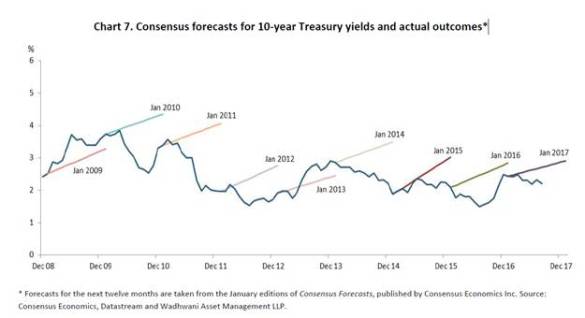
For years now, we’ve been hearing that U.S. interest rates MUST rise due to the aggressively easy monetary policy that will lead to inflation.  We’ll, glad that we weren’t holding our collective breath!  The following chart once again highlights how difficult it is to forecast interest rate changes.

Interest rate forecast

Unfortunately, many plan sponsors and their asset consultants were forecasting higher inflation and interest rates.  The higher inflation guesses lead them to plow into commodities in 2009 and 2010 only to be significantly disappointed when inflation never reared its ugly head and commodities performed woefully as the S&P GS Commodity index is -10.0% for 10-years and -14.4% for 5-years through 9/30/17. Oh, my!

Furthermore, the premature forecast of dramatically higher interest rates lead them to significantly reduce domestic fixed income exposure. This has created the greatest mismatch ever between assets and liabilities within defined benefit plans.

At KCS, we’ve been encouraging (imploring) our clients and prospects to get out of the interest rate guessing game despite correctly forecasting that rates would NOT rise (please see a number of previous blog posts questioning the rising rate crowd).  We believe that managing a pension plan is a cash flow matching exercise and not a return game.

We encourage sponsors to transition their current fixed income allocation into a cash matching strategy that ensures near-term benefit payments will be met.  In the process, the plan has enhanced liquidity to meet those payments, removed interest rate sensitivity, while also extending the investing horizon for the balance of the assets that now benefit from more time allowing the liquidity premium to be captured.

Why continue to “guess” where rates will go when a strategy exists to get your DB plan onto a glide path toward full funding and more level contribution expense.

Living Only On Social Security

Living only on Social Security is a frightening thought, but it is the scary reality for millions of Americans.  In fact, nearly 20% of those 65-years-old or older count on their monthly social security check for 100% of their income in retirement.

According to a recent Washington Post article, 61% of Americans rely on Social Security for more than 50% of their post-retirement income.  Amazingly, 43% of single seniors rely on social security for 90% or more of their retirement income.

What does that mean in reality? According to the Social Security Administration (June 2017), the average annual payment is only $15,054.  Could you live on that sum?  It is highly unlikely if you are living in the NYC metropolitan area.  With the demise of the traditional DB pension plan, it is highly likely that these harrowing numbers will only get worse.

More Needs To Be Done

The following information was provided by the Boston College Center For Retirement Research.

The brief’s key findings are:

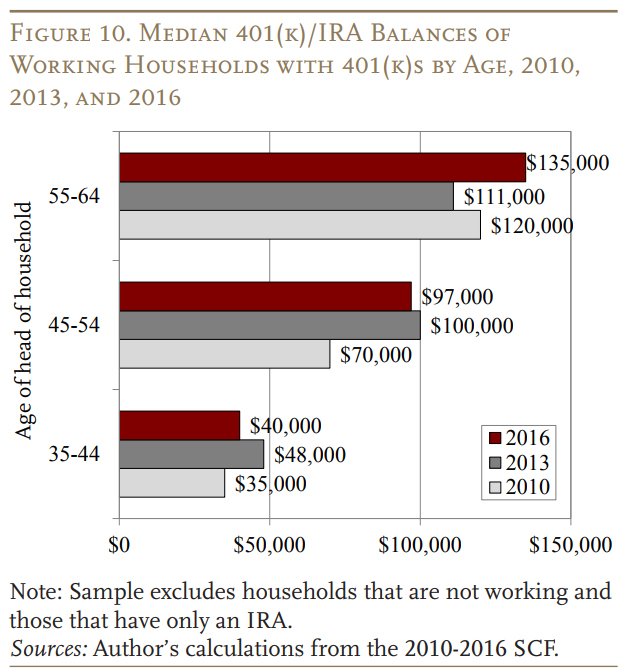
  • The Federal Reserve’s 2016 Survey of Consumer Finances offers an opportunity to examine households’ holdings in 401(k)s and IRAs.
  • For working households nearing retirement with a 401(k), median combined 401(k)/IRA balances rose from $111,000 in 2013 to $135,000 in 2016.
  • While growing balances are encouraging, $135,000 provides only $600 per month in retirement, so current saving levels are still falling short.
  • Moreover, about half of households nearing retirement have no 401(k) assets at all, so lack of access to a plan remains an enormous problem.

The key finding for us is the lack of retirement assets for nearly half of those nearing retirement. We find it incredibly disturbing that we have such a significant percentage of our workers headed for government assistance upon retirement. But, is it really surprising?

We have had little wage growth for a majority of U.S. workers for the past two decades, while demanding a greater share of their take-home pay for housing, healthcare, education, etc. There is very little left to allocate to a retirement, especially one that now has to be managed by untrained individuals.

Even a modest DB payout of $1,250/month ($15,000/year) stretched over a 20-year retirement would provide the retiree with a $300,000 payout. That is more than twice what the median 55-64-year-old has at this time in a 401(k)/IRA.

We have people in our industry trying to dismiss the notion that we have a retirement crisis unfoldin. Who are they kidding!

Not Much To Cheer About

It has recently been reported that 63% of private industry participants in defined benefit (DB) plans were in plans still open to new employees.  Are we supposed to be impressed with that finding? Regrettably, only 18% (according to BLS data) of the private sector workforce are in DB plans at all. Given that, it isn’t impressive that 63% of 18%, which is only 11.3% of the workforce, are currently in an open DB plan.  Roughly 30 years ago, the U.S. had more than 146,000 DB plans covering 46% of the private workforce.

The move away from DB plans may be comforting for senior executives at public corporations who don’t want the volatility of contribution expense to impact their companies quarterly financials or the liability on their balance sheets, but it does little for the average American worker.  DC plans are not better than DB plans, especially when our industry and public education system have failed to provide adequate financial literacy for our workers.


The Math Works!

On the Foxnews.com website, there is an article by Rachel Greszler, Heritage Foundation, discussing a potential bailout of the UMWA pension plan (coal miners).  She laments the potential federal taxpayer bailout of this plan, proclaiming that this could be the tip of the underfunded pension iceberg, which she estimates could result in trillions of taxpayer funds being used to prop up these plans.

Greszler also mentions a second proposed piece of legislation that is being considered at this time, which is a loan to the insolvent plan(s). She calls the loan a bailout because “there’s virtually no chance of repayment”.

She asks, “so what happens if Congress doesn’t step in to bail out the UMWA’s unfunded pension promises?” She mentions that the Pension Benefit Guaranty Corporation (PBGC) would step in just as it has for more than 50 other failed union-run pension plans. However, she doesn’t discuss that the PBGC’s solvency is on thin ice or the fact that union workers have benefits protected at roughly 20% of private sector workers ($13,000 annually).

You may recall that Ron Ryan, Ryan ALM, and KCS are working on the implementation that supports the “loan” proposal (see the August KCS Fireside Chat).  The process that has been created has been tested on the UMWA plan, as well as that of other large, poorly funded multi-employer plans, and the math works!  This legislation can protect the promised pension benefits despite the current poor funded status.

Does Ms. Greszler really believe that by allowing these plans to fail that the federal government won’t play a role in subsidizing the retirement plan’s beneficiaries? The potential collapse of these plans will thrust millions of union workers onto the welfare ranks, where neither they nor their fellow citizens want them to reside!

The fact that the implementation designed by Ryan ALM works, means that this process could be the foundation for a new direction for state and municipal plans, many of which are in dire shape, too. State and city finances are coming under significant pressure because of growing pension and OPEB liabilities.  Unfortunately, a significant majority of these plans continue to be managed as they have been for decades. A major rethinking is in order, and we have proposed a solution that should be given serious consideration.

The demise of the defined benefit pension system in the private sector has created social and economic issues that will be felt for generations. We shouldn’t be fooled into thinking that the elimination of these pension benefits for union and public employees could somehow be positive for our economy.