It Didn’t Take A Rocket Scientist!

We’ve been forecasting that there would be profound social and economic consequences as a result of the shift from defined benefit plans to defined contribution plans, and the proof is starting to become more evident.

According to the Federal Reserve’s survey of consumer finances, bankruptcy’s for older Americans are exploding at the same time that the universe of older Americans is burgeoning! On the surface, it appears that younger Americans are fairing better, but we know that there are more 18-34 year-olds living at home or with a relative than ever before (Pew Research Center). We also know that student loan debt is growing leaps and bounds, which is keeping Millennials from saving for retirement, which will only add to the problem for older Americans in the decades to come.

In addition to the loss of traditional pensions, older Americans are forced to wait longer for Social Security and they are incurring greater out-of-pocket medical expenses. We’ve witnessed a three-decade shift from government and employer support of the American worker to a situation in which the individual is being asked to carry this burden. It is not ending well for many.

“The people who show up in bankruptcy are always the tip of the iceberg,” said Robert M. Lawless, a law professor at the University of Illinois and another author of the study. The next generation nearing retirement age is also filing for bankruptcy in greater numbers, and the average age of filers is rising, the study found. Given the rate of increase, Thorne said, “the only explanation that makes any sense are structural shifts.”

We know that many Americans are carrying greater sums of debt into retirement than ever before. Furthermore, there is a growing wealth gap among Americans. According to the Employee Benefit Research Institute (EBRI), the median household lead by someone 65 or older is roughly $60,600 (2016), but the bottom 25% have at most $3,200, a sum which certainly doesn’t provide for protection should unexpected medical expenses occur.
The Dam May Have Just Sprung a Leak!

It is being reported that the participants in a multiemployer pension plan system that received “permission” from the Treasury Department under the Multiemployer Pension Reform Act of 2014 (MPRA) are suing the government challenging them on the legality of authorizing a private pension system to reduce benefits. This is believed to be the first such suit, and the plaintiffs are seeking class-action status to include all of the multiemployer participants in plans that have received such permission to date.

The plan participants, in this case, are part of the New York State Teamsters Conference Pension and Retirement Fund. Unbelievably, the cuts to the participants, which took effect last October, amount to a 29% per participant reduction. According to PlanSponsor’s Rebecca Moore, “the complaint notes that the Employee Retirement Income Security Act (ERISA) expressly prohibits a plan from reducing vested pension benefits: Until and unless a pension fund is broke, a retiree’s monthly payment may not be reduced.”

If the plaintiffs are successful, multiemployer pension systems that are designated “critical and declining” because of weak funded status, will need to seek an alternative to just slashing benefits. This is where potential legislation, such as the Butch Lewis Act, becomes even more critical. These plans can be rescued and secured through a low-interest loan program, preserving the promised benefits and extending the life of these systems for decades to come.

Plan participants in these failing pension systems have done nothing wrong. They contributed to a fund based on a promise that was made. It is disgraceful that the government has passed legislation to significantly reduce the benefit to which these workers are entitled. It is time to support the Butch Lewis Act legislation in order to restore and preserve these benefits. I can’t imagine being in my mid-70s only to have my pension dramatically slashed with little prospect of being able to make up the loss through part-time employment.


Time to Support H.R.911 and S.911

Anyone who knows me knows that I spend most of my time focused on issues related to the retirement industry.  However, every once in a while something will pop up that I need to focus on and bring to your attention.  Here is one of those important items!

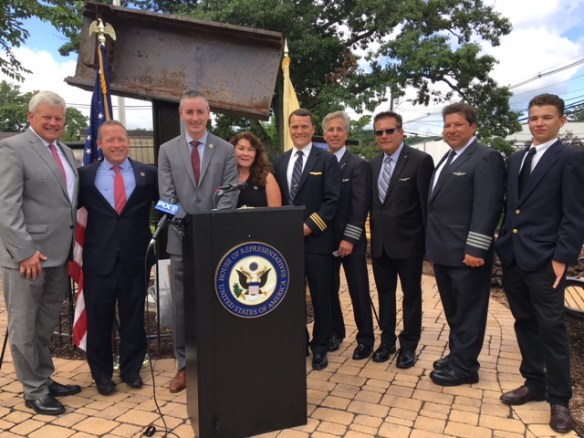
In my capacity as a member of the Midland Park Borough Council, I was invited to attend an event at the town’s 911 Memorial where U.S. Representatives Michael G. Fitzpatrick (R, PA) and Josh Gottheimer (D, NJ) were speaking about H.R.911, the Saracini Aviation Safety Act of 2015. This Act is named for Victor Saracini, United Airlines pilot of doomed flight 175. His wife, Ellen (pictured below), has been championing for improved safety and security on flight decks since the horrors of 9/11/01.

H.R.911

The Act “directs the Administrator of the Federal Aviation Administration to issue an order to require: (1) the installation of secondary barriers, other than the cockpit door, to prevent access to the flight deck of each covered aircraft; (2) such barriers on the aircraft with a cockpit door to remain locked while the aircraft is in flight and the cockpit door separating the flight deck and the passenger area is open; and (3) such barriers on the aircraft without a cockpit door to remain locked as determined by the pilot in command.”

Furthermore, a “covered aircraft” is a commercial aircraft: (1) equipped with more than 75 passenger seats, and (2) with a maximum gross takeoff weight of more than 75,000 pounds.

As I heard this morning, this is not a partisan piece of legislation, as nearly 90 Congressmen and more than 10 Senators, both Democrat and Republican, have co-sponsored this legislation. It is legislation designed to protect the flying public, as well as airline personnel. Most of us in the retirement industry travel a lot each year. I happened to be flying on the morning of 9/11, but was fortunate to be flying south from Newark to Atlanta. Obviously, many others weren’t as fortunate.

There has been recent movement to require these secondary safety doors to be installed on new planes. But, shouldn’t something be done to improve the security for the 1,000s of planes currently in operation? As the flying public, we should demand that Congress acts to pass this critical legislation and force the airline industry to invest a modest sum (<$5,000 / plane) to significantly reduce the likelihood that events of 9/11 are ever repeated. The substantial reduction in corporate tax rates should provide the airlines with the capital needed to make this enhancement.

Tough Hole To Fill

Chicago's projected pension contributions

Of course, these projected contributions are predicated on achieving the return on asset assumption (ROA) during this period. A significant correction during the next 6 years (likely after a nearly 9 1/2 year bull market) would create a situation in which additional contributions would be necessary. Unfortunately for Chicago residents, they have other budget items that need to be funded, too.

Proposed Changes In Fort Worth Plan

The Fort Worth City Manager, David Cooke, is proposing additional contributions and the elimination of the annual 2% COLA as a means to sure up the $1.6 billion unfunded Fort Worth pension system, which is forecast to become insolvent within roughly 25 years. Both employees and taxpayers are being asked to contribute more to the system.

Cooke’s suggestions flow from a task force created nearly three years ago to tackle Fort Worth’s troubled system.  This is the best that they can do after three years? What is being done with the management of the plan? I suspect that the goal remains to achieve the return on asset assumption (ROA) instead of getting a greater handle on the plan’s liabilities using multiple discount rates, and then using that output to drive investment structure and asset allocation changes. Furthermore, have they done an asset exhaustion test to actually calculate what the plan’s true ROA is?

Pension systems continue to inject too much volatility into their plans by striving to achieve a difficult ROA objective, especially this deep into a bull market. By keeping inflated ROA’s as their primary objective the plan is systematically underfunding the system through lower contributions than necessary that which are needed.

Three years seems like a very long time to determine that additional contributions are needed. It would be fascinating to learn about the other possible action items that were discussed as potential remedies for this plan’s underfunding.


DB Plans Need To Preserve Improved Funded Status

Northern Trust Asset Management (NTAM) is out with a report titled, “Corporate Pensions: The Bottom Line”.  NTAM believes that it is critically important for corporate plan sponsors to understand the impact that the DB plan has on corporate finances and ultimately the company’s stock price if a public entity. As a result, they are recommending that plan sponsors adopt de-risking approaches to lock in recent improvements in the funded status of the pension plans, which according to the report improved from 81% to 85% in 2017, as rates backed up and equity market returns exceeded long-term averages.

Many corporations have adopted de-risking strategies for years, and it is reflected in the average asset allocation, which shows a considerable shift to fixed income for S&P 500 companies (now 43% from 31% 10-years ago), while equity allocations have fallen to 37% from 60% during the same timeframe.

I agree wholeheartedly with this approach, but why stop at corporate plans? Public and multiemployer plans also have a profound impact on their sponsoring organizations. Whether it is the taxpayer supporting the public pension system or the businesses funding multiemployer systems, subjecting pension plans with improved funded status to the market volatility this late in the cycle is foolish.

DB pensions need to be protected, but they won’t be if the cost of preserving them overwhelms the ability to fund them. We are already witnessing chinks in the armor, as public DB systems are having to create new tiers to amend contribution rates, benefits, retirement ages, or worse, the adoption of DC plans in lieu of DB systems. It isn’t any different in the multiemployer space where 114 “Critical and Declining” plans are on the brink of insolvency.

As we’ve said many, many times, managing a pension system is not about the return (ROA), but meeting the promised benefit at the lowest cost. Chasing an ROA this late in the bull market ensures greater volatility but not necessarily the commensurate return. Don’t allow your recent success to be wasted. We will eventually have a market decline and most pension systems are not in financial shape to weather the next storm.

Millions of American workers are counting on this benefit to be there when they retire. There will be devastating social and economic ramifications should we fail to preserve these essential retirement benefits. KCS and Ryan ALM have teamed together to create a de-risking process designed to protect and preserve the plan’s funded status and establish a glide-path toward full funding while doing so at a significantly reduced cost.

Is U.S. Growth Sustainable

The recent release of second-quarter GDP growth (4.1%) revealed the strongest quarter in four years. But, is that growth sustainable? Given that U.S. growth is still dominated by personal consumption, how are our households doing? The following chart would suggest that total indebtedness is growing much faster than wage growth.

Source: FRBNY publication and Bill Mitchell’s blog

Total household debt is at $13.21 trillion, which is $561 billion greater than the previous peak established in 2008. Couple this with the fact that nearly 80% of U.S. workers are living paycheck to paycheck (Robert Reich), and you have a growth story that is tenuous, at best.

If you are a plan sponsor of a DB plan counting on outsized market returns based on the perception that the economy is working on all cylinders, you may want to rethink that strategy. Equity valuations are inflated, and it wouldn’t take much of a slowdown in economic growth to create negative headwinds.

Caveat Emptor

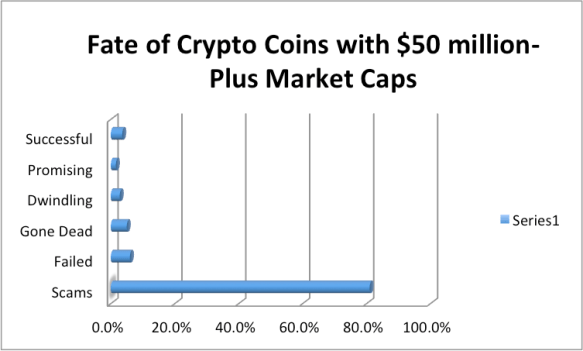
The following data (source: Satis Group) speaks volumes (thanks, Chris, for sharing it!). I am sharing it with you because I’m concerned that there are DB pension sponsors still considering cryptocurrencies as an “investment” in their pension plans. Please be very careful, as only just over 5% of the Cryptocurrencies are showing any promise at this time.

Crypto

The SOA on Multiemployer Pension Funding

There is a new report out by the Society of Actuaries (SOA) that is putting into focus the massive funding challenge facing the multiemployer defined benefit plans designated as in “Critical and Declining” (C&D) status. These pension systems are funded at less than 65% and are likely to become insolvent within the next 20 years, but unfortunately, many are anticipated to have fewer than 10 years to insolvency.

According to the report, there are more than 1,200 multiemployer DB pension systems covering roughly 10 million active employees and 4 million retirees. Of the roughly 1,200 funds, more than 100 are designated as critical and declining, and the list continues to grow. These 100+ funds cover more than 1.4 million participants, with roughly 50% retired. Importantly, they receive benefits of more than $7.4 billion per annum. That is a lot of economic stimulus for the participants’ local economy.

Utilizing a mark-to-market discount rate (2.9%) produces an unfunded liability of nearly $108 billion. Why is outside assistance necessary, such as the Butch Lewis Act? Because the SOA forecasts that 68 of the C&D plans would still fail even if they were to generate a very unrealistic 10% / annum for the next 20 years! Regrettably, the PBGC’s multiemployer insurance fund would be overwhelmed with the failure of just a couple of these larger entities.

Given the fact that many of these plans are already nearing or are at the point of no return, Congress needs to act now! The Joint Select Committee cannot let the September 30th deadline come and go without the support of some government intervention.  We certainly prefer the loan program under the proposed Butch Lewis Act, as we feel that the provisions in the Act force good behavior on both management and union trustees and their asset consultants.

“Multiemployer pension plan insolvencies will obviously be harmful to the participants and beneficiaries of the plans in question, but the loss of the significant economic momentum provided by retirees spending their pension plan assets could also harm the wider economy.” This is not a union crisis, but potentially a national economic crisis. If these plans are allowed to fail, the fallout will be huge, and we are going to pay one way or the other.

Why Is Anyone Surprised?

Employee Benefit Advisers is out with an article titled, “Millennials Are Making A Costly Investment Mistake”. In a study conducted by Bankrate.com, nearly 1 in 3 Millennials (18 to 37-year-olds) believe that “investing” in cash instruments is the best place to invest for the long-term (>10 years). This compares to 21% for older generations, which is only slightly better.

Greg McBride, Chief Financial Analyst at Bankrate.com believes that the millennial generation was scared (scarred?) by their experiences through the Great Financial Crisis. The Millenial generation is in a tough financial situation, as wage growth has been muted, student loan debt is escalating, as are home prices, etc. Saving for retirement isn’t their number one priority.

Furthermore, we are putting too much faith in the ability of individuals to handle the funding, managing, and disbursing of a retirement fund. Why does anyone believe that the “average Joe” is capable of this responsibility.  We require our professional electricians, plumbers, carpenters, etc. to be trained and licensed. Most recent graduates will not have taken any investment class in either high school or college. Managing one’s retirement is not an innate behavior.