
We are happy to share with you the Ryan ALM 3Q’20 Newsletter. As is always the case, our newsletter provides a unique perspective on how pension assets have been performing versus plan liabilities and the history of those relationships. In addition, our newsletter contains links to recent research articles and blog posts. We hope that you find our perspective useful. Finally, we encourage and look forward to your feedback.
Author Archives: russkamp
The Gap Matters Big time!
At roughly the same time that traditional DB plans were starting to fade from use in the private sector and workers were being asked to primarily fund their own retirements through a DC option, wage growth diverged unexpectedly and significantly from productivity growth.
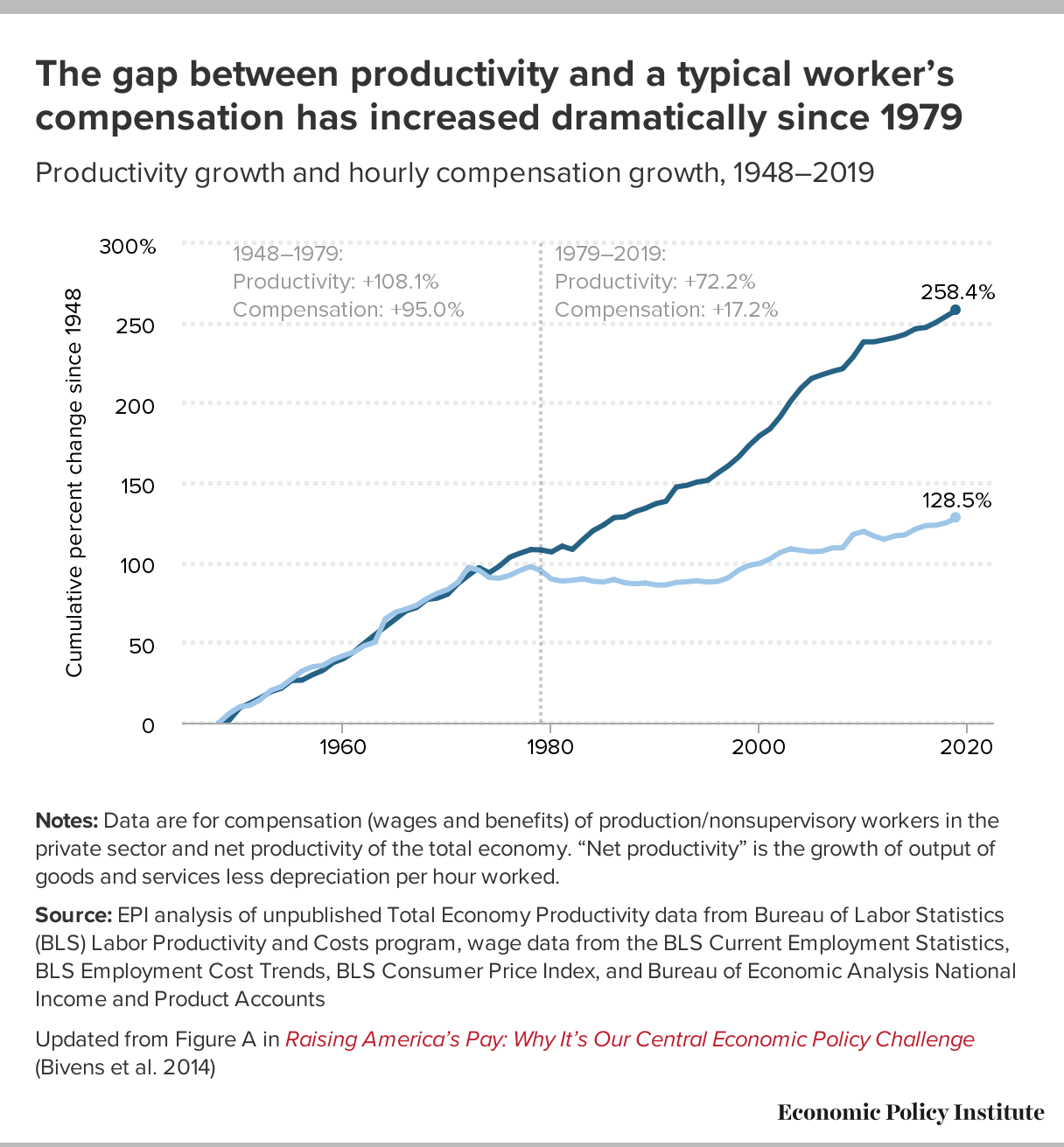
The lack of wage growth not only coincided with the loss of a pension for many Americans, but it also came at the same time of rapidly rising costs for housing, education, healthcare, etc. Should we really be surprised that Americans are falling behind in saving for retirement? I’ve often stated that there is a basic level of income needed for the average American to live. Regrettably, for many Americans their current wage falls far below that basic level.
The folks at MIT have created a “Living Wage” calculator that helps to determine the necessary minimum wage based on local cost of living expenses. For instance, a single mother with two children living in Newark, NJ needs to earn $42.33/hour to meet her basic living expenses. Unfortunately, the minimum wage currently in NJ is $11.10/hour or roughly 1/4 of what she actually needs. If you are living in Mobile, AL, that single mother of two children requires an hourly compensation of $28.42 or roughly 2/3s what is needed in Newark. Regrettably, the minimum wage in Mobile is $7.25: again, roughly 1/4 of what is needed.
For our Newark resident who works 40 hours per week and 52 weeks per year, the annual compensation that she would need in order to meet her basic living expenses would be $88,046. As of 2018, the median family income in Newark, NJ was a shockingly low $37,642, or roughly 42.8% of what that family of three needs. Is there any wonder why she may not be funding her 401(k), if she even has access to one? It drives me crazy when I read about various generations being excessive consumers. You know, the latte, avocado toast people who would rather consume than spend wisely by investing in their future. I find it hard to believe that mom and her kids are spending much money, if any, on lattes.
We absolutely need to address the ever growing wage disparity that weighs heavily on a significant portion of our population. In a previous blog post I highlighted output from a study that found that the lowest quartile of workers by wages had seen a >30% loss of jobs during the Covid-19 crisis. These individuals have very little in financial resources to weather any loss of a job/wages, let alone continue to fund a retirement benefit. It is critically important to our workers and to our economy that we preserve DB plans for the masses so that older members of our society can remain active participants in our economy demanding goods and services. DC plans should continue to be supplemental to true retirement funds, as they were initially considered. Anything short of this will result in failure.
Corporate Pension Funding Drops Slightly in September
P&I is reporting that the average corporate pension plan experienced a marginal decline in the funded ratio, as the fall in asset values, primarily driven by lower equity returns, outpaced the slight fall in liabilities, as corporate spreads marginally widened during the month. P&I was referencing four different studies by Wilshire, Legal and General, Northern Trust, and Mercer. Only the Mercer study, which evaluated the funded status of the S&P 1500 companies with DB plans, showed pension funding to be flat during the month.
The average corporate plan’s funded ratio ranged from 77.9% (L&G’s analysis) to 83.1% (Northern’s review), while the Mercer and Wilshire output reflected more consistency with Northern Trust findings of roughly 83%. In any case, funded ratios are down about 4% this year, as discount rates have declined by about 57 bps (NT’s estimate), while asset levels are flat to up marginally.
Given that the average corporation’s funded ratio is now below 85%, PBGC variable premiums are kicking in. As a reminder, plans pay 4.5% ($45) in variable premiums for every $1,000 in UVB. It might make sense to close that gap with additional contributions or the injection of proceeds from a bond offering given the incredibly low rates. We’ll discuss that strategy in a future blog post. Have a great day!
What’s The Objective?
There has been a tug of war for decades within pension systems (public, private, and multiemployer) as to what is the correct objective: maximizing return or securing the promised benefits. Unfortunately, the idea that pension systems should maximize return has come out on top in this battle. Regrettably, this “goal” has done little to improve the funded status of these plans despite the last decade of strong equity and fixed income returns. We’ve gotten a lot of risk with little to show in terms of more stable plans.
So what is the goal? I grabbed the following quote from a Voya white paper “The Lost Decade” that suggests that securing the promised benefits should be the primary objective. “Pension plans are not hedge funds. Their objective function… should be geared toward solvency and liquidity — not maximizing returns.” Furthermore, “there is an asymmetric payoff when it comes to taking equity risk. Plans receive limited upside when equities rise and incur all of the downside when equities underperform.”
Given that objective, how do we accomplish the goal of improving solvency and liquidity? We, at Ryan ALM, would recommend adopting a cash flow driven investing (CDI) approach to secure the near-term Retired Lives Liability, while then using the balance of the corpus as alpha assets to maximize return in order to meet future liabilities. In this example, we accomplish both competing objectives – securing benefits and maximizing return – while also reducing funding costs and risk.
A CDI strategy is nothing new. Immunization and dedication strategies have been utilized since the creation of DB plans. However, somewhere in the early 1980’s the pension objective switched to a more aggressive implementation that favored maximizing returns in lieu of protecting the promise that was made to the participants. We think that the current environment is perfect for adopting this strategy. Equity valuations are near all-time highs, and despite recent strength in the markets, there seems to be a disconnect between stock performance and the global economy that continues to struggle under the weight of Covid-19.
The benefits of a CDI approach are numerous, including; 1) improved liquidity, 2) reduced funding costs, 3) buys time for the alpha assets to do their job, and 4) secures the promised benefits. Importantly, this is a “sleep well at night” implementation that would be quite comforting to your plan participants. I have no idea where markets are going to be in the next 2-3 years let alone tomorrow, so if I were a plan sponsor, I’d much prefer securing the promised benefits which buys my alpha assets time as opposed to letting the focus be on achieving the ROA by injecting more risk into the process today with no guarantee of success.
The Most Vulnerable Get Hit The Hardest!
Often we read that a current event is different than that which we’ve experienced in the past only to realize that history is actually repeating itself. Well, the impact of Coronavirus on our most vulnerable workers, those making the least in earnings (bottom quartile), is highlighting the fact that circumstance are, in fact, very different this time. As the chart below highlights, job losses in previous recessions have tended to impact those in different earnings categories quite similarly. Sure, the impact on the lowest paid segment of our labor force has tended to be slightly greater with the exception being the 1990 recession. But, we’ve never experienced anything to the degree that Covid-19 has produced.
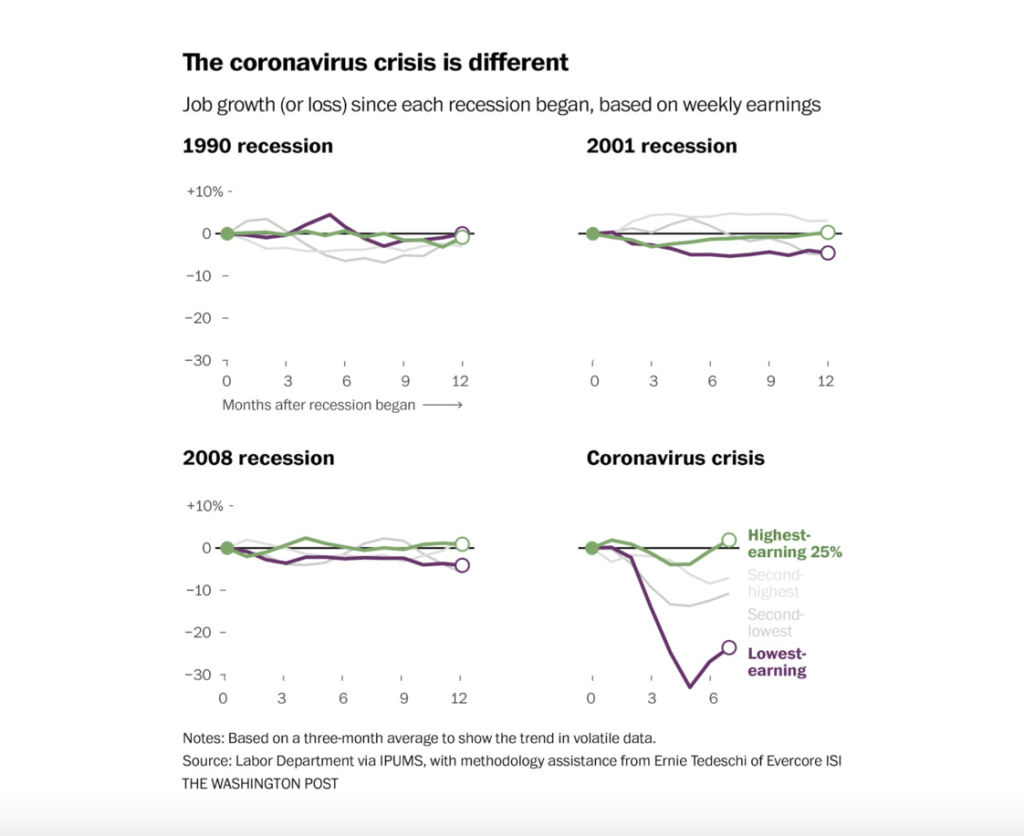
Workers in the lowest 25% of the labor force based on earnings witnessed job losses that represented more than 30% of their cohort. There has been a bit of a recovery, but for many of these workers in service industries they may be facing extended periods of unemployment, if jobs ever come back. Unfortunately, our country was already experiencing a widening in income disparity and the impact from Covid-19 has only accelerated the gaping differential.
In an age in which many American families are barely able to meet their basic needs, we are watching as the cost of education, healthcare, retirement, etc. continue to grow nearly unabated. Is there any wonder why millions of Americans haven’t been able to save for retirement? Without any discretionary income is it any wonder that “retirement” vehicles such as 401(k) plans aren’t meeting their needs?
Even though defined benefit plans only covered about 40%-45% of the labor force at their peak, the loss of these vehicles today is crushing the retirement dreams for millions of Americans who will never be able to retire with dignity, if they can retire at all. DC plans were established to be supplemental savings accounts. Today, they aren’t supplementing anything, especially for those making less than the median compensation. This income inequality will create major impediments for our economy, as demand for goods and services wanes. I find this situation to be tragic and unacceptable. We need to redouble our efforts as an industry to try and preserve DB plans where possible. DC plans have never been the answer.
That Was Unbearable!
A day after writing “Fingers Crossed”, I am left shaking my head at the embarrassing spectacle that much of America and I watched last night. Earlier yesterday I felt that because of the upcoming election politics would win out and action might finally be taken on critical legislation like pension reform given how important it is to residents in many key swing states. Well, I was wrong! What I saw last night reconfirmed for me why we have a crisis unfolding in our pension industry and why nothing has been done to date.
We have NO leadership in Washington DC: NONE! The financial future for millions of Americans depends on getting legislation passed that will finally secure the pension promises that have been made to retirees and future retirees. Yet, we are left this morning with the feeling that this issue and myriad others have little chance of being addressed as our “leaders” in Washington DC are devoid of a game plan. Calendar year 2020 has been an unmitigated disaster for many (most) Americans. We can’t wait for 2021 and a new beginning, but the next few months are likely to be as ugly as the first nine months of this year, and that frightens the hell out of me.
What is wrong with our political system that gives us candidates like this when I know that there are great American women and men who could provide the necessary leadership, promise, and HOPE that we are all craving? I was thrilled to join John Murphy’s Butch Lewis Act (BLA) team in Washington DC in April 2018 when he arranged to present this proposed legislation to both House and Senate staff. That was 2 1/2 years ago! The House passed the BLA in July 2019. Yet, nothing has been done in the Senate to move this Act or any other legislation forward. WHY?
We don’t need more Neros. The folks in DC have fiddled for far too long. We need women and men with great character to finally take action before our pension industry collapses and more Americans are left in financial ruin. Last night gives me little hope that we will see that soon, and that is just not acceptable.
Fingers Crossed
There seems to be some thawing in the negotiating stances of both Republican and Democratic representatives tasked with creating a viable solution to the unfolding multiemployer pension crisis. As everyone who reads this blog knows, we have long been huge supporters of the Butch Lewis Act legislation (BLA) that was passed by the House with bipartisan support in July 2019. Regrettably, the US senate, under Republican control, has failed to advance that legislation. Isn’t it funny how a hotly contested election can get the attention of these politicians, especially when many of the important battleground states are populated with participants from these struggling plans?
I remain hopeful (maybe naively) that these plans can get the loans necessary to meet the promised benefits without having to face benefit cuts and insurance premium increases. Benefit cuts would be hugely unfair given that the participants often deferred salary increases to support their retirement programs, while doing nothing to put these plans in the precarious position that they are in today. The thought of dramatically increasing PBGC premiums seems really silly, as these plans are already struggling to meet their current funding needs. Increasing the cost on these plans makes little sense, but it also doesn’t make sense to penalize healthier plans, too, which is also part of the Republican’s plan.
The great work by Cheiron (actuarial firm) that highlighted the effectiveness of the BLA legislation in stabilizing the funded status and contribution expenses of the Critical and Declining plans (now about 130) showed that all but three of the plans would be able to repay the loan after 30 years, the on-going interest payments, and the future liabilities of the plan. Why Republican Senators feel that pensioners shouldn’t get the full benefit that was promised is beyond me.
With so much at stake in the upcoming election, perhaps we can finally get some rationality prevailing. The roughly 1.4 million Americans that would be negatively impacted by the failure to create a viable solution might just be joined by the nearly 9.5 million union workers in “healthier” plans to create a voting block in places like Michigan, Ohio, and Wisconsin, as well as others, that just might decide who occupies the White House for the next four years. It is really too bad that it took this long to get representatives from both parties to the table, but it is better late than never. Let’s hope that they do the right thing!
Where Did My Principal Go?
We are currently engaged in a project for a large city pension plan with >$3 billion in assets and a funded ratio approaching 20%. The analysis and solutions that we prepared showed that their pension system would be able to meet all future obligations (benefit payments) with significantly reduced contributions of >$10 billion, a revised return on asset assumption (ROA) of 5.8% (current ROA is 6.75%), and reduced funding costs of the Retired Lives Liability by nearly $420 million. In addition, this plan would still have roughly $570 million in assets in 2055.
The plan sponsor was quite pleased with our analysis and solutions, especially where we reduced contribution costs by 26%, but he was confused as to why assets were so reduced at the “last” liability payment date. With $3 billion currently in AUM, his questions were: “How are we going to meet future obligations and won’t this mean that we are back in the poor financial position that we are today?” Under FASB and GASB accounting rules and actuarial standards, actuarial projections of benefit payments differ depending on the type of plan.
Public pension systems operate under GASB, which uses an Accrued Benefit Obligation (ABO) methodology when forecasting future benefits. In this framework, only current staff is included with no projection of salary increases. As a result, public pensions are a zero-sum game where actuarial projections are based on investment returns on the current assets and contributions fully funding benefits and expenses (C+I=B+E). This methodology would fully exhaust all assets when the last liability is paid. Importantly, new employees would require new contributions or asset growth. Please note we provided an excess asset cushion in 2055 of nearly $600 million.
In the case of a corporate plan, they operate under FASB and the accounting is a Projected Benefit Obligation (PBO) projection of benefits that also doesn’t include new staff, but the benefits take into consideration salary increases. Actuarial projections again are a zero-sum game. Are you confused, yet? Just wait, it gets better.
Ideally, all pension systems should use an Economic Benefit Obligation (EBO) accounting for future benefits. This methodology includes forecasts for both increases in staff and salary, but this is a very difficult exercise and often creates a lot of actuarial noise around such estimates. As a result, it is seldom used. An actuarial friend of our firm added the following: “The problem of the EBO analysis lies in the lack of acceptance by the actuarial community of the economic principles of Law of One Price that lead to Cash Flow Matching and/or Risk Recognition from Asset/Liability mismatches.” Lastly, and likely most important is the fact that this methodology leads to increased contributions which is the consequence of the EBO mathematics using standard actuarial models.
Based on the above information, it isn’t too difficult to understand why the plan sponsor involved in our project was concerned about the “loss” of assets in 2055 versus their plan’s market value of assets today. He should have been thrilled with the conclusions that we presented, but he was confused instead. This isn’t surprising given the many different ways that future benefits can be estimated. Why do we have so many methodologies to calculate benefits? Worse, why do we have two different methodologies in GASB and FASB when the world uses IASB? We’ll save our thoughts on that subject for another blog post.
We’ve invested enough time on all this actuarial stuff. You are probably wondering how a public pension system could “save” significant future contributions, while reducing funding costs and the ROA necessary to fund this plan, especially given that U.S. interest rates are at historic lows and equity valuations near all-time highs. We’d be happy to speak with you about our proposal. Call us.
Additional Contributions are Not Likely
We’ve been speculating for a while that the economic impact from Covid-19 was going to be harsh for both states and municipalities, especially as it relates to upping annual contributions to public pension systems. Just how bad the hit is going to be is starting to become public. The National Conference of State Legislators (NCSL) has on their website a very interesting (and scary) map of just how bad the carnage is likely to be.
For instance, states known for their poor pension funding such as Illinois, New Jersey, Connecticut, and Kentucky, are projecting revenue hits in 2021 that will exceed 10% in the case of CT and IL, while NJ and KY are forecasting >15% hits to their top line. It is highly unlikely that any of these states that might have been planning to enhance their annual contributions this year or next will be able to achieve that objective. In fact, it is likely that cuts should be anticipated.
New Jersey’s legislature has just passed a bill raising state income taxes on those residents earning income in excess of $1 million / year, but that additional tax revenue, if collected, is not likely to make up for a projected 18% hit to revenue in 2021. With equity markets at near all-time highs and interest rates at all-time lows, cobbling together an asset allocation that can produce a return commensurate with the return on asset (ROA) objective will be challenging.
There are strategies that might help bridge these uncertain economic times, but it will force plan sponsors and city/state officials to think outside the box and perhaps re-tool the implementation of strategies that might have been tried in the past with less than stellar results.
Let’s Frame The Problem Correctly
I was pleased to read an Op-Ed by Congressman Baron Hill, Indiana’s 9th District, calling for support of multiemployer pension reform, which is clearly long overdue. What surprised me though was his comment about the funded status deficit for multiemployer plans being $638 billion before Covid-19 set upon us. Although technically true, the $638 billion number is reached if each plan valued their liabilities at a risk free rate (which they are under no legal obligation to do) and the legislative efforts were focused on helping every single plan. It’s not!
As a reminder, there are roughly 1,400 multiemployer plans in the US. There were 114 plans that were designated as “Critical and Declining” when the Butch Lewis Act (BLA) legislation was first contemplated. That number has since grown to roughly 130 or so. The funding deficit that existed for the original 114 was roughly $68 billion in 2018. Many of the other plans are well enough funded (>80%) that federal support is not necessary at this time.
There is a crisis unfolding for the participants (1.4 million) in those C&D plans that will result in pensioners receiving mere pennies on their broken pension promise. These are the funds/participants that we should be helping at this time. The other multiemployer plans don’t have the same solvency issues that the C&D plans do. They also enjoy the benefit of time to resolve some of their current funding shortfall.
Inaction on the part of Washington lawmakers has been present for quite some time. Could it be that they aren’t addressing this issue given the false impression that the magnitude of the crisis is far greater than what it truly is? As I wrote recently, the roughly $34 billion that the OMB calculated was needed over 10-years to “save” these plans is a minor rounding error relative to the $3.8 trillion deficit that has been created in this year’s Federal budget. The BLA is terrific legislation that has already passed the House in July 2019. It is about time that the US Senate passes this legislation that will preserve the promise that was made to these American workers when they began their careers.

