Can Inflation Be Contained at an FFR of 2.25%?

By: Russ Kamp, Managing Director, Ryan ALM, Inc.

Ryan ALM’s Head Trader, Steve Devito, shared some extraordinary figures with the team last week. Thanks, Steve! We’ve been saying all along that the US Federal Reserve needs to tighten interest rates to a significantly greater extent in order to finally control inflation. We’ve produced blog post after blog post highlighting what we believe to be the reality of our current situation despite market action during the last month or so that would counter our observations. Let’s take a look at some of the numbers from the last period in which we observed inflation in excess of 8% (the latest CPI # posted was 8.5%). In February 1982 the CPI for the month was 0.3% and the annualized inflation # stood at 8.3%.

However, unlike today’s environment in which the Fed Funds Rate (FFR) stands at 2.25%-2.50%, the FFR during that month was a robust 14.8% representing a 6.5% premium to inflation. Not the -6% “premium” that exists in today’s environment. Furthermore, the 2-year Treasury Note was trading at a yield of 14.45% far outpacing today’s 3.17% yield. It seems extraordinary that today’s “investors” would actually believe that a 2.25% FFR would tamp down our significant inflation. Furthermore, why are they willing to hold bonds at such negative real rates? Skeptical that I may have cherry-picked a bond that was an outlier? For further proof of just how unbelievable today’s environment is, the 10-year US Treasury Note was yielding 14.03% in February 1982, which was -0.77% relative to the FFR, but a whopping +5.7% real rate when compared to inflation.

The 30-year Treasury Bond also showed similar results, as its yield was 13.8% for a real yield of 5.5%. Again, we ask, do you really believe that the Fed has accomplished its objective? How much economic activity do you really believe will be constrained by these incredibly modest levels of interest rates? Could it be that we have 2 generations of investors who have not experienced excessive inflation leading to significantly rising rates? Despite the double-digit FFR in 1982 (14.8%), inflation didn’t fall below 3% until July 1983 and it never touched 2% – the current Fed target – before rising again to 3.4% by year-end 1983.

With today’s robust employment and wage growth, is the average consumer more concerned about inflation or borrowing at slightly higher rates? My money is on inflation, as is the Feds. How many more times do we need to hear from a Fed Governor that inflation needs to be contained until rates can be stabilized? They’ve stated that they haven’t been dissuaded from raising the FFR based on newly released information. Not only are equity and bond investors giddy about inflation’s path, but they actually believe that the Fed may ease in the near term. However, Thomas Barkin, Fed Governor from the Richmond Fed, said on TV last weekend that the Fed needs to see real positive rates. Why the disconnect?

We aren’t suggesting that the Fed will raise the FFR to 14.8% in this environment, but 2.25%-2.5% seems like a small down payment on where rates will eventually need to go in order for this august governing body to have achieved its ultimate objective. Hoping that rates have peaked likely sets our markets up for massive disappointment leading to further declines. The greater the current euphoria the likely the bigger disappointment. Pension America has seen some nice recovery in markets. Let’s hope that they take some steps to reduce risk before everyone realizes that the Fed has much more to do. Securing benefits through enhanced liquidity and the buying of time – Ryan ALM specialties – may just be the necessary prescription for what lies ahead.
ARPA Update Through August 12, 2022

By: Russ Kamp, Managing Director, Ryan ALM, Inc.

The flood gates have been opened! From May 3rd to August 5th there had been 10 applications filed for Special Financial Assistance (SFA). During the week ending 8/12, 12 applications were submitted. The activity has been almost exclusively driven by the PBGC’s issuance of the legislation’s Final, Final Rules, as 11 applications were classified as supplemental. The only non-supplemental filing was the Central States, Southeast & Southwest Areas Pension Plan (a.k.a. 800-pound gorilla). The Central States plan withdrew the initial application that had been filed on April 28th and resubmitted an updated application on August 12th. As a reminder, this plan is seeking nearly $35 billion in SFA support for the 364,908 plan participants. To put that sum into perspective, the Central States’ request is nearly 5 times greater than the $7.5 billion that has been paid out to date to the 29 applications that have been approved.

Only the Central States plan withdrew an application last week. In addition, there were no applications that were either denied or approved. The PBGC has 120 days to act on the supplemental applications but given the fact that these entities have already received SFA from the previous submissions, it doesn’t seem likely that 120 days will be necessary for an adjustment to the original SFA to be approved and paid.

No new applications have been filed since June 30, 2022, despite the fact that Priority Group 4 plans (those projected to become insolvent before 3/11/2023) have been able to file since July 1st. To date, 41 plans have submitted applications to receive SFA. When Ron and I were involved in the Butch Lewis Act effort, Cheiron had produced an excellent analysis of 114 plans. I’ve read on numerous occasions that perhaps as many as 200 pension plans might be eligible to participate in the ARPA legislation. If that is the case, we’ve only seen about 20% of the applications filed or <50% if the number of eligible plans is closer to Cheiron’s initial study. Obviously, there is more to come. Stay tuned!

One Month Doesn’t Make A Trend!

By: Russ Kamp, Managing Director, Ryan ALM, Inc.

As a child playing football, I was told to look at my opponent’s belt buckle when going to make a tackle, so as to avoid head fakes. Well, market participants cheering yesterday’s inflation news might do well to heed this advice, as head fakes occur in the capital markets all the time. What would be the equivalent of focusing on the opponent’s belt buckle? In the inflation case, perhaps we should avoid the headline # of 8.5% and focus more attention on those components that continue to highlight significant inflationary pressures such as food and housing. Also, the 8.5% CPI number is still significant, as wages continue to fall substantially below that level at 5.2% YOY growth.

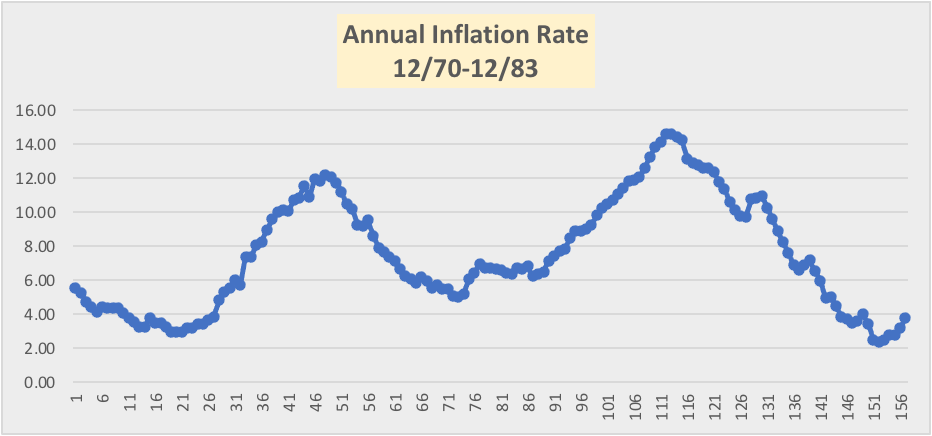
The graph below highlights the path that inflation took during the 1970s into the early ’80s. In August 1972, before Tug McGraw would famously chant “You Gotta Believe” in reference to the NY Mets going from bottom dwellers to the World Series, annual inflation would bottom at 2.95%. It would continue an unabated rise “peaking” 23 months later at 11.54%. Following that month (July 1974), the annual CPI would fall to 10.89% or -0.65% in one month – sound familiar? Did that occurrence represent the beginning of the end for inflation – NO! As August’s CPI quickly rebounded producing a 1.06% increase to an annual rate of 11.95%. Inflation wouldn’t peak until November of 1974 at an annual rate of 12.2%.

US Federal Reserve eased too quickly

In an attempt to thwart these inflationary pressures, the US Federal Reserve would raise the Fed Funds Rate (FFR) to 16% by March of 1975. However, they would dramatically reduce the Fed Funds Rate in April down to 5.25%, as inflationary pressures were subsiding – was that action premature? Inflation would fall precipitously from that November peak in 1974 to a bottom in that cycle in December 1976. However, the low annual inflation # was still at 5.04%, or 2.5 times where the Fed would like to see inflation today. Regrettably, inflation once again took off eventually peaking at 14.6% in April 1980. However, despite increasing the FFR to a whopping 20% in the month prior to the peak, it would have to revisit that extraordinary level on several occasions during the next couple of years.

Where did inflation go following these unprecedented moves? Well, it didn’t plunge. In fact, it took 3 years and two months to finally have inflation post a number that began with a 2! Inflation would eventually bottom out at an annual rate of 2.36% in July 1983 before once again ascending. Market participants that believe a Fed Funds Rate of 2.25% will quickly extinguish our current inflation have not studied past cycles. One should realize that unemployment touched 10.8% in 1982! With current unemployment at 3.5% and annual wage growth of 5.2%, just how much economic activity will be tamped down by our current levels of interest rates? I suspect very little. Don’t let one month of “falling” annual CPI rates cloud your judgment. History suggests that we are in for quite the rollercoaster ride.

ARPA Update Through August 5, 2022

By: Russ Kamp, Managing Director, Ryan ALM, Inc.

I look forward to these Monday updates but would prefer a bit more activity to get everyone excited by the progress being realized in the quest to secure the pension promises that are so important for our American workers. However, I can only report on what is actually happening at this time. That said, we had Local 966 Pension Plan file a revised application seeking Special Financial Assistance of $51.3 million for its 2,356 plan participants. The initial application was filed on March 31, 2022 and withdrawn for unknown reasons on July 15th. The PBGC now has 120 days to act on this revised application.

In other news, the PBGC announced last Monday, August 1st, that the Pension Plan of the Printers League – Graphic Communications International Union Local 119B, New York Pension Fund had its application approved for $90.6 million in SFA proceeds that will go a long way in securing the promised benefits for 1,213 plan participants.

We, at Ryan ALM, are working with a few pension plans that have or will receive SFA proceeds. We are still waiting to see how these plans and their consultants will react to the PBGC’s Final, Final Rules that permit the expansion of permissible investments. We still favor only using SFA proceeds to invest in bonds that would be used to defease the promised benefits (and expenses) chronologically from the next month’s benefits as far out as possible. I’ve modeled many scenarios using historic data and possible future returns with the newly expanded investments. I will be reporting in a separate post on those results, but I haven’t been motivated to change my opinion on how the SFA should be invested. More to come!

Recession Fears Overblown!

By: Russ Kamp, Managing Director, Ryan ALM, Inc.

Yesterday, I produced the chart below with the intent to write a piece regarding premature recessionary fears. My premise was based on the fact that since 1970, recessions only occurred as unemployment rose/peaked. With today’s jobs report, I am more convinced that we will be saddled with inflationary pressures for longer without a corresponding recessionary environment. The calendar year 2000 is interesting as unemployment began to rise but given the low level of unemployment at that time, the economy never went into recession. Could our current landscape be foretelling a similar outcome?

Produced by Russ Kamp, Ryan ALM, Inc.

As for today’s news, it’s been reported that US employers added a robust 528,000 workers in the last month which far exceeds prognostications by a factor of 2Xs. Furthermore, these new jobs spanned many industries/sectors. As a result, the unemployment rate now stands at 3.5%, which is the lowest level of unemployment in the last 50 years. As has been reported numerous times, individual balance sheets have been improved since the flood of government stimulus beginning in 2020. Their spending may be shifting from goods to services, but they are spending nonetheless!

Bond investors that were anticipating a dramatic reversal in both inflation and interest rates may want to rethink that strategy given this news. As we’ve been reporting, US real rates are at historic lows providing “investors” with significant real losses after inflation. This news shouldn’t come as a shock. The US Federal Reserve has been showing its hand for quite some time that it would do what is necessary to tame the inflationary beast. We warned you on several occasions to not ignore the Fed. Caveat emptor!

What Do They Know That We Don’t?

By: Russ Kamp, Managing Director, Ryan ALM, Inc.

It was announced earlier today that the Bank of England (BofE) has raised its key rate by 50 bps representing the largest increase since 1995. This marks the sixth consecutive meeting in which they’ve raised this rate, which now stands at 1.75%. This decision follows England’s June inflation reading of 9.4% (the US is at 9.1%). The aggressive pace of rate increases mirrors the U.S. Federal Reserve’s, but the magnitude has been slightly less intense, as the Fed Funds Rate currently sits at 2.25% to 2.50%.

In announcing this latest increase they also provided perspective on the future paths for both rates and inflation in stark contrast to the recent pronouncement by the U.S. Federal Reserve which stated that future “guidance” would be limited. BofE is anticipating inflation to eventually peak at 13.2% during Q4’22. They are also forecasting that Great Britain’s economy could suffer a recession for 5 consecutive quarters beginning later this year. However, that is not going to impact BofE’s decision to aggressively fight inflation, which mirrors the US Fed’s position that inflation poses a great threat and must be tamed even if economic growth is impacted in the short term.

It is fascinating to watch the market activity within the U.S. at this time, as investors seem sold on the idea that inflation has already been tamed and that rates will have to fall in the near term. The U.S. has not posted an inflation # yet that would indicate that inflation has peaked. Furthermore, the Fed Funds Rate is at 2.25%-2.50% which is at the low end of the normal range of 2% to 5%. In 1975, the Fed increased the FFR to 13% in July while inflation was still at 11.5%. The US economy would fall into recession later that year and the Fed aggressively reduced rates once again to 5.25% by April, but inflation remained elevated at >10%. This premature action would lead to the Fed eventually raising the FFR to 20% in March 1981. It wasn’t until 1982 that inflation eventually fell below 10%, but rates remained elevated with the FFR still at 20% in March 1982.

Given the history cited above, just how much economic activity will they have hampered with rates remaining this low? Remember, inflation peaked in early 1980, but interest rates didn’t begin to fall until 1982. If a similar pattern forms, bond “investors” will be sitting on huge negative real returns for quite some time. That is not a winning strategy!

Have We Seen Negative Real Rates of This Magnitude?

By: Russ Kamp, Managing Director, Ryan ALM, Inc.

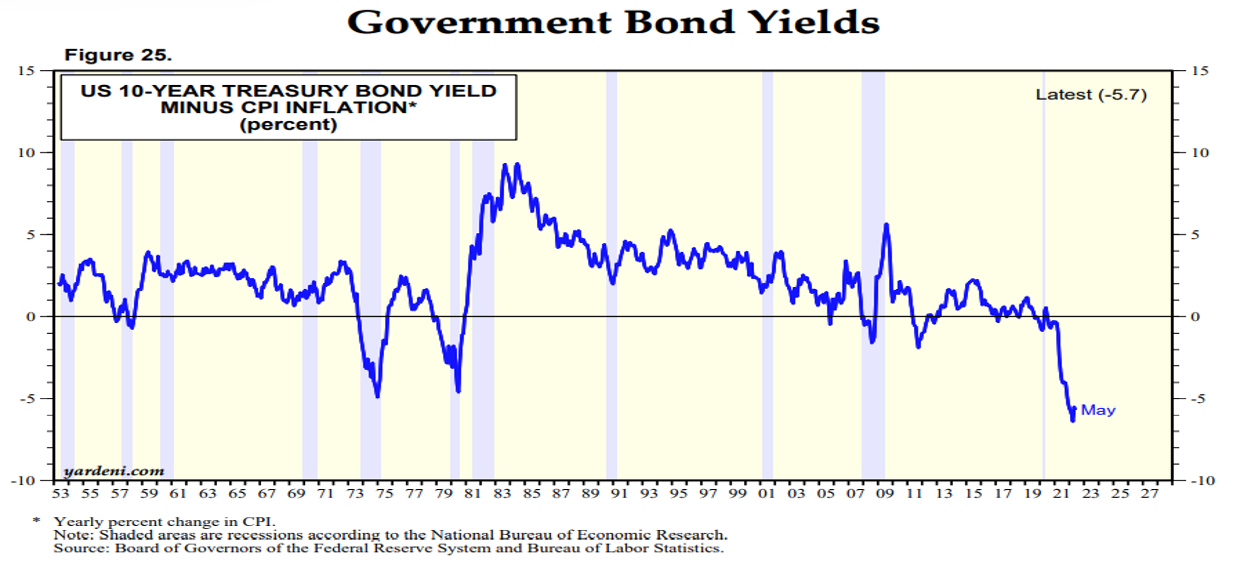
Following the publication of yesterday’s post, I received several good questions including the following: “Have real interest rates (nominal rate minus inflation) ever been below -5%, let alone the current -7%?” It is a terrific question and one that should be on the minds of all investors. The simple and not surprising answer is not since at least 1953. We came close during the turbulent ’70s, but nothing to this extreme. With the most recent rally in Treasuries, the real rate for the US 10-year Treasury Note is – 6.22% as of 8:20 am on August 3, 2022.

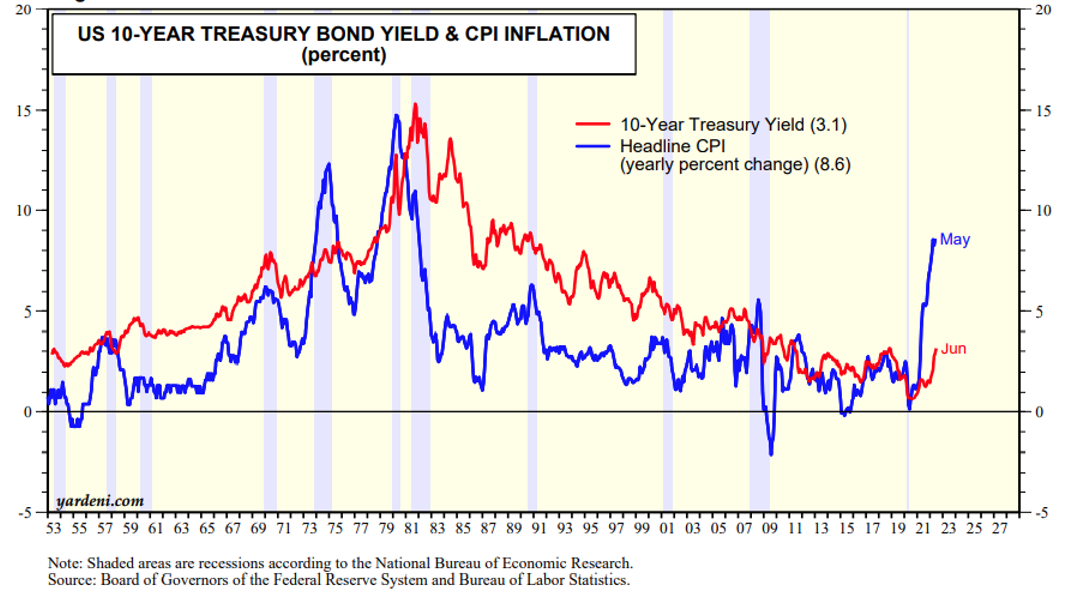
It makes no sense to me and many others why the investment community continues to accept such a ridiculously low return on US government bonds given the inflationary environment that won’t likely collapse as quickly as it rose. Again, my premise is that 4 decades of falling US interest rates that culminated in historically low rates associated with the Covid-19 crisis have clouded our judgment and anchored us to believe that interest rates will remain low forever and ever. All one needs to do is look at the yield on the US 10-year Treasury Note for the 30 years prior to 1982.

US interest rates historically provide a real return

One should also note that US rates kept rising into 1982 despite the fact that inflation peaked in 1980. Again, investors thinking that the US Fed has already accomplished its objective in curbing inflation by increasing the Fed Funds Rate to 2.25% – 2.5% are just kidding themselves. These rates remain near historic lows and likely remain stimulative to economic growth. Couple that fact with full employment and strong wage growth and it remains highly unlikely that the investment community will get their Christmas gift of a Fed providing easing early in 2023. As always, we encourage your questions and look forward to engaging with you in the near future.

Only In The Second Inning?

By: Russ Kamp, Managing Director, Ryan ALM, Inc.

We’ve been quite surprised by the magnitude of the moves in both US interest Rates (down) and US equities (up) since mid-June. In fact, July is one of only a handful of observations since WWII in which a -7.5% or worse monthly performance (June) was followed by a +7.5% or greater performance for US equities (as measured by the S&P 500). Those previous monthly gyrations have led to extraordinary returns 12 months out. But be careful not to jump with both feet into the water. False signals can be quite dangerous to one’s financial health, especially in light of the fact that each of those previous occurrences followed aggressive easing by the Fed. That isn’t about to happen anytime soon.

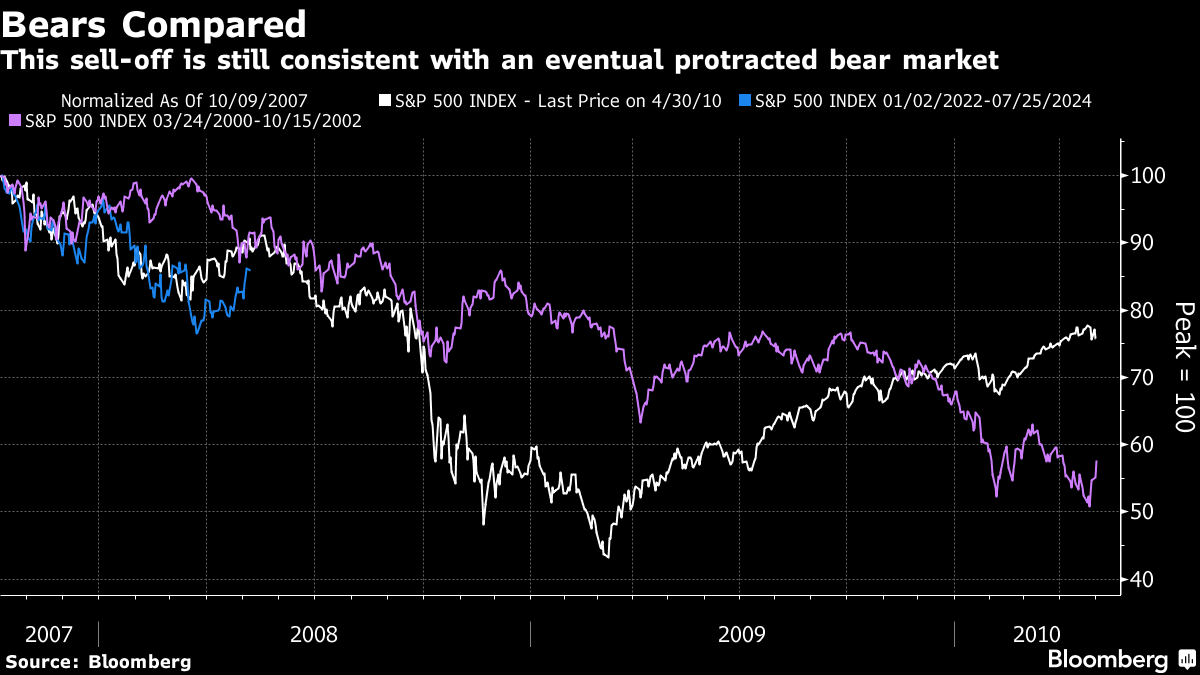
As the chart above highlights, 2022’s equity performance is revealing a pattern not too dissimilar from those of two recent significant market corrections earlier this century. In fact, the patterns are strikingly similar. It certainly seems to us that recent risk-off trades predicated on the belief that the Federal Reserve has actually accomplished its objective of taming inflation seem premature at best, if not just plain silly. The Fed has raised the Fed Funds Rate from effectively 0 to 2.25% at this time. They’ve indicated that another 0.75% increase in September is on the table, while not eliminating the possibility that additional increases might be necessary until they have tackled inflation. Yet, market participants are behaving as if we will see an immediate economic response to these recent increases off a historically low base causing the Fed to swiftly do an about-face. Do investors truly believe that the current interest rate environment is going to choke economic activity? Again, are we ALL collectively anchored with the concept of low rates forever?

In a blog post that we recently produced, the 1970s’ interest rate and inflationary environment took 10 years to unwind. Interest rates began that inflationary cycle in the low 3% range and it wasn’t until 1983 that they once again displayed a 3 before the decimal place. Today we started the day with all Treasury maturities with yields below 3% except for the 1-year T-Bill. That doesn’t seem like a level of rates that would keep most people on the sidelines. For those of us that remember buying our first homes with interest rates in the 11+% range of the early to mid-’80s that thought is almost laughable.

We’ve been encouraging the plan sponsor community to de-risk since last year’s fourth quarter. If you haven’t done so yet, the time is ripe to take profits now as we believe that this correction, due to significant inflationary pressures, is only in the second inning. We look forward to helping you accomplish this objective.

ARPA Update as of July 29, 2022

By: Russ Kamp, Managing Director, Ryan ALM, Inc.

If it’s Monday, it must but ARPA update day! We are pleased to report that there was some activity last week as reported by the PBGC. Teamsters Local Union No. 52 Pension Fund, a Priority Group 2 Critical and Declining plan, refiled an application for SFA. This application is seeking nearly $82 million in Special Financial Assistance (SFA) for the 769 plan participants. They will hear from the PBGC by November 25, 2022.

In other news, Western Pennsylvania Teamsters and Employers Pension Fund and its 21,110 participants have been awarded $715 million in SFA. Congratulations to those members who will now see the reinstatement of benefits that were previously cut under MPRA.

To date, 41 plans have filed an application with the PBGC for SFA. Of those 41, 28 have received approval, and all but one of those have received the award totaling $6.7 billion. This remains a small sample of the estimated 200 plans expecting to receive roughly $80+ billion in ARPA proceeds. As a reminder, Priority Group 4 members were eligible to file beginning on July 1, 2022. None of those have filed an application as of July 29th.