So Out Of Touch!

In another classic example of being out of touch with what is truly happening to American workers, US Senate Republicans have introduced a new bill: the Addressing Missed-savings Opportunities for Retirement due to an Epidemic Act (AMORE) Act. Senators Ted Cruz, R-TX, Thom Tillis, R-NC, David Perdue, R-GA, and Kelly Loeffler, R-GA proposed this legislation, which calls for make-up contributions for individuals who weren’t able to contribute to their plans (401(k), 403(b), IRAs, etc.) in 2020.

But, just how many people do they think this will help? According to a Vanguard study from 2017, only 13% of their participants maxed out contributions that year, while a similar Fidelity study revealed that 9.1% of their participants hit maximum thresholds. Furthermore, those that weren’t likely to contribute were part of the roughly 50 million Americans who have filed for initial jobless benefits so far in 2020. If they presently aren’t among the 17 million or so still struggling to find a job, do you really think that they will have enough disposable income to make catch-up contributions?

According to Federal Reserve Chairman Jay Powell, if you were an American worker earning $40,000 or less you had a 40% chance of losing your job this year. Yes, 40% – outrageous! This cohort was clearly struggling to cover basic living expenses; so thinking that they were making regular contributions into a retirement account is a pipe dream. Oh, and the Vanguard study that I mentioned above, they expanded on the characteristics of the 13% that were fortunate to max out contributions, and not surprisingly, these participants were older, made more money, and were longer-tenured in their jobs. What a shock!

So instead of addressing truly critical needs such as pension reform, enhanced unemployment benefits, education, and worker protections during the age of Covid-19, we get another example of our “leadership” being totally out of touch with what our workforce is dealing with on a day-to-day basis. It is well beyond the time that we finally begin to elect representatives that can relate to the struggles that MOST Americans are facing and stop electing individuals who only reside in ivory towers.

This Is Not The Reason

Recent news reports have indicated that New Jersey’s funding of their upcoming pension contribution ($3.75 billion) is going to be negatively impacted by a decline in lottery revenues. Although that is a true statement, NJ’s issues go well beyond the impact of an 11.6% decline in lottery revenue, which if the full amount had been generated was only going to cover 26.7% of the contribution in the first place. No, NJ has many issues, the least of which is a minor (given the Covid-19 environment) shortfall in lottery revenues.

First, I’m not sure that NJ has made a full payment of the annual required contribution since George Washington slept here. Second, Governor Murphy and the state legislature are today in front of the NJ supreme court trying to convince this august body that approving a $9.9 billion loan from the Federal government without a referendum was perfectly legal. Please understand that they are seeking to borrow $9.9 billion on a current budget of just over $38.7 billion (2019-2020) or roughly 25.6% of the current outlay. Also, understand that they extended fiscal year 2020 an additional 3-months through September 30th by passing an appropriations bill for $7.6 billion. A formal budget for 2021 is not likely before 9/30.

With forecast revenues for state income and sales expected to plummet, while expenditures rise as a result of Covid-19 activities, NJ is in no position to once again pay their full ARC. Given NJ’s funded status any shortfall in making the ARC is devastating. NJ’s pension system is on a slippery slope to becoming a pay-as-you-go system, with some estimates pegging 2028 as the year in which this occurs. The annual cash flow out of the system (benefit payments) will dwarf current ARC requirements placing additional and perhaps unmanageable burdens on the State’s budget.

There is NO WAY that NJ can invest their way to success given the funded status is roughly 23% when valuing liabilities on a mark-to-market basis as opposed to the ROA under GASB. The only way that NJ’s pension system survives is to arrange a loan from the Federal government large enough to cover the Retired Lives liability that will secure the promised benefits, while buying time for the current assets and future contributions to exceed future liability growth.

Nearly 800,000 (or 9% of the roughly 8.88 million residents) NJ public workers participate in the pension system either as retirees or active participants. Failure to protect and preserve the promised benefits will be catastrophic for NJ’s economy, as we know from studies that a significant percentage of benefits received are spent locally. Easy for me to suggest that the Federal government should be willing to provide low-interest loans to states such as NJ, IL, KY, and CT, but failure to secure these promised benefits will create a social and economic nightmare for the economy and country. One caveat, if any of these states are successful in arranging for such a loan, the proceeds MUST be used to defease the plan’s current liability and not invested in a more traditional asset allocation.

If this strategy sounds familiar: it is! This implementation is mandated in the Butch Lewis Act to help preserve Critical and Declining multiemployer plans.

Maximize The Efficiency of The Asset Allocation

There is a lot of volatility in a normal asset allocation in short time frames. We’ve seen this unfold dramatically in a number of cases during the last couple of decades. At Ryan ALM we are guiding pension clients to adopt a cash flow driven investing approach (CDI) that can significantly reduce the volatility associated with a traditional asset allocation.

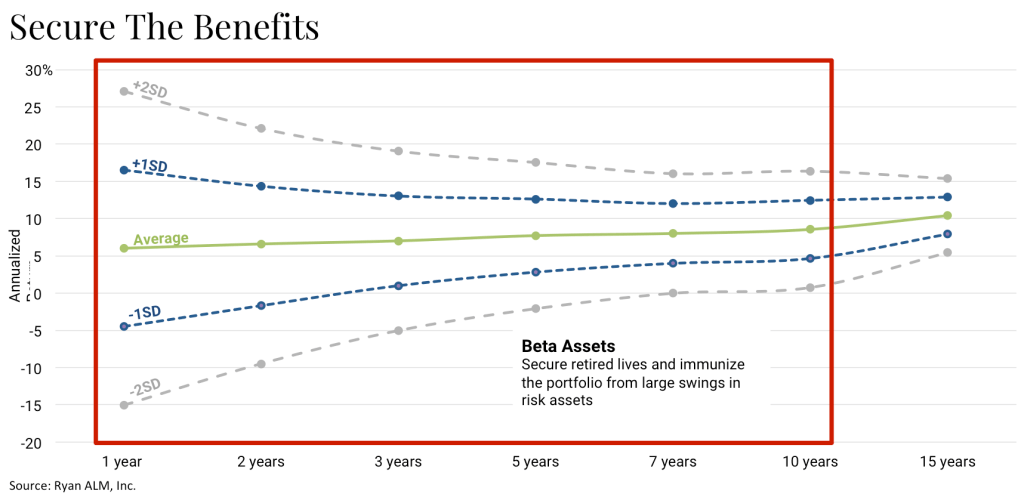
As the graph above reflects, the Ryan ALM asset allocation (5% cash, 5% international equities, 55% domestic equities, and 35% bonds) has produced an average 1-year return for the last 20 years (monthly moving average) of 6.03% with a 1 standard deviation (68% of the observations) of +/- 10.5%. A 2 SD observation would have that average 6% return showing a 95% confidence band of +27% to -14%. You can drive a couple of semis through that gaping hole!

I suspect that no plan sponsor would ever tolerate hearing their consultant remark that “your fund was down 12.5% during the last 12-months, but don’t worry, as it isn’t statistically significant”. Our primary goal is to get plan sponsors securing the promised benefits net of contributions for the next 10 years. If we can use the current bond and cash allocation to accomplish this objective, we can significantly reduce the volatility inherent in this traditional asset allocation.

As the chart above highlights, by separating the assets into two buckets – beta (the red square) and alpha, we can secure the promised benefits through a CDI implementation that extends the investing horizon for the alpha assets that now have time to grow unencumbered. In a traditional asset allocation, all assets are on hand to fund benefits net of contributions. During periods of market turmoil, liquidity may not be as abundant as usual and often assets are sold at less than ideal times. This forced selling exacerbates the underperformance experienced by the fund.

As you also see by the graph above, extending the investing horizon has substantially lessened the volatility through time. Where a 1-year period had a 1 SD observation of +/-10.5%, a 1 SD observation for the 10-year period is only +/-3.9%, which significantly enhances the probability of success for the plan. In our asset allocation example, the average 10-year return during the last 20 years was 8.55%. Thus, a 2 SD observation of the results would have a 95% confidence band of 0.75% to 15.35%: far more tolerable than living with the volatility of a 1-year horizon.

The alpha assets (highlighted by the green box) that presumably have a liquidity premium associated with them now have the time necessary to grow without being disturbed. Furthermore, the alpha bucket can invest in all sorts of assets other than traditional fixed income assets that are too highly correlated to plan liabilities. This process should result in much more stable contribution expenses and funded ratios. As the plan moves through time, it is highly recommended that the sponsor and their consultant contribute the necessary amount to keep the beta bucket defeasing the next 10-years of plan liabilities.

As we move through this incredible period for markets many participants are naturally worried that their promised benefits may be at risk. For those plans that have adopted a CDI approach such as ours, sponsors can safely tell their participants not to worry as their promised benefits are secured for the next 10-years. Furthermore, plans don’t have to worry about raising liquidity to meet those net benefit payments, as the cash flow from the CDI portfolio will be there every month to meet the next month’s payments. Don’t you think that your participants want to hear such a message?

Rightly So.

On June 23, 2020, the Department of Labor (DOL) announced a proposed rule to provide further guidance for Employee Retirement Income Security Act (ERISA) plan fiduciaries interested in environmental, social, and governance (ESG) investing. These ESG strategies must be chosen based on their financial merits and CANNOT be selected solely for ethical investing purposes if they are to gain access to defined benefit (DB) and defined contribution (DC) plans. I couldn’t agree more.

The securing of the promised benefits needs to be the number one priority for DB plans. Selecting investment programs/strategies that even marginally reduces the chance to accomplish that objective should not be considered. Furthermore, despite the growing popularity of the ESG strategies, I haven’t seen any evidence that they are producing superior results to traditional active strategies.

Given the extremely crowded investing field, I can’t help but to think that highlighting an ESG capability is just one way to further differentiate one firm from the next. However, I’ve witnessed to many fads during my nearly four decades in the business to think that ESG investing isn’t just another one for the history books.

DB plans need to be protected and preserved as the primary retirement vehicle for the majority of American workers. Let’s get back to basics in securing the promised benefits for DB participants. There are other pockets of money that can explore all the investing fads that they want.

No Fairy Tale

Once upon a time in a land not so far from here, defined benefit pension systems were over funded and cash flow positive. Yes, really! As recently as 1999, most DB pension plans were showing strong funded ratios and were at least cash flow neutral. Oh, how 20 years can dramatically alter the landscape. What happened?

Unfortunately, neither the US interest rate environment nor global equity markets cooperated. US interest rates collapsed until long Treasuries were sitting at historically low levels (US 30-year Treasury Bond is 1.34% today), while we tried to migrate through equity market gyrations (’01-’02, ’07-’09, Q4’18, and 1Q’20) that would have Elvis Presley’s hips jealous.

As a result, we have an environment that has corporate DB plans doing their best impression of a dinosaur, roughly 130 multiemployer plans that are on life support impacting the financial future of an estimated 1.4 million American workers, and a public pension system that still believes that their programs are perpetual despite several examples of plans with funded ratios below 20%. All we need is for Freddie Krueger to start showing up at industry events!

We don’t have a retirement system without DB plans. We can kid ourselves about DC plans being a viable alternative, but asking untrained individuals to fund, manage, and disburse this “benefit” is poor policy and nothing more than a pipe dream. As an industry we need to get back to basics. This means that we once again focus on why these plans exist in the first place, which is to pay the promise that was made to the employee when they were first hired. It means managing to this promise every day. It means securing the promised benefits for some extended time so that the plan doesn’t have to force liquidity in environments where it doesn’t exist.

What it doesn’t mean is that plan sponsors and their consultants have to redo their ROA target or asset allocation framework. We can get pension America back to the basics by just converting the plan’s current fixed income exposure into a cash flow driven investing (CDI) strategy. It is an implementation that provides the necessary cash flow for the next 10 years to pay the plan’s monthly benefits and expenses.

By utilizing a CDI approach, plans will see dramatically improved liquidity, the elimination of interest rate risk, the extension of the investing horizon for the balance of the plan’s assets, and an 10% to 20% savings relative to the current pay as you go approach to meeting monthly benefit payments. Furthermore, the savings is realized immediately, and those assets which are not needed to support the CDI portfolio can be used in the alpha portfolio to meet future liabilities.

Corporate America has done a much better job of managing the volatility of both the funded status and contribution expenses. Perhaps the reason is that they are forced to under more stringent accounting rules. But, given their relative success, why aren’t publics and multis embracing these tools? Again, we don’t have a true retirement system without DB plans, but we are just kidding ourselves if we think that these plans will survive without a change in course. Benefits need to be paid. A CDI approach is the only strategy that actually secures those promised benefits. Isn’t it time?

Ryan ALM 2Q’20 Newsletter

We are pleased to share with you the 2Q’20 Ryan ALM Newsletter.

This edition highlights our effort to bring forth perspective on a number of critical pension-related issues. Both Ron and I believe that education is the key to protecting and preserving defined benefit pension systems. Please don’t hesitate to go to our website at RyanALM.com to find our research, newsletters, and blog postings.

We also encourage debate, so please challenge us on anything that you question. We’d appreciate getting your thoughts. Have a great day!

No, They Aren’t!

I recently read an article that began with the statement that “pensions and 401(k) plans are totally different retirement plans” – I agree. It then went on to state that “one isn’t better than the next” – I couldn’t disagree more! The economic crisis associated with Covid-19 has highlighted once again for me just how challenging, if not impossible, it is for individuals trying to manage a defined contribution retirement plan.

First, as we’ve discussed on many occasions, many (most) Americans don’t have either the financial means to fund or the investment skill to manage these complex programs. Couple that with the fact that they have to guess as to how long they will live in retirement, and you have a math problem that even the brightest at MIT struggle to solve. Third, many employers have taken the opportunity during this crisis to suspend or eliminate their contribution to an individual’s plan. Some will reinstate them when the economy reopens, but it isn’t a guarantee. So, the funding burden becomes even more challenging for the individual employee.

I would argue that there are few American workers that wouldn’t prefer to have their employer fund, professionally manage, and then disburse a guaranteed retirement benefit every month until one’s death. Sure, there is the issue of portability that makes defined contribution plans attractive to some, but studies have highlighted the fact that a considerable percentage of premature withdrawals are the result of individuals not rolling over their accounts to their new employers and taking the withdrawal instead when shifting jobs. Furthermore, loans, which are a very slippery slope, reduce the compounding of returns that are so critical to building an appropriately sized balance.

As we reported yesterday, companies have taken every opportunity during the last several decades to restrict wage growth and benefits, and the elimination of the traditional pension plan in the private sector in favor of the defined contribution plan epitomizes this trend. A 2018 study by the National Institute of Retirement Security (NIRS) found that 59% of working-age individuals had not saved anything for retirement. I understand that DB pension plans were not available throughout the private sector and at the peak of pensions only about 45% of workers were covered, but that 45% certainly had a greater likelihood of enjoying a dignified retirement than those Americans stuck in 401(k) plans as their primary retirement vehicle.

It would be wonderful if every American worker had access to both a traditional pension plan and a DC-type supplemental retirement vehicle. Regrettably, that ship has sailed. Today’s employee is unlikely to have access to a DB plan, and for many workers, they don’t even have an opportunity to invest in a DC plan. For those that do have the opportunity to invest in a DC plan, many participants treat them as nothing more than glorified savings accounts. Even Congress, through the CARES Act, is encouraging the use of retirement plans to bridge unemployment that has resulted from the Covid-19 crisis. This is just setting up more Americans to have little to retire on in the future. We have a retirement crisis, and little is being done to address it. Saying that pensions and DC plans are equally good is neither helpful nor true!

The Financial Needs for Most Americans Are NOT Being Met!

It isn’t rocket science to understand why defined contribution plans are inferior to defined benefit plans for the simple reason that most American workers do not have the discretionary income to fund one’s retirement account, if they even have access to one. In a well-publicized report, the National Institute on Retirement Security (NIRS) has estimated that 59% of working-age Americans has not saved a single penny for retirement and regrettably they also don’t have access to a DB plan.

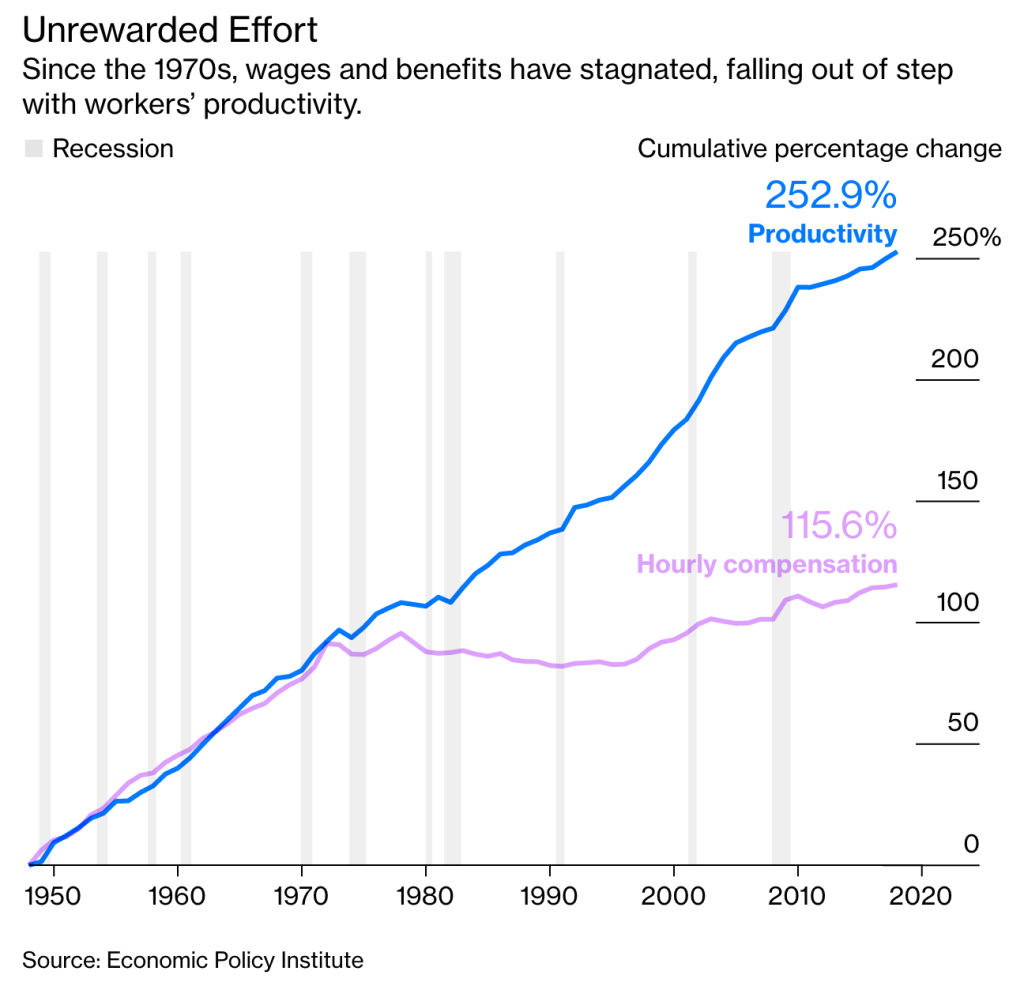
In another recent article published on Bloomberg’s site, “How The American Worker Got Fleeced”, it was highlighted how wage growth has been stagnant, traditional benefits cut, and workers’ rights revoked during the last several decades. As the graph below reflects, there once existed a fairly steady relationship between wages and productivity, but that relationship suffered a nasty divorce in the early 1970s. As a result, most Americans are being dramatically underpaid for the output that they are producing.

It should also be noted that these lower wages have been compounded by the impact of greater inflation for many household expenditures, including housing, healthcare, and education. In addition, the federal minimum wage, stuck at $7.25 since 2009, is worth roughly 70% of what it was in 1968, and about a third of what it would be had it kept pace with productivity. In fact, the bottom 90% of wage earners (those making <$120,000) has seen only a very modest increase in their incomes during last two decades. For workers receiving the minimum wage, they are making less today than in 1998, when inflation adjusted.

Couple these trends with the fact that benefits for healthcare and retirement have been scaled back and you have a formula for financial disaster, which is exactly what is transpiring today. The loss of union membership has left the private sector without a voice in salary and benefit negotiations. The movement to more of an on-call labor force has also compounded these trends. These sub-contracted workers allow companies to significantly reduce the liabilities that normally come with a full-time employee.

I’ve just ordered the book Supreme Inequality, which is a look at the US Supreme Court decisions of the last 50-years that has created a more unjust America for the American worker. I’ll have to report back on Adam Cohen’s work in a future blog post. In the meantime, we need to do everything we can to protect and preserve DB plans for the masses, as the above mentioned trends are doing everything to reduce the likelihood that today’s American worker will ever retire, let alone retire with dignity. I find this development to be shameful.

Is The Muni Market Foreshadowing Public Pension Funding Issues?

The WSJ has an article in today’s edition that frankly is pretty scary, but has gotten little press. According to Municipal Market Analytics Data, ten municipal borrowers defaulted in May and another 10 in June, the most for these months since 2012, as municipalities and states deal with the dramatic impact on revenues from the loss of income, sales, and hotel taxes, lotteries, airports, and other sources like tool roads, etc.

As these municipalities and states bootstrap their budgets, where do pension contributions fall within the pecking order? In some states there is no wiggle-room as the required annual pension contribution must be paid in full, but other states, such as NJ, don’t have such a mandate, and have rarely made the full contribution even under the best of economic environments. Just how bad can this situation get? New Jersey is forecasting a $10 billion shortfall for the next two years. The state’s annual budget is only $38.5 billion.

“The many U.S. towns that thrive on local or regional tourism are in particular distress, and nearly 90% of cities are projecting budget shortfalls, according to April surveys by the National League of Cities and the U.S. Conference of Mayors. More than a third reported they were having to make cuts to capital improvements, infrastructure maintenance and other critical public works services.” WSJ

Given that there are still more than 19 million continuing unemployment claims and the promise of more furloughs and cuts in public employees – NYC is forecasting that 22,000 furloughs/cuts are likely in the fall – it seems unlikely that full pension contributions will be forthcoming in the near future. Couple this development with asset value losses and rising liabilities, and you have a formula for disaster. As a result, these pension systems need to buy time. Implementing a CDI program allows for ample time (10-years) to see asset values once again rise, full contributions restored, and hopefully rising interest rates that will reduce the present value of the plan’s liabilities. RyanALM.com has a terrific research piece on buying time. Check it out!

We wish for you and your family a Happy Fourth or July!