Sponsors – Don’t Wait For The Butch Lewis Act to Pass – Act Now!

There is little question that passing the Butch Lewis Act is of paramount importance for the roughly 114 Critical and Declining multiemployer pension systems.  These plans are forecast to become insolvent within the next 15 years, and many much sooner, and without the benefit of a lifeline in the form of a low-interest rate loan, little can be done to rescue them at this time. It is incredibly unfortunate that plan participants are facing potentially catastrophic benefit cuts. Shameful, actually!

Hopefully, Republican and Democratic Senators and House of Representatives members will work together to overcome their philosophical differences to find a working solution to this unfolding pension crisis. Yesterday was actually too late in some cases.

However, while we wait, there are roughly 1,300 additional multiemployer plans not facing the prospect of imminent collapse. These plans have the luxury of more time to work through their funding shortfalls, but doing the same old, same old is not the answer. Why? Continued focus on the return on asset assumption (ROA) as the primary objective subjects these plans to the potential volatility associated with market corrections. As everyone realizes, we are currently participating in the longest U.S. equity bull market ever recorded (>9 1/2 years).

There is a way to protect the assets in these plans, but it will take a new approach to accomplish the objective.  Ryan ALM and KCS are presenting to the Florida Public Pension Trustees Association on Monday, October 1st. The topic is “How to Enhance the Funded Status” and we will be showcasing an alternative approach to asset allocation one in which the fund’s assets are bifurcated into de-risking assets and growth assets. The de-risking assets are fixed income securities used to cash flow match projected benefit payments net of contributions, while the growth assets get the benefit of a longer investment horizon to meet future liabilities.

We will be presenting what we believe is the MODEL on how pension systems should operate. It is a unique approach, but not different just to be different. Our system uses strategies employed when defined benefit systems were first introduced. Please remember that managing a DB plan is about meeting the promised benefit at the lowest cost and modest risk, and not at the highest return.  Unfortunately, asset allocation models are currently overweight equities. Does that truly make sense in this environment?

We need the BLA passed, but we also need the balance of multiemployer pension systems to adopt a more appropriate process before the markets sabotage current funded ratios and contribution expenses forcing many DB systems designated Critical into a worsening situation. We are happy to share our insights with you.
NIRS Warns That Retirement Is In Peril

Forbes is reporting on a new study conducted by the National Insitute on Retirement Security forecasting that a modest retirement for the “average” American Middle-class worker is in peril. The study, produced by Diane Oakley, NIRS Executive Director, claims that 4 in 5 American workers are falling short of conservative retirement savings goals, and the same 80% have less than one year’s income with 60% of those having virtually nothing put aside.

There are those in our industry that scoff at the idea that there is, in fact, a retirement crisis, but according to the NIRS, more than 100 million working Americans do not have an employer-sponsored retirement account (DC, DB, and/or individual account) – horrifying!

The typical American needs roughly 85% of their working income to maintain their lifestyle. According to the study, Social Security will only replace on average 35% of one’s income leaving a significant gap that has yet to be filled because of the absence of an employer-sponsored retirement option.


Another Supporter of the Butch Lewis Act

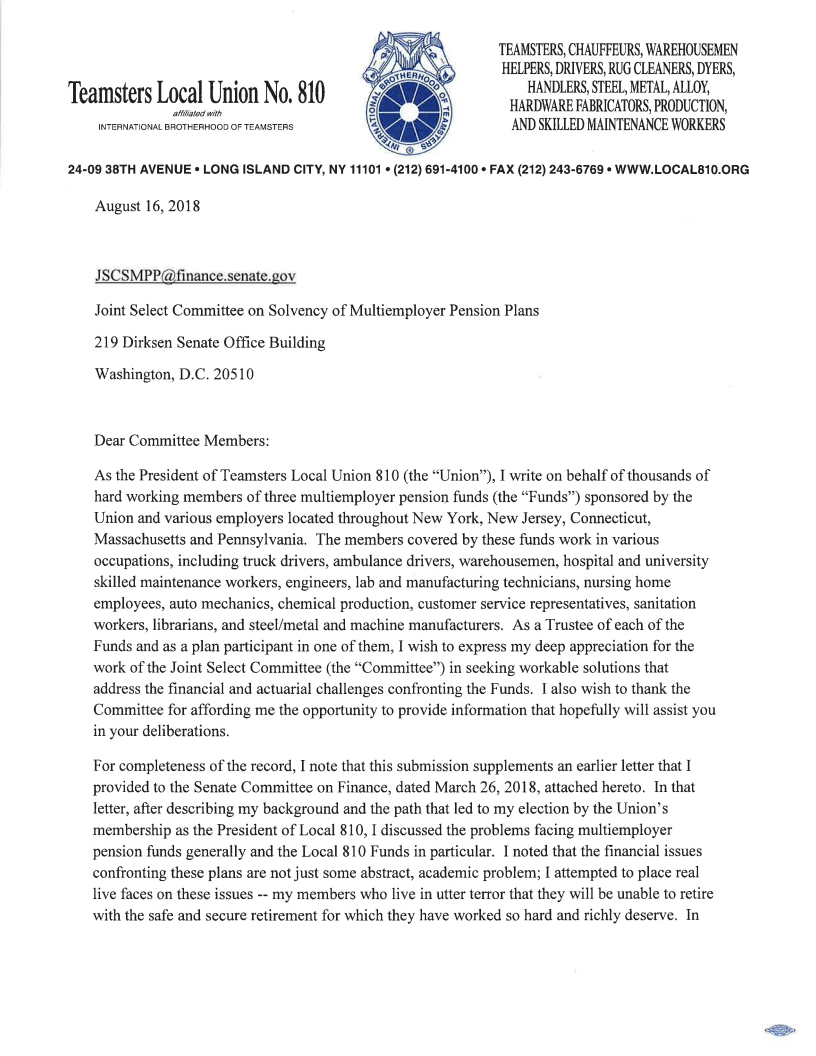
The fight to protect and preserve multiemployer defined benefit plans is happening on many fronts. As regular readers of the KCS Blog know, we have been at the forefront of bringing information to you regarding the crisis that is unfolding for the 114 critical and declining plans. The Joint Select Committee on the Solvency of Multiemployer Pension Plans continues to debate various “solutions” to this issue. Action is needed now and there is no place for politics as usual.

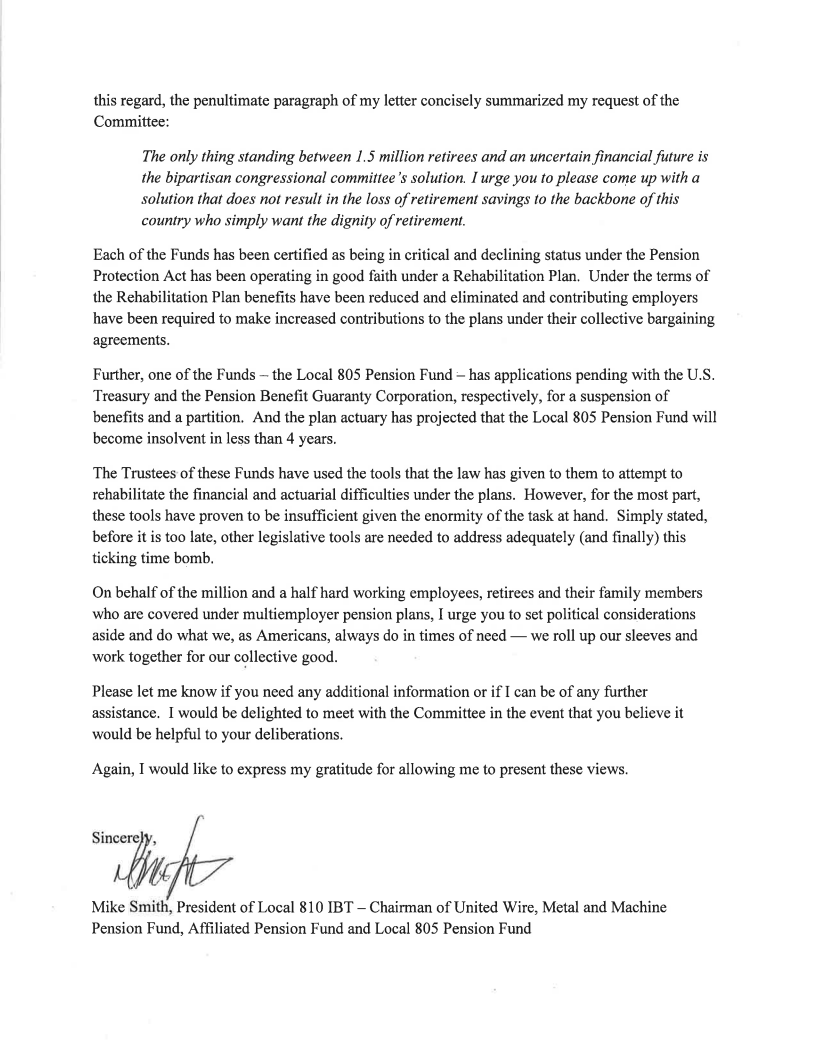
Here is a wonderfully written letter from Mike Smith, President, Teamsters Local Union No. 810.  It highlights the fact that 1.5 million retirees are facing a very uncertain (frightening) future as a result of the failure to protect the benefits for these hardworking Americans. This situation is unacceptable!

https://i0.wp.com/www.local810.org/wp-content/uploads/2018/08/page1.pnghttps://i0.wp.com/www.local810.org/wp-content/uploads/2018/08/page2.png


The Role of Fixed Income?

There was an article yesterday from Chief Investment Officer Alert highlighting the fact that CalPERS’s fixed income group had received a D grade from their lead consultant Wilshire. As it turns out, the grade was given primarily as a result of key turnover in the leadership of the fixed-income unit and not related to the implementation of their bond program.  However, it got me thinking about bonds. Do you think about bonds?

Where do bonds go in Asset Allocation for defined benefit pension plans? What is the value of owning bonds? Very simply, CASH FLOW!

  • Bonds are the only assets with a certain future value (FV)
  • They provide the best fit for matching the future value of benefit payments
  • Don’t sell bonds in this rising interest rate environment, put it to work more efficiently!

Ryan ALM and KCS have been traveling across the country discussing alternative approaches to asset allocation for much of the last 6 years. In fact, we will be presenting some of our ideas at the Florida Public Pension Trustee Association (FPPTA) next week. I will then be presenting on the same topic in three weeks at the International Foundation of Employee Benefit Plans (IFEBP) in New Orleans.

The idea is very straightforward. Bonds have one role, and that is to provide certain future values that can be used to match the value of future benefit payments. This strategy is the preferred implementation of the three (annuities and LDI being the other two) being proposed within the Butch Lewis Act legislation. Furthermore, cash-flow matching has been a strategy employed by pension executives since DB plans were first introduced.

However, this strategy lost some luster when asset consultants came into being with the promise to build a better pension mouse trap focused on the return on asset assumption (ROA). As a result, asset/liability studies were conducted with a focus on generating a return that would exceed the ROA and NOT on the principle of meeting the promise (benefits) at the lowest cost and at reasonable risk.

Unfortunately, with a focus on return, consultants and plan sponsors have dramatically reduced fixed income exposure in most pension systems during the last two decades as yields fell (asset allocation models use yield as a proxy for return) causing these plans to miss one of the greatest bull markets ever for bonds.

In addition, the growing fear that U.S. interest rates would rise rapidly caused many plans to further reduce their bond allocations. As a result, public pensions systems have equity exposures that are greater than those we witnessed in 2007, and this after 9 1/2 years of a historic equity bull market.

We believe plan sponsors would be best served by bifurcating their portfolios into two components – de-risking assets and growth assets. The de-risking assets would be a cash-flow matching strategy aimed at the current retired lives benefits, while the growth portfolio is focused on beating liability growth for active participants.

Timing any aspect of the markets has proven incredibly challenging for most market participants. Our strategy takes the guesswork out of the equation. We are happy to share our presentations with you on how a cash-flow matching strategy can be used to enhanced the funded status and stabilize contribution expense.


52 Million Americans!

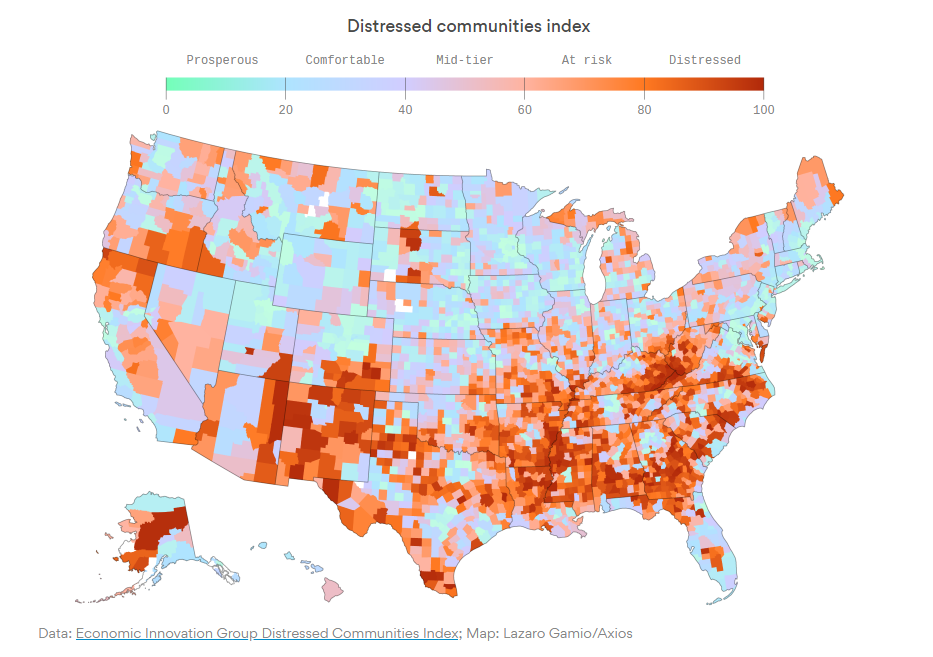
Location, location, location may be the real estate agents’ mantra, but it is also becoming critically important in determining the economic fate for the American worker. Regrettably, the recovery from the Great Financial Crisis has been incredibly uneven for a wide swath of our country.

The Economic Innovation Group has produced their annual county-by-county report and the analysis concludes that economic success is most often tied to location. Here are some of the highlights (lowlights):

  • New jobs are clustered in the economy’s best-off places, leaving one of every four new jobs for the bottom 60% of zip codes. (Yes, 60% are competing for only 25% of the jobs)
  • Most of today’s distressed communities saw ZERO net gains in employment and business establishments since 2000. In fact, more than half have seen net losses on both fronts.
  • Half of the adults living in distressed zip codes are attempting to find gainful employment in the modern economy armed with only a high school education, at best.

The analysis covers more than 26,000 counties representing 99.9% of the U.S. population. As the chart highlights, communities are grouped into five categories from Prosperous to Distressed. A further review of the data reveals that 52.3 million Americans live in distressed communities representing 17% of the population, but more than 50% of distressed communities are in the South, which only has roughly 37% of the total population.

The most Prosperous category is also the largest with regard to the percentage of the population. The 84.4 million Americans that live in prosperous communities account for 27% of the U.S. population. “From 2011 to 2015, the U.S. added 10.7 million jobs and 310,000 businesses and establishments, yet growth was limited to the top echelon of U.S. zip codes. According to the DCI, ’85 percent of prosperous zip codes saw rising numbers of business establishments and 88 percent registered job growth.'”

Given the significant gap between Prosperous and Distressed communities is it any wonder that many Americans are suffering? As was reported earlier this year, the U.S. has suffered consecutive drops in life expectancy for the first time since the early 1960s (1962-63). On average, Americans can expect to live for 78.6 years, which is a full 1.5 years less than the average for developed countries.

It is great that many Americans are prospering during the recovery from the GFC, but to claim that the U.S. is humming on all cylinders is a great injustice to many of our fellow citizens who have yet to benefit, and may never.


Wait! Help May Just be on the Way

It is being reported that Laborers Local No. 265, Cincinnati, has applied to the US Treasury Department for benefit relief under the Multiemployer Pension Relief Act (MPRA) of 2014. If approved, plan participants will see a 40% across the board reduction in their benefits. For many, this is likely to be a crushing blow. According to CIO magazine, there are seven plans that have applied and been granted relief since MPRA while another 10 are under review at this time.

We are never in favor of benefit reductions on the plan participants given the economic hardship that will be created. We are especially concerned at this particular juncture when legislation is being debated/crafted in Washington DC through the Joint Select Committee on the Solvency of Multiemployer Pension Plans.  As regular readers of the KCS blog know, the Butch Lewis Act is one of the pieces of legislation being reviewed that would provide low-interest rate loans to Critical and Declining plans, of which Laborers 265 is one, that would likely extend the plan’s solvency long into the future (30-year loan).

“The Board of Trustees does not think it is reasonable to rely on the PBGC,” said the board in its recovery plan. We agree, which is why passage of the loan program under the BLA is incredibly necessary so as to eliminate the PBGC from this equation. As we’ve reported in previous blog posts, it is estimated that only about 1/8 of the promised benefit would be protected should the PBGC become involved.  We cannot let that happen.


S&P Predicts Reduction in Funds Available for the Social Safety Net

S&P is out with a recent analysis suggesting that many American cities with weak pension funded status will likely face challenges in meeting both pension obligations and other social safety net funding. According to an article by Cole Lauterbach, Illinois News Network, S&P Global Ratings is predicting that growing public retirement debt will eat up a greater share of the funds available to meet other taxpayer needs.

S&P’s annual report specifically highlights the funding for America’s largest 15 cities and their public debt. It is not surprising that S&P warns that taxes will rise and services will be cut if additional sources of revenue cannot be identified. This problem has been anticipated for a long time. What is disappointing is the fact that S&P does not focus on the management of the pension systems, but only speaks to the growing burden created by these plans. The failure of pension America to secure full-funding in the late 90’s when the war was won is a critical component not often discussed when highlighting the burgeoning deficits.

Furthermore, we are now 9 1/2 years into a historic equity market bull market and yet, funding hasn’t improved for many of these plans. Focusing on the return on asset (ROA) assumption has never been the right strategy, but it is particularly fraught with peril at this time. Pension systems should be managed against their promised benefits, and investment structure and asset allocation determined by the plan’s funded ratio. By adopting more of a liability focus, plans can remove much of the short-term funding volatility, while extending the investing horizon for the balance of the assets in order to capture the liquidity premium of equities, real estate, private equity, etc.

Pension obligation bonds are another means to close some of the funding gaps, but only if the proceeds are used to defease retired lives (and terminated vesteds) and not placed in a traditional asset allocation subject to all of the equity market’s volatility. It is one thing to repay the bond and interest, but an entirely different scenario to have to make up for a 20% decline in the value of the bond proceeds.  Let’s hope that America’s largest cities develop a willingness to try alternative approaches to the management of these critically important pension programs.

Nearly 6 in 10 Haven’t!

A decade after the Great Financial Crisis and we find that nearly 6 in 10 American workers have still not recovered from that horrific financial event. In a survey of workers from the Transamerica Center for Retirement Studies, 56 percent of respondents said they have not fully recovered. 37% of those polled indicated that they had recovered somewhat, 12% said that they had yet to recover, and the remaining 7% felt that they never would recover.

This comes at a time when the country is enjoying a historic equity bull market, unemployment is at decade lows, and median family income has risen for the third consecutive year to >$61,000. What gives? Well, for one, many American workers lost more lucrative jobs during the GFC only to be forced into lower paying occupations just to survive. So, yes, they are employed, but those individuals will never be able to recover when annual incomes have been slashed to the extent that they were.

In addition, many American workers already had their “retirement” plan shifted from a traditional pension, such as a defined benefit fund to a defined contribution offering.  For many workers, the shock of seeing the markets fall by roughly 50% has steered many away from continuing to contribute. As a result, only about 50% of American workers have access to or are funding a retirement benefit. So when we discuss the terrific bull market, we are really addressing the 10% of Americans that own 84% of the outstanding stock.

Yes, median family incomes have begun to rise, but the 1.8% increase from 2016 didn’t keep pace with the growth in the CPI. Furthermore, a significant percentage of Americans are now tasked with funding health care and retirement to a greater extent than those from prior generations. Less traditional worker/employer relationships (on-call employment) means fewer benefits in general.  In addition, housing and education costs are also rising rapidly. Asking workers who have not been trained to fund, manage, and then disburse a retirement benefit is a poor policy decision.


More on the Butch Lewis Act

Happy to share the following graphic with you.

No automatic alt text available.

As the above chart highlights, the recalculation by the CBO of the costs associated with the Butch Lewis Act makes it a clear-cut choice relative to the propping up of the PBGC. Furthermore, the absence of benefit cuts will reduce the likelihood that many of these retirees would need subsequent assistance through some kind of social safety net.

As we’ve discussed many times before, the benefits that these retirees receive are an engine to economic growth throughout the communities in which they live. Cuts to benefits impact more than just the pensioner.

More On The Proposed BLA Changes

In yesterday’s KCS Blog post, “No More Excuses”, we touched on the fact that CBO scoring for the Butch Lewis Act legislation showed only a $34 billion price tag down substantially from the original $101 billion calculated last year. Our friends at Cheiron (outstanding actuarial firm) have shared the following with us.

The CBO scoring came in at $34 billion, and reflects the following changes:

  1. Eligibility: the pension plan must be in critical and declining (C&D) status as of implementation date, or be critical as of the same date, but have a funded ratio of under 40% and the ratio of actives to in-actives is under 40%.
  2. PBGC financial assistance will not kick in until the plan is within 5 years of insolvency. This reduced the scoring significantly.
  3. The loan amount will be for Retirees and Term Vesteds (this is new).
  4. To incentivize the plans to pay back the loan, they will be offered two loan repayment options at the front end; either accept the 30-year interest with a balloon payment at the end, or 20 years of interest, with the loan then being amortized over the last ten years. Plans choosing the latter payback option will enjoy a 50 bps reduction in the loan repayment interest rate throughout the term of the loan.
  5. The maximum interest rate on any loan will be 20 bp above the prevailing 30 year Treasury bond rate.
  6. The PBGC will be able to recommend merger that they see fit, plans that do not want to merge will need to show why remaining independent would be in the best interests of plan participants.

The most significant changes, as we see, are the PBGC’s support being withheld until a plan is within 5 years of insolvency, the opportunity to repay the loan earlier and at a reduced interest rate, and the fact that the PBGC could recommend merging two or more plans.

We touched on the repayment options yesterday, but the possibility of receiving a loan with a 50 basis point discount is meaningful. It is too soon to know how many of the critical and declining plans would seek this option, but I would hope that a majority would be in a position to elect the accelerated payment schedule.

Cheiron mentioned that the CBO scoring was impacted significantly by the fact that the PBGC will withhold funds until a plan is within 5 years of insolvency under this new proposal. I have not seen the math behind this aspect of the revised bill to be able to comment on this provision. However, I am concerned that not having the assets in the fund from day one and growing at the projected ROA of 6.5% seems potentially harmful to the ultimate success of the loan program. But, then again, placing the PBGC assets into a traditional asset allocation more than 9 1/2 years into an equity bull market may be worse.  We’ll see if we can get a better handle on this revised language.

Lastly, the PBGC’s ability to recommend merging pension plans together is interesting. We, at KCS, are not sure at this time what the criteria are to make such a suggestion, but once the recommendation is made the onus falls on the plan sponsor to say why it doesn’t make sense for their plan. We often highlight the fact that municipal and state pension systems would benefit from greater economies of scale by combining pension systems.  Is this any different?