ARPA Update as of November 25, 2022

By: Russ Kamp, Managing Director, Ryan ALM, Inc.

I hope that you had a wonderful Thanksgiving holiday.

We are pleased to provide the weekly update on the PBGC’s activity as it relates to the ARPA legislation. As one would imagine, activity during the holiday week was tame, as only one fund, Bricklayers Union Local No. 1 Pension Fund of Virginia, submitted a revised application seeking $12.7 million for the plan’s 395 participants. The initial application was filed on June 30, 2022. The PBGC has until March 23, 2023, to act on the application.

In other ARPA news, there were no applications denied or withdrawn during the previous week. Two plans, Teamsters Local Union No. 52 Pension Fund and the New York State Teamsters Conference Pension and Retirement Fund are waiting to receive the SFA that was approved earlier this month. Local 52 is expecting to receive nearly $85 million for its 769 participants, while the NYS Teamsters are approved for more than $963 million for their 33,643 participants.

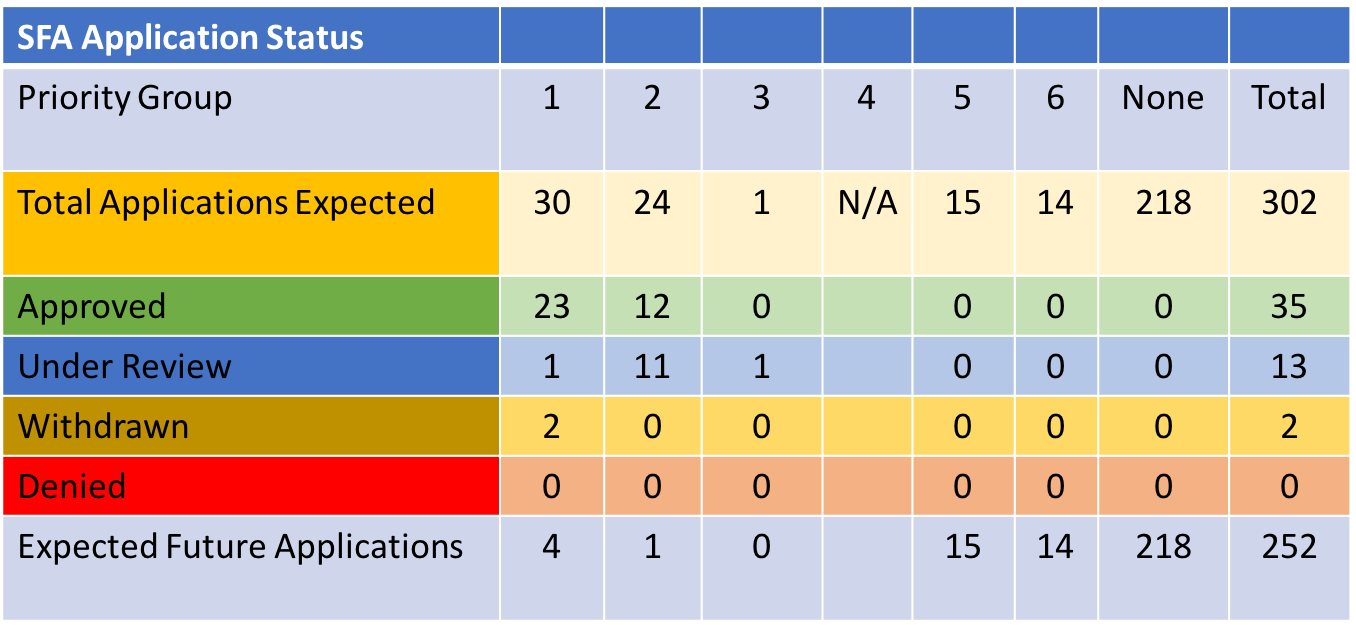
The chart above is as of November 25th. To date, 35 funds have been approved to receive SFA (not counting supplemental filings) for a total of $8.9 billion. There is still much work to be done by the PBGC, as they anticipate as many as 252 additional funds will be eligible to eventually file for the legislation’s Special Financial Assistance.

Slowing? Possibly.

By: Russ Kamp, Managing Director, Ryan ALM, Inc.

With great anticipation, the Federal Reserve’s notes from the November 2nd meeting were released at 2 pm EST. Immediately, both equity and bond markets rallied. I was sure that there must have been language in the notes that indicated that the Fed had come to the conclusion that they had accomplished the objective of containing inflation and that the “great pivot” was about to begin as inflation neared their 2% target. But no! What they said, was “a number of participants observed that, as monetary policy approached a stance that was sufficiently restrictive to achieve the committee’s goals, it would become appropriate to slow the pace of increase in the target range for the federal funds rate.” But that doesn’t mean stopping the increases. It also doesn’t mean that the Fed believes that it has accomplished its goal. In fact, FOMC members said inflation was “unacceptably high” and “well above” the committee’s longer-run 2% target, the minutes showed.

Why the rally? How does this change anything that was already anticipated? Whether the increase is 50 bps or 75 bps, the Fed will continue to raise rates. Despite the majority opinion that a tempered pace may be more acceptable, “A few other participants noted that, before slowing the pace of policy rate increases, it could be advantageous to wait until the stance of policy was more clearly in restrictive territory and there were more concrete signs that inflation pressures were receding significantly,” What can the Fed point to at this time that clearly demonstrates that the tightening to date has worked? Sure, mortgage applications have fallen, but new home sales exceeded expectations by 62K in today’s release. The labor market is still strong, despite a slight increase in the initial unemployment claims data that was also released today (up +15,000 over expectations).

“With inflation remaining stubbornly high, the staff continued to view the risks to the inflation projection as skewed to the upside,” according to the minutes. With so much uncertainty, shouldn’t plan sponsors of DB plans seek alternatives to asset allocation strategies singularly focused on the ROA? Why not devise a strategy that improves liquidity in the short-term, while extending the investment horizon for those alpha assets that need time to achieve their long-term potential? Doing the same old, same old has never been a winning strategy. Given so much uncertainty in today’s investing climate, it is doomed before it begins.

“Bonds Are Back!”

By Russ Kamp, Managing Director, Ryan ALM, Inc.

I don’t know Bob Michele, JP Morgan’s CIO for fixed income, but I absolutely agree with his sentiment when he said on Bloomberg Television’s “Wall Street Week” that “bonds are back”! He said, “Every wealth-management platform in JPMorgan, every institutional client — they’re coming to us, they’re putting money in bonds.” Clearly one of the reasons for his and his clients’ excitement has to do with the dramatic increase in yields this year. The BB Aggregate Index is currently yielding 4.75% up from roughly 1.75% at the start of 2022. What he failed to mention was the fact that return-seeking fixed-income strategies benchmarked to the Agg. have produced a nearly -13% year-to-date return.

We, at Ryan ALM, love bonds, too, but we don’t believe that they are performance drivers. Importantly, they are income producers. Bonds are the only asset class with a known terminal value and semi-annual cash flows. Given the uncertainty in the markets due to Fed policy, we believe that those bond cash flows should be used to secure a defined benefit plan’s promised benefits (and expenses). We don’t know where interest rates will be in the near future. But we do know that pension plans have a monthly obligation to make benefit payments. Establish a liquidity portfolio through a cash flow matching product using bonds that will make sure that the cash necessary to fund those promises is there.

We appreciate Mr. Michele’s enthusiasm for bonds but understand that a rising rate environment will negatively impact the price of bonds. As a reminder, a bond with a 10-year duration will suffer a -10% price loss for every 100 bps move up in rates. We’ve had several Fed Governors suggest that Fed Funds rates need to rise significantly above their current level to achieve real rates with an inflation premium. Return-seeking fixed-income strategies will get hurt. Cash flow matching eliminates interest rate risk, as future values are not interest rate sensitive while buying time for the plan’s alpha assets to grow unencumbered. This is the epitome of a “sleep well at night” strategy. Go bonds!

ARPA Update as of November 18, 2022

By: Russ Kamp, Managing Director, Ryan ALM, Inc.

As we begin this holiday week, we at Ryan ALM, Inc. wish you and yours a very Happy Thanksgiving!

The window has been opened for Priority Group 5 multiemployer pension plans (effective November 15th). Did any of those plans take advantage of the opportunity? Simply put – no! Actually, there were no new or supplemental applications filed in the last week. We are happy to report that two plans, Teamsters Local Union No. 52 Pension Fund and the New York State Teamsters Conference Pension and Retirement Fund had their revised applications approved. Both of these plans were Priority Group 2 members (MPRA suspension and Critical and Declining) that will receive $84.9 and $963.4 million, respectively. They join the Bricklayers and Allied Craftsmen Local 7 Pension Plan as the only three approved plans that have yet to receive the SFA funds.

As a reminder, the PBGC is anticipating that as many as 15 Priority Group 5 plans will file. The Priority Group 6 members must wait until that window becomes ajar currently slated to occur on February 11, 2023.

US capital markets remain in a state of flux as US Federal Reserve action continues to put pressure on interest rates as they attempt to thwart decades-high inflation. Forecasts as to the eventual peak in inflation, US rates, and stock and bond performance range broadly, as you can imagine. Given this great uncertainty, we continue to believe that pension systems receiving the SFA are best served by defeasing pension liabilities with bond cash flows of principal and interest. Securing the promised benefits was the original intent of the ARPA legislation. It is by far the most fiduciarily prudent implementation.

It Seems Like Plain English – What am I Missing?

By: Russ Kamp, Managing Director, Ryan ALM, Inc.

Early this week I published a post titled “I Don’t Get It”, in which I questioned the incredible reaction of market participants to last week’s modest improvement in the inflationary environment. Please understand that I’m not rooting for high inflation, rising rates, and falling returns for both equities and bonds, but I am questioning the reaction of market participants to the current events. Every article that I have read and continue to read that cites comments from US Federal Reserve Governors supports the notion that there is NO PIVOT in our immediate or near-term future. The language being used seems to be fairly straightforward English. There is no “Fed speak”. Yet, there seems to be a great expectation among market participants (perhaps hope) that the Fed will soon declare victory! They will soon announce that everything that they had set out to tackle has been accomplished. Inflation has been tamed and the Fed’s 2% target has been met. Victory is ours!

Yet, as much as I would like to believe that I don’t think that the Fed is close to accomplishing what they set out to achieve. I don’t believe for one minute that they will soon divulge that they were only kidding that their mandate was to tame inflation down to a 2% level. You see, with the CPI sitting at 7.7% and the core inflation rate at 6.3%, they haven’t gotten to a level of “real” rates – not even close. Furthermore, with US Treasury Bonds, Notes, and Bills rallying during the last month, the Fed’s job has gotten harder in its attempt to tamp down inflation. How much economic activity will truly be thwarted by a Fed Fund’s Rate with a range of 3.75 to 4.0%? Remember, in 1980, when we last experienced the ravages of high inflation, US interest rates reached double digits and the Fed Fund’s Rate hit 20%! Furthermore, US unemployment was nearly 10% and not the 3.7% level that we currently sit at.

So, if you don’t believe me, here is a bit of sobering commentary from St. Louis Fed President James Bullard who said, “interest rates have not reached a level that could be justified as sufficiently restrictive, even with generous assumptions.” Furthermore, “to attain a sufficiently restrictive level, the policy rate (Fed Fund’s Rate) will need to be increased further”. He went on to say that the FFR would need to reach a minimum of 5% and possibly as high as 7%. There shouldn’t be any misunderstanding with what he’s said, and his fellow governors have been sharing similar expectations/thoughts.

I suspect that nearly 40 years of Fed easing could possibly blind some people to the fact that US Fed policy isn’t always accommodative. The road to ZIRP contributed significantly to our current inflationary environment. It is highly unlikely that this Fed makes a U-turn back onto that path. They seem singularly focused on not repeating the mistakes of the Federal Reserve during the 1970s. If that is true, brace for higher rates, choppy markets, and an inflation struggle that takes longer to rein in.

ARPA Update as of November 10, 2022

By: Russ Kamp, Managing Director, Ryan ALM, Inc.

We are pleased to provide you with the latest update related to the ongoing implementation of ARPA’s pension legislation. As we’ve discussed in recent updates, we were in a quiet period as there was only 1 Priority Group 3 plans and no Priority Group 4 plans. However, relative calm is likely to end as Priority Group 5 plans will be permitted to submit initial applications beginning on November 15th. Despite the relative lull, there were two funds that submitted supplemental applications seeking additional Special Financial Assistance (SFA). Those two plans are the Freight Drivers and Helpers Local Union No. 557 Pension Plan and the Gastronomical Workers Union Local 610 and Metropolitan Hotel Association Pension Fund which are seeking  $12,383,121 and $2,065,531, respectively.

We are happy to report that the PBGC didn’t reject any current applications and no submissions were withdrawn. Finally, the Bricklayers and Allied Craftsmen Local 7 Pension Plan is the only fund with an approved application that is awaiting payment of the SFA. They are expected to receive just over $34 million in SFA. To date, the PBGC has doled out just about $7.8 billion in SFA proceeds.

SFA Application Status
Priority Group123456NoneTotal
Total Applications Expected30241N/A1514218302
Approved239000032
Under Review014100015
Withdrawn3000003
Denied0000000
Expected Future Applications4101514218252

* Total expected count is from PBGC’s Enrolled Actuary Meeting on May 2, 2022
Note: Chart details presented by Segal’s Jason Russell at the IFEBP annual conference in Las Vegas, NV

“I Don’t Get It”

By: Russ Kamp, Managing Director, Ryan ALM, Inc.

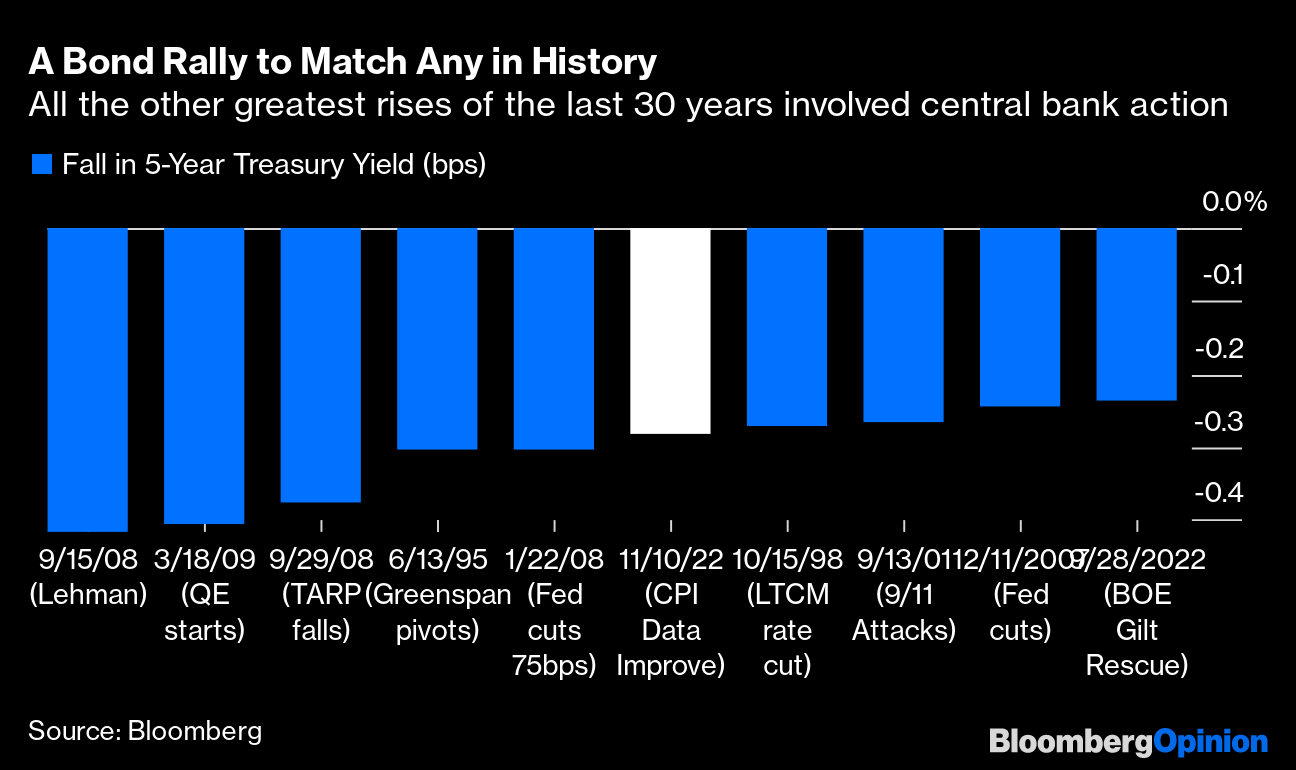
One of my favorite movies is “Big” starring Tom Hanks, John Heard, Elizabeth Perkins, and many others. You may recall that Tom Hanks is constantly challenging John Heard’s character (Paul) by stating “I don’t get it” whenever “Paul” is presenting an idea related to a new toy before senior management. As I reflect on last Thursday’s market activity, I feel very much like Tom Hanks’ character Josh. Sure, the CPI declined from 8.2% to 7.7% and Core inflation came in at 6.3%, which was below expectations, but the market’s reaction to this news would have had you believe that the Fed had accomplished its goal of driving inflation to 2%. I don’t get it! The rally in US Treasuries was nearly unprecedented. In fact, the move in the 5-year Treasury Note was the 6th greatest in the last few decades and the only one that didn’t involve central bank action.

The Federal Reserve has raised the Fed Funds Rate to a range of 3.75% to 4.00%. Given the stated objective to get to a point where there are “real rates”, the Fed will have to do more work. Based on yesterday’s inflation news, the probability of a 50bps increase in the FFR in December now stands at just over 80%. That is still a significant increase. Again, you would have thought that market participants had heard the Fed Governors proclaim that the “great pivot” was soon to begin. Yet, that is not what we heard. Dallas Fed President Lorie Logan said, “while I believe it may soon be appropriate to slow the pace of rate increases so we can better assess how financial and economic conditions are evolving, I also believe a slower pace should not be taken to represent easier policy.”

Former Treasury Secretary, Larry Summers, warned last month that “history indicates inflation will be slower to fall than Fed officials anticipate.” The concerted effort to rein inflation comes with the risk of driving the economy into a potential recession. However, based on the current strength in the US labor force and projections of strong 4th quarter GDP growth (Atlanta Fed’s GDPNow forecast of 4%), Fed action in 2022 has not shown much progress.

It was great to see markets rally, but the magnitude of the moves seems truly premature. We’ve seen myriad head fakes in 2022. This market action may prove to be just another in that series.

CFM – Interest Rate Neutral

By: Russ Kamp, Managing Director, Ryan ALM, Inc.

Yesterday, Ryan ALM was invited to participate in a “Lunch and Learn” event with a major asset/liability consulting firm. Our agenda was to provide education related to Cash Flow Matching (CFM), which this leading firm wasn’t actively using. It was a great opportunity for us, while hopefully opening some eyes as to the significant benefits of CFM. We received a lot of terrific questions from those in attendance, both in-person and virtually. One of the more important questions had to do with interest rate risk and the impact on CFM strategies in a rising rate environment. It was the perfect set-up question for our team and strategy.

Total return-focused fixed-income strategies are highly interest rate sensitive. These strategies have been beaten down significantly (BB Agg. -15.7% YTD through 10/31/22) in this current rising rate environment. Fortunately, CFM strategies are not interest rate sensitive. How’s that? The matching of asset cash flows (interest and principal) against liability cash flows focuses on their future values. A $5 million monthly benefit payment 10 years out is still $5 million no matter which way rates move. It is this characteristic, among other positive attributes, that makes this strategy so critically important to the success of managing a defined benefit pension plan.

It has been 40 years since we last had a prolonged bear market in bonds driven by changing monetary policy. In 2022, rates have risen dramatically across the Treasury yield curve and credit spreads have widened in the process. Both of these actions have been driven by Fed policy. Does anyone really know where future rates are going? Based on today’s market action you’d come to the conclusion that the US Federal Reserve has accomplished its objective. Have they? Core inflation remains elevated at 6.3% annually. The CPI is still at decades-high levels at 7.7%. Sure, the trend may be indicating some downward action on inflation, but with a Fed Fund’s rate at 4%, have they elevated rates significantly enough to tamp inflation to the Fed’s 2% target and a market with real rates?

Wouldn’t you want to use a strategy that doesn’t care where interest rates go? Wouldn’t it be comforting to know that asset cash flows are matched almost precisely with liability cash flows for some defined period of time? That this relationship doesn’t change if rates rise or fall? Wouldn’t it also be incredibly helpful to have bought time (considerable time?) for your plan’s growth/alpha assets to grow unencumbered? Oh, and by the way, CFM portfolios that utilize investment-grade corporate bonds are producing yields in the 6% range.

CFM strategies are the perfect “sleep well at night” offering, especially at the current level of rates. Unfortunately, duration-matching LDI strategies that used leverage were the impetus behind the near collapse of the UK’s pension system. Those strategies engaged in SWAPs are highly interest rate sensitive. That risk may have been acceptable during the last 40 years of accommodative Fed policy, but we are in a different ball game at this time.

Don’t create an asset allocation structure that is highly dependent on the direction of rates. Bifurcate the plan’s assets into two buckets – liquidity and growth. Use CFM for the liquidity bucket and build a robust growth portfolio that is no longer a source of liquidity.  Let a CFM strategy fund Benefits and Expenses which will allow the alpha assets to grow unencumbered. There is absolutely no need for a cash sweep of income from the growth assets to fund B+E. Let that income be reinvested in potentially higher-returning strategies. 

Being able to sleep better at night shouldn’t be discounted!

ARPA Update as of November 4, 2022

By: Russ Kamp, Managing Director, Ryan ALM, Inc.

A trip to visit my daughter in Copenhagen, Denmark kept me away from providing an update last week. I would highly recommend that you visit that city/country if you can as it provided myriad positive experiences. As you will soon read, you didn’t miss much while I was out of the office galivanting.

To the update, according to the PBGC’s website, there were no new applications filed, but the Retirement Plan of Local 1482 – Paint and Allied Products Manufacturers Retirement Fund submitted a supplemental application for additional SFA. They received approval for the initial application in December 2021. Fortunately, there were no applications rejected or withdrawn during the last couple of weeks. Lastly, Freight Drivers and Helpers Local Union No. 557 Pension Plan received their SFA of $192.8 million on November 3rd.

As we recently reported, Priority Group 5 plans, those funds that are projected to become insolvent before 3/11/2026, can begin filing an initial application starting on November 15th. It is estimated by the PBGC that 15 funds fall within this priority grouping.

SFA Application Status
Priority Group123456NoneTotal
Total Applications Expected30241N/A1514218302
Approved239000032
Under Review014100015
Withdrawn3000003
Denied0000000
Expected Future Applications4101514218252
update as of November 4, 2022

It will be interesting to see if the PBGC’s estimate of application filings (218) for pension funds that don’t fall into one of the 6 priority groupings comes to be. If so, we will have a lot of fun trying to stay on top of the comings and goings of that cluster of plans.

ARPA Update as of October 21, 2022

By: Russ Kamp, Managing Director, Ryan ALM, Inc.

Under the category of better late than never, I bring to you the ARPA update for multiemployer plans through last Friday evening. As regular readers of this blog know, I provide this update on Mondays. However, I, along with more than 5,000 of my closest multiemployer friends, was in Las Vegas for this year’s IFEBP Annual Conference. What an event! I think that it is important for multiemployer plan participants to know that there are many people who are fighting to protect and preserve your plans. I very much appreciated the opportunity to teach the investment class for the CAPPP program. I also had the chance to speak on Tuesday to the general audience.

But, I digress. With regard to the PBGC’s implementation of the ARPA legislation, there is little to update, as we seem to be in a quiet period. There were no new applications filed, no new applications approved or denied, and no applications withdrawn. There are still two plans, Local 557 and Sheet Metal Workers Local Pension Plan, that are awaiting payment of their SFA. I believe that as a result of this inactivity, the PBGC has announced that Priority Group 5 plans, those plans projected to become insolvent before March 11, 2026, will become eligible to file the initial application seeking Special Financial Assistance beginning November 15, 2022.

Given all the activity to date, it can become confusing as to where everything stands in terms of applications filed, approved, and SFA paid. Here is a scorecard of where everything stands as of today.

SFA Application Status
Priority Group123456NoneTotal
Total Applications Expected30241N/A1514218302
Approved239000032
Under Review014100015
Withdrawn3000003
Denied0000000
Expected Future Applications4101514218252
SFA Status as of October 27, 2002

The information above was presented by the PBGC at the Enrolled Actuary Meeting on May 2, 2022. The chart details were presented by Jason Russell, Segal, at the IFEBP Annual Conference in Las Vegas, NV.

The 300+ potential ARPA participants represent about 15% of the active multiemployer pension plan universe.