Social Security Administration (SSA) Announces 3.2% COLA for 2024

By: Russ Kamp, Managing Director, Ryan ALM, Inc.

Earlier this year, I published a post titled, “What You Might Expect From Social Security in 2024” that attempted to project the possible COLA in 2024 for recipients of Social Security benefits. At the time (8/11/23), it was looking as if the increase would be about 3%, as inflation had subsided to about 3.2%. With the passage of time, we have a concrete answer, as the SSA announced that the average monthly Social Security check would increase by 3.2% or $59 to $1,906 ($22,872 per year). This increase is certainly much smaller than those which SS recipients received for 2022 and 2023. Worse, it doesn’t match the current impact of inflation that touched 3.7% on an annual basis through September.

As I’ve discussed in posts related to Social Security through the years, the COLA is based on inflation for the 3 summer months. In addition, the CPI-U is used to measure the inflationary environment, which doesn’t truly reflect the inflation rate experienced by the more senior members in our country. The CPI-E would be a more appropriate index as healthcare costs carry a greater weight for those 62 years old and up. The CPI-E for the prior 12 months is 4.14%, while inflation measured using the CPI-U ran 3.69%. That 0.45% is meaningful when one is living on a fixed income.

Ryan ALM, Inc. Q3’23 Newsletter

By: Russ Kamp, Managing Director, Ryan ALM, Inc.

We are pleased to share with you the Ryan ALM, Inc. Q3’23 Newsletter. Inside you’ll find our unique insights on issues facing Pension America, especially how assets are performing versus liabilities. We also share research and a small selection of blog posts produced during the quarter. As a reminder, you can find this newsletter and all of our research at Ryanalm.com. Please don’t hesitate to reach out to us with any questions, as today’s market environment of higher US interest rates is so beneficial for pension plans looking to reduce the risk of a traditional asset allocation framework, while SECURING the promised benefits.

Ryan ALM – ASC 715 Discount Rates

By: Russ Kamp, Managing Director, Ryan ALM, Inc.

As we near the end of 2023 (how is that possible?), actuaries, accounting firms, and pension plan sponsors may begin reviewing their current discount rate relationship. If you are one of those, you may want to speak with us about the Ryan ALM discount rates. Since FAS 158 became effective December 15, 2006, Ryan ALM has created a series of discount rates in conformity to then FAS 158 (now ASC 715). Our initial and continuous client is a BIG 4 accounting firm, which hopefully testifies to the integrity of our data.

The benefits of the Ryan ALM ASC 715 Discount Rates are:

  1. Selection – we provide four yield curves: High End Select (top 10% yields), Top 1/3, Above Median (top 50%), Full Universe
  2. Transparency – we provide very detailed info for auditors to assess accuracy and acceptability of our rates
  3. Precision – precise and consistent reflection of current/changing market environment (more maturity range buckets, uses actual bond yields rather than spreads added to Treasury yield curve, no preconceived curve shape/slope bias relative to maturity/duration) than most other discount rate alternatives  
  4. Competitive Cost – our discount rates are quite competitive versus other vendors and can be purchased with a monthly, quarterly, or annual subscription
  5. Flexibility – we react monthly to market environment (downgrades, gaps at certain maturities) with flexibility in model parameters to better reflect changing environment through variable outlier exclusion rules, number of maturity range buckets, and minimum numbers of bonds in each maturity range bucket to better capture observed nuances in the shape of the curve, especially at/near the 30 year maturity point where the market is sparse or nonexistent at times.
  6. Clients – our rates are used by several actuarial and accounting firms including, as stated above, a Big 4 accounting firm
  7. Integration into Ryan ALM products – we use ASC 715 discount rates for our Custom Liability Index and Liability Beta Portfolio™ (cash flow matching) products

Development of our discount rates is the first step in our turnkey system to defease pension liabilities through a cash flow matching (CFM) implementation. Our Custom Liability Index (CLI) and Liability Beta Portfolio (LBP) are the other two critical elements in our de-risking process/capability. We’d be pleased to discuss with you our discount rates or any element of this state-of-the-art capability.

ARPA Update as of October 6, 2023

By: Russ Kamp, Managing Director, Ryan ALM, Inc.

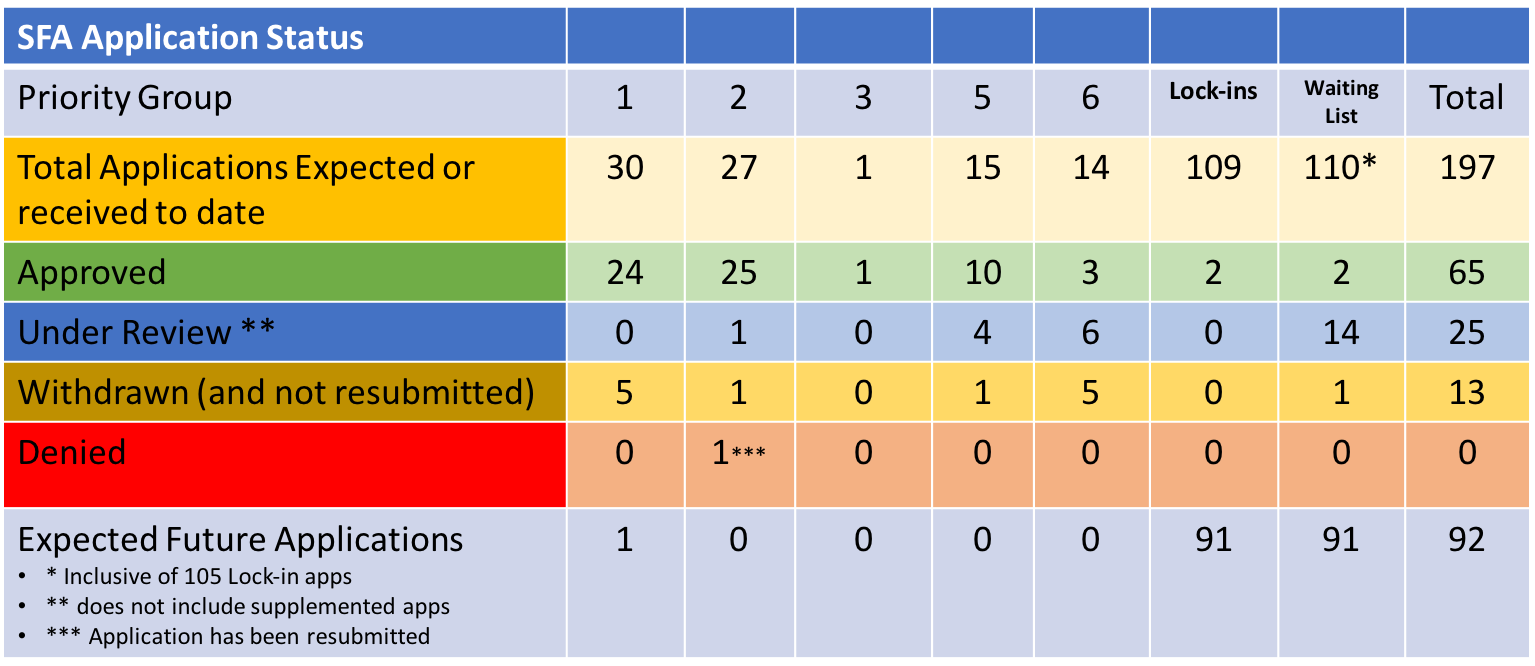
Whether you celebrate Columbus Day or Indigenous People’s Day, we continue to celebrate the implementation of ARPA and the awarding of Special Financial Assistance (SFA) to eligible multiemployer pension plans. There isn’t a lot to review as far as activity from last week, but there is some.

Of great note, Bakery and Confectionery Union and Industry International Pension Fund, has submitted their revised application seeking $3.3 billion in SFA for the 103,056 plan participants. This Priority Group 6 member filed its initial application on March 1, 2023. The PBGC has until 2/3/24 to act on this submission.

In other news, there were no applications approved during the prior week, no additions to either the waiting list (still 111 plans to date) or the Lock-Ins list. There was one application withdrawn from consideration at this time. The Retirement Benefit Plan of the Newspaper and Magazine Drivers, Chauffeurs and Handlers Union Local 473, a non-priority plan, first submitted its application on July 5, 2023. They are seeking an SFA grant of $29.4 million for 804 plan members.

The SFA recipients going forward will have an incredible opportunity to invest the proceeds into a cash flow matching strategy that will have US interest rates at 6% or greater depending on the portion of the portfolio invested in IG corporate bonds. With yields at these levels it really doesn’t make any sense to assume risk through investments outside of investment grade bonds despite the PBGC allowing for 33% of the SFA to be invested in return-seeking investments. Tread carefully.

Ryan ALM Pension Monitor as of September 30, 2023

By: Russ Kamp, Managing Director, Ryan ALM, Inc.

We are pleased to share with you the Ryan ALM, Inc. Pension Monitor for Q3’23 which reviews the year-to-date relationship of pension assets to pension liabilities. As you will see, the differences among public and corporate funding results for the first 9 months of 2023 are far smaller than those experienced during 2022’s volatile year, when corporate plans outperformed public plans by an incredible 31.4%, but they are still meaningful.

So far in 2023, corporate plans have outperformed (assets – liabilities) public plans by 11.2% as US interest rate increases, particularly during the third quarter, impacted liability growth (very negative) on private pensions that operate under FASB accounting standards. Public plans operating under a GASB framework use the ROA as the discount rate so they showed positive liability growth despite the rising US interest rate environment. This difference in accounting for pension liabilities is the sole reason why it appears that 2023 is a challenging year for public (and multiemployer plans) when comparing assets to liabilities. This discount rate disparity may cause higher contribution costs if assets don’t outgrow the ROA hurdle rate.

Asset allocation differences among plan types in exposures to both public bonds and equities reduced some of that performance differential as public plan asset performance topped corporate plans by 1.9%. Public pension plans have much more modest exposures to fixed income and far greater exposure to public equities vis a vis an average corporate asset allocation structure according to P&I’s annual asset allocation survey. With US equities, as measured by the S&P 500 up nearly 13.1% YTD, public plans have captured more of that return.

As always, please don’t hesitate to reach out to you with any of your questions or visit RyanALM.com to see the plethora of research that we continue to produce for your benefit.

Liability Growth Can Be Negative!

By: Russ Kamp, Managing Director, Ryan ALM, Inc.

For pension plans operating under GASB accounting standards it might come as a surprise to read that pension liability growth can be negative, but for those using FASB accounting standards they were once again reminded of that fact in September, and in a meaningful way! In fact, according to Milliman and the Milliman 100 Pension Funding Index (PFI), which analyzes the 100 largest U.S. corporate pension plans, liability growth was quite negative as a result of the 43-basis-point jump in the monthly discount rate, from 5.41% in August to 5.84% in September. The 5.84% is the highest discount rate since March 2010.

The dramatic rise in the discount rate more than offset the estimated asset investment loss of -3.73%, which according to the study was the worst performing month in 2023. Taken together, the average corporate funded ratio improved marginally from 103.1% at the end of August to September’s 103.6%, marking a peak for 2023.

As a reminder, liabilities are like bonds. They, too, are highly interest rate sensitive, and the present value of those liabilities can move in dramatic fashion as a result of interest rate shifts. Of course, rising rates can impact assets, but as witnessed in this case, only focusing on one side of the pension equation can mask what is truly occurring. Plan sponsors should want greater transparency into the fund’s liabilities (the promise made to participants). It is through this lens that more appropriate asset allocation decisions can be made.

In this environment of higher and higher US interest rates, plan sponsors have the opportunity to dramatically reduce the risk in their plans. Use these elevated rates to SECURE the promised benefits by cash flow matching liabilities as far into the future as the plan can afford. Let the funded status of the plan dictate the asset allocation. You’ll likely be pleasantly surprised by how much those future benefits now cost in present value terms.

Jobs Report Powers Yields Higher

By: Russ Kamp, Managing Director, Ryan ALM, Inc.

On August 5, 2022, I produced a post titled “Recession Fears Overblown” in which I stated, “I am more convinced that we will be saddled with inflationary pressures for longer without a corresponding recessionary environment.” I further mentioned that “calendar year 2000 is interesting as unemployment began to rise but given the low level of unemployment at that time, the economy never went into recession. Could our current landscape be foretelling a similar outcome?”

Well, 14 months later and we still don’t have a recession in the US, inflation remains elevated, and the US labor force continues to defy odds, as today’s US employment report highlights with 336K jobs created and positive adjustments to the prior months. As a result, US Treasury yields are rising in a pronounced fashion across the yield curve. The 30-year Treasury bond yield is <1 bp away from breaching 5%. I guess that it is safe to say that 2023 has proven to be very much like 2000.

This robust move up in rates continues to create an incredible environment for pension plan sponsors to de-risk their funds by migrating total return-seeking fixed income products to a cash flow matching strategy that carefully matches asset cash flows from bonds of principal and interest with the liability cash flows of benefits and expenses. There has not been this good an environment to reduce risk in at least 15 years. Please don’t linger. You have the chance to capture through a cash flow matching strategy roughly 85%-90% of the ROA objective with minimal risk, while securing the promised benefits for as far out as the allocation will cover. It is a win/win!

A Risk Management Tool Like No Other

By: Russ Kamp, Managing Director, Ryan ALM, Inc.

I just returned from speaking at the FPPTA conference at the Sawgrass Marriott, FL. This organization continues to provide world class education to a significant percentage of Florida’s public fund trustees. I am always grateful for the opportunity to share my insights. I spoke on two subjects during my time in Florida, but I want to focus my attention on the subject of de-risking a pension plan, as DB plans need to be protected and preserved through a risk mitigation technique. My presentation was centered on adopting a new asset allocation framework that moved away from having all of a plan’s assets focused on achieving a return on asset assumption (ROA) to a new structure that bifurcates the assets into two buckets: liquidity and growth.

My liquidity bucket is designed to use Cash Flow Matching (CFM), which is a strategy using bond cash flows of principal and interest that has been employed by financial institutions and corporations for many decades as a “risk management” technique. These strategies primarily aim to match the timing and amount of cash inflows and outflows to meet specific liabilities or financial obligations. With regard to pension plans, this process is used to SECURE the promised benefits and the expenses incurred to meet those obligations.

Cash Flow Matching involves constructing a portfolio of bonds, which for Ryan ALM is usually investment-grade corporate bonds rated BBB+ or better, that match and fund the liability cash flows (benefits and expenses). The cash flows from the bonds are optimized in such a way that the principal and interest align with the timing and amounts required to fulfill the obligations. This strategy is commonly used by insurance companies, and was initially the primary investment strategy for pension plans, to ensure they have sufficient funds to meet future payment obligations, such as insurance claims.

The process of cash flow matching typically involves analyzing the future cash flow requirements, such as the timing and amounts of liabilities. This is done by first building a Custom Liability Index (CLI) that was first created by Ron Ryan in 1991. Once the liabilities have been mapped, a bond portfolio is constructed to minimize the cost to defease those future obligations. Importantly, and especially in today’s environment, the use of CFM minimizes interest rate risk, which remains the greatest risk for bonds and bond managers, as benefit payments are future values which are not interest rate sensitive.

The remainder of the plan’s non-bond assets will be part of the growth (alpha) bucket, that can now grow unencumbered in their quest to meet future liability growth. These assets are not a source of liquidity, which is handled exclusively by the CFM portfolio. As success is achieved in the growth portfolio, the excess assets can be ported (transferred) to the liquidity bucket to further extend the benefit coverage period thus reducing the volatility of the plan’s funded status and contributions.

Pension America should be taking full advantage of the current US interest rate environment to secure as many of the promised benefit payments as possible. Done right, CFM will bring a measure of certainty to the management of pension plans that presently operate in a world of great uncertainty due to the focus on return. Traditional, return-seeking fixed income products will be hurt by rising interest rates, as we’ve seen during the last couple of years. Only through a CFM program can you ensure that the assets and liabilities of your plan will move in lockstep with each other.

ARPA Update as of September 29, 2023

By: Russ Kamp, Managing Director, Ryan ALM, Inc.

I don’t know if the historic rainfall registered on the east coast last week had anything to do with activity levels at the PBGC, but we witnessed very little tangible output as it related to the implementation of ARPA and the Special Financial Assistance (SFA). I can report that one fund, UFCW Regional Pension Fund, a non-Priority plan, has had its application placed under review. This fund is seeking $52.4 million for the 4,605 plan participants.

As a reminder, there are 110 funds on the “Waiting List”. These are all non-priority group plans that may prove to be eligible for SFA grants. Of these 110, 17 applications have been submitted with two already approved for more than $323 million.

US interest rates continue to march higher providing recipients of the SFA assets an opportunity to lock in benefit payments (and expenses) for a longer coverage period as the present value of those future payments continues to fall. It is great news and should encourage plans and their advisors to forego return-seeking assets in the SFA bucket. Seek risk within the legacy portfolio.

The Magnificent Seven Have Masked Reality

By: Russ Kamp, Managing Director, Ryan ALM, Inc.

Not much was expected from the capital markets in 2023 given the Federal Reserve’s focus on tamping inflation. Could 2023’s capital markets be as testy or worse? Well, what has transpired so far this year has caught a lot of folks off guard, including me. Few would have predicted that the S&P 500 would climb by 18.5% as of August 31, 2023, especially in the face of continuing rising rates and a short-live “banking crisis”. US interest rates, as measured by the Fed Fund’s Rate (FFR) are up 525 basis points since March 17, 2022. Yet, economic activity and the US labor force have seemed to shrug off this development with little difficulty.

But is this a fair depiction of what has truly occurred? We would say, “no”! Yes, the S&P 500 has advanced by 18.5% through the end of August, but the rally has been far from robust. In fact, seven securities, primarily Information Technology, which now makes up 28.2% of the index, have advanced roughly 50% YTD, while the average stock in the index is flat to down. Is that masking of reality impacting asset allocation decisions? Are plan sponsors and their advisors hanging on to these exposures in the hope that they are a prelude to a broadening of market leadership within the S&P 500? At present the “Magnificent Seven” account for 25.5% of the S&P 500 capitalization weighting and the top 10 holdings (as of 9/12) accounted for 34% of the index’s weight. I don’t recall another time when a concentration of this magnitude existed during my more than 41 years in the industry.

It would be one thing if the huge price gains of the Magnificent Seven were driven by earnings growth, but that isn’t true. In fact, most of the 18.5% gain (68% according to a UBS report) for the S&P 500 has been the result of P/E expansion. That isn’t a foundation on which I’d want to put too much weight. Given the dramatic rise in rates at what point do all equities come under selling pressure? Would you want to own the capitalization weighted index at this point? If you’ve been fortunate to have exposure to the S&P, would it not make sense to sell “high” and use the proceeds to secure some of those promises that have been made to the plan participants?

Equities appear to have had a phenomenal run this year because of the nature of the index’s construction, but an equal weighted index has appreciated only 1% according to the Invesco ETF RSP. Other asset classes have continued to struggle, with most remaining below 2021 peaks. It is time to get off the asset allocation rollercoaster driven by the focus on return. The current US interest rate environment is providing plan sponsors with a wonderful opportunity to take risk off the table. For better funded plans, significant risk should be withdrawn. We have an opportunity to secure benefits while also expanding the investment horizon for the alpha assets that remain in the plan. Don’t let this opportunity slip through our fingertips like we did at the end of the ’90s.