ARPA Update as of November 17, 2023

By: Russ Kamp, Managing Director, Ryan ALM, Inc.

We at Ryan ALM, Inc. wish for you and your family a wonderful Thanksgiving holiday.

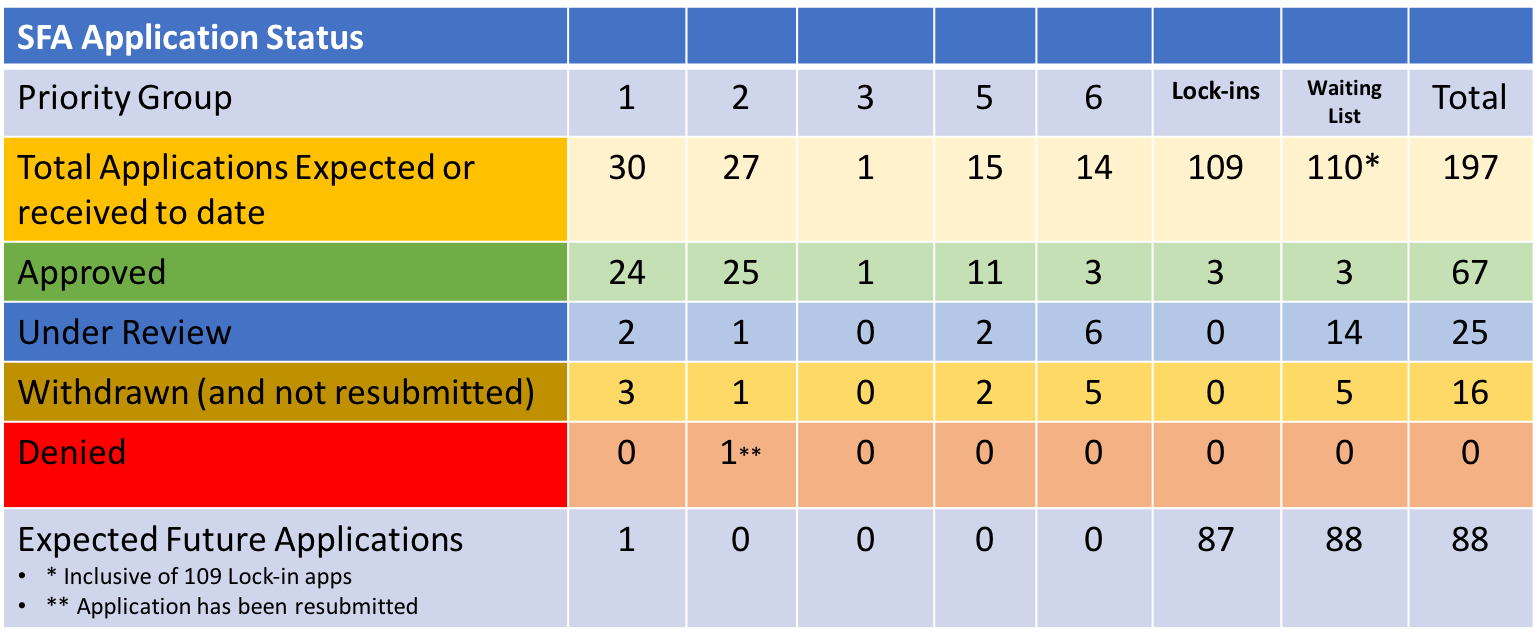
On another note, it is a Monday which means that we provide you with an update on the PBGC’s progress implementing the ARPA legislation. This past week has been relatively quiet in terms of visible output, as there was only one new application added to the current review queue. Pacific Coast Shipyards Pension Plan, a non-priority plan, has submitted a revised application having withdrawn the initial request on October 25th. This plan is seeking nearly $17.9 million in grant money for its 507 plan participants.

In other news, there were two applications that were withdrawn during the week, as United Food and Commercial Workers Union Local 152 Retail Meat Pension Plan and the Pension Plan of the Moving Picture Machine Operators Union Local 306 pulled the applications. In the case of the UFCW plan, this was the initial submission seeking $262.8 for the 10,252 plan participants for the non-priority group member. The Machine Operators, a Priority Group 5 member, recalled a revised application which is seeking $19.8 million for the 542 members of this plan.

What’s Your Purpose?

By: Russ Kamp, Managing Director, Ryan ALM, Inc.

I recently saw an interesting LinkedIn.com post that touched on marketing one’s firm in the investment management industry. It claimed that most asset management organizations spend tons of money on marketing with little to show for the effort. I agree! 

The post had to do with how you present your firm’s capability to the world in a way that might just differentiate them from their peers. But, I don’t think that the marketing stinks because you can’t articulate why you’re different. I think there are few firms that stand out because of the lack of focus on the retirees.

The defined benefit (DB) pension industry has been around for a very long time, but despite the significant importance of providing a promised benefit to the plan participant each and every month, they are fading away. This is tragic. 

Why is this happening? I believe that we lost focus. The primary objective in managing a DB pension plan should be to secure the promised benefits at a reasonable cost and with prudent risk. Somewhere along the way, that objective was replaced by one focused solely on generating a return that – – if achieved (and that’s a BIG IF) – – would minimize the contributions needed to fund the original promise.

What that ignores is that asset class returns come with risk on an annual basis, and in some cases, significant variability. That uneven return pattern led to periods of significant drawdown on the plan’s assets, and the need to make up for those losses with greater contributions. Sponsoring entities didn’t like the impact that those volatile contributions had on their financial statements (this is especially true for corporate plans). I can’t say that I blame them.

There are a lot of people who play a part in securing a retirement for members: the plan sponsors/trustees, custodians, asset consultants, third-party administrators, actuaries, lawyers, accountants, and asset managers (sorry if I missed your specific role). Each one of these businesses plays an important role in the sacred promise to each and every plan participant that they can retire secure in their financial well-being. It is our collective responsibility to ensure that the funds necessary to meet the promised benefits are available. Furthermore, it is our responsibility to provide our services at both a reasonable cost and with prudent risk. 

Can we all say that we’ve done that?

At Ryan ALM, Inc. we know that we are but one of thousands of organizations engaged in the management of DB plans, but we know our purpose. We may be a fixed income shop focused on cash flow matching (CFM), but it is much more than that. We have as our mission the lofty goal of protecting and preserving DB plans for the masses, one DB plan at a time. We know that there is no substitute for a DB plan. That getting a monthly retirement check after a long working career is the least that an American worker should expect, and we collectively have not done well meeting that expectation. We know that pension plans riding the asset allocation rollercoaster aren’t making the necessary progress to keep their promises, while potentially jeopardizing ongoing support for the idea of a retirement program itself.

Let’s get back to pension basics. Let’s get off the asset allocation rollercoaster! Bifurcate your assets into liquidity and growth buckets. Fixed income should be the core holding as bonds are the only asset class that has a known terminal value and a contractual semi-annual interest payment. An allocation to a cash flow matching strategy will ensure that the benefit payments are the focus of the pension plan. Your plan will now have the necessary liquidity to meet each and every payment chronologically as far into the future as that allocation will go. GREAT NEWS: we haven’t had an interest rate environment as favorable as the current one in two decades. Now is the time to act.

Finally, let’s once again realize that the primary pension objective is the keeping of our promises to those who’ve dedicated their careers to us. Let us all work together to secure those promised benefits at both a reasonable cost and with prudent risk. The entire concept of dignified retirement for each American hangs in the balance. That is a huge responsibility that we all have a stake in.

Confused, Yet?

By: Russ Kamp, Managing Director, Ryan ALM, Inc.

During the last week, I’ve reported on two reports from the Milliman organization. Each pertained to the current state of pension funding with one focused on corporate plans while the other addressed public pension systems. Both studies follow the funding for the top 100 plans in each of the two categories.

With regard to corporate plans, Zorast Wadia, author of the PFI, disclosed that in aggregate the top 100 plans had seen negative asset performance for the third consecutive month. Becky Sielman, co-author of Milliman’s PPFI, also mentioned that asset performance was down in October, and that the Top 100 public plans had also suffered negative performance for the third straight month. In the case of the corporate index the aggregate performance was -2.7% knocking total assets down by $40 billion for the 100 plans, while public plan aggregate performance had declined by only -1.9%, but the asset loss was roughly $89 billion.

Despite the similar performance results, it was reported that corporate plans saw aggregate funding improve as the funded ratio went from 103.6% at the end of September to 104.2% as of October 31. Good for Corporate America! On the other hand, the PPFI highlighted that aggregate pension funding had deteriorated as the funded ratio fell from 73.2% to 71.4%. So, that raises the question: How could both monthly studies highlight negative performance yet corporate plans enjoyed an improved funded ratio, while public pensions saw deterioration by 1.8%?

Well, it comes down to the valuing of plan liabilities. Corporate plans use a more market-based rate (under FASB accounting rules) which is an AA corporate yield curve rate to value their pension obligations, while public pension systems can use the ROA (GASB accounting rules) as the discount rate for their liabilities. In the current environment, with US interest rates rising, the present value (PV) of those future value (FV) liabilities have fallen to a greater extent than the plan assets. With regard to public pension accounting, given the use of the ROA, liability values don’t reflect current market interest rates.

Ryan ALM, Inc.’s founder, Ronald J. Ryan, CEO, wrote an insightful book several years ago titled, “The U.S. Pension Crisis”. It is a deep dive into accounting rules for pension plans, which he believes have distorted the economic reality for pension plans, especially public funds. As I highlighted above, you have two types of plans that experienced similar asset declines, yet one saw improved funding while the other witnessed funding deterioration. How does that make sense? Actuaries have a very challenging job. Why do we make it more challenging given the disparate valuation methodologies? Some in our industry will argue that public pension systems are “Perpetual”. As we’ve seen on a number of occasions, that doesn’t make them sustainable.

>25% Are <60% Funded – Ouch!

By: Russ Kamp, Managing Director, Ryan ALM, Inc.

Last week we reported on the Milliman Corporate Pension Funding Index report. Yesterday, Milliman released the results for their Public Pension Funding Index (PPFI), which consists of the nation’s 100 largest public defined benefit pension plans.

Unfortunately, the aggregate funded ratio deteriorated from September’s 73.2% to 71.4% as of October 31. The 100 plans experienced a decline of roughly -1.9% during the month marking the third consecutive negative month for the index. The decline in asset values totaled about $89 billion giving the 100 plans a market value of about $4.4 trillion. Becky Sielman, co-author of the PPFI, reported that  “At the end of October, only 12 of the plans were more than 90% funded, while 26 were below the 60% funding mark.”

According to Becky, the last 12 months have seen six months with positive performance and six months with market declines. Once again highlighting the fact that pension America just rides the asset allocation rollercoaster up and down. It is time to get off that ride!

The Handwringing is Misplaced

By: Russ Kamp, Managing Director, Ryan ALM, Inc.

Like Chicken Little, many in our industry believe that the sky is about to fall on top of us as a result of the abundant US debt financing. It is expected that record levels of Treasury debt will need to be “purchased” and refinanced at increasingly higher levels of interest. As a result, we’ve recently learned that Moody’s has placed a negative watch on Treasuries. It follows on the heels of the action taken by Fitch in August (AA+).

Given all of the noise surrounding current and future Treasury auctions, investors are worrying that we have borrowed too much. However, I’m reminded by my former colleague, Charles DuBois, who referenced Paul Sheard, former Chief Economist at S&P, who put the issue in its proper framework. According to Charles, Paul supposedly stated that the issue is not “have we borrowed too much?” But rather “have we created too much purchasing power?”.

This is a major issue facing the US Federal Reserve at this time as they consider their next move in this rate cycle. It is also an issue that doesn’t get nearly the attention that it deserves. Not surprisingly, the investment community celebrated a CPI reading today that came in light, but they need to understand that the stimulus currently being put into the economy through record deficit spending may offset recent gains made through the FOMC’s rate action. Prolonged wars on two fronts might just lead to further deficit spending and greater inflation. In that scenario, the Fed will have great difficulty meeting the investment community’s collective expectation of falling, and in some cases, dramatically falling rates in 2024.

There isn’t a lot of slack in our economy at this time. If the government continues to maintain this level of stimulus, GDP growth is going to have to shrink in a meaningful way. But is that happening? According to the Atlanta Fed’s GDPNow model, we should expect annualized real GDP growth of 2.1% for Q4’23. That doesn’t indicate substantial weakness. For today we will celebrate a CPI that is closing in on the Fed’s 2% target. But it remains too early for victory to be declared.

Strong Market – Really?

By: Russ Kamp. Managing Director, Ryan ALM, Inc.

Like everyone else, I get a ton of emails regarding various markets and the associated performance. Just got one that spoke to 2023’s surprising equity market strength versus 2024’s concern about recession. First, in 2022 market participants were talking a lot about 2023 being the year of the recession because the Fed had already gone too far. So much for that expectation. But back to 2023’s equity market strength. Is it really a strong market or one that is dominated by just two handfuls of companies?

In an analysis by Gen Eagle Trading, they mentioned (11/6) that “the 10 largest companies by market cap have been responsible for 96.5% of the S&P 500’s return in 2023. This is unprecedented. For example, the ten largest companies have had an average annual contribution to the S&P 500 of 29.8% in all positive performance years from 1993. Given the fact that institutional US equity managers tend to build equal weighted portfolios favoring more value factors, it is highly unlikely that “active” managers are even close to matching the performance of the S&P 500 in 2023, continuing a trend that has seen active management struggle for 20+ years.

So, I repeat, when only 10 stocks that are not likely held at similar weight as that of the benchmark so dramatically outperform leaving the remaining 490 companies to generate only 4.5% of this year’s gain, is it correct to say that 2023 has been defined as a strong market environment for equities? For instance, the capitalization weighted S&P 500 is up 10.7% YTD through October 31, 2023, while the equal weighted S&P 500 is at -2.4%. The level of underperformance by small cap value (R1000V -6.5% YTD) has been unprecedented. With the exception of 2022, large growth (R1000G +23.2% YTD) has dominated the equity markets. Is it sustainable or should plan sponsors begin looking to migrate equity assets to small value?

Better yet, given the uncertainty of Fed policy going forward, it might make more sense to take profits from the S&P 500-like investments with all of its concentration risk, and migrate the proceeds to US bonds that can be used to create much greater certainty through a cash flow matching implementation that will secure the promised benefits chronologically as far out as the allocation goes. The current US interest rate environment is providing a gift to plan sponsors at this time. Take advantage of it. We didn’t do that in 1999 and have paid the consequences since.

ARPA Update as of November 9, 2023

By: Russ Kamp, Managing Director, Ryan ALM, Inc.

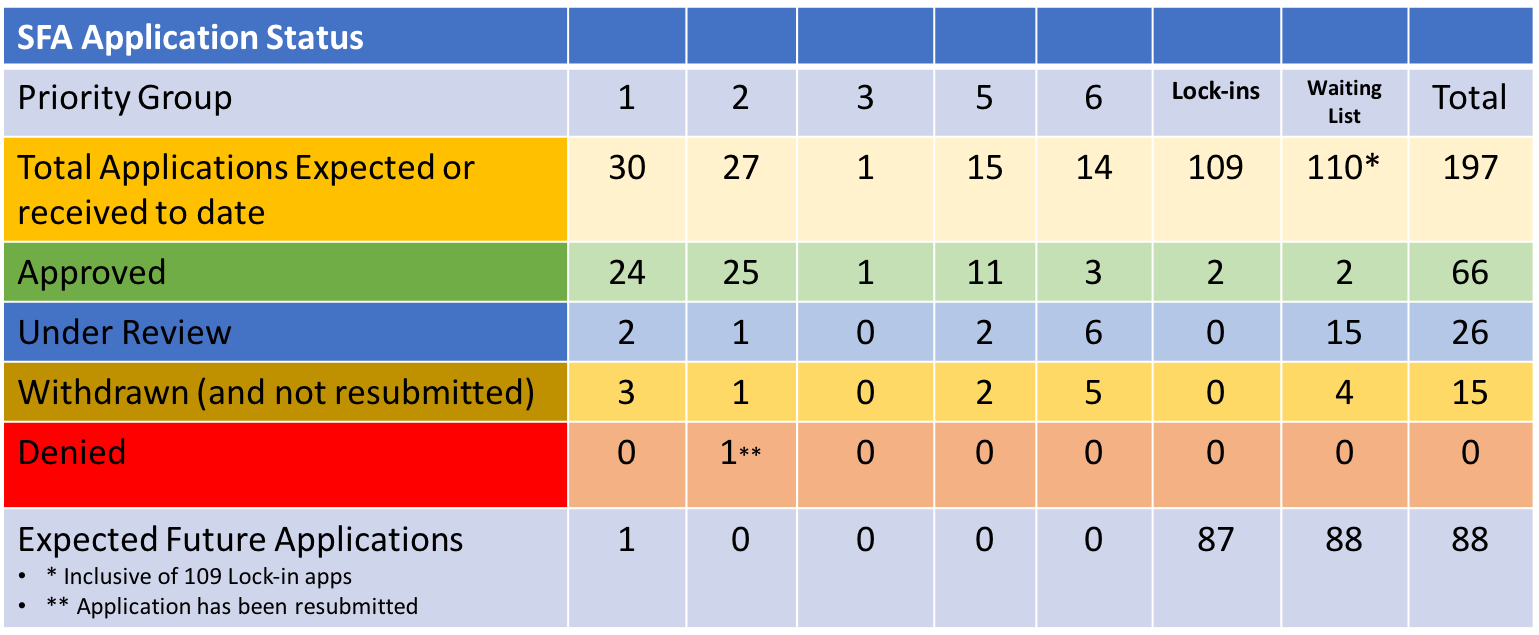
We are pleased to provide you with this update of the progress of the PBGC’s implementation of the ARPA pension legislation. Clearly, great progress has been made since the inception of the program in 2021. There was one additional plan that received approval last week. The Central New York Laborers’ Pension Plan, a non-priority plan, will receive $18.9 million, including interest, to support its 1,085 participants. Beyond this news, there isn’t much to share, as there were no new applications to review, none withdrawn or denied, and none seeking to be added to the waiting list for non-priority plans.

As the table above highlights, there are currently 25 applications under review 11 that have a priority designation. More importantly, 67 plans have already had their applications approved for a total of $53.53 billion. The US interest rate environment continues to support these grant recipients who want to create certainty of meeting their benefit obligations through a cash flow matching implementation. Keep it going!

Oh, What A Beautiful Morning!

By: Russ Kamp, Managing DIrector, Ryan ALM, Inc.

I’m certainly no Gordon MacRae, who sang the original as part of the Oklahoma soundtrack in 1955, but I can tell you that I almost feel like belting that song out! Sorry to those that might be around me when I do! For those that might not know the song, the chorus goes:

Oh, what a beautiful mornin’
Oh, what a beautiful day
I’ve got a beautiful feelin’
Everything’s goin’ my way

Given the news of the last couple of days regarding defined benefit plans or hybrid offerings being reintroduced, I’ve got a beautiful feelin’ that we will certainly see brighter days ahead for the American worker. It has been a long and painful slog for so many tasked with trying to cobble together a retirement benefit. We are still at the starting gates, but as least there is a race to be run. Let’s hope that the current momentum can be continued.

As a reminder, both IBM and the City of Trumbull, CT, have taken action to support their workers with the relaunch of DB programs or quasi-DB funds. Here is what I produced on LinkedIn.com.

Is that a barn door that has just been opened?

News that IBM is eliminating the company’s 5% 401(k) match in lieu of a 5% of salary contribution into a company sponsored “Retirement Benefit Account” whether the employee contributes or not certainly sounds as if they are once again offering a cash balance plan. YES! The money will be invested within the current IBM Personal Pension Plan. No investment decision will be taken by the employee. There will be a guaranteed 6% return for the first 3 years of the program’s existence. An IBM spokesperson is quoted as saying, “The RBA adds a stable and predictable benefit that diversifies a retirement portfolio and provides employees greater flexibility and options.”

You don’t say! As I’ve said numerous times, asking employees to fund, manage, and disburse a retirement benefit without disposable income, investment acumen, and a crystal ball is just poor policy. I’m glad that IBM agrees. BTW, employees will still be able to fund their “supplemental” 401(k). Much more needs to be researched, but having IBM take this step is huge.

With regard to Trumbull: I’m currently in Santa Monica getting ready to teach the investment program for the IFEBP’s “Essentials” program, it is 6:31 am. I mention this only in the context that I want to “celebrate” but it is a bit too early! Not only have we had the IBM news come out, but Trumbull, CT, is reinstating its pension plan for police officers. The initial plan was frozen to new hires after 2014. Since that time, they have had great difficulty recruiting and retaining new officers (they’ve lost 15).
“I am pleased we are able to reach this agreement with our Police Union through the collective bargaining process,” said First Selectman Vicki Tesoro in a news release. “Based on feedback from Chief (Michael) Lombardo, the Police Commission, and the Union, this action will go a long way to restore Trumbull’s competitiveness in the hiring market.”

What a day!!! The restoration of DB and DB-like plans has begun, and “they” said that wouldn’t happen. It is time to get on board!

Protecting the Downside is Much More Important

By: Russ Kamp, Managing Director, Ryan ALM, Inc.

Milliman has once again produced the results of its latest Milliman 100 Pension Funding Index (PFI), which analyzes the 100 largest U.S. corporate pension plans. As reported, the average funded ratio for the constituents in the index rose from 103.6% at the end of September to 104.2% as of October 31. The increase was driven by the continuing rapid rise in the discount rate which stood at 6.2% at the end of October which was up 36 bps from September 30th’s 5.84%. The increase in the discount rate was more than sufficient to make up for the asset decline of -2.68%. Assets have now declined for three consecutive months, while the 6.2% discount rate is at a level last achieved in 2009.

According to the study’s author, Zorast Wadia, the funded ratio of 104.2% marked a high level for 2023. Zorast also made mention of the fact that the recent increase of more than 100 bps in the discount rate during the last 4 months makes this a “very favorable economic environment for plan sponsors.” We agree. Who knows where rates will be in the next 6-12 months? Why try to time the market?

In addition to reporting on the current state of corporate America’s pension funding, the Milliman study framed possible scenarios for the end of 2023 and the conclusion of 2024. “Under an optimistic forecast with rising interest rates (reaching 6.3% by the end of 2023 and 6.9% by the end of 2024) and asset gains (9.8% annual returns), the funded ratio would climb to 106.0% by the end of 2023 and 118.0% by the end of 2024. Under a pessimistic forecast (6.1% discount rate at the end of 2023 and 5.5% by the end of 2024 and 1.8% annual returns), the funded ratio would decline to 103.0% by the end of 2023 and 93.0% by the end of 2024.

Given these possible outcomes, why take the risk of having your plan’s funded ratio fall from a healthy 104+% to something close to 93% or worse? Again, the primary objective in managing a DB pension plan should be to SECURE the promised benefits at a reasonable cost and with prudent risk. Subjecting the plan to unnecessary risk at this point with so many unknowns potentially impacting the capital markets is silly, if not fiduciarily imprudent. Secure those promises (benefit payments) at these attractive yields. You will have won the battle, if not the war.
 

ARPA Update as of November 3, 2023

By: Russ Kamp, Managing Director, Ryan ALM, Inc.

Welcome to November! The PBGC has now been busy implementing the ARPA legislation for 15 months. Lots has happened during this period of time, but nothing more important than the fact that $52.5 billion in grants, including interest, has been approved so far. Awesome!

There was not a lot of activity during the last week, but three funds, America’s Family Benefit Retirement Plan, Union de Tronquistas de Puerto Rico Local 901 Pension Plan, and American Federation of Musicians and Employers’ Pension Plan (AFM) submitted revised applications seeking SFA. In the case of AFM, they withdrew an application after identifying a minor input error. They were permitted to correct the issue and immediately resubmit another revised application without losing their spot in the review process. Although the PBGC has 120-days from the submission of an application to act, it is expected that AFM will get a decision on its application before year-end, which would coincide with the original 120 day period.

There were no other applications denied or withdrawn and no additions to the waiting list, which seems to have been settled at this time since we haven’t seen a fund request a place on the list since August 24, 2023. There were no applications approved among the 26 currently being reviewed.