Corporate Pension Funding Deteriorates in November – Milliman

By: Russ Kamp, Managing Director, Ryan ALM, Inc.

Milliman has published the results of the latest Milliman 100 Pension Funding Index (PFI) that reviews the funding for the 100 largest U.S. corporate pension plans. November wasn’t a great month for funding as the significant drop in the discount rate of 65 basis points (6.20% to 5.55%), the largest monthly decline since 2008, saw pension liabilities escalate by $82 billion. This hurdle was too much to overcome despite a stellar investment gain of 6.53%. The collective funded ratio dropped from 104.1% at the end of October to 103.2% as of November 30th.

The market value increase of $74 billion inassets was the best performance for the index in 2023. Collectively, the index constituents now have $1.302 trillion in assets. However, the $82 billion in liability growth resulted in funding deterioration of $8 billion during the month, leading to a decline in the surplus which now stands at $41 billion.

According to Zorast Wadia, author of the PFI. “All eyes will be on where interest rates and plan asset values end up in December, as this will lay the foundation for 2024 pension calculations for calendar-year plans.” As part of their monthly review, Milliman looks at the potential impact on funding from both an optimistic and pessimistic forecast.  Under an optimistic forecast with rising interest rates (reaching 6.2% by the end of 2024 and 6.8% by the end of 2025) and asset gains (9.8% annual returns), the funded ratio would climb to 117% by the end of 2024 and 131% by the end of 2025. Under a pessimistic forecast (4.9% discount rate at the end of 2024 and 4.3% by the end of 2025 and 1.8% annual returns), the funded ratio would decline to 93% by the end of 2024 and 85% by the end of 2025.

That is quite some gap in potential funding under those two scenarios. As we’ve been saying, given the uncertainty as to the Fed’s interest rate policies going forward, why make an interest rate bet by waiting? Despite the recent pullback in rates, we are still in a very supportive interest rate environment in which to take risk from your DB plan. SECURE a portion of the Retired Lives Liability today which will ensure that the liquidity necessary to meet the promised benefits is there, while extending the investing horizon for your growth or alpha assets. This extending investing horizon will help the pension plan wade through potential market turmoil. Plans that adopted a cash flow matching strategy in October have secured the pension promises at much more attractive rates leading to far greater cost reduction of those future benefits. Who knows what December holds, let alone 2024.
What is Duration?

By: Russ Kamp, Managing Director, Ryan ALM, Inc.

There seems to be a fascination in our industry about using the duration of bonds to help mitigate pension funding risk, but does it? Let’s start with the basics. What is duration? Duration is the average life of cash flows priced or weighted by present values (market values). Duration is commonly used as a measure of the price sensitivity of a bond to changes in interest rates. The purpose of duration matching is an attempt to match the interest rate risk sensitivity of assets to liabilities. The objective is to have the market value or PV changes (growth rate) in the bond portfolio match the market value or PV changes (growth rate) in liabilities for a given change in interest rates. Problem: because duration is a PV calculation, it is constantly changing, which creates the need to constantly adjust the plan’s asset allocation! More problems: duration is not calculated by the actuary so where do you get the duration of liabilities?

Furthermore, duration matching strategies are implemented by either using a single average duration or by investing in several key rates along the yield curve. The truth is that liabilities are a term structure of monthly liabilities. You need to match this entire liability yield curve to match its interest rate sensitivity. Moreover you have to match or exceed the discount rate used since duration does not include income in its calculation. As a result, a portfolio of US Treasury STRIPS will not match the liability growth rate if liabilities are priced as AA corporate bonds (ASC 715 – FASB rules). Duration is far from a precise mathematical calculation (see Seven Flaws of Duration research on our web site for more insights) given the volatility of interest rates and the fact that yield curves do not move in parallel shifts.

Frequently, duration strategies are implemented by fixed income managers attempting to match the average duration of the bond portfolio to the average duration of a bond market index with a similar duration to the pension plan’s liabilities (i.e., Bloomberg Barclays Long Corporate Index). They use the generic bond index as a proxy for liabilities, but no two pension plan liability streams will ever be the same – they are like snowflakes.

Actuarial practices use PV to calculate the funded ratio and funded status. But benefit payments are future values (FV). This suggests that the future value of assets vs. the future value of liabilities is the most critical evaluation. But most asset classes are difficult (impossible) to ascertain their future value. This is why the PV is used. Only bonds (and insurance annuities) have a known future value and have historically been used to cash flow match (CFM) liabilities (i.e. defeasance, dedication). Importantly, duration matching strategies DO NOT provide the liquidity needed to secure the promised benefits.

What is the primary objective in managing a defined benefit pension plan? It is to SECURE the promised benefits at a reasonable cost and with prudent risk. How does a duration matching strategy secure the benefits? Only a cash flow matching strategy can match and fund the monthly benefits and expenses chronologically. Importantly, a CFM strategy provides a more precise duration matching then duration matching strategies do, as each and every monthly liability payment of the CFM program is duration matched as opposed to a few key rate durations.

Duration matching products are a poor substitute for cash flow matching programs if the desired goal is to ensure that the plan’s promises to the participants are SECURED each and every month, as duration matching products fall short as a result of the following:

  1. Duration matching does NOT fund and does NOT secure benefits
  2. Duration is a PV calculation so it is very interest rate sensitive – benefit payments are FV and not interest rate sensitive
  3. Duration changes every day requiring frequent rebalances
  4. Generic bond indexes typically used as proxy for liabilities
  5. No generic bond index can match client’s unique liability cash flows
  6. Forced into buying costly Treasury STRIPS after 16 years

If it is That Good, Why Disclose it?

By: Russ Kamp, Managing Director, Ryan ALM, Inc.

Every investment management organization believes that it has some secret sauce that provides their investment process with the ability to consistently add value. If that were true, one would think that the special insight(s) would be carefully guarded. Yet, I see on a fairly regular basis emails touting various investment insights from one firm after another. Why? In an investment landscape that has proven to be incredibly challenging for advisors to actually add value relative to stated objectives, the sharing of one’s secret sauce seems detrimental to one’s ability to consistently add value.

In a previous life, I was the head of Invesco’s quantitative equity business (roughly $30 billion in AUM). I was extremely fortunate to work with and learn from so many incredible investors. Our fundamental ideas were implemented in a systematic fashion as we attempted to remove as many biases as we could from the investment process. As good as our insights were, they didn’t always work in every investing environment. We would monitor our indicators on a regular basis to make sure that the forecasting ability of the insights wasn’t deteriorating, which occasionally one would. I can assure you that we were incredibly protective of our ideas and how they were carefully blended to form our stock selection model.

So, I was surprised to see an email today highlighting the forecasting ability of a particular “factor”. In this case, it was a Free Cash Flow factor. Now, we used FCF as one of our indicators 20+ years ago, so there isn’t anything particularly new. But, again, why highlight the supposed value added? Back in 2007, the quant space underwent a significant correction as many of the leading practitioners were engaged in very crowded trades as a result of having significant value biases among their various models. It wasn’t that these firms lost their edge, it was the result of too much money chasing to few good ideas.

Investment firms in our industry have a tendency to grow AUM far beyond the natural capacity of an insight or strategy. The result is the arbitraging away of one’s own insights rendering those factors more harmful than good. Again, if capacity is an issue, and it is, then why highlight one’s secret sauce? The capacity of a particular insight is going to be different depending on that factor. Each one will have a different alpha decay that is dependent the availability of the data, on the number and size of other investment firms using that insight or a similar idea, the trading frequency of the strategy, the AUM of the strategy, and where it is applied to various segments of our equity market, such as small cap exposure. These insights need to be monitored closely and changes shouldn’t be frowned on, as strategies that don’t evolve are ultimately going to be rendered to the status of expensive index funds, at best.

At Ryan ALM, Inc. we are not engaged in stock selection activities and our selection of bonds for our Cash Flow Matching (CFM) portfolios depend on many fundamental and quantitative credit research ideas. However, we do have a unique cost optimization process that we believe differentiates us from our competition. Our model has proven to be extremely cash flow efficient. What does that mean? It means that we don’t have a lot of excess cash from month to month which would reduce the cost savings of the implementation longer-term. All CFM implementations are not the same.

Getting behind the curtain of the various CFM strategies is not easy, but it should be a task worth pursuing. One way to accomplish the objective would be to ask multiple CFM managers to “build” a portfolio using the same projected benefits/expenses and contributions in order to see which firm produces the greatest reduction in cost, which can be impacted by factors such as the the type of securities used, credit quality, length of the assignment, etc. You can try to get us to disclose our secret sauce – good luck. We will, however, be happy to produce an initial review of a potential CFM portfolio so that you can evaluate the benefit(s) of adopting a Ryan ALM CFM program in order to compare us to the competition. We aren’t scared.

ARPA Update as of December 1, 2023

By: Russ Kamp, Managing Director, Ryan ALM, Inc.

Welcome to December! Wow, 2023 certainly seems to have flown by. Let me take this opportunity to wish our Jewish readers a Happy Hanukkah, which begins on Thursday, December 7th and will run through December 15th.

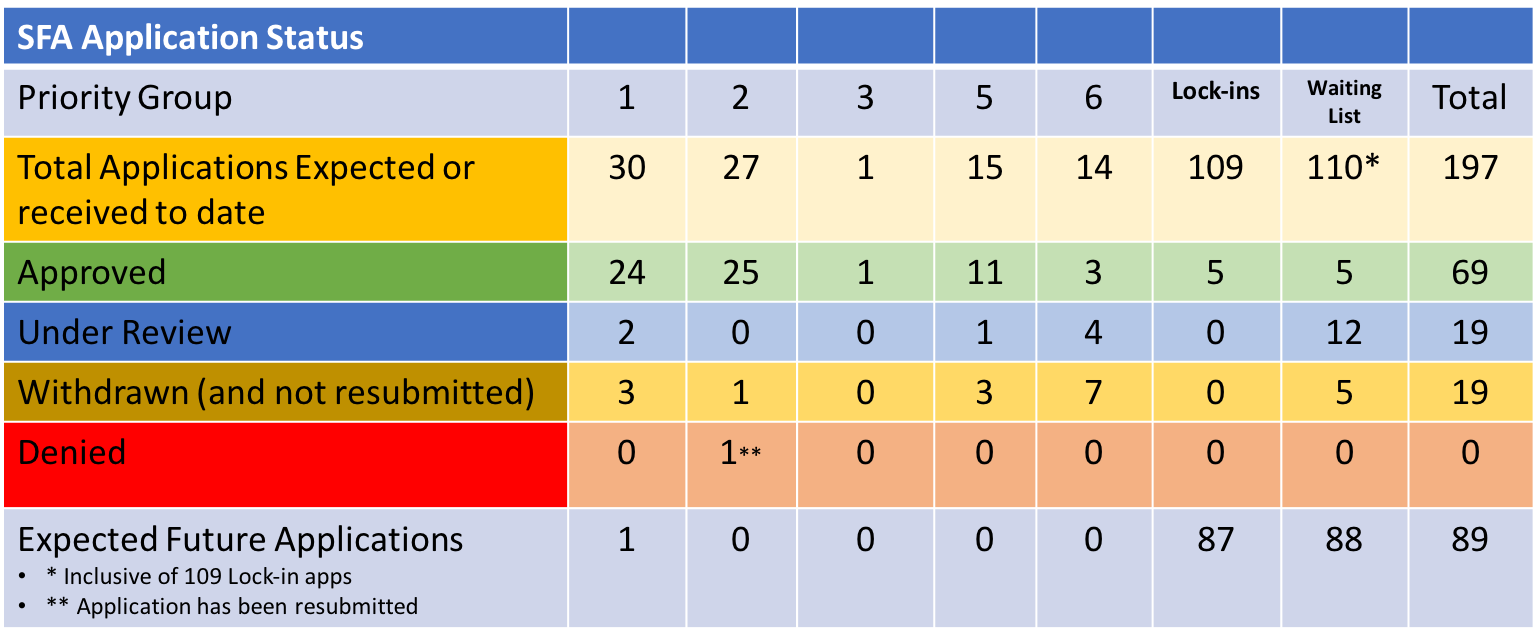
With regard to the PBGC’s effort implementing the ARPA legislation, last week was rather quiet, as only one new plan filed its application for SFA. United Food and Commercial Workers Union Local 152 Retail Meat Pension Plan, Mount Laurel, NJ, a non-priority group member, is seeking $266.1 million in SFA for the 10,252 plan participants. There are currently 19 applications under review with many more to go.

In other news, Laborers National Pension Plan, Dallas, TX, withdrew its revised application. This Priority Group 6 member is seeking $280 million in SFA for its 41,439 members.

Most importantly, 69 funds have been awarded SFA (and in some cases supplemental SFA) since inception of the program. In total, $53.6 billion in grants, including interest, have been awarded to date.

Charlie Munger – He Lived by the KISS Philospohy

By: Russ Kamp, Managing Director, Ryan ALM, Inc.

Unfortunately, I never had the opportunity to meet or speak with Charlie Munger, but I would always welcome the opportunities to read what he has to say. His brilliance was in the simplicity of his message. I’ve seen a number of tributes to the man from those who had the gift of knowing him to those, like me, who simply admired his amazing career and his words of wisdom. 

In an industry where one complicated strategy after another is introduced, usually accompanied by larger and larger fee schedules, Charlie’s perspective and message was a breath of fresh air. You can find his quotes on a number of subjects. In our industry the pursuit of constant learning is so very critical. On the subject of learning, Charlie is quoted as saying, “Without the method of learning, you’re like a one-legged man in an ass-kicking contest. It’s just not going to work very well.” — 2021 Daily Journal Annual Meeting He’s also quoted as saying “In my whole life, I have known no wise people (over a broad subject matter area) who didn’t read all the time — none, zero. You’d be amazed at how much Warren reads — and at how much I read. My children laugh at me. They think I’m a book with a couple of legs sticking out.” — Poor Charlie’s Almanack

With regard to investing, he said, “One of the inane things [that gets] taught in modern university education is that a vast diversification is absolutely mandatory in investing in common stocks. That is an insane idea. It’s not that easy to have a vast plethora of good opportunities that are easily identified.” — 2023 Berkshire Hathaway Annual Meeting I couldn’t agree with the following quote, in which he said “Mimicking the herd invites regression to the mean (merely average performance).” — Poor Charlie’s Almanack I think that it would be quite beneficial for our pension industry to take Charlie’s thoughts seriously about diversification and the herd mentality exhibited with regard to asset allocation.

On the subject of technology, he commented that “We now have computer algorithms trading with other computers. And people buying stocks who know nothing, being advised by people who know even less. It’s an incredibly crazy situation … All this activity makes it easier for us.” — 2022 Berkshire Hathaway Annual Shareholders Meeting In addition, he stated that he’s “personally skeptical of some of the hype that has gone into artificial intelligence. I think old-fashioned intelligence works pretty well.” — 2023 Berkshire Hathaway Annual Meeting But he was also a staunch supporter of capitalism and opposed to breaking up big tech, saying “”I would not break them up. They’ve got their little niches. Microsoft maybe has a nice niche, but it doesn’t own the Earth. I like these high-tech companies. I think capitalism should expect to get a few big winners by accident.” — 2023 “Acquired” podcast

Again, I wish that I’d had the opportunity to meet the man who became a legend. In addition to Charlie, there have been a number of incredibly influential people in our business whom I’ve admired, but never had the chance to meet, including John Bogel, John Templeton, and Peter Lynch. Fortunately, I’ve had the great opportunity to work with a number of brilliant and critically important investors who don’t carry the same cache as Charlie or the others that I referenced. 

Currently, I have the great fortune of working with a fixed income legend in Ron Ryan. Recognized for his work with indexes (Bill Sharp Lifetime Award winner) and Asset/Liability Management, Ron (and Ryan ALM, Inc) is more than a provider of product. His personal mission is to protect and preserve defined benefit plans for the masses. He, too, follows the KISS philosophy. If pension plans exist to meet a promise that has been given to a participant, shouldn’t that promise be the focus of our effort? Seems obvious, right? However, in a world where over diversification (“deworsification” according to Munger) and the herd exist in spades, the management of pension assets focused on the “goal” has morphed into a return objective – tragic! 

Thank you, Charlie, for the wisdom you shared over more than six decades. Thank you, Ron, for showing me how we can make a true difference for the millions of American workers who are counting on (hoping) the promise that was given to them when they began working by focusing on the true pension objective of SECURING the promised benefits at a reasonable cost and with prudent risk.

Hurry Up…and WAIT! Why?

By: Russ Kamp, managing Director, Ryan ALM, Inc.

Given the significant escalation in US interest rates during the last 20 months, it isn’t surprising that the investing community has taken a greater interest in bond strategies that can help reduce risk within a pension plan. We, at Ryan ALM, Inc. have provided detailed analysis to dozens of plan sponsors, consultants, and actuaries related to our work as cash flow matching (CFM) experts.

Each analysis reveals a significant reduction in the cost to SECURE the future promised benefits and the expenses incurred to provide those promises. Importantly, the longer the coverage period the greater the cost savings, as bond math is very straightforward: the longer the maturity and the higher the yield the lower the cost.

Despite the evidence suggesting that reducing risk and future expense is quite achievable, action has been slow to come. Why? Do those engaged in the management of pensions really like the uncertainty that comes with investing in markets? Do they like the rollercoaster ride that we’ve been on since 2000, when most pension plans were significantly overfunded only to see funded status plummet and contributions escalate as we went through a series of mind-blowing market events?

Pensions blew an opportunity to take substantial risk off the table after the 1990’s. Are we going to miss another golden opportunity today? Remember: the primary objective in managing a DB plan is to SECURE the promised benefits at a reasonable cost and with prudent risk. It is not and never has been a return objective! Focusing on return instead of the pension liabilities subjects the plan’s assets to this unnecessary ride of markets up and down and the implications of that action.

At the end of October, we were producing investment grade portfolios that were yielding close to 6% and in some cases >6% YTW. Plan sponsors could have reduced future benefit costs by as much as 70%. Unfortunately, Treasury yields have plummeted in November with the 10-year Treasury note yield down about 70 bps from its peak achieved in late October. The cost to defease those future liabilities has now gone up. For some of the plans that we have analyzed, that cost increase is in the 100s of millions!!! What a wasted opportunity. Again, what are you waiting for?

Everyone that touches a DB pension plan is a fiduciary. We have an obligation to the plan participants to do what is best for their pension system. I suggest that continuing to ride the asset allocation rollercoaster is not the best or fiduciarily prudent approach to the management of pensions. Humans hate uncertainty! Why are those engage in the management of pension assets embracing the uncertainty that comes with investing in the capital markets?

Instead of having all of your pension assets focused on the return on asset assumption (ROA), split the assets into two buckets: liquidity and growth. The liquidity assets should be a defeased bond strategy (CFM) that ensures that the benefits are covered chronologically as far into the future as the allocation goes. Now the growth assets have all the time in the world to grow unencumbered in order to meet future liability growth. Extending the investing horizon always leads to a higher probability of achieving the desired outcome. Stop living in a day-to-day cycle of gains and losses. Adopt this approach and everyone associated with that pension plan will sleep better knowing that no matter what happens today, those promised benefits are secure. Cash flow match liabilities with certainty and BUY TIME for the growth assets to grow unencumbered…what a concept!

IBM Discloses Further Details…

By: Russ Kamp, Managing Director, Ryan ALM, Inc.

You may recall that 20 days ago in a blog post titled, “Oh, What A Beautiful Morning”, I threatened to break out into song. I didn’t then and I won’t now. You are welcome! However, the gist of my enthusiasm was the announcement that IBM would be converting a 5% company 401(k) match into a 5% contribution into a retirement account that very much sounded like a cash balance plan.

In a recent P&I article, more details of the IBM plan were revealed. As previously known, they are eliminating the company 401(k) match and they will be replacing it with a cash balance component called a “retirement benefit account” (RBA), which is part of the IBM Personal Pension Plan, a defined benefit plan. YES! Details regarding the RBA are available in the 2024 IBM U.S. Benefits Guide.

From the Guide, “All regular employees begin participating in the RBA after one year of service.” “You (the employee) will receive a monthly pay credit that is 5% of your eligible pay, and your balance will grow with interest, which is applied monthly.” The interest rate will be 6% per year through 2026. Beginning in 2027, the interest rate applied to the RBA will be the 10-year US Treasury yield with a minimum of 3% through 2033.

Importantly, unlike the IBM 401(k), one does not have to contribute to be eligible for a RBA contribution. Each employee is eligible after 1 year of service and their benefit vests immediately. The employee has flexibility in what they do with the benefit once they leave IBM, including taking a lump sum, annuitizing the balance, rolling it into the IBM 401(k) plan or into an IRA.

According to the IBM benefits guide, this action is being taken to provide a “stable and predictable benefit that diversifies a retirement portfolio and provides employees greater flexibility.” Furthermore, IBM employees may continue to contribute to the existing 401(k).

Let’s hope that this action by IBM reignites conversations within HR departments on the importance of a defined benefit-like structure as the primary retirement offering. Defined Contribution plans are terrific as supplemental retirement structures, but many American workers are not in a position to fund, manage, and then disburse a benefit through a DC plan. Let us help them realize the American dream of a dignified retirement.

ARPA Update as of November 24, 2023

By: Russ Kamp, Managing Director, Ryan ALM, Inc.

We hope that you had a wonderful Thanksgiving holiday!

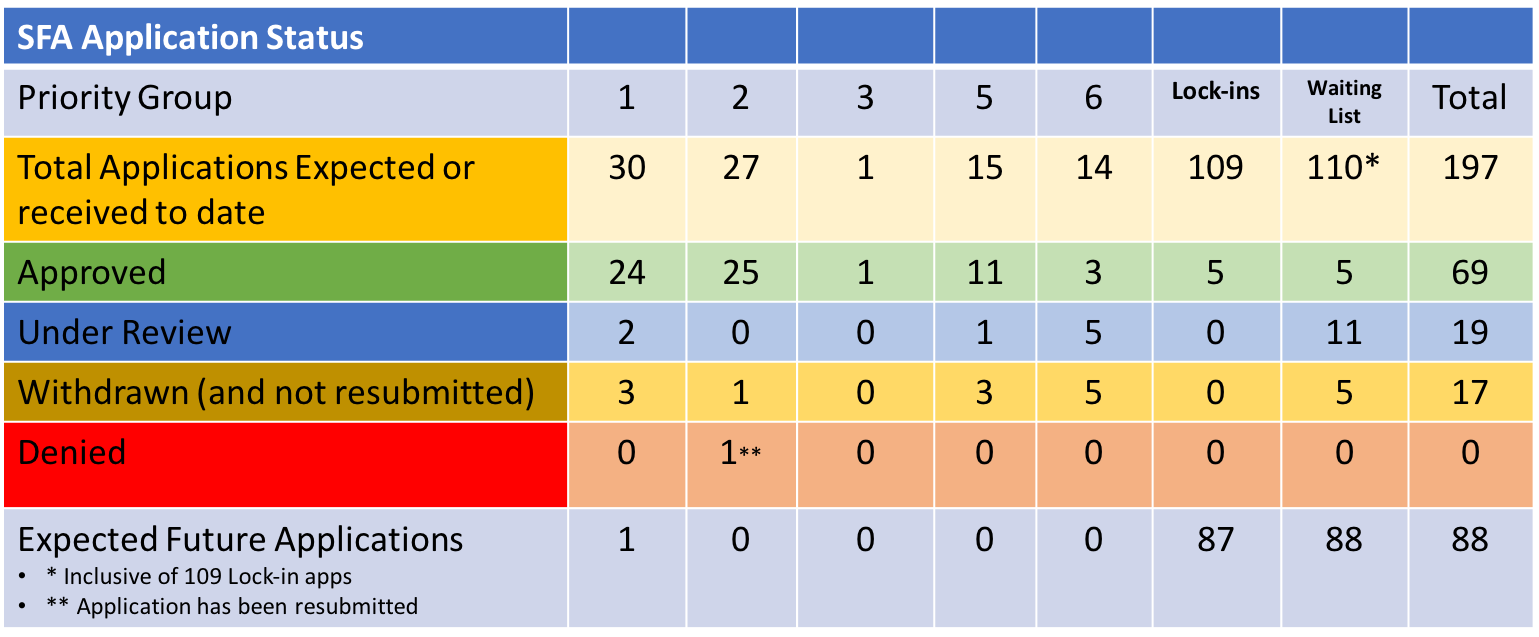
Given the short work week it isn’t surprising that there wasn’t a ton of activity related to the ARPA legislation. However, there were two plans that received approval from the PBGC for SFA grant money. Twin Cities Bakery Drivers Pension Plan and the United Association of Plumbers and Pipefitters Local 51 Pension Fund will receive $25,981,671 and $16,486,118, respectively, for their combined 2,589 plan participants. The amounts above include interest.

There have now been 69 successful SFA applications processed amounting to $53.57 billion in grants awarded to these multiemployer plans. In addition, there are currently 19 applications being reviewed and another roughly 90 yet to be submitted. Wonderful!

Is the PBGC now a Profit Center?

By: Russ Kamp, Managing Director, Ryan ALM, Inc.

The PBGC has recently published its annual performance and financial report for 2023. Because of the ARPA legislation and the grant monies awarded to 35 distressed plans (covering roughly 615,000 participants), the Multiemployer Program had a net positive position of $1.5 billion at the end of FY 2023, compared with $1.1 billion at the end of FY 2022. Terrific news. The ARPA legislation is doing exactly what it was intended to do.

With regard to the single-employer program, the PBGC reported a net position of $44.6 billion at the end of FY 2023, compared with $36.6 billion at the end of FY 2022. Question: Does the PBGC need to have this type of surplus, especially given the improved funding of single employer plans in the US? As I recently posted, Milliman’s 100 Pension Funding Index (PFI), which analyzes the 100 largest U.S. corporate pension plans, reported that the average funded ratio for the constituents in the index rose from 103.6% at the end of September to 104.2% as of October 31. Given the improved funding, we’ve encouraged the plan sponsor community to utilize the elevated interest rate environment to de-risk and secure the promised benefits through a cash flow matching approach. Has the PBGC undertaken such an initiative?

Furthermore, wouldn’t it be wiser at this time to reduce the premiums (excessive) paid by sponsoring organizations to assist them in maintaining these important retirement programs or perhaps even encourage the reopening of plans closed because of the high cost to provide them? Does the PBGC really need to have a $44.6 billion net position? We’ve seen the impact on the American worker from having to rely on defined contribution plans as the only employer-sponsored retirement program. Encouraging the use of defined benefit plans would not only help the individual worker, but it would help the sponsoring organization manage its labor force.

What are the Median Balances?

By: Russ Kamp, Managing Director, Ryan ALM, Inc.

Fidelity has provided an update through Q3’23 for participants in their 401(k), 403(b), and IRA accounts. The third quarter proved challenging for the participants who saw declines in each of the plan types. The average 401(k) balance declined 4% to $107,700, while the average 403(b) account balance fell 5% ($97,200). With regard to IRAs, those balances declined by 4% to an average of $109,600.

What I find disheartening, but not shocking, is the fact that an increasing number of individuals are accessing their retirement savings through in-service withdrawals, hardship withdrawals or loans. During the third quarter, 2.8% of participants took a loan from their 401(k). The percentage of workers with an outstanding loan increased slightly to 17.6%, compared to 17.2% last quarter and 16.8% in Q3 2022. More troubling, in Q3, 3.2% of participants took an in-service withdrawal, marking a 2.7% increase from a year ago, and forcing the participant to pay taxes and penalties.

Again, defined contribution plans are beneficial as supplemental retirement accounts, but because of easy access to the assets, they remain nothing more than glorified savings accounts. Furthermore, can we encourage the “record keepers”, such as Fidelity, to report on the median balances in these various types of plans. Doing so would provide a truer picture of the state of retirement-readiness in the US.

Fidelity’s Q3 2023 401(k) data was based on 25,300 corporate defined contribution plans and 22.9 million participants, as of September 30. Its IRA analysis was of 14.6 million accounts as of September 30, 2023, and its 403(b) data was based on 10,165 tax-exempt plans and 8.3 million plan participants as of September 30, 2023.