Controversial? It’s Inane!

By: Russ Kamp, Managing Director, Ryan ALM, Inc.

I have a great appreciation for the research produced by the Center for Retirement Research (CCR) at Boston College and I’ve admired Alicia Munnell for years, but I have to say that I am absolutely opposed to her latest research that she produced with Andrew Biggs. They are proposing the elimination of the tax deferral for contributions into defined contribution plans, stating that the deferral doesn’t really matter. That “the percentage of workers age 25 to 65 participating in employer-sponsored retirement plans has remained stubbornly at roughly 50% since 1989” (P&I). Furthermore, they claim that those contributing tend to be high earners that don’t care about the deferral. Munnell and Biggs would rather see the lost tax revenue from these contributions be used to prop up Social Security claiming that action would be fairer to lower income earners.

Unfortunately, we’ve had defined benefit plans in the private sector go by the way of the dinosaur and now they want to eliminate the tax benefit for contributions into DC plans. Many, if not most Americans, especially Millennials and younger cohorts, are struggling to meet daily needs. You want to know why participation in employer-sponsored plans has remained around 50%, these younger workers are burdened with student loan debts, exorbitant housing costs, monthly child care expenses that rival a mortgage payment, ever increasing healthcare insurance costs, let alone food, energy, clothing, etc. Oh, and regrettably, contributions to a retirement account that were once made by one’s employer are now also on their plate.

You want to help Social Security? Eliminate the annual cap on the amount of compensation that gets taxed for SS purposes. For 2024, the amount of compensation that will be taxed for SS purposes is $168.6K. Why? Lower income Americans will pay 100% of the tax applied to their SS bill. Why should wealthy Americans not pay an equal percentage? Those earning < $168.6K will pay 6.2% toward SS. Those earning more than that amount will pay less on a percentage basis. Make $300,000? Your SS tax rate is 3.48%. How is that fair?

I think that the participation in employer-sponsored defined contribution plans has remained stubbornly at 50%, not because the tax-deferral isn’t enticing, but because the average American worker is stretched! They don’t have the financial means! Take away the tax deferral and let’s see how stubborn that 50% level really is. I’d hate to think of the potential impact of that level falling to 40% or less on our American worker’s retirement readiness. As a retirement industry we should be doing everything that we can to encourage the use of DB and DC plans. We should NOT try to find ways to further harm these programs, which eliminating the tax-deferral would in my humble opinion.

Finally, the US enjoys the benefits of a fiat currency. We will always be able to pay our debts as long as those debts remain in US $s, including SS, which they are! Eliminate the ceiling for the SS tax and you’ll go a long way to securing SS without screwing up DC plans.
An Answer?

By: Russ Kamp, Managing Director, Ryan ALM, Inc.

In yesterday’s weekly update on the PBGC’s ARPA implementation, I mentioned that I didn’t have any particular insight into why the process of receiving and approving applications seemed to have come to a screeching halt. Well, I may finally have an answer or at least an insight into what might be happening.

According to an article (NY Post) in the “King Report”, members of Congress have reached out to the PBGC with concerns about the potential overpayment of Special Financial Assistance (SFA) due to incorrect census data. In fact, they referenced the possibility that Central States received roughly $127 million in overpayments as a result of nearly 3,500 deceased participants included in the calculation for SFA. Now, let’s put that into context, as the $127 million was part of a $35.8 billion SFA payment (including interest) or roughly 0.35% of the total. In addition, the 3,479 deceased participants are roughly 1% of the plan participants.

I don’t know if there have been deceased members among the other 68 plans that have received SFA to date, but if the ratios are similar, the “overpayment” represents a drop in the bucket of the total outlay to date. Yes, the ARPA funds are taxpayer monies, but the benefit of this program on the lives of millions of plan participants far outweigh the potential impact of erroneous census data. I’m going to assume (always fraught with danger) that the lack of progress since November is tied to this action. I can imagine the PBGC requiring those plans seeking SFA to be 100% certain that their census data is correct.

Implementing this legislation has been a challenge for the PBGC based on the sheer magnitude of the program and the importance, certainly as it pertains to those pension plans that had cut benefits, of getting the promised benefits restored and secured. I have had my issues with the PBGC’s Final Final Rules (FFR) allowing for the inclusion of risk assets given the importance of maximizing benefit coverage, but overall I’ve been impressed with the pace by which plans have had applications approved and funds received. As reported yesterday, 69 pension plans have been granted nearly $54 billion in SFA.

Unfortunately, the Butch Lewis Act (BLA), which passed the House in 2019, was caught up in politics in the Senate during the same year. Fortunately, a very similar form of the BLA was attached to ARPA, passed, and signed into law in March 2021. The roughly $90 billion that will eventually flow to perhaps 200 or so plans will secure the pension promises for millions of plan participants, while providing them with the economic wherewithal to remain active participants in our economy. Without this legislation, many plan participants would have struggled in retirement and likely become more dependent on the Federal government through their social safety net.

It is important that this program be implemented appropriately, but let’s hope that politics doesn’t get in the way of the important task of allocating ARPA grant money to these struggling pension plans whose participants have worked long careers with the understanding that they would receive X in retirement. Not X minus something, if anything at all.

ARPA Update as of January 12, 2024

By: Russ Kamp, Managing Director, Ryan ALM, Inc.

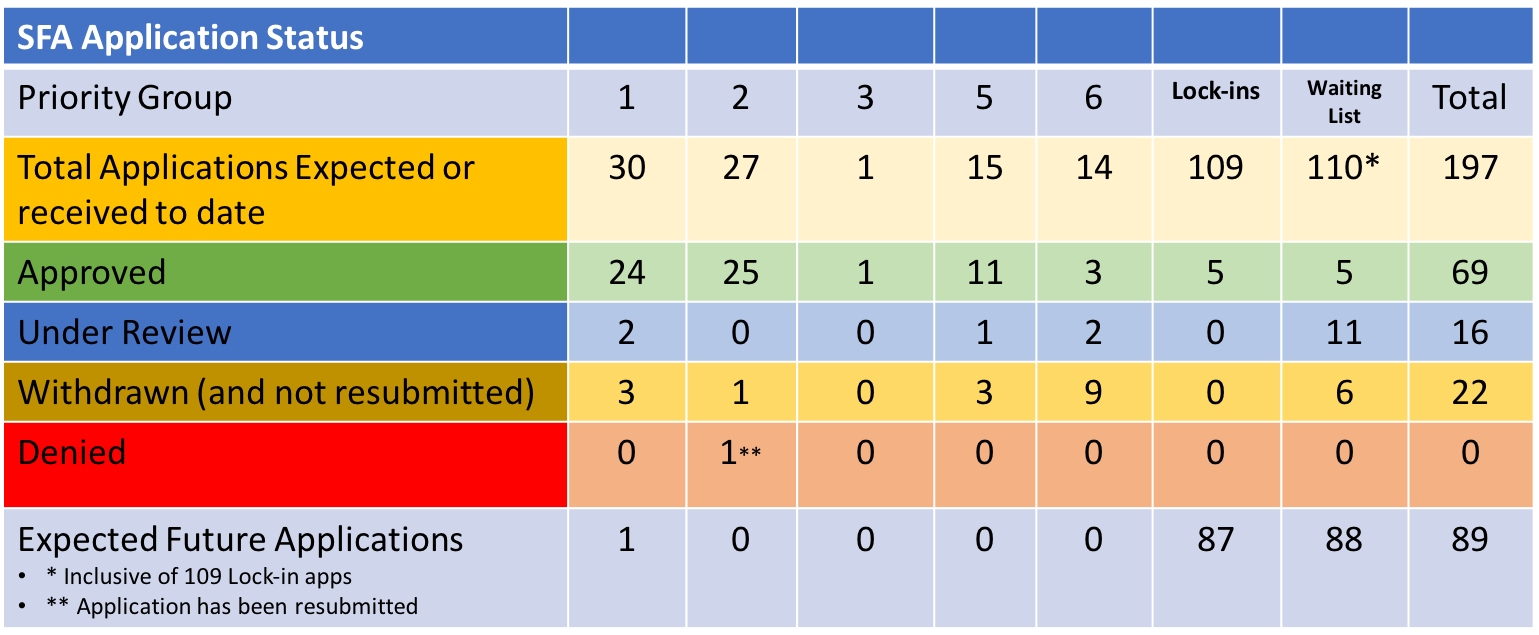
It has been 46 days since the PBGC has permitted an application to be submitted through their portal. I was still digesting my Thanksgiving dinner when the last application, United Food and Commercial Workers Union Local 152 Retail Meat Pension Plan, was submitted seeking $266.1 million in SFA for its 10,252 plan participants. As we’ve reported before and as highlighted below, there are still dozens of applications waiting (patiently??) in the queue for the opportunity to request SFA.

I don’t have any particular insight into why this process seems to have been halted following a frenzied pace that saw 69 plans gain approval for more than $53 billion in SFA. Most of those assets have been disbursed at this time. There are still 16 applications “under review”, but not a single one has been approved since November. Fortunately, no applications have been denied, while just one was withdrawn in the latest week. The Legacy Plan of the UNITE HERE Retirement Fund withdrew its already revised application that is seeking $938.1 million for the nearly 92K participants.

Let’s hope that whatever seems to be holding up this process gets resolved sooner than later, as many retirees and those hoping to retire wait patiently to see if the promised benefit will actually be available when needed.

Opal Public Fund Summit Follow-up

By: Russ Kamp, Managing Director, Ryan ALM, Inc.

I’ve been extremely fortunate to participate in the Opal Public Fund Summits – both East and West – for the better part of the last 10 years. I used to attend these events and almost never hear the word liability uttered, especially as it related to a pension liability. They might have spoken about so and sos golf swing being a liability or some teams QB, but pension liabilities were missing in action.

I’m thrilled to say that several of the panels/panelists mentioned pension liabilities, with terms such as ALM, defeasement, immunization, de-risking, duration, and even cash flow matching (CFM), and not just by me, also being uttered. It was so refreshing. They are right to be discussing this strategy at this time given the sea change that has occurred in US interest rates. The cost to implement asset/liability management strategies, especially CFM, have been reduced significantly in the last two years.

That said, there are still so many misconceptions regarding CFM. It is NOT a laddered bond portfolio, which would be quite inefficient and costly. It IS a highly sophisticated cost optimization process that maximizes cost savings by emphasizing longer maturity bonds (within the program’s parameters = # of years defeased) and higher yielding corporate bonds, such as A and BBB+.

Furthermore, it is not just a viable strategy for private pension plans, as it has been deployed successfully in public and multiemployer plans for decades. It is also NOT an all or nothing strategy. The exposure to CFM is a function of several factors, including the plan’s funded status, current allocation to core fixed income, Retired Lives Liability, etc. Many of our clients have chosen to defease their pension liabilities from 5-30 years or beyond. When asked, we recommend a minimum of 10 years, but again that will be a function of each plan’s unique funding situation.

CFM strategies are NOT “buy and hold” programs. CFM implementations must be dynamic and responsive to changes in the actuary’s forecasts of benefits, expenses, and contributions. There are also continuous changes in the fixed income environment (I.e. yields, spreads, credits) that might provide additional cost savings that need to be monitored and managed. Plan sponsors may seek to extend the initial length (years) of the program as it matures which will often necessitate a restructuring or rebalancing of the original portfolio to maximize potential funding coverage and cost reductions.

CFM programs CANNOT be managed against a generic index, as no pension plan’s liabilities will look like the BB Aggregate or any other generic index. Importantly, no pension plan’s liabilities will look like another pension plan given the unique characteristics of that plan’s workforce and plan provisions. The appropriate management of CFM requires the construction of a Custom Liability Index (CLI) that maps the plan’s liabilities in multiple dimensions and creates the path forward for the successful implementation of the asset/liability match.

Importantly, CFM programs are NOT going to negatively impact the plan’s ability to achieve its desired ROA. In fact, a successful CFM program, such as the one we produce, will actually enhance the probability of achieving the return target. How? Your plan likely has an allocation to core fixed income. Our implementation will likely outyield that portfolio over time creating alpha as well as SECURING the promised benefits. Given the higher corporate bond interest rates, an allocation to this asset class can generate a significant percentage of the ROA target with risks substantially below those of other asset classes.

What a successful CFM implementation does is the following:

Secures benefits for time horizon LBP is funding (1-10 years +)

Buys time for the alpha assets to grow unencumbered

Outyields active bond management… enhances ROA

Reduces Volatility of Funded Ratio/Status

Reduces Volatility of Contribution costs

Reduces Funding costs (roughly 2% per year)

Mitigates Interest Rate Risk as benefits are future values that are not interest rate sensitive.

It was a great conference spurred on by the fact that folks are beginning to think outside the “performance/return” box. Taking advantage of higher US interest rates is the prudent action today. CFM strategies accomplish a lot for the plan and plan sponsor, but most importantly it provides everyone with a great night’s sleep.

ARPA Update as of January 5, 2024

By: Russ Kamp, Managing Director, Ryan ALM, Inc.

Welcome to the first ARPA update of 2024. I hope that your year has gotten off to a great start.

With regard to the PBGC’s recent activity, there isn’t much to report at this time, as there were no new applications received or approved. Fortunately, there were no applications under review that were denied. There was one application that was withdrawn on 1/5/24. The United Food and Commercial Workers Unions and Employers Midwest Pension Plan, a Priority Group 6 member, withdrew its previously revised application seeking nearly $1.2 billion for its 35,223 plan participants. Let’s hope that the third time proves to be the charm.

There was one additional plan added to the waiting list. Local Union No. 1430 Pension Fund was supposedly added to the queue on 12/28/23, but this is the first time that I’ve seen them listed. That makes 112 non-priority pension funds that are seeking Special Financial Assistance (SFA) under ARPA. Of the 112 plans on the waitlist, 22 have been given approval to submit their applications. Of those 22, 5 have had the applications approved, 11 are under review, and 6 have withdrawn to presumably revise data in some way.

Ryan ALM, Inc. Pension Monitor Q4’23

By: Russ Kamp, Managing Director, Ryan ALM, Inc.

We recently shared with you the Ryan ALM, Inc. Newsletter. Attached for you review is the Ryan ALM, Inc. Pension Monitor. This document uses the asset allocation output from P&I’s annual survey of the top 1000 defined benefit plans. Their survey clearly highlights significant differences in the asset allocation of corporate and public DB plans, most notably the exposure to fixed income presumably for hedging purposes.

In addition, we highlight the fact that different accounting rules (FASB vs. GASB) often lead to different conclusions. 2023’s performance differential favoring public plans was significantly smaller than the outperformance of corporate plans in 2022.

As always, we stand ready to respond to any of your questions. Please don’t hesitate to reach out to us if we can help you think through your risk reducing goals. Corporate plans have engaged in these strategies for years and the differential in funded status is stark. The US interest rate environment is providing a wonderful opportunity to take risk off the table without a substantial impact on potential returns.

Ryan ALM, Inc. 2023 Newsletter

By: Russ Kamp, Managing Director, Ryan ALM, Inc.

We are once again pleased to share with you the Ryan ALM, Inc. Newsletter. This edition is a review of 2023. It was a surprisingly good year for Pension America. Markets overcame significant uncertainty related to the Fed’s action related to interest rates, inflation, economic growth, war, etc. Much of the outperformance of plan assets to liabilities is attributable to equities, both domestic and foreign, which enjoyed significantly improved results following 2022’s challenging markets.

US interest rates were on a rollercoaster for a good chunk of the year, as the Fed continued to elevate the FFR to its present level of 5.25%-5.5%. However, during the path upward in the FFR we had markets rocked by the regional banking crisis which sent yields plummeting only to have them reach decade high levels by October. A pause by the Fed with regard to additional FFR increases has convinced many investors that the Fed will now aggressively reduce rates. As a result, the Treasury yields curve dropped since October with most maturities seeing yields plummet by at least 1% to levels below 4%. That action seems premature.

As always, we welcome feedback related to this newsletter. Please don’t hesitate to reach out to us with any questions. We are always available to assist you in thinking through asset/liability issues. May 2024 be your best year yet!

Aggregate Funding hits 100% – WTW

By: Russ Kamp, Managing Director, Ryan ALM, Inc.

I recently reported on Milliman’s Corporate Pension Plan Index that indicated aggregate funding for the top 100 plans had settled at 102% at the end of November. Today, P&I ran a report form Willis Towers Watson (WTW), that suggested that the aggregate funding for 358 of the Fortune 1000 companies with a defined benefit plan had reached 100%, up 2% since the end of 2022. Both reports are highlighting considerable strength for Corporate America’s pension funding. Great!

Now what?

After a great 2021, we asked not only what Corporate America would do regarding their pension systems, but pension plans in general including public and multiemployer. Unfortunately, they didn’t do much and the Fed’s aggressive interest rate moves beginning in March 2022 created a lot of angst and uncertainty for sponsors and large drawdowns in asset values. The rising rates led to a significant reduction in the present value of those future benefit payments or the funding situation would have been much worse.

Well, 2023 was a surprisingly good year for pension plans from both an asset and liability standpoint. Will plan sponsors and their advisors work to protect the gains or will they once again allow the markets to dictate the funded status? We believe that a defined benefit plan is superior to a defined contribution plan. We believe that they act as great recruiting and retention tools. As a result, DB plans need to be protected and preserved. SECURING the promised benefits at a reasonable cost and with prudent risk should be the goal. Chasing a return through a traditional asset allocation only leads to excessive volatility in contributions and funded status.

US interest rates are still at very attractive levels. Take advantage of this environment to secure the promised benefits through a defeasement strategy. Use your current bond allocation to match bond cash flows with liability cash flows (benefits and expenses) chronologically as far into the future as the allocation will permit. Your fund will now have the necessary liquidity to meet your monthly needs, while buying time (extending the investing horizon) for the plan’s alpha assets to grow unencumbered.

ARPA Update as of December 29, 2023

By: Russ Kamp, Managing Director, Ryan ALM, Inc.

Happy New Year! I hope that your 2024 is filled with great health, prosperity, joy, and friendships! Higher US interest rates would be welcomed, too, as that makes managing defined benefit pensions and the Special Financial Assistance (SFA) much easier.

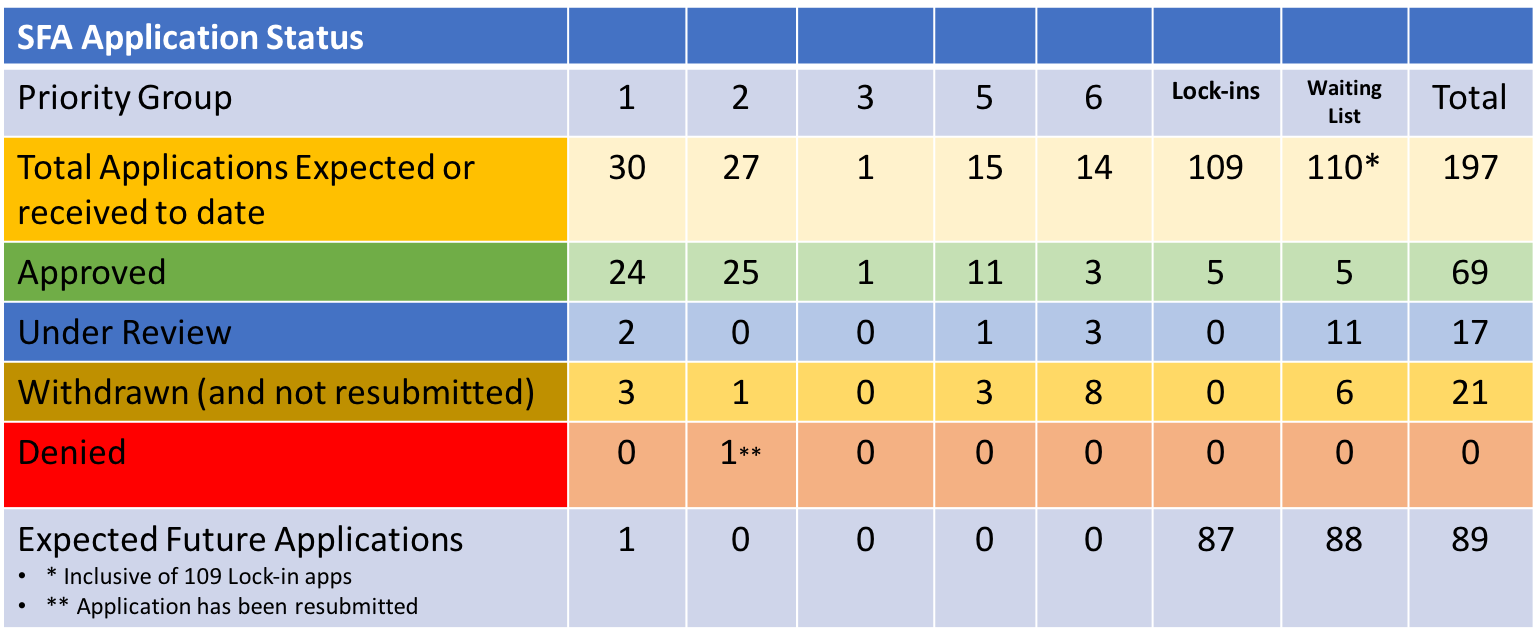
With regard to the PBGC’s implementation of the ARPA legislation, they reported (12/29) no activity for the week. So, no new applications received, denied, approved, and no new pension funds added to the waiting list, which hasn’t seen a new addition since 8/23. Here is the current status of the activity:

There remains a ton of work before the PBGC can declare an end to this process, as only 69 applications have been approved to date, which is 35% of the 197 total applications that will eventually be processed. Importantly, those 69 approved plans have received $53.5 billion in SFA.

Did The Investing Community Get too Far Ahead of the Fed? – Continued

By: Russ Kamp, Managing Director, Ryan ALM, Inc.

As I posted on December 19, 2023, I believe that the investing community has gotten too far ahead of the Fed with regard to potential interest rate policy changes in 2024. The move down in Treasury yields of more than 100 bps across the curve has been incredible. Despite this rapid repricing, the current Fed Fund Futures are anticipating 6 rate cuts in 2024. Given the strength of the US economy, labor force, and significant deficit spending, how realistic is that expectation? Furthermore, given that 2024 is a presidential election year, will the Fed act aggressively leading up to November?

If history is our guide, it is not likely that we will see the Fed insert themselves into the campaign. The Fed has set the explicit Fed Funds rate since 1994. How many times in those nearly 30 years have they changed rates during a presidential election year? The answer is only 3 times – 1996, 2008, and 2020. In 1996, they cut one time by 25 bps in January and were finished for the year. In 2008, they drove rates to zero in reaction to the Global Financial Crisis, and in 2020 they reduced rates from 4% to zero as the impact of Covid-19 and the pandemic took hold.

Based on this history, it will take a nearly unprecedented event to see the Fed act to the extent that is currently priced into the market, especially given the current expectation of a “soft” landing. Furthermore, it has been an extremely rare event to have the Fed cut US interest rates when the labor market has been this strong and unemployment <4% (currently 3.7%). Yet, market participants continue to drive Treasury rates lower as witnessed yesterday, when the yield on the 10-year note fell another 11 bps.

According to Jim Bianco (and shared by Steve DeVito, Ryan ALM’s Head Trader), a move of that magnitude is incredibly rare. Here are the observations during the last 62 years:

December 29, 2010 = -0.13% to 3.3489%

December 28, 2007 = -0.12% to 4.0732%

December 27, 2001 = -0.13% to 5.0650%

December 30, 1991 = -0.11% to 6.7160%

December 31, 1981 = -0.19% to 13.9820%

December 26, 1980 = -0.17% to 12.2520%

The yield on the 10-year Treasury note sits at 3.82% this morning, which is down 117 bps since late October. With Core inflation remaining at 4% and proving to be quite sticky, “investors” are accepting a real yield that is negative when compared to core inflation. As Ron Ryan pointed out recently in his blog post, the 10-year note has provided investors with a real yield of between 2% and 3% dating back to at least 1953. Given the Fed’s target of 2% core PCE would suggest nominal 10-year Treasury rates of 4.0% to 5.0%. Investors hoping to get a return greater than the current yield may be in for quite the surprise.