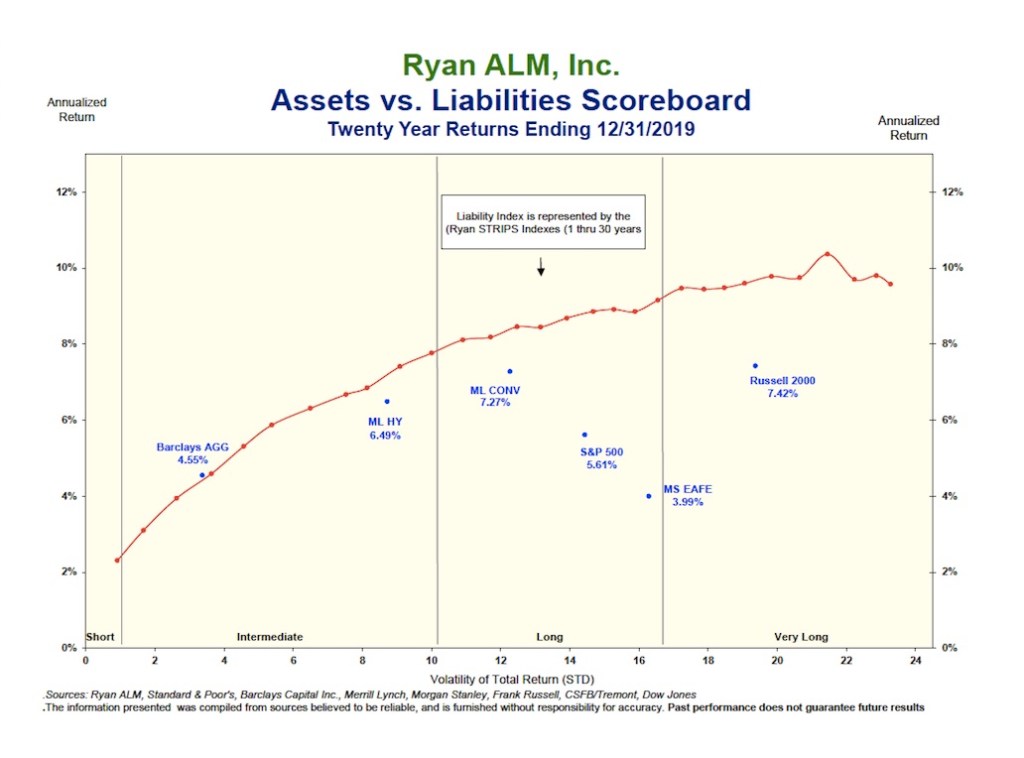
Why DB? Need Any Other Reason?

Of course, this has occurred while we are in one of the most protracted bull markets for equities and a continuation of a 30+ year bull market for bonds! Think that you could retire on these account balances if you were in the bottom 80%? DC plans are a failed model for a majority of Americans.

Cheiron Updates Their Multiemployer Analysis

Cheiron, a leading actuarial consulting firm, has provided a fresh perspective on the state of the multiemployer pension universe with a particular focus on those plans deemed to be in Critical and Declining (C&D) status.  Here is the report.

As a reminder, Cheiron played a leading role in providing the critical analysis that was used to support legislative efforts surrounding the successful passage of the Butch Lewis Act in the House of Representatives earlier this year. It was their work that showed that 111 of 114 C&D funds at that time would benefit tremendously from a Federally provided low-interest rate loan through the Pension Rehabilitation Administration, the new agency that would be created under the BLA. Through this lifeline, these funds would be able to defease the Retired Lives liability, thus securing the promised benefits, pay the loan’s interest, meet future benefit liabilities, and repay the loan in year 30, while only needing a 6.5% annual return from the plan’s assets.

In their analysis from November 2018, the determined that 121 plans would soon fail relative to the 117 that they identified in this analysis.  Unfortunately, the smaller number of failing plans is not reflective of an improved environment for these struggling plans as seven plans fell out of the analysis because they either failed or shut down. In this latest report, Cheiron determined that the 117 plans in danger of failing include roughly 1.4 million participants and have collectively $56.5 billion in unfunded liabilities. With each passing month, this funding issue becomes worse subjecting more American workers to an uncertain retirement.


Reversion To The Mean?

My crystal ball is certainly no better than anyone else’s in forecasting just about anything (just look at my NFL football pool results), let alone how the U.S. equity market is going to perform over the next day, week, month, and year.   But, by looking at how the S&P 500 has performed since 1926 (when it consisted of 90 stocks until 1957 when it went to 500) through to November 30, 2019, one can get a “rough” idea how it will perform in the next 10-years based on how it performed during the prior 10-year period.  Why? There has been a regression to the mean tendency exhibited in this market with the exception of the strong equity market of the 1980s that was followed by an even stronger 1990s period.

For example, the strongest positive differential between a prior 10-year period and the subsequent 10-years occurred in 1948 where the earlier period produced an “average” return at 8.3%, but the subsequent strong period of the 1950s had the next 10-years outperforming by more than 13% per annum.  On the flip side, 1998 was the only year-end that had a 10-year performance greater than 20% per annum. It shouldn’t have come as a surprise that the following 10-years produced the weakest results for a decade at 0.7% or -19.4% worse per year than the 10 years ending 1998.

Why do I bring this up now? Well, the prior 10-years ending November 2019 has the S&P 500 generating a 13.8% annualized return that is well above the long-term expectation for stocks. What does the future hold? Might we get the next 10-years behaving similarly to that of the 1990s that produced more exceptional performance or are we likely to see a regression to the mean pattern similar to all the other decades? As a matter of reference, outside of the six 10-year periods of the mid to late 90s and 1950’s subsequent 10-years, there have been 28 10-year periods that had the prior 10-years producing 13% or better annual performance only to have the subsequent 10-years produce worse results. The average underperformance for the next 10-years was -7.7%, which would suggest that the next 10-years may produce a roughly 6% annualized return from equities – not very impressive, especially if your ROA is still in excess of 7%.

Should we continue to see strong equity market returns through 2020 and into 2021, the prior 10-years will look even more robust. As one can imagine, the greater the prior 10-years the weaker the subsequent 10-years have been, with many following decades being 10% or more weaker than the prior period. Given the steady economic picture for the U.S. and the declining likelihood of an impending recession as the U.S. government continues to provide abundant stimulus ($1 trillion annual deficits for the foreseeable future), I am not suggesting that this party has run its course.  However, it has gotten long in the tooth. Why not take some risk off the table, especially since bonds have also enjoyed a lengthy period of outperformance.

We’d suggest that you bifurcate your asset allocation into two buckets – beta and alpha – in which the beta assets are used to cash-flow match near-term Retired Lives liabilities chronologically, while the alpha assets have now been given time (10-years) to meet future liabilities.  This strategy will help DB plans migrate through choppy periods of performance without forcing liquidity to meet benefit payments where that liquidity isn’t naturally found. This implementation is especially important for those plans that have incorporated significant exposure to alternatives, both equity and fixed.

So I repeat, I haven’t a clue when the equity markets will begin to underperform, but at some point, they will, as they always have. Given how strong the prior 10 years have been, the next 10 years are likely to be weaker. Why wait until you are in the midst of a correction to adopt a de-risking strategy? Call me, as I’m happy to discuss my thoughts in greater detail.

A Letter From The IBEW

The following note was written by the IBEW Media Center, and it highlights the same concerns that I’ve shared with readers of this blog. This proposed “rescue” plan would, in fact, be the death knell for multiemployer pensions, as no lifeline is provided for the seriously negative cash-flow plans while ratcheting up the costs for healthy plans.

“Senate Republicans are readying a radical plan to raise taxes on retiree pension benefits and put catastrophic burdens on union retirement plans, according to documents released last month.

Undercover of a “rescue” for a few endangered multiemployer pensions – primarily troubled Mineworkers and Teamsters plans – Senate Republicans are preparing to raise taxes on all retiree pension benefits by nearly 10% and raise expenses on healthy plans by 500%. The sweeping changes would almost guarantee a reduction of benefits for millions of union retirees, IBEW members included.

International President Lonnie R. Stephenson called on every IBEW member to immediately contact their senators, whatever their party, and demand they kill the plan before it’s even filed as legislation.

“Don’t even negotiate,” Stephenson said. “You already pay income taxes on your retirement benefits; now they want you to pay even more. This is a disaster for working Americans.”

The changes would also reclassify the IBEW’s green-rated National Electric Benefit Fund plan into red, endangered status and spell bankruptcy for many, if not all, local union-run pensions. Worse, by raising costs on healthy plans, the “rescue” would leave the pension system worse off than before legislators interfered.

“An approach like the one Sens. Chuck Grassley and Lamar Alexander are proposing is completely unacceptable,” Stephenson said. “Rather than fix the problem with sensible solutions, they want to burn the whole house down and take unions with it.”

Two years ago, Congressional Republicans introduced a bill they said would “save” the threatened pensions plans. It did nothing of the kind, and unions killed it. A year ago, after promising a new start, Republicans introduced another rescue plan they said would be completely different. It was the same recipe again: crippling cost increases for healthy pensions; more tax cuts for corporations. Unions killed that too.

The new proposal is somehow even worse than the ones that came before, said Political and Legislative Department Director Austin Keyser.

“This puts us out of business almost immediately,” he said. “A year ago they wanted to kill us.” 

The IBEW’s main multiemployer National Electric Benefit Fund is in excellent shape, said International Secretary-Treasurer Kenneth W. Cooper. This plan – which Republicans could shoehorn into the budget bill – would end that.

“We saved our pension from the worst recession in 80 years with no help. The banks that caused that mess, they got a bailout. The car companies, they got a bailout. We recovered in spite of the people in Washington,” Cooper said. “Now, the same people who cut corporate taxes by $1.4 trillion want to finish what the banks couldn’t and tear down what we built with our hands. Again.”

For years, the IBEW has been pushing Congress to adopt a bipartisan, compromise bill named the Butch Lewis Act, named after a Teamster who died in 2015 fighting to save his union brothers’ and sisters’ pension benefits, which were set to be cut by 70%. Butch’s bill solves the liquidity problems of the few endangered plans without taxing retirees or penalizing healthy plans. Instead, troubled plans would be offered $65 billion in loan guarantees which would be paid back in full.

“If they wanted to truly solve this tomorrow, they could reverse 0.5% of the corporate tax cut. That raises the $65 billion straight away. We’re not even asking for the bailout the banks got,” Keyser said. “The no-cost loan guarantees are already the compromise and Congress should have gotten this done years ago.”

And unlike the banks, even the pension plans most at risk did nothing wrong. They suffered from the same bad deregulation and bankruptcy laws that have decimated the working class, Keyser said.

“Every IBEW retiree has paid more federal taxes on their pension than some major corporations have paid on anything, yet their plan is to take more of our money,” Stephenson said. “Instead of fixing bankruptcy laws that put everybody else first and workers last, instead of fixing deregulation that cut us off at the knees, instead of freeing workers to fight for better wages and benefits, they want to come after our hard-earned pensions. Well, we’re not getting down on our knees. I’m not going to take this, and you shouldn’t either.”  

To reach your senator call the Senate switchboard at (202) 224-3121 or visit this website and tell them the Grassley-Alexander plan to tax multiemployer pensions is a disaster for working families and retirees. Be sure to tell Democrats not to negotiate and Republicans to keep their hands off our pensions.

Even better, visit your senator’s nearest office to pay a visit in person. Addresses can be found on your senator’s website.”

NOW is the time for action. According to Gene Kawarski, CEO, Cheiron, the cost of inaction is roughly $750 million each month! The Butch Lewis Act is the only true rescue plan. It has already passed the House. The roughly 1.3 million Americans that are participants in these trobled plans need the attention of the US Senate now. They’ve earned the promised benefits.


Robust? Hardly!

The U.S. economy seems to be steadying at this point following some signs of weakness earlier in 2019. But, to describe the economic performance as robust is an exaggeration, yet that is what I continue to read in a number of financial journals. Since when is growth that hovers around 2% ever considered robust?  In Fact, we are experiencing an unprecedented era for U.S. growth rates and it isn’t something to be celebrating. Yes, our economy suffered through the Great Financial Crisis (GFC) only 10+ years ago, but we’ve gone through other significant downturns since 1929 (The Great Depression) and we’ve never had such a sustained period in which U. S. GDP growth has failed to exceed 3.0% for a calendar year.

The last time the U.S. GDP Growth Rate exceeded 3% was in 2005. We have now failed to achieve that level for 13 consecutive years, and 2019 doesn’t provide much hope that we will get there once again. Prior to this period, the longest annual drought without a 3%+ annual GDP growth rate was four consecutive years from 1930-1933. That four-year slide was followed by an eleven-year period in which the U.S. economy only witnessed one year of negative growth and an 11-year average growth rate of 10.2%. There have been four other 3-year periods in which the U.S. has failed to achieve a 3% or greater annual growth rate since 1934, including periods ending 1947, 1958, 1982, and 2003. But, nothing comes close to what this current period would have prepared us for.

What makes this period even more unusual is the fact that the U.S. government deficit continues to climb well into the recovery, and now hovers around $1 trillion. Can you imagine where our growth rate would be today if we hadn’t had that abundant stimulus?  Roughly 2/3s of GDP growth is driven by the consumer and that ratio hasn’t changed much over the years. What has happened is the fact that demand for goods and services is being hampered by weak real wage growth and declining labor participation.  We’ve reported in prior blogs that wealth and income creation is found in a much smaller subset of our population and that is also impacting demand and economic activity.

What concerns me greatly is the impact that a weakening retirement system will have on future demand. The demise of the defined benefit system and the reliance on DC plans will create a strong headwind for future growth as Americans retire with much smaller income replacement rates. There are currently about 1.3 million Americans in critical and declining multiemployer plans that might see a significant reduction in the promised benefits that they were expecting to receive. We are kidding ourselves if we think that this is the only cohort that might see their previous economic participation negatively impacted by benefit reductions.  Despite tax cuts and “historically” low unemployment, this economic expansion has been anemic. What will it take for our country to once again witness actual “robust” economic growth?


Cash-Flow Driven Investing (CDI)

The U.S. defined benefit pensions have enjoyed a good performance run during the last 10 years. Funded status has improved for a majority of plans, although contribution expenses continue to rise. Is it time to take some risk off the table? We believe that it certainly is the right time. But, taking risk off the table doesn’t mean that our approach would harm a plan’s ability to meet the return on asset (ROA) objective for both public and multiemployer plans.

There are only two ways to secure the promised benefits: 1) through a pension risk transfer (PRT – annuity), and 2) cash-flow matching. We believe that PRTs are expensive, and not a realistic strategy/opportunity for poorly funded plans so we focus on cash-flow matching.

Our approach is called the Liability Beta Portfolio (LBP), which is trademarked and our cash-flow driven investing (CDI) approach provides many benefits that are listed below:

  • Reduces risk (de-risks) by cash flow matching benefit payments with certainty
  • No interest rate risk since it is funding future values (benefit payments)
  • Reduces funding costs by 3% + (1-10 years) to 8% (1-30 years)
  • Reduces asset management costs (Ryan ALM fee is only 15 bps)
  • Enhances ROA by out-yielding active bond management
  • Reduces volatility of the funded ratio and contributions
  • Buys time (extends the investing horizon) for the remainder of the plan’s assets to outgrow future liabilities

The value-added of the LBP model is the cost savings and risk reduction that it provides. Performance should not be based on returns although the LBP will outyield liabilities creating some excess returns versus liability growth. Why subject the entire corpus to the whims of the markets, especially given the extended bull markets for both equities and bonds. Take risk off the table before the markets once again highlight the fact that what goes up will go down at some point.

Why’d You Pick That Fund?

We’ve been suggesting that moving employees from defined benefit plans (DB) to defined contribution plans (DC) forces participants with little skill to become portfolio managers, even if all they are doing is picking a target-date fund.  New research supports the idea that a lack of investment skill is becoming more apparent in how they are choosing their investments. The WSJ has produced an article based on a research paper from the Ipsos Behavioral Science Center claiming that how a fund is listed among the choices determines the allocation.

Dr. Itzkowitz, a senior vice president of Ipsos Behavioral Science Center, a market-research firm in New York, is joined on the paper by his wife, Jennifer Itzkowitz, associate professor of finance at Stillman School of Business at Seton Hall University; Thomas Doellman, associate professor of finance at Richard A. Chaifetz School of Business at Saint Louis University; and Sabuhi Sardarli, associate professor of finance at the College of Business Administration at Kansas State University.

What the research suggests is “while not all plan participants will choose funds that appear at the top of a plan’s alphabetical menu, on average, participants are biased toward choosing those funds”.  In fact, each of the top 4 funds on the plan’s list receives on average 10% more in allocations than they would if money was allocated equally across the menu. The next 5-10 funds receive 5% less than they would with equal distribution while funds listed from 11 on down receive on average 10% less than they would when allocating equally. These results are not shocking by any stretch of the imagination, but disappointing none-the-less.

We continue to expect a lot from our untrained employees to fund, manage, and then disburse a retirement benefit with little skill. Given the findings cited above, do we really believe that DC plans are an appropriate retirement vehicle for the masses? At best these vehicles are glorified savings accounts. Until we can eliminate premature withdrawals, loans, individual responsibility to manage these plans, opt-out provisions, etc, DC plans will not produce the outcomes that our employees need in order to produce a positive outcome for a successful retirement.

Worst Idea Ever?

Just who does the HELPER Act help? Senator Rand Paul (R, KY) has put forward a startling proposal that proclaims to help our struggling students with their student loan debt. But does it? We do have a massive student loan debt issue with roughly 42 million Americans saddled with approximately $1.5 trillion in debt. So, instead of seeking relief by reducing the ridiculously high cost of college education, we instead get a proposal that would further diminish savings for retirement.  I’ve called defined contribution (DC) plans nothing more than glorified savings accounts and Senator Paul is putting a rubber stamp on my description.

Those individuals who have student loan debt are likely the ones that don’t have a 401(k) or IRA plan at this time as they are using whatever discretionary income they have to meet their student loan debt obligations. We know that many life events – marriage, childbirth, home purchase, etc – are being delayed as a result of this enormous debt burden. To think that taking prematurely assets that were intended to meet their retirement needs is a good idea just further highlights the disconnect between many in Washington DC with the reality that is facing our general population.

Let’s not take one awful situation regarding the cost of higher education and compound it with a dreadful decision to impact one’s financial future in retirement. As we reported yesterday, 53 million American workers are averaging roughly $10.22/hour or $18,000 per year. Do you really think that they have enough assets to pay for college and save for retirement let alone put a roof over their head and food on their table? It is time to get serious about the many social and economic issues facing our society. The HELPER Act is NOT a serious attempt.

Not The Answer

I’ve written a lot on this subject, so I suspect that you would prefer another point of view. Here are the words from Cecil Roberts, International President for the UMWA on the subject of the Grassley-Alexander proposal.

Grassley-Alexander multi-employer pension plan proposal not the answer for retired miners and widows

[TRIANGLE, VA.] United Mine Workers of America (UMWA) International President Cecil E. Roberts issued the following statement today regarding the proposal by Senators Chuck Grassley (R-Ia.) and Lamar Alexander (R-Tenn.) addressing the multi-employer pension plan crisis:

“This proposal provides everything those who advocate against working families have ever wished for. It penalizes workers for joining unions, it penalizes retirees for sticking with those unions, it penalizes employers for recognizing unions and it penalizes unions themselves for successfully representing their members.

“This is not a starting point for negotiations. It is a multi-billion dollar tax increase on working families – especially retired Americans living on fixed incomes – their employers and their unions. Retirees covered by the UMWA Pension Fund, for example, would be subject to a 10 percent tax on pensions that average a little under $600 per month.

“This proposal does not begin to address the immediate crisis UMWA retirees and their families are confronting. Fortunately, the Bipartisan American Miners Act –by Senator Joe Manchin (D-W. Va.), Senate Majority Leader Mitch McConnell (R-Ky.) Senator Shelley Moore Capito (R-W. Va.), and a dozen bipartisan Senate cosponsors – does address that crisis, using an existing source of funding that requires no new bureaucracy and most importantly, no new taxes on working families.

“Retired miners, their families and widows do not have the luxury of waiting to see if Congress can eventually come up with a comprehensive solution to the multi-employer pension crisis that treats retirees fairly. 1,200 stand to lose their health care at the end of this year, 12,000 more will lose health care within a few short months, and more than 82,000 will likely see drastic cuts to their pensions a few months after that.

“We continue to strongly urge House and Senate leadership – all of whom say they want to address the immediate crisis retired miners face – to put partisanship aside and pass the Bipartisan American Miners Act. These senior citizens, who provided the fuel to power America at great risk of life and limb, need action now. Let’s get this done.

I agree with Mr. Roberts. My fear is that the U.S. Senate, under Republican majority, will act on this proposal that basically dooms to failure the 120+ multiemployer plans that are designated as Critical and Declining. Why? Instead of providing these cash-starved plans with the lifeline that they need, the proposed legislation will strengthen the PBGC so that when these funds ultimately fail they will be able to provide some of the promised benefits. I’d much prefer the Butch Lewis Act that provides a low-interest loan to these struggling plans that insures the Retired Lives liability is met in full and gives these plans a 30-year lifeline to get their house in order. Without DB plans the next generation of workers will likely be left with only a DC option, and we know how badly that has worked out for many U.S. workers in the private sector.

Don’t Let The Headlines Fool You!

Headline after headline promotes the idea that the U.S. economy has a historically low unemployment rate that currently sits at 3.6%, with only September’s reading of 3.5% lower in the last 40+years. However, according to a Brookings Institute study, nearly 50% of America’s workers (age 18-64) are in low-paying jobs and making on average just over $10/hour or roughly $18,000/year. In addition, many of these jobs either don’t provide benefits or those benefits, such as healthcare and pensions, have diminished over time. Regional biases do exist, as nearly 6 in 10 workers in the South and West struggle under the burden of low-wage work.

The study looked at the country’s nearly 400 metropolitan cities and found that between 1/3 and 2/3 of the jobs in those areas were low-paying. Regrettably, there is a perception that most of these poorer quality jobs are occupied by younger individuals, but this study found that not to be the case.  In fact, most of the 53 million American workers in low paying jobs were in their prime working years of 25-54. For many of these Americans with fulltime jobs, they are not earning a living wage for their region. Worse, as our businesses migrate their employees to defined contribution plans (DC) from defined benefit plans (DB) the burden of funding one’s retirement falls squarely on the shoulders of those that can least afford the extra burden.

Brookings also found that some of the wealthiest cities with the strongest economies had significant issues with low-quality jobs, which might just explain why places like San Francisco (700,000 low-paying jobs) and Seattle (560,000) have such awful homelessness issues. One of the areas not touched in the study was the impact that this development is having on the health of those males that have been driven from the workforce at premature ages. Life expectancy continues to fall in the U.S (3 consecutive years) which is outrageous given our wealth and medical institutions. Depression, suicide, and drug abuse are increasingly common among those forced to work in low paying jobs.

Those not able to find high-quality jobs are most often found to be lacking a college education but given the extraordinary cost of attaining a college degree, it isn’t surprising. We currently have more than 41 million Americans with student loan debt that tops $1.5 trillion at this time. The implications are profound and have delayed family unit creation, initial home buying, and many other activities that were once completed by Americans in their 20s, which is no longer the case.

So given these developments, does it still make sense, if it ever did, to thrust a majority of Americans into DC plans? Should it be a surprise that nearly 50% of Americans have saved little to nothing for retirement? I shudder to think of what might happen to the vast majority of Americans currently in the workforce when technological advances (AI) truly begin to impact a majority of occupations.