Today is National 401(k) Day. Where is National DB Pension Plan Day?

By: Russ Kamp, Managing Director, Ryan ALM, Inc.

I suspect that most of us have no idea that today, September 8, 2023, is National 401(k) Day. This day is recognized every year on the Friday following Labor Day. The day is supposed to be an opportunity for retirement saving education and for companies to inform their employees about their ability to invest in company sponsored 401(k)s. Did you get your update today?

401(k) plans are defined contribution plans (DC). This plan type was created in the late 1970s as a “supplemental” benefit. Corporate America liked the idea of a DC offering because it helped them recruit middle and senior management types who wouldn’t accrue enough time in the company’s traditional pension plan. Again, the benefit was supplemental to the traditional monthly pension payment and not in lieu of it!

I think that defined contribution plans are fine as long as they remain supplemental to a DB plan. Asking untrained individuals to fund, manage, and then disburse a retirement benefit is a ridiculous exercise. Why do we think that 99.9% of Americans have this ability? Unfortunately, we have a significant percentage of our population living within 200% of the poverty line. Do you think that they have any discretionary income that would permit them to fund a retirement benefit when housing, health insurance, food, education, childcare, and transportation costs eat up most of an individual’s take home pay? Remember, these plans are predicated on what is contributed. Sure, there may be a company match of some kind, but we witnessed what can happen during difficult economic times. That employer contribution suddenly vanishes.

Defined benefit plans are the gold standard of retirement vehicles. They once covered more than 40% of the private sector workforce, most union employees, and roughly 85% of public sector workers. What happened? Did we lose focus on the primary objective in managing a DB plan which is to SECURE the promised benefits in a cost effective manner with prudent risk? Did our industry’s focus on the return on asset assumption (ROA) create an untenable environment? Yes, we got more volatility! Did we did we get the commensurate return? Not consistently. It was this volatility that impacted the financial statements and led to the decision to freeze and terminate a significant percentage of private DB plans. It is a tragic outcome.

What we have today is a growing economic divide among the haves and haves-not. This schism continues to grow, and the lack of retirement security is only making matters worse. DB plans can be managed effectively where excess volatility is not tolerated, where the focus is on the promised benefit and not some made up ROA, and where decisions that are made relative to investment structure and asset allocation are predicated on the financial health of the plan and the funded status. We need DB plans more than ever and ONLY a return to pension basics will help us in this quest. Forget about all the newfangled investment products being sold. Replacing one strategy for another is no better than shifting deck chairs on the Titanic. We need improved governance and a renewed focus on why pensions were provided in the first place.
ARPA Update as of September 1, 2023

By: Russ Kamp, Managing Director, Ryan ALM, Inc.

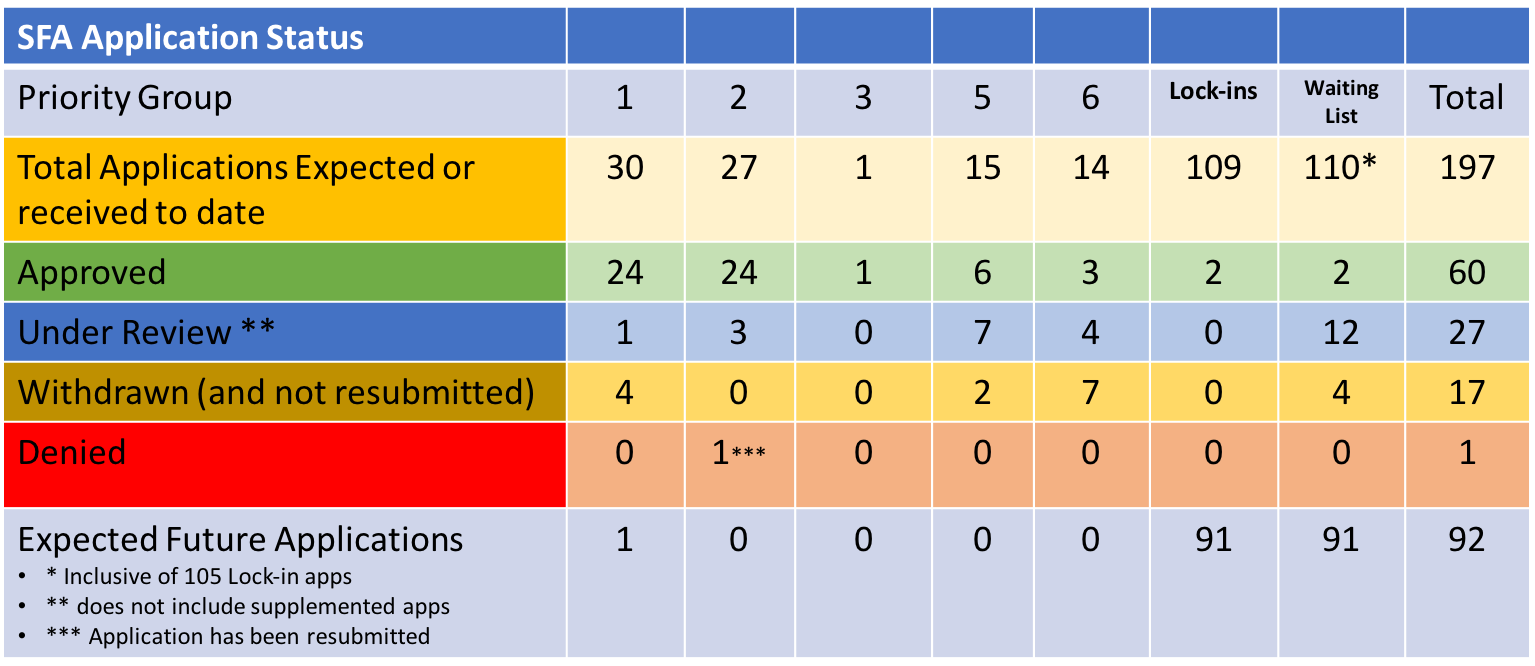
For us in the Northeast, the start of September marks the beginning of another school year for our K-12 students. We hope that your summer has been wonderful. For the PBGC, the beginning of September just marks another month of focus on ARPA and the approval and distribution of Special Financial Assistance (SFA) for eligible multiemployer plans. They have now been active with ARPA since July 2021. To date, 60 plans have received SFA, with some getting additional funding through supplemental organizations.

During the last week of August, the PBGC approved the SFA for one plan – Ironworkers Local Union No. 16 Pension Plan – which will receive $75.8 million, including interest. This Priority Group 2 plan needed to submit a revised application before getting approval. In other news from last week, Teamsters Local 11 Pension Plan, a plan without a priority designation, submitted its revised application. They are seeking $28.9 million in SFA for their 2,012 plan participants. The week witnessed no applications being either withdrawn or denied and no new plans were placed on the waiting list.

In a post from earlier today, I reminded folks about the need to protect and preserve the SFA, as required by the legislation, especially given the rising rate environment and the potential significant losses that rising rates will cause to a bond’s principal. Who knows whether or not the Fed is done with tightening? But, if they remain data dependent, the current environment suggests to us that they have NOT accomplished their objective (controlling inflation) at this time.

Another Difficult Month for Total Return-Seeking Fixed Income

By: Russ Kamp, Managing Director, Ryan ALM, Inc.

August 2023, proved to be another challenging month for return-seeking fixed income managers and their strategies when using the BB Aggregate index as the proxy, as the index declined -4% (-3.98% if you want exactness). This was the most challenging monthly result so far in 2023. For the year-to-date period, the index has posted a 1.4% return, as the higher yields buffered the loss of principal value as US interest rates continued their path upward.

How are things shaping up for the balance of the year? Well, we at Ryan ALM, Inc. are not in the business of predicting US interest rates, but we do look at the data like most everyone else. What we see is a nearly historic labor market, rising oil prices, with WTI now over $87/barrel, and a GDP for Q3’23 of 5.6% according to the Atlanta Fed’s GDPNow model (as of 9/1/23), which would certainly suggest that a recession is not in our immediate future. Given these metrics, is there really any wonder where US rates might be headed?

As you may recall, we railed against the use of return-seeking fixed income strategies as investment vehicles for the Special Financial Assistance (SFA) received by multiemployer plans under ARPA. We spoke and wrote frequently that rising US interest rates would negatively impact the total return for traditional fixed income strategies… and they have! As a reminder, 2022 was the worst year, by far, for the BB Aggregate index as it posted a -13% return. 2023 is not nearly as bad, but it certainly isn’t helping preserve the SFA which is supposed to be used to secure benefits and expenses far into the future.

We also discussed the importance of the sequencing of returns. Witness dramatic losses, such as those incurred last year, early in the life of the SFA and you create a situation where the benefit “coverage” period is shortened, and perhaps dramatically so. For those plans still waiting (hoping) to receive SFA support, don’t play games with the funds. Use those proceeds to SECURE as many benefits and expenses as far into the future as possible (as the ARPA legislation requires). Remember, when you defease pension liabilities through a Cash Flow Matching (CFM) strategy, you are matching future value liabilities that aren’t interest rate sensitive, which remains the biggest risk in the management of bonds.

The Benefits of Becoming Liability Aware

By: Russ Kamp, Managing Director, Ryan ALM, Inc.

Those in attendance at a recently concluded industry conference voted unanimously that securing the promised benefits was the “primary” objective in managing a DB pension plan. It was great to get such a response, but once again, how do they accomplish that objective when achieving the ROA seems to be the singular focus.

You can’t possibly secure the promised benefits without first knowing your plan’s liability cash flow schedule. For decades, Pension America has focused almost exclusively on cobbling together a portfolio designed to exceed the return on asset assumption (ROA), and for decades many plans have failed.  As a result, the average Public plan funded ratio is no higher today than it was in 1999. As we have monitored ever since, this lower funded ratio has led to a significant increase in contributions since 1999.

As stated above, the objective of a pension system is to SECURE the promised benefits in a cost-efficient manner. Unfortunately, there are only two ways to secure benefits: 1) Insurance annuity buyouts, and 2) Cash flow matching (CFM) liabilities through a bond portfolio. Many believe that duration matching strategies accomplish this objective, but they don’t as they don’t match the asset cash flows to the liability cash flows.

Importantly, getting one’s arms around the promised benefits (plan liabilities) is the only way that a DB plan can de-risk. Through becoming more liability aware a plan sponsor can acquire the following:

  • Greater transparency of the plan’s unique liabilities in multiple dimensions – discount rates based on GASB (ROA), FASB and risk-free rates (STRIPS)
  • Enhanced knowledge of both cash flow and liquidity requirements
  • Greater accuracy in calculating the TRUE return on assets (ROA) that is required in a test of solvency
  • The ability to establish a cash flow matching bond portfolio created to meet benefit payments
  • Stabilization of both the funded status and contribution expense
  • A much longer investing horizon for the portfolio’s growth assets in order to fund future liabilities
  • Reduced costs
  • Peace of mind that benefits are secure for the next 10 years or so (depends on funded status)
  • Enhanced viability of the pension system

These benefits seem to be pretty significant, yet many plans fail to gain these advantages. Regrettably, most plans only get a once-per-year view of their specific liabilities, which is too infrequent to engage in these important activities. Can you imagine playing a football game and knowing only how many points that your team has scored? How could you possibly adjust either your offense or defense to reflect the current game situations? Well, Pension America has been playing the game without knowing their opponents score for quite some time. It is about time that every plan sponsor has at their fingertips a Custom Liability Index (CLI) to help bring the pension game back into focus.

There are many reasons why we’ve witnessed a dramatic reduction in the use of defined benefit plans during the last four decades. Becoming liability aware will help plan sponsors secure those that remain. Our plan participants are counting on our industry to take a different path to help them achieve a prosperous retirement. Don’t hesitate to call on us. We’ll explain how you can begin to SECURE those promises, which will allow everyone to sleep better at night!

ARPA Update as of August 25, 2023

By: Russ Kamp, Managing Director, Ryan ALM, Inc.

We hope that your “last” week of summer is a good one. Can’t believe that Labor Day is almost upon us. The PBGC has been laboring, as they continue to work through a massive universe of potential SFA recipients. They approved four applications during the previous week, including the following funds: Pension Plan for Employees of United Furniture Workers of America and Related Organizations, the Southern California, Arizona, Colorado & Southern Nevada Glaziers, Architectural Metal & Glass Workers Pension Plan (this plan now holds the unofficial record for longest fund name), the New Bedford Fishermen’s Pension Fund, and the Local 917 Pension Plan.

The PBGC continues to work through the applications from the initial Priority Groups, as they approved the revised submissions for four plans with one each from Priority Groups 1 and 2, while also accepting two from Priority Group 5. These four plans will receive a total of $613 million, including interest, for their 5,799 plan participants. In total, 62 plans have been awarded Slightly more than $53 billion in SFA grants.

There were no applications denied or withdrawn during the prior week. There were also no new applications permitted to submit from the waiting list, which still has 92 funds waiting for activity to begin.

What A Difference a Year Makes

By: Russ Kamp, Managing Director, Ryan ALM, Inc.

Regular readers of this blog know that we’ve been on record since the first Fed Funds Rate increase that we were likely in a higher for longer scenario. That the prior nearly 40-year bull market for bonds was about to be eradicated, and with that would come pain for most investors who hadn’t worked and, in many cases, lived through a period of sustained inflation and rising rates.

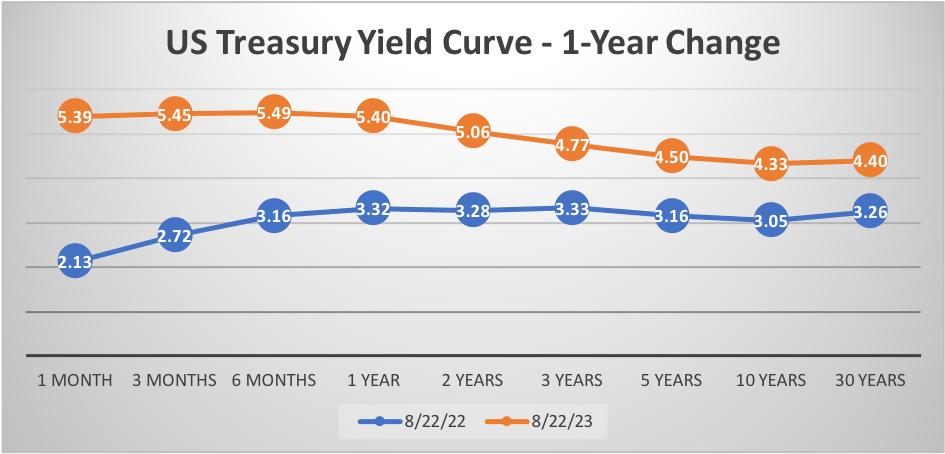
One year ago, I published a post titled, “Tough August For Bonds“, which wasn’t referring to Barry Bonds once again being rejected by MLB’s Hall of Fame, although he was. At this point last year, the FOMC had elevated the FFR 5 times (which is now 11 times), and many investors were sure that US interest rates were nearing a peak. We didn’t think so, and expressed that sentiment with the following:

“Based on the current strong employment picture with 315,000 jobs created, 5.2% annual wage growth, and a labor participation rate that grew 0.3% in August (62.4%), it is likely that the Federal Reserve needs to continue to aggressively elevate rates until it accomplishes its primary objective of reducing inflation. This action will continue to weigh on the performance of the US bond market. Fed Chairman Powell has admitted that the Fed’s policy will inflict pain on American families as the strong labor market needs to be tamed. In order to impact the labor market, US rates must rise substantially. Are fixed-income managers and their clients prepared?

Based on the following graph, I guess that we were correct.

The Fed’s action has yet to inflict pain on the American family (fortunately) despite the aggressive increases in US rates, as the US labor market remains strong. These increases really haven’t inflicted much pain on the overall economy, as GDP growth has been well above consensus so far through two quarters and the third quarter is looking exceptional, if the Atlanta Fed’s GDPNow model is to be believed as they are forecasting a 5.8% annualized growth rate. Oh, my!

It isn’t hard to imagine that the Fed will once again say in September that inflation remains well-above the stated objective and that rates will be adjusted based on the data. For us, that means a scenario of higher for longer. If so, I must ask: Are fixed income managers and their clients prepared?

ARPA Update as of August 18, 2023

By: Russ Kamp, Managing Director, Ryan ALM, Inc.

We are pleased to provide you with our weekly update of the PBGC’s progress in implementing the life-changing ARPA legislation. Tremendous activity has already taken place, but there is much more to accomplish. With regard to last week’s activity, the PBGC announced that the Retirement Plan of the Retirement Fund of Local 305 CIO’s Pension Fund’s revised application had been approved. This plan will receive $36.3 million to support the promised benefits for the 918 plan participants.

As the chart above highlights, there are still roughly 140 plans that may receive the Special Financial Assistance (SFA). We’ve highlighted on many occasions how this groundbreaking legislation has been life changing, especially for those participants that saw their promised benefits slashed under MPRA. As a reminder, here is a story about one of those union workers whose life was turned upside down. Still much more to do, but there shouldn’t be any question about why this effort is so very critical.

The Extraordinary Impact of Interest Rates on DB Pension Plans

By: Russ Kamp, Managing Director, Ryan ALM, Inc.

I don’t think that it is much of a stretch to claim that the last 41 or so years have been an amazing time to be in the capital markets. Personally, I’ve been blessed to be in the investment/pension industry since October 13, 1981 (thanks, Larry and Ted). On the day that I entered the industry, the US 10-year Treasury Note was trading at a yield of 14.9%. During the next 39 years, that yield would plummet to a Covid-19-induced low of 0.52% on August 4, 2020. Today, that 10-year Treasury note yield is 4.25% (2:10 pm).

During this incredible run, the cost of Pension America’s promises soared as the present value of those future value benefit promises outpaced asset growth, despite the incredible wind behind the investment community’s sails. This dramatic present value cost increase in those future benefit promises certainly contributed to the on-going shuttering of defined benefit plans in the private sector. Why? Liabilities are bond-like and highly interest rate sensitive!

Back in 1981, on the day that I entered this industry, it would have taken only $17.81 to fully fund a $1,000 liability 30-years out. Yes, only $17.81 in contributions to meet that future obligation. On the other hand, at the bottom of the rate cycle, when the US 10-year Treasury note had a yield of 0.52%, it would have cost the plan sponsor $860 to fund that $1,000 liability in 30 years. Oh, my! Any question as to the impact of the collapsing rate environment on those future promises?

Fortunately, for those plans still open and accruing benefits, the cost of those future promises is getting more affordable. At today’s 10-year Treasury note yield of 4.25%, it would cost the plan sponsor only $301 to meet that 30-year obligation. Not nearly as great as the $17.81 needed in 1981, but certainly more manageable than the exorbitant costs at the bottom of the rate cycle.

Plan sponsors and their advisors missed opportunities to de-risk Pension America’s DB plans in the early ’80s and again at the end of 1999 when most plans were well-funded. Let’s not let another opportunity pass us by. Corporate America and public pension funds are enjoying improved funding. The higher US rate environment is once again providing us with an opportunity to significantly reduce the cost of those future benefit payments by engaging in a de-risking strategy through Cash Flow Matching (CFM).

Bonds, like liabilities, are highly interest rate sensitive, and the present value of both bonds and liabilities are impacted by interest rate changes. Use the asset cash flows of interest and principal from bonds to cash flow match the plan’s liability cash flows. This action will SECURE the promised benefits chronologically as far into the future as the bond allocation goes. Why continue to live with the uncertainty that investing in our capital markets brings? Create an investment program that captures the benefits of our current higher interest rate environment, while securing the promises that have been given to your participants.

Outstanding!

By: Russ Kamp, Managing DIrector, Ryan ALM, Inc.

Milliman’s midyear 2023 Multiemployer Pension Funding Study has been released. The Headline: “The aggregate market value funded percentage for multiemployer plans is estimated to be 87% as of June 30, 2023, up from 79% at the end of 2022.” Most importantly, roughly 6% of that increase is attributable to the Special Financial Assistance (SFA) that has been doled out to more than 50 plans through the ARPA legislation that is being overseen and implemented by the PBGC.

This is outstanding news, as the program is doing exactly what it was intended to do – protect and preserve the promised benefits for the many hard-working American workers that would have seen their benefits put at risk if this legislation hadn’t passed. Milliman anticipates that there will ultimately be about $80 billion in SFA allocated to more than 200 eligible multiemployer plans. As you may recall, initial forecasts on the cost of this legislation were in the $90 billion range.

Milliman also estimated in this midyear report that the funded status would improve to about 92% if the remaining SFA were to be included in today’s numbers. Obviously, market forces will impact these funds prior to the completion of the SFA application process which should wrap up by 2027. Given the significant importance of this allocation to what were fund’s on life support, we encourage recipients of this government grant to treat it with the utmost care.

Equity valuations appear to be stretched at this time, while the rapidly changing US interest rate environment is providing plan sponsors with a wonderful opportunity to SECURE the promised benefits through a cash flow matching strategy at interest rates that we haven’t seen in decades.

ARPA Update as of August 11, 2023

By: Russ Kamp, Managing Director, Ryan ALM, Inc.

Good morning. Happy to share with you a very brief update on the PBGC’s activity implementing the ARPA pension legislation. Brief because there is only 1 action item to report on. Southwest Ohio Regional Council of Carpenters Pension Plan had its application approved. They will receive $182.6 million for the 5,399 plan participants. Outstanding!

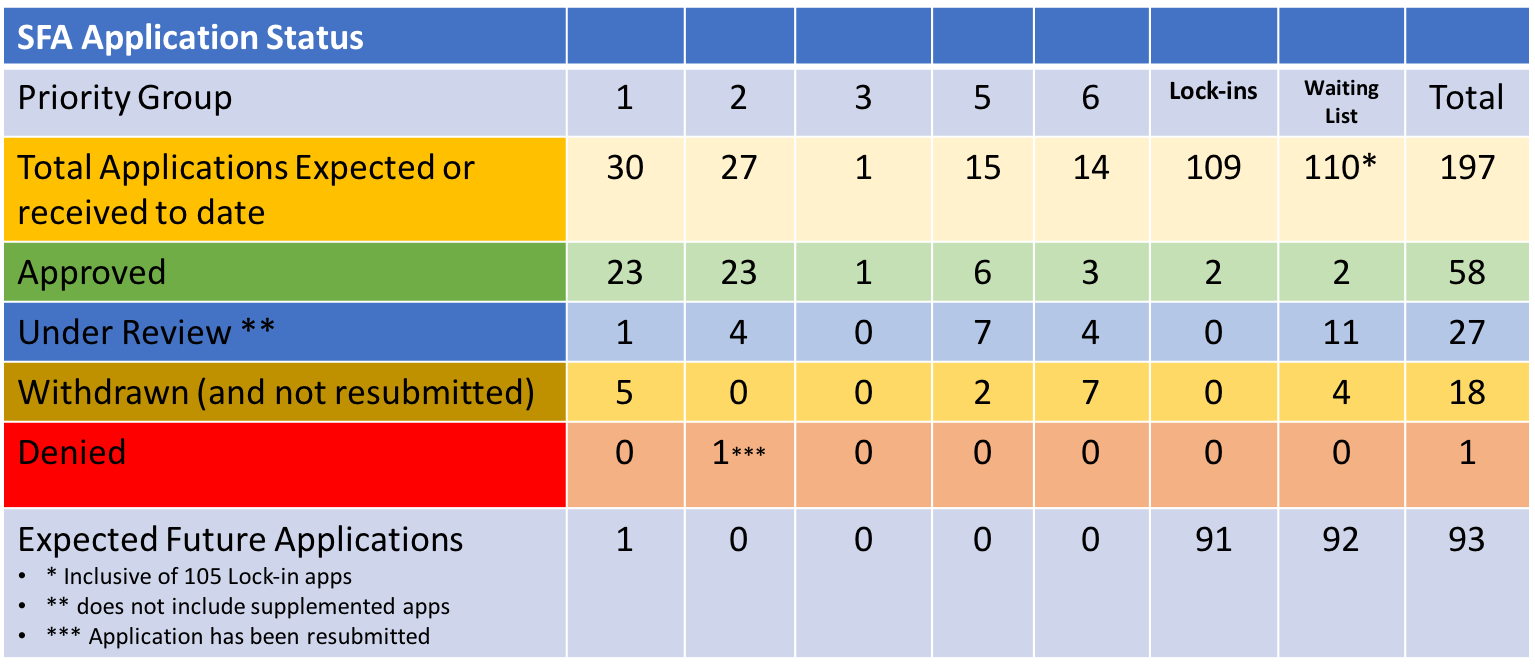
There were no new applications submitted during the prior week. In addition, there were no current applications under review that were either declined or withdrawn in the last 7 days. As reflected in the table below, there are currently 28 applications under review. They consist of 17 applications that had a Priority Group designation and 11 applications that have been submitted from the waiting list.

To date, there have been 57 pension systems that have had their applications approved. In addition, 35 supplemental applications were approved providing additional grant money to these pension systems. In total, $52.4 billion has been granted to these plans, which includes interest. It is anticipated that another roughly 120 plans may receive grant money, too.