Protecting the Downside is Much More Important

By: Russ Kamp, Managing Director, Ryan ALM, Inc.

Milliman has once again produced the results of its latest Milliman 100 Pension Funding Index (PFI), which analyzes the 100 largest U.S. corporate pension plans. As reported, the average funded ratio for the constituents in the index rose from 103.6% at the end of September to 104.2% as of October 31. The increase was driven by the continuing rapid rise in the discount rate which stood at 6.2% at the end of October which was up 36 bps from September 30th’s 5.84%. The increase in the discount rate was more than sufficient to make up for the asset decline of -2.68%. Assets have now declined for three consecutive months, while the 6.2% discount rate is at a level last achieved in 2009.

According to the study’s author, Zorast Wadia, the funded ratio of 104.2% marked a high level for 2023. Zorast also made mention of the fact that the recent increase of more than 100 bps in the discount rate during the last 4 months makes this a “very favorable economic environment for plan sponsors.” We agree. Who knows where rates will be in the next 6-12 months? Why try to time the market?

In addition to reporting on the current state of corporate America’s pension funding, the Milliman study framed possible scenarios for the end of 2023 and the conclusion of 2024. “Under an optimistic forecast with rising interest rates (reaching 6.3% by the end of 2023 and 6.9% by the end of 2024) and asset gains (9.8% annual returns), the funded ratio would climb to 106.0% by the end of 2023 and 118.0% by the end of 2024. Under a pessimistic forecast (6.1% discount rate at the end of 2023 and 5.5% by the end of 2024 and 1.8% annual returns), the funded ratio would decline to 103.0% by the end of 2023 and 93.0% by the end of 2024.

Given these possible outcomes, why take the risk of having your plan’s funded ratio fall from a healthy 104+% to something close to 93% or worse? Again, the primary objective in managing a DB pension plan should be to SECURE the promised benefits at a reasonable cost and with prudent risk. Subjecting the plan to unnecessary risk at this point with so many unknowns potentially impacting the capital markets is silly, if not fiduciarily imprudent. Secure those promises (benefit payments) at these attractive yields. You will have won the battle, if not the war.
 

ARPA Update as of November 3, 2023

By: Russ Kamp, Managing Director, Ryan ALM, Inc.

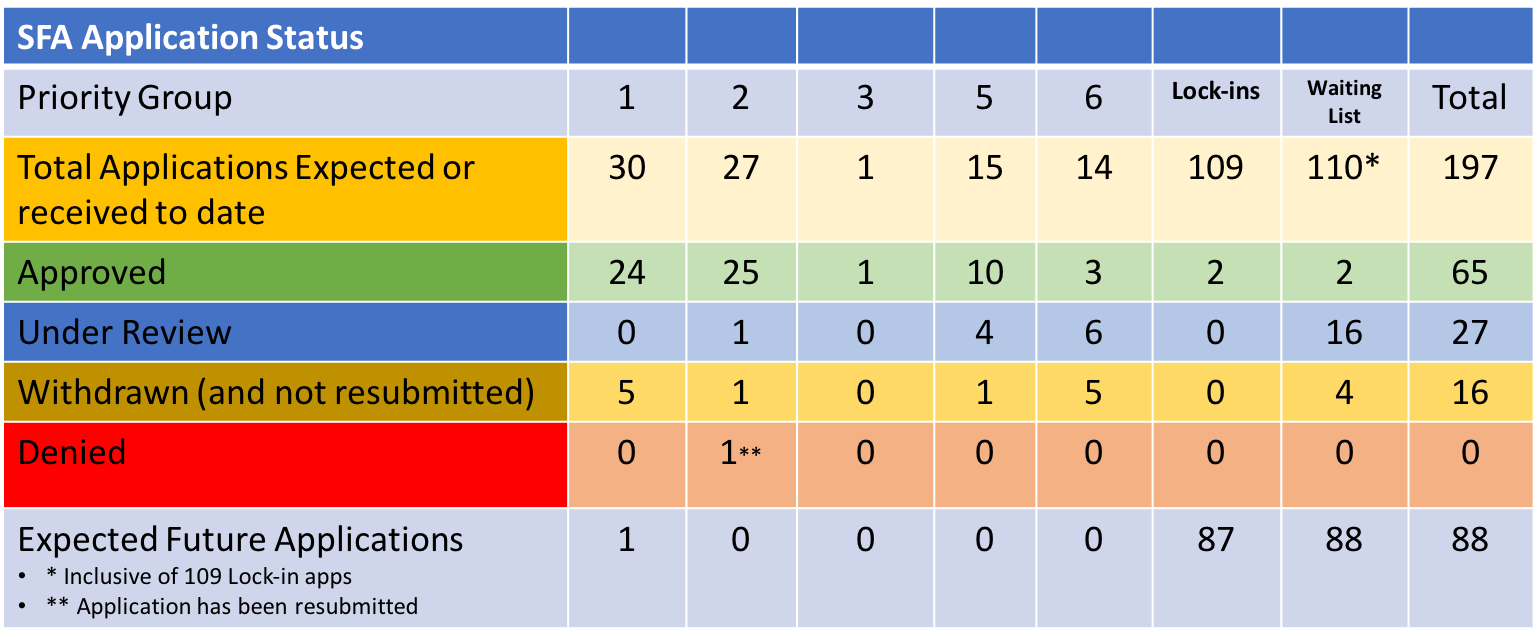
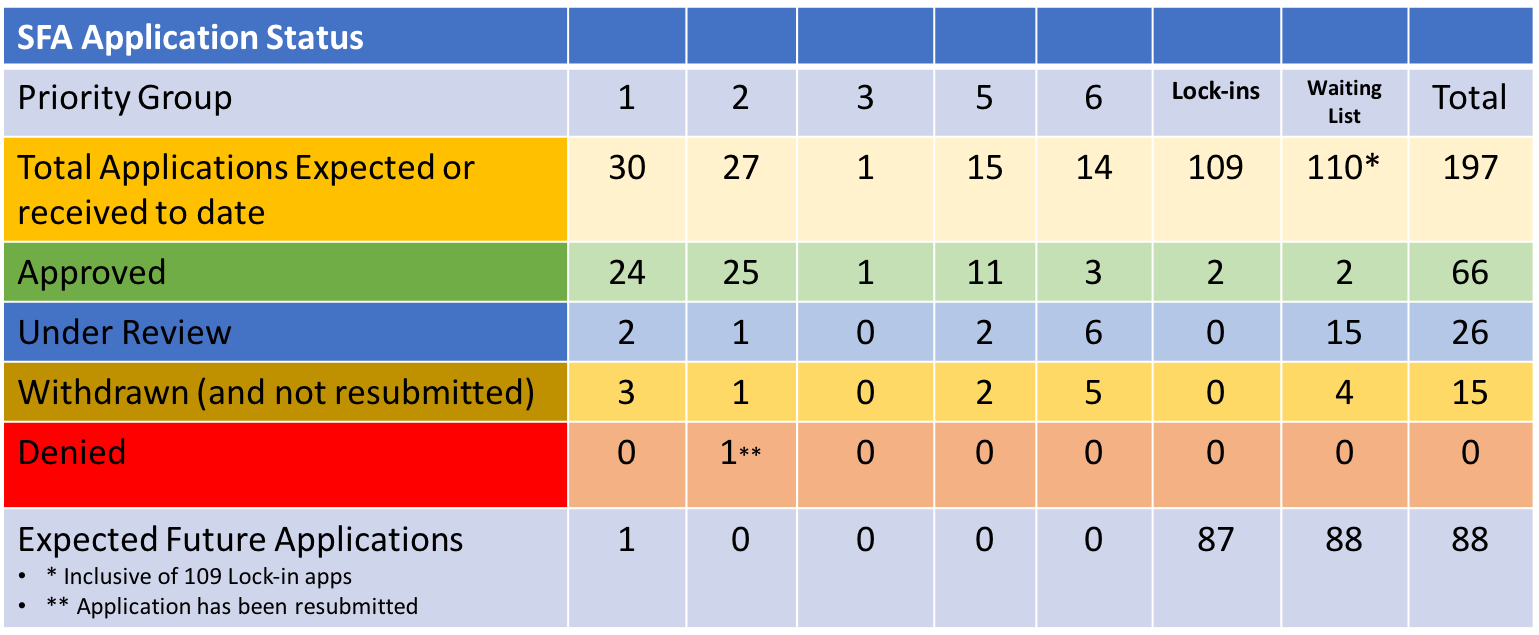
Welcome to November! The PBGC has now been busy implementing the ARPA legislation for 15 months. Lots has happened during this period of time, but nothing more important than the fact that $52.5 billion in grants, including interest, has been approved so far. Awesome!

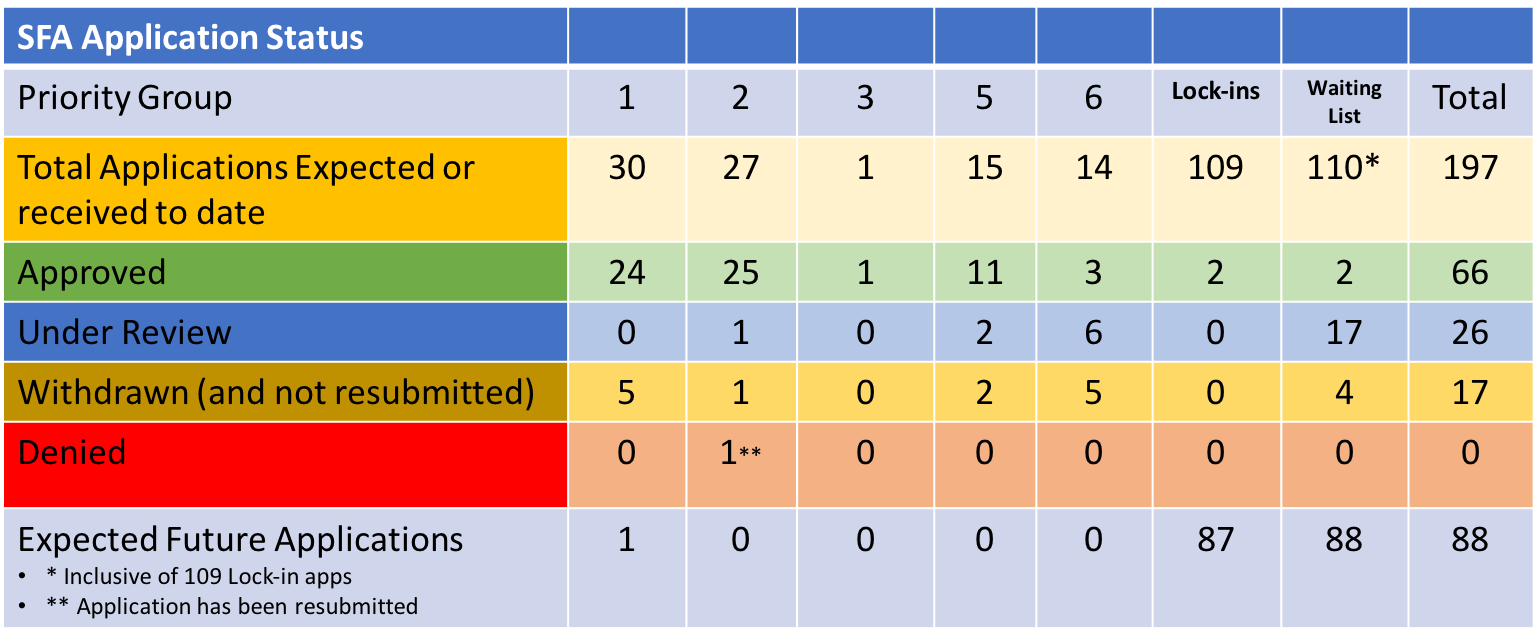
There was not a lot of activity during the last week, but three funds, America’s Family Benefit Retirement Plan, Union de Tronquistas de Puerto Rico Local 901 Pension Plan, and American Federation of Musicians and Employers’ Pension Plan (AFM) submitted revised applications seeking SFA. In the case of AFM, they withdrew an application after identifying a minor input error. They were permitted to correct the issue and immediately resubmit another revised application without losing their spot in the review process. Although the PBGC has 120-days from the submission of an application to act, it is expected that AFM will get a decision on its application before year-end, which would coincide with the original 120 day period.

There were no other applications denied or withdrawn and no additions to the waiting list, which seems to have been settled at this time since we haven’t seen a fund request a place on the list since August 24, 2023. There were no applications approved among the 26 currently being reviewed.

What is the Pension Objective? It Isn’t Maximizing Fees!

By: Russ Kamp, Managing Director, Ryan ALM, Inc.

As we’ve stated many times, the primary objective in managing a pension plan is to SECURE the promised benefits at a reasonable COST and with prudent RISK. For most of Pension America, the primary objective has morphed into a return objective and the asset allocation has migrated toward a much more aggressive risk profile. One in which alternative investments (real estate, private equity, and private debt) have been emphasized. One can argue about the value add that has been achieved, but you would be hard-pressed to argue that the cost structures of these plans hasn’t risen dramatically.

I saw this little blurb in a Bloomberg email this morning and it immediately grabbed my attention. “New York City’s pensions paid Wall Street money managers about $1.7 billion in fees last year, a roughly $150 million increase from the prior year. Fees paid by the city’s five pensions rose 10%, faster than the growth rate of assets, according to the city’s annual comprehensive financial report.” The combined assets of the City’s pension systems are $253 billion and the $1.7 billion in fees is equal to 67 bps annually. Wow!

It was reported in the CAFR > 70% of the 321 investment managers were alternative managers. That is fine if plans are actually being rewarded for the lack of liquidity, but that doesn’t seem to be the case. Sure, the nearly 8% fiscal year return eclipsed the annual return objective of 7%, but it fell nearly 4% below a 65% equity/35% fixed income benchmark, as reported by the City. Worse, and I repeat, fees grew by $150 million in the last fiscal year or about 10% more than in fiscal year 2022 despite assets not growing by a similar level.

Given NYC’s combined funded ratio of about 83%, they would be wise to take risk off the table by bifurcating the assets into liquidity and growth buckets. They would quickly realize a substantial savings in fees, as a cash flow matching strategy can accomplish the objective of securing benefits at both a reasonable cost (<15bps) and also at a prudent level of risk. They might also find that the present value cost of the future value benefits will provide substantial savings and a likely surplus. What a deal!

No Victory, Yet

By: Russ Kamp, Managing Director, Ryan ALM, Inc.

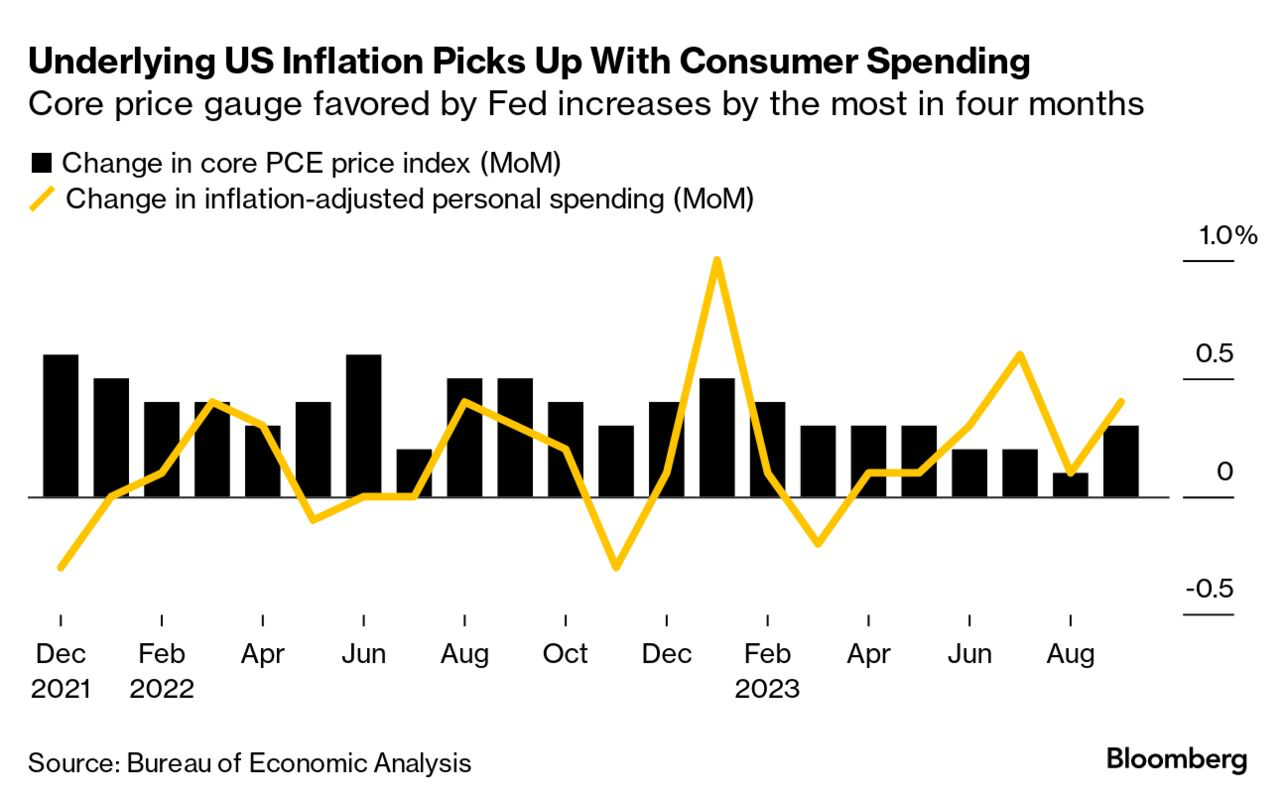
The FOMC has paused additional increases since July, but that doesn’t necessarily mean that they have been victorious in their quest to defeat inflation. If 2% is the Fed’s line in the sand, they still have quite a bit to accomplish. There has certainly been progress made since last summer, but not enough at this time to feel confident that future increases in the FOMC’s FFR aren’t necessary. Recent economic data belie the broad expectations of a US recession. Furthermore, the Fed’s “preferred” measure of inflation, the core personal consumption expenditures (PCE) price index, which strips out the volatile food and energy components, rose 0.3% in September, according to a new Bureau of Economic Analysis report. Please note that the Food & Energy components rose by 6.7% annualized in September.

As of the writing of this post, each of the key rates on the Treasury yield curve are up, with the 10-year Treasury note yield up just over 5 bps to 4.89%. As we wrote last week, 5% Treasury yields are meaningful. As investment-grade corporate bond yields eclipse 6%, bonds become a significant alternative to equities in asset allocation strategies, especially for pension plan sponsors looking to SECURE the promised benefits through a cash flow matching (CFM) strategy.

None of us know where US interest rates and inflation will be in 6-12 months. Why assume the investment risks of a traditional asset allocation in which all of a plan’s assets are focused on the return on asset (ROA) objective. Bifurcate the plan’s assets into liquidity and growth (Alpha) buckets. Use CFM to ensure that the promises have been secured and the liquidity is available to meet those monthly needs. Doing so “buys time” for the Alpha assets to grow unencumbered. As you know, time is your friend, at least in an investing sense, and the more time that we give to an investment strategy the greater the probability of success.

ARPA Update as of October 27, 2023

By: Russ Kamp, Managing Director, Ryan ALM, Inc.

This week brings us Halloween and the markets may provide both “tricks and treats”, but the PBGC continues to hand out treats in the form of SFA grants to multiemployer plans. There wasn’t a lot of activity last week, but any action is good for the plan participants who continue to hope for a secure retirement.

According to the latest update by the PBGC, there was one plan, Local 210’s Pension Plan, a priority Group 5 member, received approval for its revised SFA application. Local 210 will receive $49.3 million for the plan’s 3,887 participants. In other news, United Food and Commercial Workers Unions and Employers Pension Plan’s application is now under review. This plan is seeking more than $74 million for its 15,420 participants. While the UFCW application proceeds through the review process, two other funds have withdrawn applications, including the Southwestern Pennsylvania and Western Maryland Area Teamsters and Employers Pension Fund and the Pacific Coast Shipyards Pension Plan. Southwestern’s application had already been revised. Perhaps three times will prove to be the charm.

There was a presentation delivered at the recently concluded IFEBP annual conference in Boston that addressed LDI broadly. At the end of the presentation there were a series of questions listed that went unanswered. Here is one of those: Can this concept (LDI) be applied to SFA assets? If the presenter was referring to cash flow matching as the LDI strategy then the answer is unequivocally, YES! In fact, it should be the only strategy considered for the SFA bucket, as it is a sinking fund designed to fund benefits and expenses chronologically as far into the future as the SFA will go. Please DON’T assume unnecessary market risk by investing in equity or return-seeking fixed income strategies, as the potential “reward” is minimal versus the pain of not being able to secure benefits for as long as possible.

Why 5% Yields are a BIG thing!

By: Russ Kamp, Managing Director, Ryan ALM, Inc.

From basically the time that I entered our industry (October 13, 1981) to the end of 2021, US interest rates were on a decline. Sure, there were modest periods in which the Fed tightened, such as 1994, but for the most part the investment community enjoyed the benefits of falling rates and low inflation for nearly four decades. The returns associated with investing in bonds from that period forward were quite beneficial for pension plans. How times have changed!

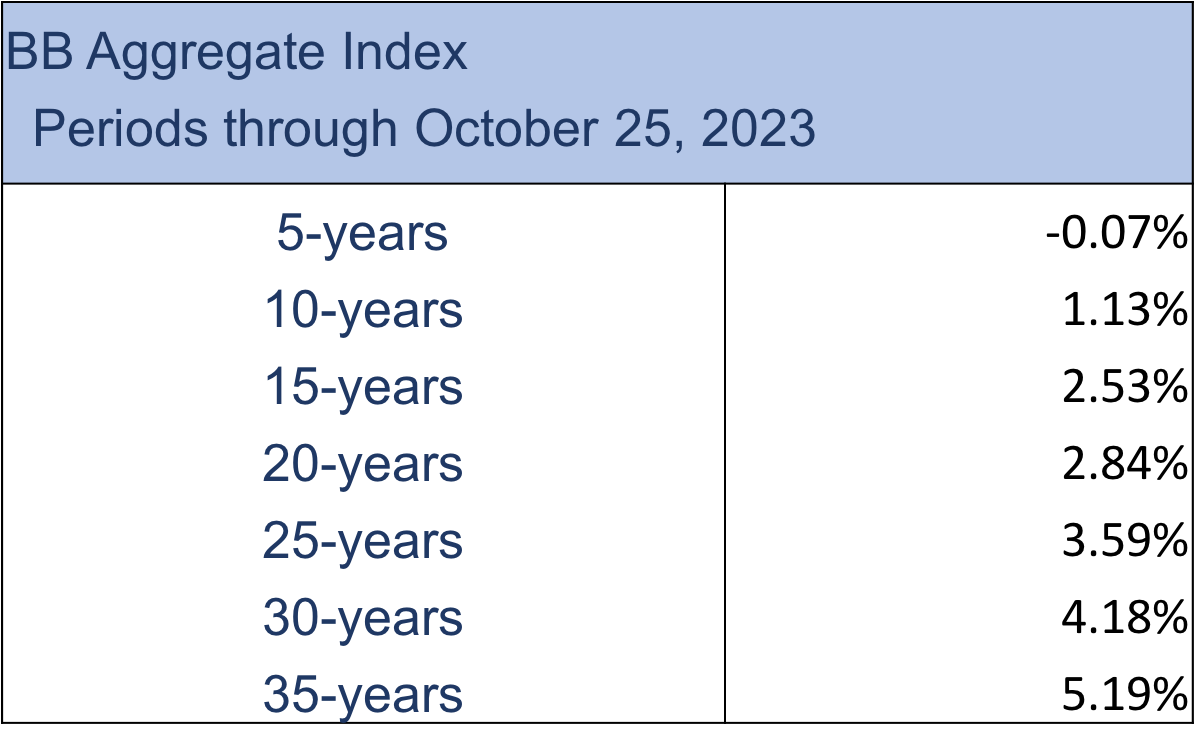
Since the Federal Reserve began raising rates on March 17, 2022, the aggregate index has witnessed its worst calendar year return ever at -13.0% in 2022 and it is on the verge of producing the second worst calendar year performance in 2023. Prior to this interest rate move, the worst return experienced on a calendar year basis had been 1994’s -2.9%. Again, how times have changed. As the table below highlights, one would have to go back 35 years from yesterday (October 1988) to have gotten a 5+% annualized return for any period of length.

That said, today’s rate environment is presenting plan sponsors with a terrific entry point, as most yields are close to the 5% level and investment grade corporate yields are close to 6% or more at this time. As a reminder, a bond purchased at par and allowed to mature will generate a return equal to the bond’s yield. Buying a bond in this environment will provide plan sponsors with the opportunity to capture a significant percentage of the target ROA without an abundance of risk.

At Ryan ALM, Inc. we would suggest that bonds should not be looked at as return-seeking instruments. They have known cash flows of interest and principal and those can be used to defease a pension plan’s liability cash flows with certainty. The current interest rate environment is providing pension plan sponsors and their advisors with a wonderful opportunity to SECURE the promised benefits at significantly reduced cost. As we highlighted in the recent blog post “Just the Facts”, it is not unheard of to reduce the present value cost of those future value benefits by 50% or more depending on how far into the future that the cash flow matching program covers.

The current level of rates may not rival the double-digit rates available in 1981, but they are certainly quite attractive relative to the Covid-19 induced historically low levels. Use the current rate environment to secure the promises made to your participants and bring certainty to a very uncertain investing environment.

“Just the Facts”

By: Russ Kamp, Managing Director, Ryan ALM, Inc.

Sgt. Joe Friday, Dragnet, is credited with saying, “Just the facts, Ma’am”, but he actually never uttered the phrase. However, that wording did appear in the movie starring Tom Hanks and Dan Aykroyd (1987). Why mention this? Well, investment management firms may be better at marketing/sales than they are at actually managing investment products. Spin wins! However, in this challenging investment environment, getting “just the facts” is incredibly important.

I’ve produced more than 1,300 blog posts and many, if not most, are focused on how plan sponsors and their advisors can secure the pension promise, reduce funding cost, while maintaining prudent levels of risk. Does this seem too good to be true? It’s not, especially today with US interest rates at nearly a two decade high. Securing the promises at a reasonable cost and with prudent risk is very achievable. Here are the facts based on a recent analysis that we completed for a large public pension system.

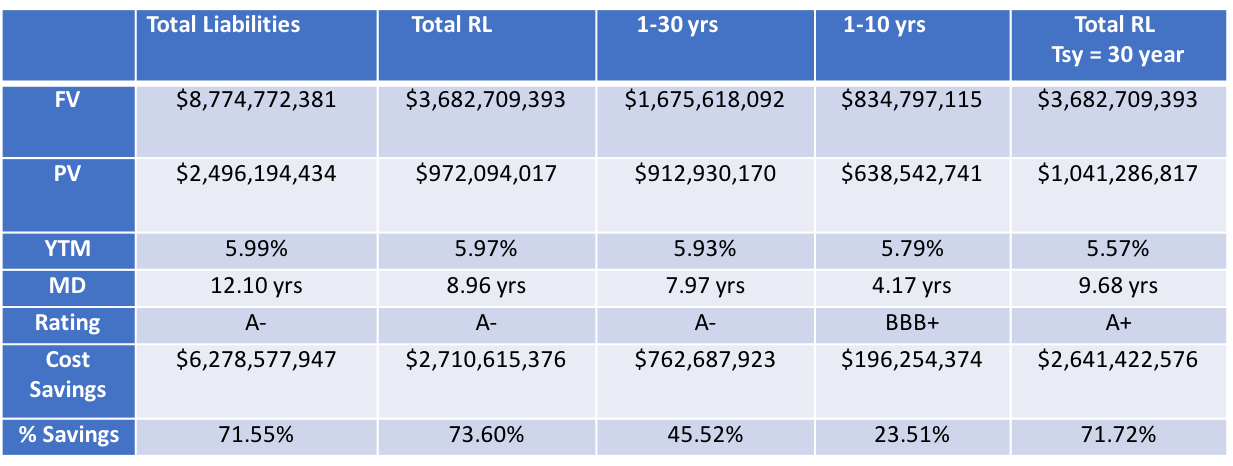
Their defined benefit fund has roughly $2.1 billion in AUM. The total estimated liabilities going out beyond 2100 have a future value (FV) of $8.8 billion, while the Retired Lives Liability (RLL) carries a FV of $3.7 billion.

As the table below highlights, we can defease all of the RLL at a present value (PV) cost of $972 million. This equates to a cost reduction of 73.6% or $2.7 billion. Yes, some will say that the “savings” are nothing more than the time value of money. However, when one defeases pension liabilities, the “savings” are realized immediately and generated with little risk through an investment grade bond portfolio, unlike a traditional asset allocation and the volatility associated with that process. Furthermore, we can tell you what the return will be on the portfolio on day 1! Is there any other strategy that can do that?

If securing all of the RLL is not a desired goal at this time, we can defease any series of years that you desire. Again, in the table below, we have defeased liabilities for 10- and 30-years. The cost savings reduction is quite meaningful. The cost savings will always be more robust the longer the maturity of the program. Bond math is very straightforward: the longer the maturity and higher the yield, the lower the cost.

As a plan sponsor, why wouldn’t you want to SECURE the promises made to your participants? Why wouldn’t you want to reduce funding costs significantly? Why would you want to continue investing in the capital markets with all of the uncertainty that brings? How comforting it would be for all involved in the process to know that the RLL has been fully defeased. The yields highlighted above are robust. Take advantage of those. Don’t let this opportunity pass as we’ve done on multiple occasions before.

I’ve presented the facts. We’d be happy to generate a similar analysis for you at no cost to complete the review. Call us.

AMEN!

By: Russ Kamp, Managing Director, Ryan ALM, Inc.

P&I recently interviewed Ronald Peyton, Executive Chairman, on his nearly 50 years at Callan, where he also served as CEO from 1990-2017. First, congratulations, Ron, on an impressive career. Your influence within the retirement industry will be felt forever. Second, thank you for sharing your thoughts with us through the P&I interview. It was refreshing to read many of your comments. Here is one exchange that had me applauding:

Q: Have clients changed much over the years in terms of what they are seeking?

A: Clients have always focused on generating maximized returns at an acceptable level of risk. Our job is to keep them focused on a longer-term perspective of achieving the returns they need with the least risk and to avoid focusing on short-term gains. We consistently advise clients that one of the most important elements of investing is minimizing risk in achieving the returns needed to fund their objectives, not always seeking the highest returns. When all you do is chase returns, you expose yourself to almost unlimited risks.

Yes, yes, and YES!

Our industry has migrated through the years from focusing on the promise and managing to that promise to trying to generate the greatest return. All we’ve done in the process is guarantee volatility in the funded status and contribution expenses and not success. Isn’t it time to get off the asset allocation rollercoaster? Isn’t it time to bring certainty to a very uncertain process due to the focus on return? The US interest rate environment is providing a wonderful opportunity through a cash flow matching (CFM) strategy to do what Mr. Peyton has suggested: Achieve the returns necessary to fund their objective, while not seeking the highest return! We couldn’t agree more.

ARPA Update as of October 23, 2023

By: Russ Kamp, Managing Director, Ryan ALM, Inc.

It is the week before Halloween, but things are already scary for the US capital markets, as rising US interest rates continue to create uncertainty for bonds, equities, real estate (particularly housing), and other investments. Fortunately, the implementation of the ARPA legislation continues unabated as the PBGC allowed for the submission of five more applications for Special Financial Assistance (SFA). Each of those applications came from the waiting list and included, CWA/ITU Negotiated Pension Plan, Local 1034 Pension Plan, Kansas Construction Trades Open End Pension Trust Fund, Local 945 I.B. of T. Pension Plan, and the Radio, Television and Recording Arts Pension Plan. These pension funds are collectively seeking $710 million for just over 37,000 plan participants. Presently, there are 27 applications under review by the PBGC.

In other news during the prior week, there were no applications approved or denied. Furthermore, there were no new additions to the waiting list. There were, however, 3 funds that withdrew the SFA applications, including, CWA/ITU Negotiated Pension Plan, UFCW – Northern California Employers Joint Pension Plan, and the Retail Food Employers and United Food and Commercial Workers Local 711 Pension Plan. In total, they are seeking $2.9 billion for roughly 188,000 participants. The largest of these by far is the UFCW plan of Northern California (seeking $2.3 B in SFA).

It is easy to get lost in the large $s associated with this legislation, but it is critically important to remember that 1,396,465 plan participants are in these pension plans that have either received the SFA (959,286) or are in the review queue, with many, many more to come. This legislation is truly life-saving in many cases. Please refer back to previous blog posts that highlighted Carol’s plight.

More Work May Be Needed!

By: Russ Kamp, Managing Director, Ryan ALM, Inc.

We’ve had a very exciting week in the US capital markets as a number of Fed officials, including Fed Chair Powell, had the opportunity to update us on the current inflationary environment and the outlook for US interest rates. US interest rates and equities have been bouncing around with each utterance. However, many market participants interpreted Powell’s comments that the Fed has accomplished its objective, as recent “core” inflation has moderated. But did he really close the door on a future further increase in rates?

Here’s what Powell shared, “Additional evidence of persistently above-trend growth, or that tightness in the labor market is no longer easing, could put further progress on inflation at risk and could warrant further tightening of monetary policy”. In my opinion, the door remains open and more than ajar. What does above-trend growth mean? Does the current forecast by the Atlanta Fed’s GDPNow model of 5.4% annualized real growth for Q3’23 warrant the label of above growth? It certainly seems so to me.

Furthermore, the job market continues to surprise. Near historic low unemployment levels persist and initial jobless claims seem to come in below forecast each and every week. The most recent data release revealed the lowest level (198K) in more than nine months. As we’ve mentioned in numerous blog posts, oil may prove to be the fly in the chardonnay, as the price of WTI has crept above $90/barrel once more. Oil and its byproducts are in more than 6,000 products.

Despite these facts, US Treasury bonds across the yield curve have rallied this morning, bringing the yields for 3- to 10-year Treasury Note maturities below or further away from the 5% level, while equities are once again down anywhere from 0.5% (DJIA) to 1.5% (NASDAQ). Clearly, there remains great uncertainty as to how the US economy will react to the Fed’s aggressive tightening first enacted in March 2022. Given this uncertainty, plan sponsors and their advisors should seek greater certainty through an investment in cash flow matching, which carefully matches asset cash flows to benefits and expenses. The elevated US interest rates are providing plan sponsors with a wonderful opportunity to significantly reduce risk while not sacrificing return, although managing a pension is truly not a return game.