83%!

By: Russ Kamp, Managing Director, Ryan ALM, Inc.

In a country as divided as ours, it is incredibly rare when one sees such unanimity as 83% of Americans believing that all workers should have access to a pension plan. This result is according to a recent study conducted by the National Institute on Retirement Security (NIRS). According to the survey, the American worker is not confident in the least that they will enjoy a dignified retirement given the current state of affairs.

According to NIRS, “Eighty-three percent of Americans say that all workers should have a pension so they can be independent and self-reliant in retirement, and more than three-fourths of Americans agree that those with pensions are more likely to have a secure retirement.” Imagine that, a super majority of American workers want access to a pension plan so that they can be independent and self-reliant! They aren’t looking for a handout from the federal government, but that is what they’ll be forced to incur should our retirement industry continue to fail our workers.

Furthermore, “79 percent of Americans agree there indeed is a retirement crisis, up from 67 percent in 2020More than half of Americans (55 percent) are concerned that they cannot achieve financial security in retirement.” Not shocking that a majority of Americans are concerned about achieving financial security. A good chunk of our working population doesn’t have access to an employee-sponsored plan and when they do, most workers can’t put in nearly enough to achieve the financial independence that they desire. These findings are detailed in a new report from the National Institute on Retirement Security (NIRS), Retirement Insecurity 2024: Americans’ Views of Retirement. The report findings are based upon a national survey of working age Americans conducted by Greenwald Research.

There is also great anxiousness involving the securing of Social Security. More than 90% of the respondents to the survey believe that securing SS needs to be a priority for the next administration. SS is a critical benefit that currently supports >67 million Americans. In many cases, SS is the only source of funds for older Americans. I am incredibly concerned about the lack of retirement progress in this country. DB plans need to be the backbone of any retirement system, as asking untrained individuals to fund, manage, and disburse a “benefit” is just poor policy.

I’m less concerned about our government’s ability to continue to fund SS given our fiat currency. I am concerned that those in Congress don’t necessarily understand our monetary system and will enact unnecessary changes in order to fix something that isn’t broken.

Defined benefit plans were once used effectively by corporate America to attract and retain talent. They were a tool to manage a workforce from the initial hire to retirement. By migrating from DB to DC plans, corporate America has lost that ability, as the American worker now goes up and down the elevator with their “retirement” benefit in their back pocket. There are investment strategies that can be deployed to reduce the volatility of the funded status and contribution expenses that worked against retaining DB plans. Will DB plan asset allocations finally take advantage of these investment ideas to get off the performance rollercoaster? I significant majority of Americans sure hope so!

ARPA Update as of February 23, 2024

By: Russ Kamp, Managing Director, Ryan ALM, Inc.

Good morning, and welcome to the last week of February. Wow, this month seems to have flown by.

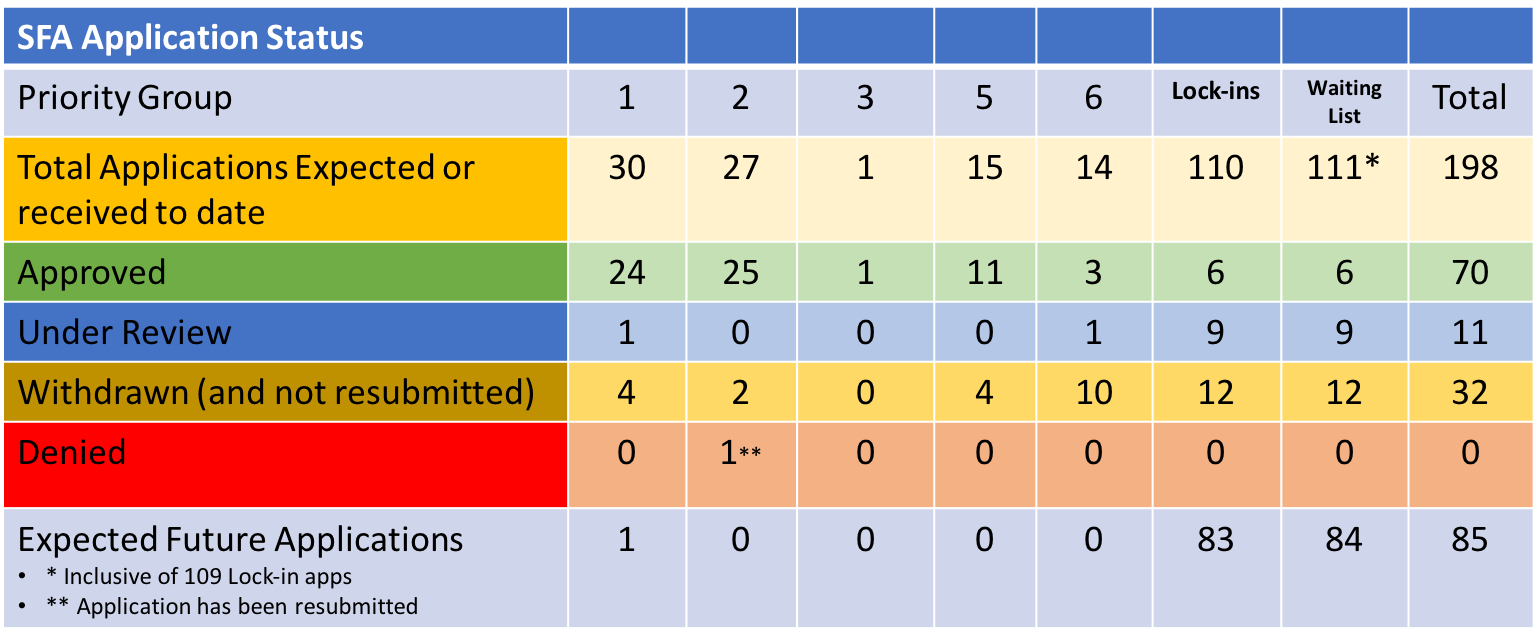
With regard to the PBGC’s implementation of the ARPA legislation, activity is picking up. There were five applications submitted through the PBGC’s portal. These included 3 Priority Group 6 members and two funds without a priority designation. The five funds are the Retail, Wholesale and Department Store International Union and Industry Pension Plan (the initial application), the Bakery and Confectionery Union and Industry International Pension Fund, United Food and Commercial Workers Unions and Employers Midwest Pension Plan, the Radio, Television and Recording Arts Pension Plan, and the GCIU-Employer Retirement Benefit Plan.

The five plans are seeking $5.5 billion in SFA for slightly more than 200k plan participants. The Bakery and Confectionery Union is seeking nearly 60% of the $5.5 billion in SFA grant money. The Bakery and Confectionery Union cooked up applications in March 2023, October 2023, and again in February 2024. Hopefully, they have the right recipe this time.

In other news, there were no applications approved, but the Laborers’ International Union of North America Local Union No. 1822 Pension Fund did receive the SFA payment of nearly $16 million for its 525 participants. Fortunately, there were no applications denied and none were withdrawn.

The US interest rate environment continues to be favorable for plans receiving SFA grants, as higher rates mean that the future benefit payments can be defeased at lower cost. Given the strength of the economy and labor force, it is less likely that the US will experience a recession keeping the current rate environment higher for longer.

Concepts in Advanced Asset Allocation

By: Russ Kamp, Managing Director, Ryan ALM, Inc.

I’ve been asked to speak to this topic on many occasions. In one such case, the IFEBP conference in October 2017, I returned to New Jersey and penned a post on the subject. In reviewing what I wrote that day and where we are today, I have to ask: What has changed? We are nearly 6 1/2 years removed from that event, but one needs to ask have pension asset allocations truly evolved.

For most plan sponsors and their consultants, the concept of “Advanced Asset Allocation” has to do with altering exposures to one asset class or style category (growth vs value) versus another. The adjustments often result in token shifts of 2-3% from one asset class to another. Is that really an advanced asset allocation discussion? Does the inclusion of private debt or equity really support the concept of a dramatic improvement in asset allocation, especially when one contemplates that these strategies come with higher fees, a lack of transparency, and poor (non-existent) liquidity? NO!

The problem with most asset allocation frameworks is that they focus attention on returns and not nearly enough on the benefit promise that has been given to the plan participant. With a focus on the return on asset assumption (ROA), volatility of the funded status and contribution expenses is assured, but the full funding of the plan is not, as we continue to ride the asset allocation rollercoaster up and down. Currently, the cars on that rollercoaster are making their way up, but who knows when the peak will be breeched and the cars will once again plummet, leading to further funding shortfalls and the need to get more aggressive with the return target and composition of the portfolio.

I don’t believe that approaches to pension asset allocations have changed much, especially among public pension systems. Sure, there have been moves among the asset classes, especially from public markets to private, but does that highlight an advancement? I suggest that it doesn’t. However, we have witnessed the markets change quite dramatically. We currently have a US interest rate environment that we haven’t experienced in two or more decades. In addition, we have a US equity market that is experiencing an “unprecedented” concentration in leadership (Tech) that is leading to persistent underperformance by active managers trying to eclipse the S&P 500’s return. Furthermore, we’ve had significant assets moving into private debt (>$3 T) at a time when higher rates may create problems for the companies trying to cover their interest expenses. Do you want to discuss real estate or private equity that have their own issues at this time? Does shifting marginally among these asset classes protect the funded status of the pension plans?

An advanced asset allocation framework would be one that gets the pension system off the performance rollercoaster. It is one that SECURES the promised benefits at both a reasonable cost and with prudent risk. It is one that stabilizes the funded status and contribution expenses. It is one that creates a liquidity profile that ensures that monthly benefit payments and expenses are met without having to liquidate assets, perhaps during periods of market disruption. Importantly, having an enhanced liquidity profile buys time for the remainder of the assets – presumably the fund’s alpha assets – to now grow unencumbered, as they are no longer funding monthly payments for several years or more.

Furthermore, an advanced asset allocation strategy understands that a pension plan’s liabilities need to be the focus of any asset allocation framework. Those liabilities need to be measured, monitored, and managed. A once per year, at best, review of the plan’s liabilities doesn’t accomplish the objective. Could you play a football game without knowing how many points your opponent has scored? Of course not! Then how can you manage a pension plan without knowing how the plan’s promises (liabilities) are behaving?

Having an advanced asset allocation that factors into the equation both liabilities and risk doesn’t mean that 100% of your assets have a new mandate. The funded status and the sponsoring entity’s ability to contribute will provide guidance on just what percentage of your assets will be impacted. There is no excuse for a plan with a 60% funded status to have the same asset allocation and ROA as one that is 90% funded. Yet, we see this all the time when both plans are striving for the same or similar ROA.

We, at Ryan ALM, Inc. understand and preach advanced asset allocation strategies. Our cash flow matching (CFM) capabilities become the backbone of the new asset allocation framework. CFM provides the necessary liquidity, while buying time for the alpha assets (non-bonds) to meet future liabilities. Our approach actually secures the promised benefits. This is a “sleep well at night” process that brings certainty to a very uncertain environment. We’d be happy to do a free analysis for you to highlight what can be done to truly create an advanced asset allocation framework.

Proof in the Pudding!

By: Russ Kamp, Managing Director, Ryan ALM, Inc.

The Milliman organization has just released its year-end “results of its Multiemployer Pension Funding Study (MPFS), which analyzes the funded status of all multiemployer defined benefit pension plans in the United States, based on data and assumptions from these plans’ latest Form 5500 filings.” The analysis covers 1,207 multiemployer plans. 

It is not surprising to see dramatic improvement in the aggregate funding of these plans given the strong performance of markets in 2023 and the continuation in providing Special Financial Assistance (SFA) grants under ARPA. How dramatic was the improved funding? According to the study, Milliman estimates that the aggregate funding is now at 89% up from 79% at the end of December 2022. As I report on a weekly basis, 70 multiemployer plans have now received more than $54 billion in SFA, with more than 120 plans still expecting to receive an SFA grant before the program ends in 2025. Without these grants, aggregate funding would fall to 83%. ARPA is proving to be such an incredible lifeline to these troubled plans and the participants that are counting on receiving their earned benefit.

According to the analysis by Milliman, 37% of the plans are at 100% funded or greater, while 78% have a funded status at or >80%. Given that there are still more than 100 pension systems expecting to file for SFA, it isn’t surprising that a small subset of multiemployer plans (9% are at <60%) are still struggling.

Just as we have suggested for those plans receiving SFA grants, we’d say the same thing to those plans with a funded status >100%. Now is NOT the time to take risk given so many cross-currents in the economy and markets. Multiemployer plans receiving the SFA can secure the promised benefits within the segregated bucket by using a cash flow matching (CFM) strategy to defease those promises as far into the future as the grant goes.

For those plans enjoying a fully funded status, bifurcate the plan’s assets into liquidity and growth buckets. The liquidity bucket will also be a defeased bond strategy that secures the promises as far into the future as the allocation goes. The remaining assets now have the benefit of an extended investing horizon. Should markets wobble once again, the growth assets will no longer be a source of liquidity to meet benefits and expenses, and as such, they can continue to grow unencumbered. Subjecting 100% of the assets to the performance rollercoaster created by traditional asset allocation strategies is not prudent.

It’s Different This Time! Is it Really?

By: Russ Kamp, Managing Director, Ryan ALM, Inc.

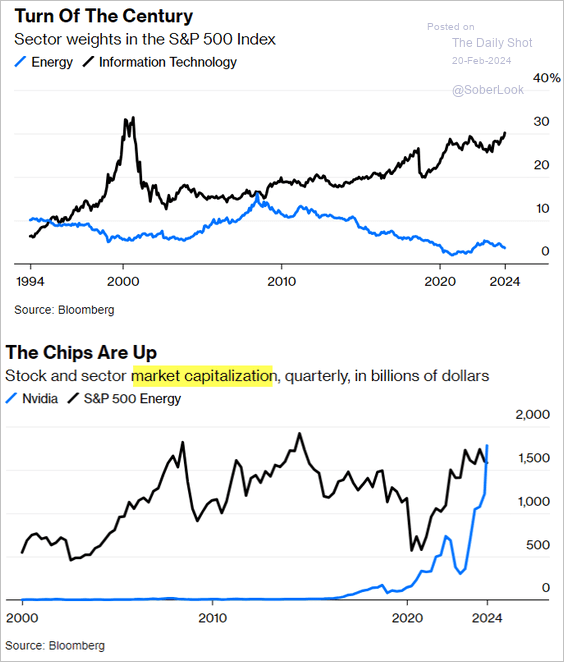
Having spent more than four decades in the investment pension/industry, I’ve seen more than enough cycles to know that history does repeat. The specifics of the trend/cycle may be different from one event to the next, but the outcomes are normally quite similar. Nothing in our industry stays at equilibrium. Valuations matter and they move from one extreme to another on a fairly continuous basis. We may be nearing a peak once again within the S&P 500’s sector weightings. I’m specifically referring to the weighting of the tech sector (information processing to be more precise).

Source: @liamdenning, @opinion

As the above graphs highlight, we are once again witnessing tremendous exposure within the S&P 500 to information processing. The last time that this sector’s weight eclipsed 30% of the index was just before the Tech bubble burst. Again, it is different. Companies within this sector have great businesses and actual earnings but do they have valuations that can justify the current stock prices? Perhaps we’ll find out more this afternoon when Nvidia announces their latest results.

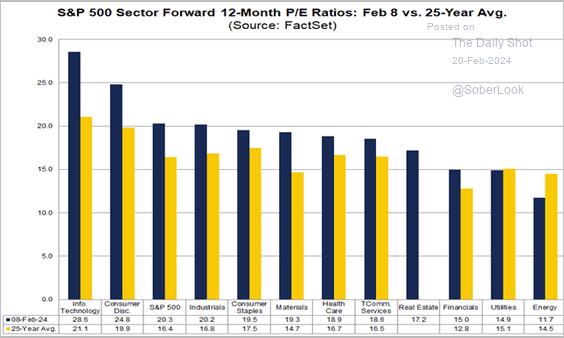
In any case, it seems a bit shocking to me that Nvidia’s capitalization is now greater than that of the entire S&P 500 Energy sector. Furthermore, only Energy and Utilities have a forward P/E multiple that resides below the average for the last 25-years as reflected in this FactSet chart.

We are all taught the importance of buying low and selling high, but most of us get caught up in the excitement of today’s “story” failing to realize that momentum is created by cash flows moving into that theme and that they will eventually peak. It is at that time that Momentum as a factor can reverse quickly. Need we remind you that the NASDAQ 100 declined by 83% from its peak in March of 2000.

The S&P 500 was the place to invest last year. It wasn’t that great the year before (2022). Where will 2024 take us? I wish that I knew. I can tell you that these rollercoaster events are not good for a pension plans funded status or contribution expenses. Adopting a focus on the ROA and not securing the promised benefits has created an asset allocation framework that guarantees volatility, but not necessarily a successful outcome. Securing the pension promise (benefits) at a reasonable cost and with prudent risk does! Why continue to ride the asset allocation rollercoaster for all of the plan’s assets? Given the valuations highlighted above, there doesn’t seem to be a lot of “value” investing in the S&P 500 at this time. Remove some risk and create greater certainty by defeasing a portion of your plan’s liabilities. Not only will you secure those benefits, but you will extend the investing horizon for the remainder of the assets so that they can successfully wade through potentially choppy markets. It is a “win/win”.

ARPA Update as of February 16, 2024

By: Russ Kamp, Managing Director, Ryan ALM, Inc.

We hope that you enjoyed your President’s Day. I remember way back in my grammar school years getting both Lincoln’s (2/12/1809) and Washington’s (2/22/1732) birthdays off from school. However, that fun was squashed in 1971, when the Uniform Holiday Act was passed by Congress, which moved some federal holidays to specific Mondays. Thus “President’s Day” was created as the third Monday in February.

As for the ARPA legislation, the PBGC didn’t quite open the floodgates, but they did allow the application portal to open wide enough to allow four initial applications to be submitted. These plans included, the Carpenters Pension Trust Fund – Detroit & Vicinity, Pension Plan for the Arizona Bricklayers’ Pension Trust Fund, Pension Plan of Local 102, and Maryland Race Track Employees Pension Plan. These funds are all non-priority group members. There have now been 27 plans from the waiting list to see some action in the ARPA process. As a reminder, there are 111 pension funds that were non-priority members.

For those four applications, the plans are seeking a combined $642.7 million in Special Financial Assistance (SFA) for their more than 25k plan participants. In other ARPA happenings, there were no applications approved or denied, and only one plan withdrew its application. The America’s Family Benefit Retirement Plan, a Priority Group 1 member, withdrew the revised application on February 13th. They are seeking $188 million in SFA for 3,109 members. As a reminder, Priority Group 1 members began filing applications in July 2021. Twenty-four of the 30 expected Priority Group 1 members have received approval and SFA funding to date.

US Treasury yields have risen by more than 30+ bps across the yield curve since the beginning of 2024. These elevated yields help reduce the present value (PV) cost of those future benefit payments. Cash flow matching strategies will take advantage of these higher yields and lock-in the savings (cost reduction) as soon as the asset cash flows from bonds (principal and interest) and the liability cash flows (benefits and expenses) are matched. 

You Don’t Say?

By: Russ Kamp, Managing Director, Ryan ALM, Inc.

The WSJ recently produced an article that highlighted the US economic activity relative to the other leading developed nations of Europe and Asia, with a particular focus on both the UK and Japan. In the case of Japan, which suffered an economic contraction over the latter part of 2023, its economy saw GDP growth contract by -0.8% in Q3’23 and -0.1% in Q4’23. This economic weakness has resulted in Japan falling to fourth place behind Germany in a ranking of economic powerhouses with a GDP of roughly $3.9 trillion. At the same time that Japan was witnessing weakness, the UK’s “statistics agency Thursday said gross domestic product fell at an annualized rate of -1.4% in the final three months of 2023.”(WSJ)

At the same time that these “leading” economies were experiencing economic contraction, the US was defying expectations posting a 3.3% GDP annualized growth rate in the fourth quarter. Why? All three economies have tight labor markets which would normally lead to economic expansion and not contraction. In fact, US and UK wage growth is finally eclipsing inflation, while Japan’s wage growth still lags. So, why is the US outperforming these other economies to the extent that they are? I believe that it is the US government’s deficit spending that is providing the stimulus necessary to keep the consumer demanding goods and services at a far greater extent than in Japan and the UK. According to the WSJ, they agree, stating that “government spending in the U.S. has also remained at historically high levels for periods outside of recessions, giving the economy an added boost.” 

As I’ve mentioned before, the US deficit (currently at $34 trillion) is an asset of the private sector. The ability of the US to deficit spend is an economic driver. The debt is actually “income” which is providing stimulus on top of what is being created by the private sector. The US deficit in fiscal year 2023 was $2 trillion. That is tremendous stimulus. So, the US is NOT facing a “debt crisis”, but a potential issue of greater inflation if the US economy cannot match the enhanced demand for goods and services through production created by this government stimulus.

Those expecting US rates to fall because of a looming recession have not appropriately considered the significance of the government stimulus. Instead of this debt being a burden it is economic rocket fuel. Furthermore, US rates remain low relative to history. The 10-year Treasury yield averaged approximately 6.5% from 1971 to 2021. Today, the yield on that note is only 4.31%. Furthermore, Yardini Research, Inc. has produced a long-term chart that indicates that the “real return” on the 10-year Treasury has been just over 3%. Today, the “real yield” is about 1% based on the latest CPI reading of 3.3%. Prognostications of 6-7 rate cuts for 2024 are appearing silly at this time. Inflation targets haven’t been achieved, US interest rates are not stifling economic growth, and the US government debt is not a burden but a driver of economic activity.

Try It, You’ll Like It!

By: Russ Kamp, Managing Director, Ryan ALM, Inc.

In 1971, Alka-Seltzer launched an Ad campaign with the now famous slogan “Try It, You’ll Like It”. I can’t believe that it was nearly 53 years ago when that phrase first hit the airwaves, since I remember it so well. As you likely know, those 5 words subsequently took on a life of its own. Not surprisingly, it has been used by many of us over the years.

Well, it is time for Ryan ALM, Inc. to dust off that saying. I believe that sponsors of DB pension systems would benefit tremendously from a greater focus on their plan’s liabilities, since they are the only reason why a plan exists in the first place. We believe that with more attention to the promises that have been given, a pension plan can achieve greater stability in its funded status and contribution expenses. The greater certainty should be embraced since there is so little certainty in most aspects of pension management.

As an FYI, we were recently approached by a prospect to undertake an analysis on what a defeasement strategy might do for their fund. Given the current rate environment, one in which we believe that we can reduce costs by roughly 2%/year, it wasn’t shocking that our cost optimization model estimated >54% reduction in the cost to defease the future value benefits! Yes, >-54%. You’re probably skeptical of that last statement. So let us prove it to you.

We’d be willing to create, at NO COST, a Liability Beta Portfolio™ (LBP), which is what we call our cost optimization model. All we need from you to create the output are the projected liability cash flows (benefits, expenses, and contributions) as far into the future as possible. We are confident that you will be pleasantly surprised by the results. Importantly, you dictate the allocation to our CFM strategy from as little as 5 years of benefit coverage to defeasing all of the Retired Lives Liability. We normally recommend converting your current total return fixed income assets to a CFM strategy thus keeping intact the fund’s asset allocation.

How often are you given an opportunity in our industry to have a comprehensive analysis done at no cost? There really is nothing to lose. If I can be so bold as to amend Alka-Seltzer’s original wording, I encourage you to “try us, you’ll like us!”

ARPA Update as of February 9, 2024

By: Russ Kamp, Managing Director, Ryan ALM, Inc.

In case you were entirely focused on the PBGC’s implementation of the ARPA legislation, the Kansas City Chiefs won Super Bowl 58 last night in a thrilling overtime win 25-22. What did you think of the new OT rules? Personally, I think that they are here to stay. Good job NFL.

In more series news, the PBGC is still implementing the ARPA legislation despite the application portal being temporarily closed. There is a bit of news to report. One application was submitted on February 8th. CWA/ITU Negotiated Pension Plan, Mount Laurel, NJ, a non-priority group member, submitted a revised application seeking $516 million in SFA for 24,288 plan participants. While that was occurring, two funds – United Food and Commercial Workers Unions and Employers Pension Plan and the Kansas Construction Trades Open End Pension Trust Fund – both non-priority group members withdrew their initial applications. In total, they were seeking $115.4 million for roughly 23,500 participants.

There is still much to be done to get through the roughly 200 plans that are seeking financial assistance under this legislation. US interest rates have continued to rise since the beginning of 2024 given Chairman Powell’s cautionary comments about expecting the Fed to move soon on potential rate cuts. However, there is good news to report as the rise in rates is providing plan sponsors with additional cost cutting opportunities for those that elect to SECURE the promised benefits through a cash flow matching strategy. As a reminder, the rise in US interest rates reduces the present value of those future promises given the higher discount rate.

The Funded Status Should Absolutely Drive AA

By: Russ Kamp, Managing Director, Ryan ALM, Inc.

I had the opportunity to listen in on a conference panel yesterday in which the individuals of several public pensions were asked if the asset allocation frameworks for their pension systems were based on the return on asset assumption (ROA) or the plan’s funded status. Somewhat surprisingly each of the participants responded that the plan’s funded status didn’t influence the asset allocation. Perhaps it is an appropriate answer if the horizon is a one-year timeframe in which funded status isn’t likely to vary too significantly unless, of course, we experience another GFC. But for longer measurement periods the funded status should absolutely drive asset allocation.

For instance, does it make sense for a pension plan that is 60% funded to have the same asset allocation (AA) as one that is 90% funded even if they are striving for the same ROA? No, it doesn’t! Yet, we see this quite often. Why would the plan that is 90% funded want to assume the same level of risk as one that is more poorly funded? The plan that is better funded should be striving to reduce risk in order to stabilize both the funded status and contribution expenses. Again, reducing risk doesn’t mean shuttering the plan or eliminating the possibility of providing benefit enhancements or COLAs. What it does mean is that a portion of your assets should be removed from the rollercoaster of returns bringing some stability to the funded status and contribution expenses.

Furthermore, we don’t believe that an asset allocation strategy should have all of the assets focused on the ROA. That AA strategy guarantees a lot of volatility, but no guarantee of success. We highly recommend bifurcating the assets into two buckets – liquidity and growth. The liquidity bucket should be a bond portfolio that matches asset cash flows of interest and principal with the liability cash flows of benefits and expenses. By adopting this framework the plan assures that appropriate liquidity is always available even during periods of great market stress. By building a liquidity bucket the plan sponsor is buying time for the growth assets to grow unencumbered. One of the most important investment tenets is time! Then longer the investing period the higher the probability of achieving the desired outcome.

Importantly, this cash flow matching strategy can fit within the existing asset allocation framework. Bond allocations still exist in a significant majority of plans. They may be smaller given the interest rate environment from which we’ve just come, but they will still provide ample assets to begin to de-risk. A 5-year cash flow matching (CFM) program is better than not having secured the benefits at all. Once adopted, the CFM can always be extended, especially if the funded status continues to improve.

The primary objective in managing a DB plan is to SECURE the promised benefits at a reasonable cost and with prudent risk. I would posit that the current focus on the ROA doesn’t support that objective. Get off the rollercoaster of returns and begin to bring effective risk control into your asset allocation process.