The “Rothification” of 401(k)s

Anyone who follows KCS knows that we prefer defined benefit (DB) plans relative to defined contribution (DC) plans for a significant percentage of our workforce.   Sure, there are some workers who can handle the funding, management, and distribution of a DC plan, but it is a small minority of participants.  However, since DC plans are quickly becoming the only retirement option, we, of course, want these programs to be the very best that they can be.

Congress, as part of tax reform, considered significant changes to 401(K)s.  Although legislative changes do not seem likely at this point, there are significant debates raging as to how to make the tax reform package revenue neutral, which may force both branches of Congress to reconsider their options.

Forcing individuals to adopt a Roth option for some, if not all, of their future 401(k) contributions is not going to help alleviate the growing U.S. retirement crisis.  A wonderful report has recently been released by the Center for Retirement Research at Boston College.  The report, titled, “Dodged a Bullet? ‘Rothification’ Likely to Reduce Retirement Saving” by Alicia H. Munnell and Gal Wettstein does a terrific job of comparing and contrasting the pre- and post-tax benefits of traditional and Roth 401(k)s. In the report they speculate that “many, especially those who have lower incomes or are cash-strapped, may overreact and save much less.”

It appears that 401(k) participants favor the immediate tax savings as opposed to waiting years for the tax benefit to kick in.  According to Vanguard, nearly 70% of all of their 401(k) participants are provided with an opportunity to invest in a Roth option, yet only 9% actually use one. Furthermore, when polled, 80-90% of plan sponsors believe that eliminating or reducing pre-tax contributions would have an adverse effect on retirement savings.

As mentioned above, we are already facing a retirement crisis in this country. Let’s not exacerbate the situation by imposing more hurdles.  Let’s spend the necessary time fixing traditional 401(k)s to make them more like retirement vehicles than glorified savings accounts.


The Butch Lewis Act Must Be Supported

For months we’ve teased our readers with references to possible legislation to preserve and protect multi-employer defined benefit plans. Finally, the Bill named the Butch Lewis Act, is being put forth by Senator Sherrod Brown, Ohio, that will protect those promised retirement benefits. Senator Brown’s office put out a press release outlining the goals of the Bill.

As we’ve mentioned, Ryan ALM and KCS have been involved in creating an implementation that will be used to invest the proceeds from the loans provided by the U.S. Treasury through a new office called the Pension Rehabilitation Administration (PRA). The money for the loans and the cost of running the PRA would come from the sale of Treasury-issued bonds.

Unlike Pension Obligation Bonds, whose proceeds have been invested in a traditional asset allocation and subject to normal market volatility, the proceeds from the PRA must be used to secure all of the retired lives benefits earned to date.  By securing the currently retired lives, the fund has bought time to meet the remaining plan liabilities.

This process has been tested on some of the poorest funded plans, and it works! We believe that this model can be used to secure the promised benefits for state and municipal plans, too.  Please don’t hesitate to reach out to us if you’d like to learn more about the legislation or implementation.

Is Retiring In America Less Attractive?

MarketWatch recently published an article by Angela Moore, titled “Why Retiring In America Has Become Less Attractive”. I would suggest that most Americans find the idea of one day retiring to be very attractive.  I would propose an alternative title which would read, “Why Is Retiring In America Less Attainable?”

The  MarketWatch article highlights the fact that the U.S has fallen 3 places in the Natixis Global Asset Management Global Retirement Index. The index ranks 43 mainly developed countries on their ability to offer its citizens a secure retirement.  We now rank a very unimpressive 17th.

We’ve been highlighting the fact that the move away from defined benefit plans to defined contribution plans will produce profoundly negative social and economic ramifications, and they are clearly beginning to materialize.  According to the article, the U.S. took hits in income equality, health care spending and life expectancy. Despite America’s high income per capita, we have the sixth lowest score for income equality, suggesting that retirement saving is difficult for average workers.

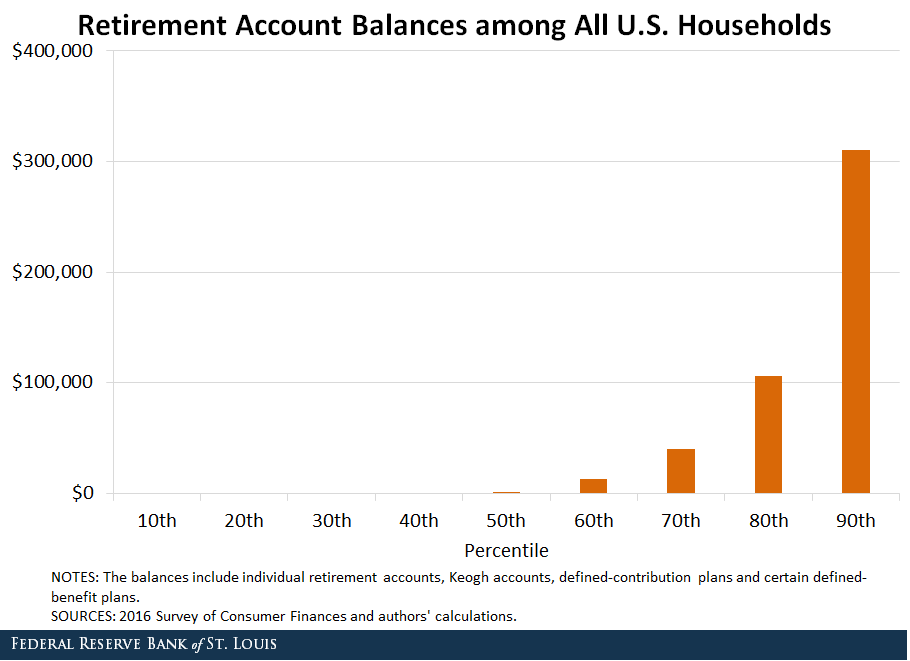
Why should that be a surprise? We’ve been highlighting the fact since KCS’s inception (2011) that asking untrained individuals to fund, manage, and disperse a retirement benefit was an incredibly challenging task made more difficult by the fact that wage growth has been stagnant for two decades! According to the National Institute on Retirement Security,  the median retirement account balance is $2,500 for all working-age households and $14,500 for near-retirement households. That won’t get most people through half a year let-alone an average retirement of 20+ years.

Winning the lottery is not a sound retirement strategy, yet that may be what our future retirees will need to one day retire!

Bitcoin – What Is It? It Sure Isn’t An Asset Or Currency!

In July we dedicated the KCS Fireside Chat to Bitcoin.  I wrote it as much for my education as that of our clients, prospects, and friends. In our a July article we wrote,”If you thought that bitcoins could become a store of value, then the sharp price volatility seen in this currency may just change your opinion.” Furthermore, “The main reason for this volatility is that there is no underlying object/support to which the value of the bitcoin can be pegged.”

Well, if we thought that we were witnessing volatility in July, just take a look at what occurred during the last several days.  Bitcoins experienced a 29% decline in price which resulted in a loss of “value” of roughly $35 billion. At the same time, Bitcoin cash saw its price quadruple. How ridiculous!

Since neither Bitcoin nor Bitcoin Cash is a store of value, we are witnessing a very public game of Russian Roulette. Wolf Richter, Wolf Street, recently penned, “instead of being usable currencies, cryptos – CoinMarketCap lists nearly 1,300 of them, with many of them already worthless – are a form of online betting based on a new technology, and they’re subject to different dynamics than classic online betting, but not regulated or forbidden by governments, unlike classic online betting.”

If you feel that you need to participate in some of this action, we’d suggest that you tread very, very lightly!

KCS November 2017 Fireside Chat – All About DC Plans

We are pleased to share with you the latest edition of the KCS Fireside Chat series.  This article is all about defined contribution plans (DC), with a particular emphasis on some troubling practices.  In addition, we provide the reader with 2018 savings limits.

The tragic hurricane season may prove to be even more harmful in the future, as the government is allowing DC participants to use their precious “retirement” assets to address hurricane-related expenses.  Once again, our government is encouraging bad behavior,  while proving once more that DC plans, as they are currently structured, are nothing more than glorified savings accounts!

We need real retirement vehicles!

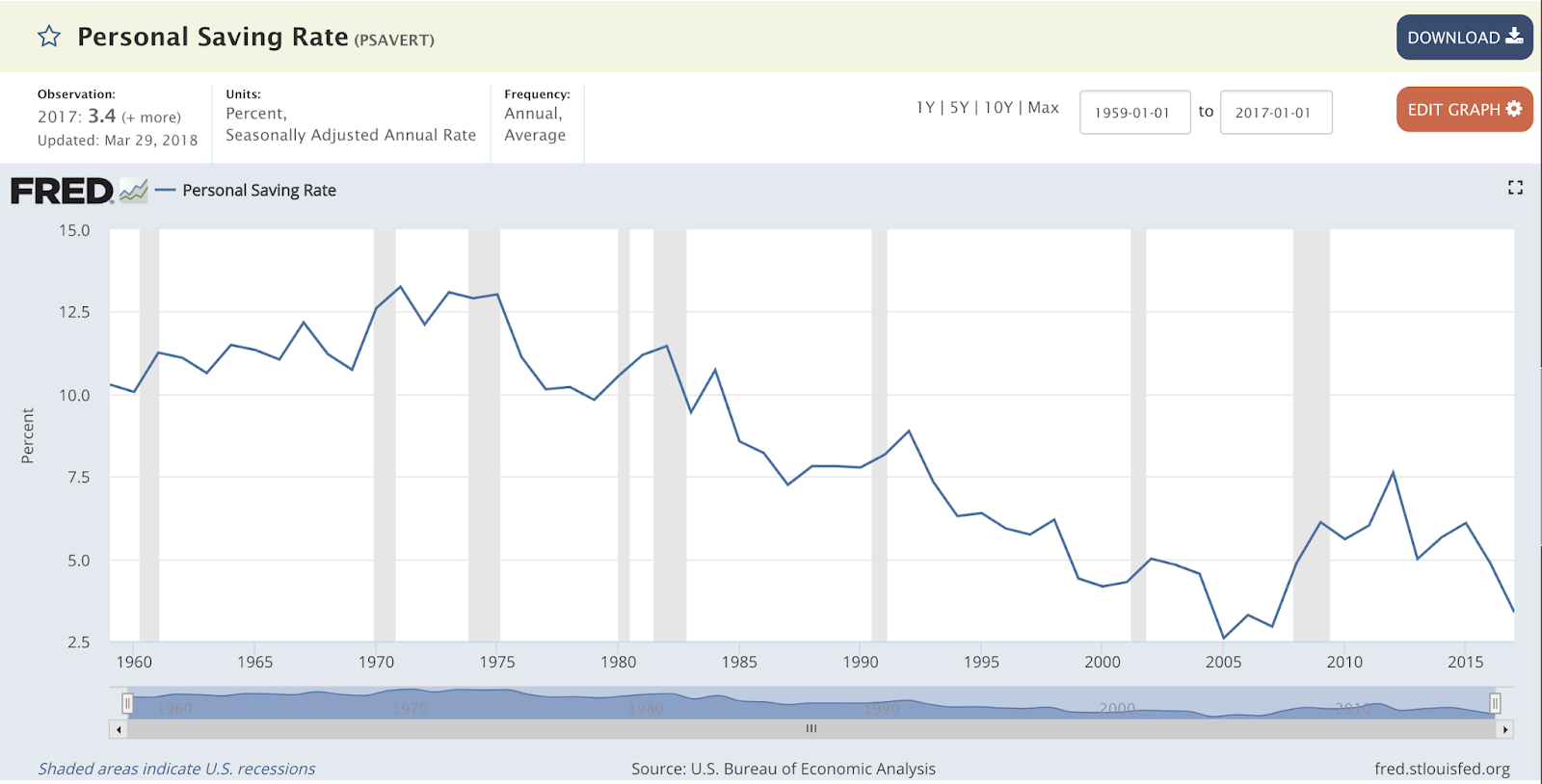
U.S. Savings Rate at Decade Low

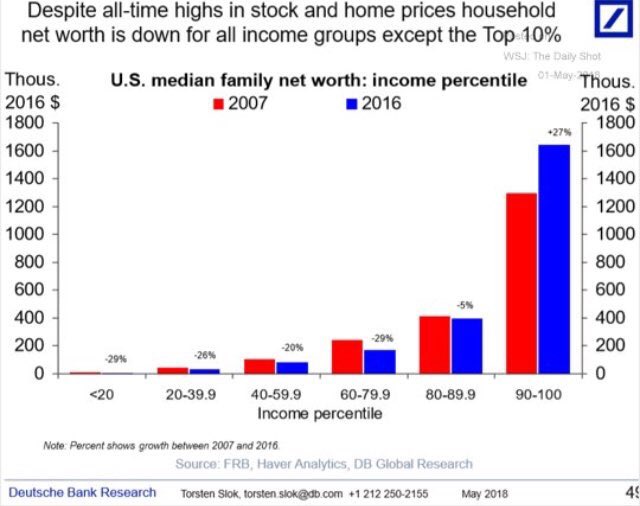
It has been reported that the U.S. savings rate is at its lowest in a decade. An analyst attributed this to the fact that U.S. households’ net worth is at a record high of 670% relative to disposable income. I don’t buy it!

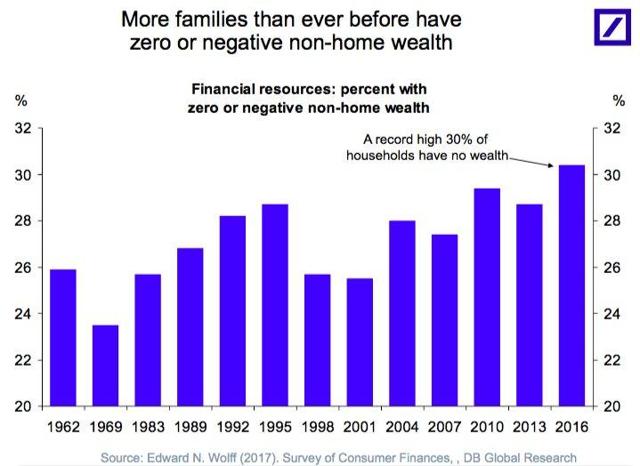
Sure, housing and the stock market gains will have provided paper profits for a subset of Americans, but the median American continues to struggle.  In fact, leverage levels are escalating for the lowest earners (not surprising), who have not enjoyed much, if any, wage growth in the last couple of decades. Leverage ratios are at or near the highest levels for the “bottom” 80%.

With escalating healthcare, education, and housing costs, why do we think that our lower wage earners have the disposable income to fund a defined contribution plan? Let’s finally understand that DC plans should be supplemental savings vehicles for wealthier Americans, as they were originally designed for, and not the primary retirement vehicle for most Americans, especially lower wage earners.

Concepts In Advanced Asset Allocation

What does the title of this post mean to you?

I just got back from Las Vegas (IFEBP), where I had the chance to present twice on this topic.  I began my talk by apologizing up front (usually not a great way to start a talk) to anyone attending the session thinking that they were going to glean insights on how much they should allocate to growth versus value, or large versus small, or U.S. versus international or if they should go into alternatives and hedge funds because that just wasn’t going to happen.

The above-mentioned scenario is played out in nearly every conversation between asset consultant and plan sponsor and has since our industry moved from having a single bank trust department manage the entire pension plan in some balanced approach. The focus on trying to earn incremental return relative to the ROA by shifting among asset classes and managers is a fools game! I equate this to being nothing more than rearranging the deck chairs on the Titanic.

In case you haven’t realized this yet, defined benefit plans are going away in all sectors (public, Taft-Hartley, and certainly, corporate), and the trend isn’t your friend. The fact that we continue to do the same thing year in and year out is mind-boggling! STOP! Managing a pension plan is not an arms race in trying to generate the highest return.  It is all about providing the promised benefit at the lowest cost.

Unfortunately, the ROA is the pension industry’s iceberg. Are you prepared for the coming disaster?

Oh, BTW, I am happy to share with you my presentation that I delivered.  Just ask!

TIme For A Change? How about the S&P 600

For plan sponsors with small-cap exposure, the Russell 2000 index has likely been your preferred benchmark. But why? We would suggest, especially if you have your small-cap manager(s) on a performance fee, that you begin to use the S&P 600 as the benchmark.

For the 20-years ending September 30, 2017, the S&P 600 has beaten the Russell 2000 index by 1.8%. The advantage is not period specific, as the S&P 600 also bests the R2000 by 1.5% for 10-years, 2.1% for 7-years, 1.8% for 5-years, and 1.9% for 3-years. The advantage is not just related to the annual June rebalance, although that event does explain some of the differentials, as some front-running does occur given that the index is more rules-based than the S&P 600, whose construction is driven by a committee.

The S&P 600 is also propelled by screens for liquidity and profitability. Given that the S&P 600 averages less turnover annually than the R2000, the liquidity screen will reduce transaction costs, while the profitability screen (a company must have 4 consecutive quarters of profitability), creates a higher “quality” index.

As the equity markets have rocketed forward this year, lower quality names have been favored, but even in this environment the S&P 600 still maintains an advantage over the R2000 by 0.4% for the first nine months.  Don’t make it easy for your managers to earn their small-cap fees. Use the S&P 600 and make them work a little harder.


Multiemployer DB Plans See Improved Funding in 2017

Milliman is reporting that multiemployer DB plans have seen a pick-up in their funded status during the first half of 2017, as asset returns have exceeded the annual return on asset (ROA) targets.  That is terrific news!

However, that is where the good news ends. For those multiemployer plans that are defined as critical and declining funded ratios continue to hover around 60%.  At that level of funding, plans need to generate returns that significantly exceed the ROA to begin to make a dent in the deficit.

Couple this with the fact that the U.S. is 8 1/2 years into a bull market for equities and 30+ years for bonds, how likely is it that DB plans continue to enjoy outsized returns?  Also, please note that the funded ratio is calculated using liabilities that are discounted at the ROA, and not a risk-free rate.  This methodology dramatically undervalues a plan’s liabilities, and thus inflates the funded status.

Plan sponsors believing that their plan’s funded status is better than it is will naturally act differently than if they had a more realistic view of their current situation.  I know that I would. If I thought that my plan was 90% funded instead of something closer to 60-65%, my inclination would be to maintain the status quo instead of searching for a solution to our underfunding.

It is a positive development that funding has improved for multiemployer plans in general, but let us not kid ourselves that the average plan has a 90% funded ratio.

So, Who Will Help You?

Most everyone is aware of the significant seachange occurring within the U.S. retirement industry. We’ve documented for years the demise of the traditional defined benefit pension and the push by sponsors to use defined contribution plans. This trend has been most notable among corporate plan sponsors, but we are now witnessing this migration in public and multi-employer plans, too.

We don’t like it, especially since it places an unfair burden on most people in this country who are now being asked to become investment management professionals without the appropriate skills to handle this responsibility.  Sure, defined contribution plans give the individual some freedom through portability, but at what cost?

We’ve seen the results from this policy change, and they aren’t pretty.  In fact, they are fairly ugly.  As if that isn’t bad enough, try getting advice from the big wirehouses with an account balance of <$250,000. That’s right, an investor with a “small” account balance will be shuttled to a call center.  Unfortunately, size matters in the financial service industry!

According to an article by Jeb Horowitz, Advisor Hub, Merrill Lynch will only pay their brokers full commission on accounts greater than $250,000, “while giving one-time incentives for referrals to Bank of America’s no-frills Merrill Edge platform. Well, given the average DC balance, that would basically exclude most everyone that wants to roll a DC balance into an IRA. So much for a helping hand.

This post was not intended to pick on just Merrill Lynch, for many of the other wirehouses are doing the same thing.  According to Horowitz, Morgan Stanley and UBS are only offering payouts on accounts greater than $100,000.

So I repeat, we force those less capable of handling a retirement from a DB plan providing a monthly check into a DC plan where they are now responsbile for funding, managing, and dispersing their acccount.  But, when they begin to start the process of dispersing they are most often too small to get the individual expertise that they so desperately need.  No retirement crisis? Are you kidding me!