The PBGC has just announced that two more multiemployer plans that filed applications for the Special Financial Assistance (SFA) have had those applications approved. In both cases, these were Group 1 priority filers that had become insolvent. The Milk Industry Office Employees Pension Plan (Milk Industry Plan) has been insolvent since 2017 at which point the PBGC started to provide assistance. According to the press release that plan will receive $6.6 million to support and restore the benefits for the 78 plan participants for years to come.
The other plan that has been approved is Local 584 based in New York City, New York, which covers 2,172 participants in the transportation industry. The Local 584 Plan became insolvent in July 2021. At that time, PBGC started providing financial assistance to the plan. PBGC has been providing benefits at roughly 50 percent below the benefits payable under the terms of the plan. With the approval of the SFA ($225 million), the participants will see their benefits restored.
This is excellent news for these two plans and their participants, as well as the ARPA multiemployer program. The addition of these two plans brings to seven the number of plans that have had their applications for SFA approved. Each of the seven was a Priority Group 1 plan. Let’s keep the good news rolling.
With regard to this post’s title, I’m not referring to the additional six weeks of winter predicted by Punxsutawney Phil or any other groundhog this past February 2nd. Winter in New Jersey is always cold, gray, and damp well into April no matter what our friendly rodent is forecasting. My reference has to do specifically with the fact that according to the PBGC’s ARPA update (last produced on March 8th) it has been six weeks since either a Priority Group 1 or 2 plan has had its application approved (January 24th was the last). Furthermore, only one pension system has filed a new application for Special Financial Assistance (SFA) during that timeframe.
It is estimated that roughly 80% of the Priority Group 1 pension plans have filed an application so far. However, the Priority Group 2 plans, including those that are expected to be insolvent within one year of the date the plan’s application is filed or those plans that implemented MPRA benefit suspensions before 3/11/2021, have been incredibly slow to file with only 7 having been filed to date since first becoming eligible at the end of December 2021. We know that there are 18 plans that received approval to restructure the promised benefits under MPRA that would now be eligible to file within Priority Group 2 yet only 4 pension plans have filed an application as of March 8th.
As we recently reported, there is no obligation on the part of an eligible pension system to file an application within the prescribed priority grouping, provided that they file by December 31, 2025, and not earlier than the eligible time. I am not going to speculate as to why plans may be delaying their filing, but it must be incredibly frustrating for the plan participants, especially those living with reduced pension benefits, to see the pace of activity so incredibly slow. Priority Group 3 candidates (those with more than 350,000 participants) are eligible to file effective April 1st. That group won’t add too many applications to the pile to be reviewed (perhaps it will only be the Central States plan), but the backlog is growing and the PBGC is obligated to render a decision on each application within 120 days of its filing.
Congress, in crafting the bill, encouraged the PBGC to use an application process that was lean allowing for a quick ruling on these applications. Some of the submissions that I’ve reviewed are >500 pages. So much for a streamlined process!
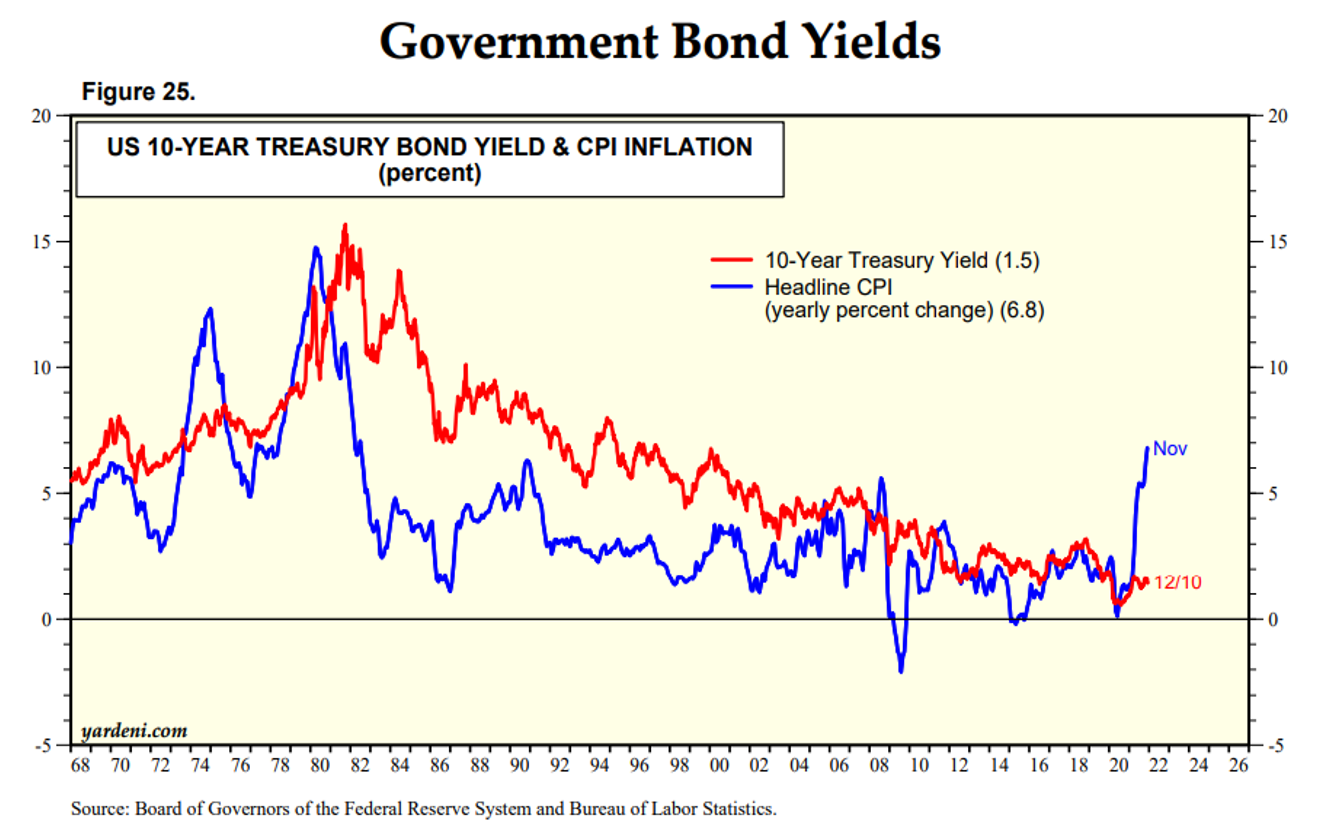
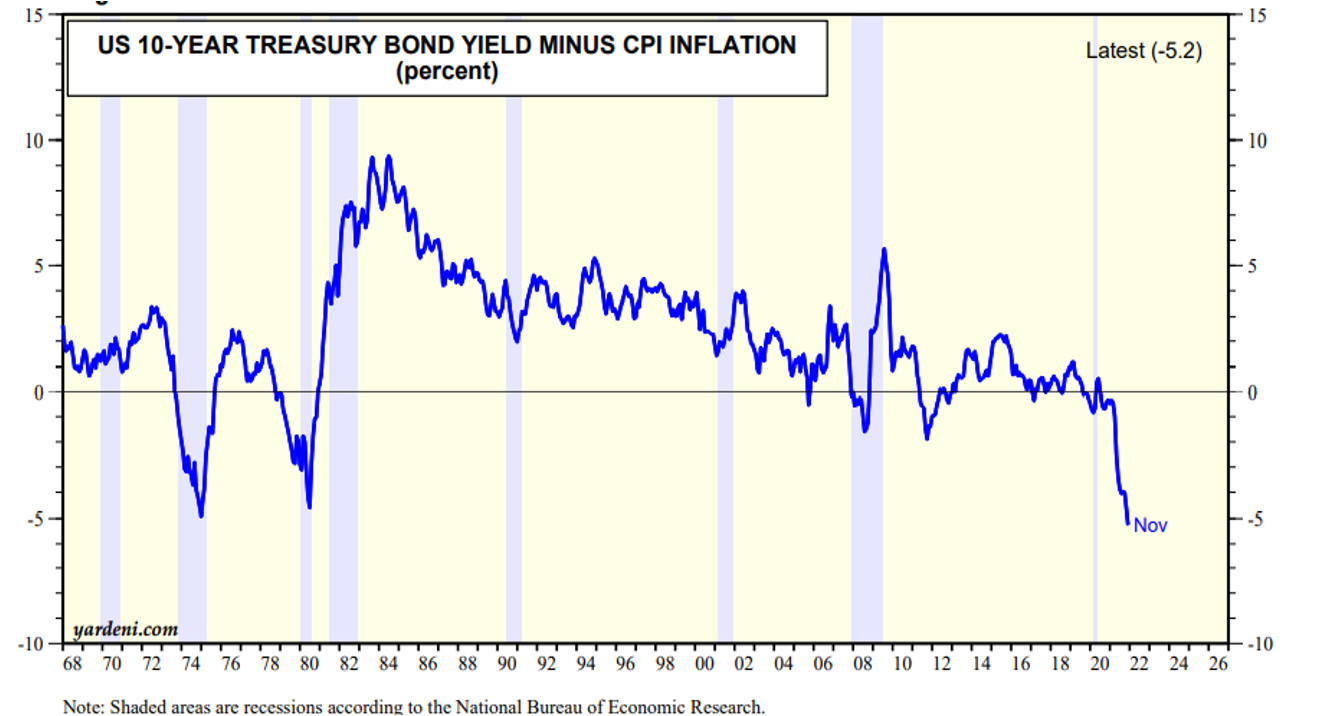
The Bloomberg survey for the 4th quarter of 2022 has the US 10-year Treasury Note yield projected to be 2.25%. The 10-year is currently trading at 1.995% (3/10 at 11:20 am EST). That doesn’t seem to be much of a forecasted increase given today’s announcement that the CPI was recorded at 7.9% and recent trends indicate that the CPI has a high probability of hitting 10% before it resumes a path lower. If the CPI # proves accurate, how is it possible that the 10-year Treasury Note yield is only going to be 2.25% in the fourth quarter? As the chart below highlights, bond investors have demanded a premium real yield with few exceptions, which tend to be short-lived.
As we’ve indicated in previous blog posts, the 39-year bull market in bonds is likely over. An interest rate rise will put pressure on total return bond programs. It only takes a 30 basis points rise in rates for a 7-year duration bond to have a negative return for the year. That isn’t much of a buffer, especially since we’ve witnessed 30 bps moves on a fairly regular basis.
A historic negative real yield?
If predictions hold that we post a 10% CPI during this rampant inflationary environment, a 2.25% yield on the 10-year would equate to a negative real return of 7.75% or roughly 50% more than the previous low in real yields. Why would investors accept this condition? Rising rates will help reduce the present value of your plan’s liabilities, but it will also impair your assets. Why take the risk that asset level falls greater than your plan’s liabilities? Match asset cash flows with liability cash flows to help secure the promised benefits and reduce funding volatility while controlling contributions. DB pension systems are too critically important to allow chance to dictate future outcomes.
The time draws near when this standard goes into effect on your next valuation. Is your actuary ready? The Ryan ALM Custom Liability Index (CLI) is the perfect tool to help plan sponsors AND participants understand the significance of the low-default-risk obligation measure with respect to the funded status of the plan, future contributions, and importantly, the security of participant benefits. We stand ready to assist you with this effort.
The Actuarial Standards Board (ASB) is responsible for setting standards for actuarial practice in the United States and they accomplish that objective through the development of Actuarial Standards of Practice (ASOPs). One such standard, ASOP No. 4 addresses “measuring pension obligations and determining pension plan costs or contributions”. This guideline is not specific to either FASB or GASB, so this standard should be applied by all actuaries when performing the following tasks:
Measurement of pension obligations, funded status, solvency risk, and the pricing of benefits. There are several other areas of focus, but the assessment of a Low-Default-Risk Obligation Measure was the one that grabbed our attention. Section 3.11 of ASOP No. 4 states that “when performing a funding valuation, the actuary should calculate and disclose a low-default-risk obligation measure of the benefits earned or costs accrued as of the measurement date”. When calculating this measure, the actuary should select…
Do you believe that we will see inflation maintained at elevated levels for some time to come? Do you think that bond yields eventually migrate higher to reflect this more robust inflation? After 39 years of a bull market in bonds, do you think that we might just be witnessing a reversal in interest rates? Do you think that equities are a hedge against inflation? Your answers to these questions should drive your asset allocation strategy. As a reminder, we’ve had the wind behind our sails for 4 decades! It’s been perhaps the greatest investing environment ever experienced. Wow, despite what has been a historic time for markets, Pension America’s fortunes aren’t great as most pensions (especially Public) have a deficit-funded status. Are they about to get worse?
The chart below was shared by John Authers, Bloomberg, in his daily blog (which is so good). He captured it from the updated analysis provided by Elroy Dimson, Paul Marsh, and Mike Staunton, “a trio of British academics then working together at London Business School”. Their original work, “Triumph of the Optimists” was published two decades ago. According to Mr. Authers, it is “a massive work of data analysis, aiming to build a history of stocks, bonds, and bills for the whole 20th century, across the globe, to measure the equity risk premium — the average extra annual return compared to bonds or bills that investors gained by taking the risk of buying stocks.” The recent update takes the analysis through 2021 (thank you, gentlemen). There are many charts in this version (and in John’s blog), but I found this one to be the most relevant.
If you believe like I do that the 39-year bull market is ending for bonds, that elevated levels of inflation are here for the time being, and that interest rates will eventually reflect the inflationary environment, then US stocks will have a difficult time for the foreseeable future, as they are NOT an inflation hedge in the short-term. As the numbers above reflect, real equity returns are only 3% during periods of elevated inflation. This future period is also troubling for bonds, but since Pension America, particularly public and multiemployer plans, has increased the exposure to risk assets the more modest equity returns will be quite devastating if this period lasts for any length of time.
What to do? We’ve been very consistent in our messaging. A bear market for bonds will create significant headwinds for total return bond programs. It is time to use bonds for their intrinsic value… very predictable cash flows. Match those bond asset cash flows to liability cash flows (i.e. defease). Not only will the plan’s liquidity profile be enhanced, but you’ve now eliminated interest rate risk for that portion of the assets that are defeased! Furthermore, by bifurcating the plan’s assets into liquidity (beta) and growth (alpha) buckets you are extending the investing horizon for the growth assets to grow unencumbered, as they are no longer a source of monthly liquidity. This lengthened period of investing may actually bridge an uncertain time for equities and equity-like products that are ahead for us. Pension systems need to secure the promised benefits and stabilize the funded status while keeping contribution expenses contained. Our approach accomplishes those goals. Call us at 561-656-2014!
Unlike any other asset class, fixed income (bonds) have two risk/reward values:
Total Return
Certain Cash Flows
Total Return Value
The total return value in bonds is the converse of interest rate movements. When rates go down, as they have from 1981 to 2021, they produce price appreciation and higher total returns. And the opposite happens when rates go up as they did from 1953 to 1981.
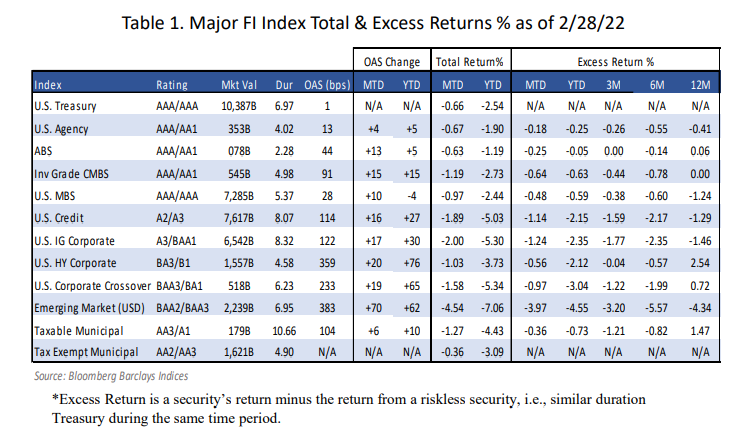
Since the start of 2022, interest rates have trended upward causing negative bond returns (BB Aggregate Index -3.25% YTD thru 02/28/22 ). Given the current inflation rate of over 7.0% on the CPI and over 9.0% for the PPI, coupled with the expectation that the Fed will raise short rates several times this year… this interest rate trend to higher rates should continue. As a result, pensions should expect negative fixed income returns this year and for the foreseeable future.
Certain Cash Flow Value
If you buy bonds for their intrinsic value (certainty of cash flows) you will immunize or mitigate interest rate risk! Since cash flows are future values they are not affected by interest rate movements.Moreover, any excess cash flow reinvested will be able to buy new cash flows at reduced costs. This is truly the value in bonds and we strongly recommend that pensions use bonds as their liquidity or Beta assets. Let the performance or Alpha assets be the non-bond assets. Use bonds to cash flow match pension benefits and expenses chronologically. This synergy of Beta and Alpha assets should secure benefits, reduce funding costs, and buy time for the Alpha assets to grow unencumbered.
Cash flow matching by any name (defeasance, dedication, immunization) may be the oldest fixed-income strategy. It should be the core portfolio of a pension and the fixed income strategy chosen by pensions today given the likelihood of higher interest rates. With stocks also struggling this year (S&P 500 -10.7% YTD thru 03/07/22), a cash flow matching bond allocation will buy time for the equity allocation to recover without any dilution to fund benefits and expenses. It isn’t too late to change your fixed income approach, as we are only in the 1st inning of what could be a full 9-inning game!
“Increasing equity exposure in the hope that a greater return will reduce the need for future contributions hasn’t yet proven to be true. It has ensured that total expenses (management fees) have gone up, as well as the overall volatility of the funded status, but success hasn’t been guaranteed. Given where valuations currently reside, either dramatically reduce the equity exposure or reconfigure your fixed-income exposure from a total return-seeking mandate to a cash flow matching implementation that now allows time for the alpha assets to recover after the next equity market correction. There will be one!”
We are monitoring closely the application filings for Special Financial Assistance (SFA) under ARPA which began with Group 1 eligible plans in July 2021. Group 1 plans were those pension funds that were already insolvent or those that were forecast to become insolvent before March 2022. To date, 18 Group 1 plans have filed an application. I reached out to the PBGC to see if all the eligible plans in that Group had been filed and they let me know that they don’t have a complete list of all eligible plans and they only know in what Priority Group a pension system is once the application has been processed. However, my contact did estimate that roughly 80% of the Group 1 eligible plans have filed an application with the PBGC.
As a reminder, the ARPA legislation states:
APPLICATION DEADLINE.—Any application by a plan for special financial assistance under this section shall be submitted to the corporation (and, in the case of a plan to which section 432(k)(1)(D) of the Internal Revenue Code of 1986 applies, to the Secretary of the Treasury) no later than December 31, 2025, and any revised application for special financial assistance shall be submitted no later than December 31, 2026.
There is no penalty for filing an application after the next Priority Group begins but as the language specifies, new applications must be submitted by December 31, 2025. I’m sure that these plans have their reasons for not yet processing an application, but personally, I’d want to get the SFA as soon as possible and have it begin working for my plan and participants. More to come!
I suspect that those who read this blog regularly are likely able to finish this next point before they get to the end of the sentence. But it is worth repeating. The primary objective in managing a DB pension plan is to SECURE the promised benefits (liabilities) in a cost-efficient manner and with prudent risk. If everyone had focused on that objective 4 decades ago, instead of a return objective, we wouldn’t have a pension funding crisis today. Pension plans could have secured the promises with very little risk back in the early 1980s. In fact, investing solely in the Lehman Aggregate Index (now Bloomberg Barclays), one would have achieved a 40-year annualized return of 7.69%, easily beating most ROA objectives, with only a 4.65% standard deviation. Yes, you read that right – only a 4.65% SD over 40-years, which equates to a Sharp Ratio of 0.77.
One didn’t have to get fancy by adding a plethora of products/asset classes, reducing liquidity to meet benefits in the process, while enduring ever-growing contribution expenses. No, a simple strategy to invest 100% in fixed income would have solved all of your funding issues. All of them! Regrettably, we outthought ourselves and as a result, we are paying the piper today. Major cities are struggling under the weight of the contributions that they must make, as they take up more and more of the annual budgets. Corporate America has basically abandoned private pension plans. None of this had to happen if we had just remembered that the pension objective is to secure benefits.
We missed the opportunity in the early ’80s and again in 1999 when most pension plans were fully funded. We equated the yield of a bond with its return, which is not correct. As bond yields declined asset allocation “strategies” minimized the use of fixed income believing that bonds would be an anchor on returns. As a result, we subjected our plan’s asset bases to huge volatility, perhaps 3-4 times the volatility of the Aggregate index. As I wrote the other day, the main consequence of riding the asset allocation rollercoaster is the tremendous growth in contributions, which you can’t recoup.
At the end of 2021, we were imploring pension America to take risks off the table. Funded ratios had been improved and markets performed well above long-term expectations. Did anyone listen? Unfortunately, equity and fixed income markets have performed poorly to start the year. Funded ratios and funded status are under pressure. Inflation, the possibility of rising rates, and war in Europe are creating potentially huge headwinds for our pension systems. The good news: it isn’t too late to do something about it.
As we’ve discussed, traditional total return fixed income programs will be under stress in a rising rate environment. The 39-year bull market in bonds may have expired. It doesn’t take much of an interest rate move upward to generate some pretty ugly performance. The following chart from RW Baird highlights the impact in just the first two months of 2022 on a variety of fixed-income instruments.
Solution: Don’t use the fixed income assets for returns. Use bonds for their cash flows, as they are the only asset class with a known cash flow schedule of interest and principal payments (ie future values). One can construct a carefully matched portfolio of asset cash flows to liability cash flows to secure those promised benefits at both a reasonable cost and with prudent risk! Sound familiar? Defined benefit plans need to be protected and preserved as they are the only true retirement account. However, burgeoning contribution expenses are jeopardizing the future of these important vehicles. Let’s get back to pension basics. Treat your pension system as if it were a lottery system or insurance company. Understand what that future promise looks like and manage to it. Don’t let a return-focused asset allocation strategy guarantee more volatility with no assurance of success.
Many US states find themselves with surplus funds after significant support from ARPA legislation. Although direct DB pension plan support was not a permitted use of the ARPA proceeds, states with surpluses are looking for ways to prop up their underfunded systems. One state, Michigan is considering making available to its municipalities $1.15 billion in state grants to help pay down the unfunded pension liabilities.
“House Bill 5054 would make $900 million in grants available to municipalities with pension plans less than 60% funded and $250 million for those that are at or above the 60% mark if the governmental units agree to a series of conditions (my emphasis).” source: (The Bond Buyer)
The proposed legislation would also direct another $350 million to the state police retirement system. Local government groups are said to be in favor of this proposal as the state contemplates the allocation of $7 billion in surplus revenues.
Importantly, these grants would come with conditions that I believe are quite appropriate for plans that are as poorly funded as those that would be eligible to receive the payments. Pension systems that are <60% funded must make all actuarially determined contributions and hold the discount rate and the assumed rate of return (ROA) at current levels or lower. Furthermore, they must adopt the most recent mortality tables recommended by the Society of Actuaries and they must not enhance benefit payments for 10 years after accepting the grant or the local unit must repay the full value of the grant.
Future benefit increases can only be adopted if the system is 80% funded and the value of the new benefit is 100% funded. We, at Ryan ALM, are huge supporters of DB pension systems, but we believe that the current pension promise should absolutely be secured before benefits are enhanced. It makes little sense to us that pension systems jeopardize the plan’s overall funding in an attempt to elevate current payouts. The legislation limits Grants to a maximum of $100 million per system.
It is great to see legislators utilizing excess funds to sure up their pension systems. Poorly funded plans are hard-pressed to close the funding gaps through investment returns only. Remember that a 50% funded plan must beat the ROA by twice in order to maintain the funded status. Yes, a plan that is 50% funded and has a 7.5% ROA objective must generate at least a 14.5% annual return, or the funding gap grows in $ terms. How likely are we to see above-average returns from the capital markets given the extraordinary returns achieved in the markets since the Great Financial Crisis (GFC)? When investments fail to achieve the objective plans must contribute more. House Bill 5054, if passed, shows that the legislators are not waiting to see if Michigan plans fall short of their objectives. Good for them!