Will The Fed Get “Real”?

By: Ronald J. Ryan, CEO, Ryan ALM, Inc.

Chairman Powell and the Fed have been steadfast in their stated goal of 2.0% inflation as measured by Personal Consumption Expenditures (PCE). The November PCE was announced today at 2.6% YoY. The Fed also has consistently expressed a goal of real rates or the inflation premium. The Fed has not announced a target real rate but the historical average is about 3%, as suggested in the chart below.

Indeed, most pensions have an inflation premium built into their plan’s projections of about 3%. But let’s assume that 2% is an acceptable Fed real rate target. That would suggest nominal rates of about 4.6% on the 10-year Treasury. Currently, the 10-year Treasury is at 3.86%. As Russ suggested in a blog post from earlier this week, has the investing community gotten ahead of themselves? If PCE inflation went to 2%, a real rate of 2% would suggest a 4.0% nominal 10-year Treasury, which would be slightly above where the market is today. This reality would not suggest interest rates should trend lower in 2024.

The question remains… where will inflation (as measured by the PCE) level off? Who knows… there are too many factors to consider. With durable goods coming in at 5.4% increase for November, two wars being financed and an election year looming, it is hard to suggest a recession is forthcoming. But why speculate on interest rates. With interest rates so much higher than they were in the last 10 years, why not defease Retired Lives? The value in bonds has always been in the certainty of their cash flows. Use bonds for their value and defease the most certain liability cash flows (Retired Lives). The Ryan ALM cash flow matching model (Liability Beta Portfolio™) can reduce funding costs by about 2% per year (1-10 years = 20%).  

Did the Bond Market (and Investors) Get Ahead of Itself?

By: Russ Kamp, Managing Director, Ryan ALM, Inc.

It wasn’t two months ago that Treasury yields were approaching or had breached 5% across the yield curve. Today, those yields are just above or below 4% for maturities 3-years and out. What changed? Clearly, the Fed’s messaging has indicated to the investment community a sea change related to future interest rate moves. But what has changed from an economic perspective to warrant such a dramatic move? US employment remains near historic levels. Labor participation rates are growing. Wages are increasing at a decent rate. The US economy continues to outperform expectations. Core inflation remains elevated at nearly 2X the Fed’s 2% target. Where is the long-anticipated recession? Oh, and by the way, housing starts blew away expectations today at 1.56 million units when 1.36 million were anticipated. This is the most activity since May 2023, and the lower mortgage rates (7.34% from the peak at 8.28%) might just continue to thrust housing forward.

Was the reaction to the Fed’s third consecutive meeting pause an overreaction? Is the expectation among investors that the Fed’s next move must be to reduce rates a reflection of living with 40-years of Fed easing anytime that there was a wobble in the investing world? Has the potential Fed easing in 2024 been fully priced in already and what might that mean for bond investors as we go through 2024 and beyond? Are you confused yet? Well, that isn’t surprising since most of us have never been through a protracted secular interest rate rise such as the one experienced from 1953 to early 1982. Well, as the chart below highlights, you aren’t the only one who is uncertain as to where US interest rates might be at the end of 2024. Thanks to the following Bloomberg chart that my college Steve DeVito (Ryan ALM’s Head trader) grabbed from LinkedIn.com, it seems like strategists on Wall Street are also at odds with one another as to where rates are going.

I suspect that if this chart had been produced at the end of October 2023, there might be greater unanimity as to the future direction of rates given that the 10-year Treasury yield was at nearly 5% at that time. At 3.89% (10:24 am EST on 12/29) there is far greater uncertainty. Again, given the economic backdrop, why should the 10-year be trading at a negative real yield to US core inflation?

There is some speculation in the market that the significant rally in bonds was partially fueled by hedge funds unwinding their short future positions, which had been significant since the Fed began raising rates. I think that there is some merit in that opinion despite not having position reports to support that thought. It just doesn’t seem that the current economic environment would support such a robust drop in rates just because the Fed refused to elevate rates for the third consecutive meeting.

Given the uncertainty in today’s market, why make an interest rate bet? Being long fixed income benchmarked to the BB Aggregate Index is an interest rate bet. The plan sponsor and their consultant believe that at worst rates will remain at this level in which the manager will capture the yield of the portfolio. If rates were to fall there might be some appreciation (on paper at least) to go along with the interest. However, if the market has moved to quickly and created in the process an overbought US bond market (at least Treasuries) the possibility of capital depreciation exists should rates reflect the current environment and not some future state that might not be achieved.

Take this opportunity of higher rates and use corporate bonds to defease your plan’s Retired Lives Liability (RLL) chronologically as far into the future as your bond allocation will cover. Given that benefit payments are future value promises they are not interest rate sensitive. No guessing or hoping needed. The cost reduction to defease the plan’s liabilities is locked in on day one of the strategy being deployed. How comforting would it be to know that no matter what transpires in the capital markets your plan participants will receive their promised benefits. It is very easily arranged and quite cost effective. Give your DB plan participants a Christmas present by defeasing your liabilities while reducing funding costs with certainty.

ARPA Update as of December 15, 2023

By: Russ Kamp, Managing Director, Ryan ALM, Inc.

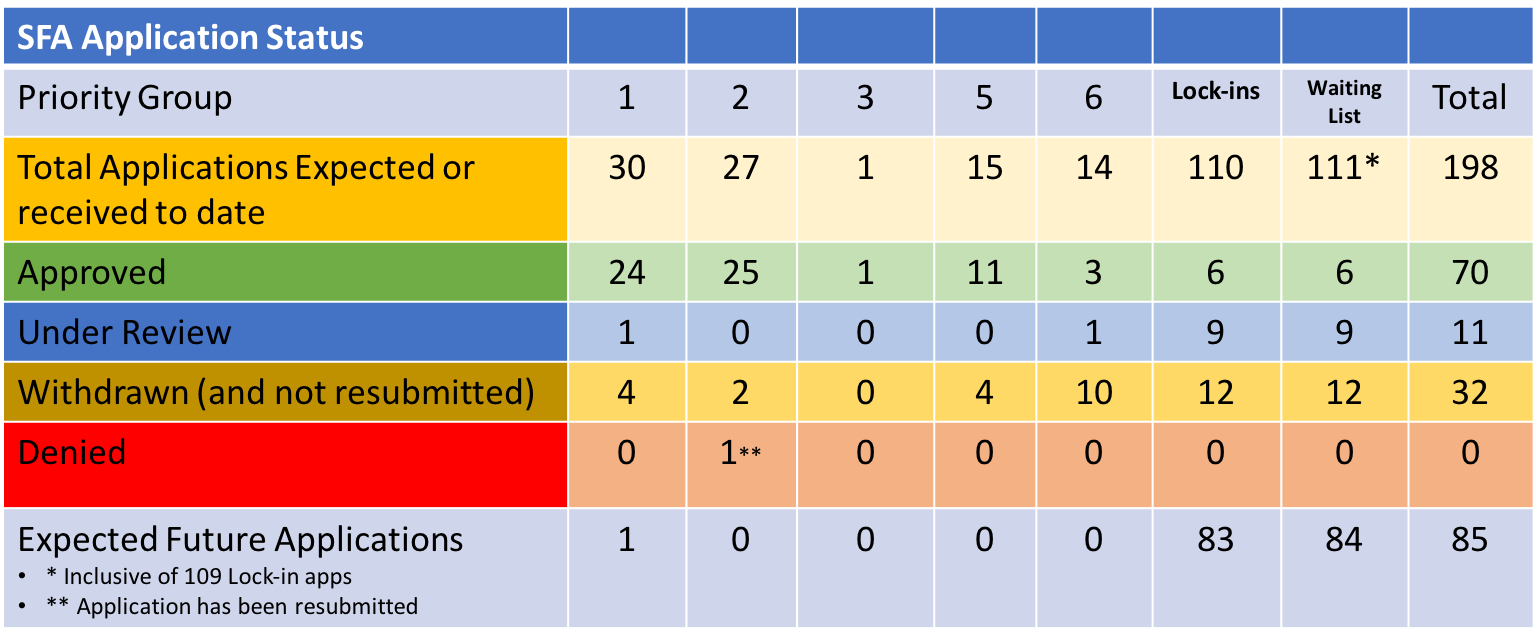
There is nothing new to report for the second consecutive week. There were no new applications received, denied, withdrawn, or approved, and no new non-priority plans added to the waiting list. I’m sure that there is a lot going on behind the scenes, but the waiting must be frustrating for the roughly 130 pension plans that are still in the queue to have their applications reviewed/approved.

I am under the impression that some of the delay may be related to ensuring that the census data that was provided in each application is accurate. I would imagine that becomes a very tedious process, especially for some of these plans with 1,000s and 1,000s of participants. Unfortunately, the delay in processing these applications has a real cost to it, as Treasury yields have plummeted during the last 6 weeks. The lower yields elevate the present value (PV) cost of those future value (FV) benefit payments that are to be made by the Special Financial Assistance (SFA). The greater cost reduces the coverage period and the security that comes with a fully defeased benefit.

Conditions Have Eased Substantially

By: Russ Kamp, Managing Director, Ryan ALM, Inc.

Inflation has moderated. That is the good news. But the current level of inflation is not yet near the Fed’s target of 2%. Despite the Fed’s effort to force inflation down with a very aggressive tightening that has seen the Fed Fund’s Rate (FFR) elevate from 0% to 5.25%-5.5%, inflation remains sticky, especially with regard to the services sector and housing.

What may make the Fed’s job more challenging is the fact that the investing community feels that the Fed’s task has been achieved. It was only about 6 weeks ago that the Treasury curve had yields for the key rates at or above 5%. Today the 10-year Treasury note’s yield is 84 bps lower. The impact of falling Treasury yields and risk on trades has made the access to financing much easier. As the graph below highlights, conditions haven’t been this easy since February 2022.

Core inflation, which excludes volatile food and energy prices, rose 4.0% on an annual basis after climbing the same amount in October. This reading clearly demonstrates that the Fed’s task at hand isn’t over. Yet, the significant rally in Treasuries and the subsequent collapse in bond yields has to make the Fed’s job more challenging. There currently seems to be unanimity among the investing community that the Fed’s next action is to lower rates. Some of that feeling is based on the inflation trends and other aspects just plain hope, which has never been a great investing strategy. But how likely is that given the easing financial conditions?

Could the recent action in Treasuries force the Fed to maintain the current FFR for longer than they had anticipated? Could the easing of financial conditions and the significant deficit spending by the U.S. government (already have a $391 billion deficit for fiscal 2024 after only 2 months) counteract the progress that has been made by the Fed? Perhaps market participants should adjust their focus from the U.S. consumer and concern that they are getting stretched to the U.S. government and the stimulus that is being provided that will continue to prop up the U.S. economy.

One is Tough – Both Nearly Impossible!

By: Russ Kamp, Managing Director, Ryan ALM, Inc.

For most Americans buying a house has become nearly impossible, especially since the Fed’s aggressive rate increases beginning in March 2022. As the WSJ reported earlier today, and highlighted in the below graph, affordability has never been more challenging.

Mortgage rates have recently fallen to 7.6% (conventional 30-year) having peaked at 8.28% earlier this year. However, home prices have continued to rise, with the median house in the US hitting $392,000 in October, as supply of single family homes remains incredibly tight. In today’s environment, buying a $400,000 home with 20% down and mortgaging the balance over 30-years results in today’s purchaser incurring nearly $360,000 more in interest expense. In order for the new homeowner to keep their $2,000/month for housing budget intact, you’d have to find a house for about $295,000 or roughly $100,000 less than the current median cost. Good luck!

At the same time, working Americans are being asked to fund their retirements that employers once did. The combination of funding a defined contribution plan and trying to put a roof over one’s head is a math problem that many can’t solve. Many Americans are trying, but few have the financial means to fund at a level that will come close to providing a “benefit” that will replace 70% of their pre-retirement income for their golden years. This reality is why it is so critically important to have a retirement benefit that doesn’t rely on the individual worker to fund, manage, and then disburse the proceeds.

I’ve mentioned just two of the major expenses facing Americans. What about health insurance, student loan debt, property taxes (especially if you live in NJ), food, energy, clothing etc. Try buying a new car? Fortunately, we are at full employment (3.7% unemployment) and wage growth remains right around 4% annually. But is that enough to keep Americans housed and contributing to their retirement programs? I’m not sure and I really worry about the generations following the Boomers.

ARPA Update as of December 8, 2023

By: Russ Kamp, Managing Director, Ryan ALM, Inc.

Hibernation – the condition or period of an animal or plant or the PBGC spending the winter in a dormant state. Only kidding, as I’m sure there is a tremendous amount of work going on behind closed doors by the PBGC regarding the implementation of ARPA’s Special Financial Assistance (SFA). That said, there was no activity – none – reported by the PBGC for the week ending December 8, regarding applications received, approved, denied, or withdrawn, and no new pension plans were added to the waiting list for non-priority group members.

There may not have been much noticeable activity from the PBGC, but I suspect that there is a lot going on within the various plans that have received the SFA. For those plans that didn’t use 100% investment grade (IG) bonds either in a cash flow matching (CFM) defeasement strategy or one that might have been more active versus some generic index (i.e. BB Aggregate Index), the use of equities will necessitate a rebalancing back to a 67%/33% minimum IG exposure within a 12-month period as stated in the legislation. Plans that received the SFA in 2022 will have already rebalanced, but those only getting the grant in 2023 still have a bit of time to get back within compliance.

Despite the recent rally in bonds, the selling of equities and the subsequent buying of bonds will allow plan sponsors to sell high and buy low, as equities have performed well, especially if the money was invested in the S&P 500 index and buy bonds at lower prices as yields are up during the last 12 months.

Why the Disconnect?

By: Russ Kamp, Managing Director, Ryan ALM, Inc.

For years we’ve attempted to reorient the plan sponsor community away from focusing their plan’s asset allocation on total return to one that secures the promised benefits through a focus on the plan’s liabilities. You know, the promise that has been made to the plan participant. At Ryan ALM, we believe that the primary objective in managing a defined benefit system is to SECURE the promised benefits at a reasonable cost and with prudent risk.

Given our expertise, we’ve been heartened by the increased focus on asset/liability management (ALM) strategies, and not just within the private pension universe. Consultants, actuaries, and plan sponsors are more willing to discuss the opportunity to reduce risk, while securing the promised benefits given the current U.S. interest rate environment. The goal of any ALM strategy is to align the fund’s asset cash flows with the liability cash flows or future obligations of the pension plan. The careful cash flow matching of the plan’s assets with the fund’s liabilities also acts to mitigate interest rate risk, since benefit payments are future values that are not interest rate sensitive. Importantly, through a cash flow matching (CFM) strategy, the plan’s liquidity is enhanced, and benefit payments are secured chronologically from the first month as far into the future as the allocation goes.

ALM is NOT a return objective, since the careful matching of assets and liabilities ensures that they move in lockstep with each other whether rates are rising or falling. Those liabilities should be removed from the funding equation. The balance of the assets should be used to meet future liability growth. These assets can now be managed as aggressively as needed since the CFM mandate has bought time by creating a longer investing horizon.

We were grateful to recently be included in a search conducted by a leading asset consulting firm that was seeking to employ a strategy to secure the overfunded status for their pension client. We produced a series of reports highlighting the fact that we could defease all of the plan’s liabilities as far into the future as the actuary could forecast. Effectively, they had won the pension game. Congratulations! Yet we were recently told that they were leaning toward a duration matching (DM) strategy because DM products will outperform CFM. What? Our CFM is heavily skewed to A/BBB+ corporate bonds which should outyield any duration matching strategy since they tend to use higher rated bonds especially Treasury STRIPS for longer durations. Again, the use of ALM strategies is to reduce risk and secure the promised benefits. It isn’t a return seeking effort. Save that for the residual assets that now have time to wade through whatever markets will present in the future.

Furthermore, CFM strategies will always out perform DM mandates at the same duration/maturity because of the higher yield, especially the Ryan ALM CFM product that emphasizes A/BBB+ exposure. Furthermore, since the longest duration today of any bond is around 17 years, DM products are forced to use low yielding Treasury STRIPS past 17 years. Whereas CFM can buy 17- to 30-year A/BBB+ bonds to cash flow match long liabilities. The difference in yield could be significant at +100 bps or more.

Plan participants are counting on the benefits to be paid as promised. We have an obligation to manage them with that goal in mind. Let’s get off the asset allocation rollercoaster driven by the industry’s focus on return that only creates incredible uncertainty regarding the volatility of returns, contributions, and funded status. If you are going to engage in ALM/CFM, please focus on how best to neutralize assets and liabilities and forget return. It isn’t part of the game plan.

Corporate Pension Funding Deteriorates in November – Milliman

By: Russ Kamp, Managing Director, Ryan ALM, Inc.

Milliman has published the results of the latest Milliman 100 Pension Funding Index (PFI) that reviews the funding for the 100 largest U.S. corporate pension plans. November wasn’t a great month for funding as the significant drop in the discount rate of 65 basis points (6.20% to 5.55%), the largest monthly decline since 2008, saw pension liabilities escalate by $82 billion. This hurdle was too much to overcome despite a stellar investment gain of 6.53%. The collective funded ratio dropped from 104.1% at the end of October to 103.2% as of November 30th.

The market value increase of $74 billion inassets was the best performance for the index in 2023. Collectively, the index constituents now have $1.302 trillion in assets. However, the $82 billion in liability growth resulted in funding deterioration of $8 billion during the month, leading to a decline in the surplus which now stands at $41 billion.

According to Zorast Wadia, author of the PFI. “All eyes will be on where interest rates and plan asset values end up in December, as this will lay the foundation for 2024 pension calculations for calendar-year plans.” As part of their monthly review, Milliman looks at the potential impact on funding from both an optimistic and pessimistic forecast.  Under an optimistic forecast with rising interest rates (reaching 6.2% by the end of 2024 and 6.8% by the end of 2025) and asset gains (9.8% annual returns), the funded ratio would climb to 117% by the end of 2024 and 131% by the end of 2025. Under a pessimistic forecast (4.9% discount rate at the end of 2024 and 4.3% by the end of 2025 and 1.8% annual returns), the funded ratio would decline to 93% by the end of 2024 and 85% by the end of 2025.

That is quite some gap in potential funding under those two scenarios. As we’ve been saying, given the uncertainty as to the Fed’s interest rate policies going forward, why make an interest rate bet by waiting? Despite the recent pullback in rates, we are still in a very supportive interest rate environment in which to take risk from your DB plan. SECURE a portion of the Retired Lives Liability today which will ensure that the liquidity necessary to meet the promised benefits is there, while extending the investing horizon for your growth or alpha assets. This extending investing horizon will help the pension plan wade through potential market turmoil. Plans that adopted a cash flow matching strategy in October have secured the pension promises at much more attractive rates leading to far greater cost reduction of those future benefits. Who knows what December holds, let alone 2024.

What is Duration?

By: Russ Kamp, Managing Director, Ryan ALM, Inc.

There seems to be a fascination in our industry about using the duration of bonds to help mitigate pension funding risk, but does it? Let’s start with the basics. What is duration? Duration is the average life of cash flows priced or weighted by present values (market values). Duration is commonly used as a measure of the price sensitivity of a bond to changes in interest rates. The purpose of duration matching is an attempt to match the interest rate risk sensitivity of assets to liabilities. The objective is to have the market value or PV changes (growth rate) in the bond portfolio match the market value or PV changes (growth rate) in liabilities for a given change in interest rates. Problem: because duration is a PV calculation, it is constantly changing, which creates the need to constantly adjust the plan’s asset allocation! More problems: duration is not calculated by the actuary so where do you get the duration of liabilities?

Furthermore, duration matching strategies are implemented by either using a single average duration or by investing in several key rates along the yield curve. The truth is that liabilities are a term structure of monthly liabilities. You need to match this entire liability yield curve to match its interest rate sensitivity. Moreover you have to match or exceed the discount rate used since duration does not include income in its calculation. As a result, a portfolio of US Treasury STRIPS will not match the liability growth rate if liabilities are priced as AA corporate bonds (ASC 715 – FASB rules). Duration is far from a precise mathematical calculation (see Seven Flaws of Duration research on our web site for more insights) given the volatility of interest rates and the fact that yield curves do not move in parallel shifts.

Frequently, duration strategies are implemented by fixed income managers attempting to match the average duration of the bond portfolio to the average duration of a bond market index with a similar duration to the pension plan’s liabilities (i.e., Bloomberg Barclays Long Corporate Index). They use the generic bond index as a proxy for liabilities, but no two pension plan liability streams will ever be the same – they are like snowflakes.

Actuarial practices use PV to calculate the funded ratio and funded status. But benefit payments are future values (FV). This suggests that the future value of assets vs. the future value of liabilities is the most critical evaluation. But most asset classes are difficult (impossible) to ascertain their future value. This is why the PV is used. Only bonds (and insurance annuities) have a known future value and have historically been used to cash flow match (CFM) liabilities (i.e. defeasance, dedication). Importantly, duration matching strategies DO NOT provide the liquidity needed to secure the promised benefits.

What is the primary objective in managing a defined benefit pension plan? It is to SECURE the promised benefits at a reasonable cost and with prudent risk. How does a duration matching strategy secure the benefits? Only a cash flow matching strategy can match and fund the monthly benefits and expenses chronologically. Importantly, a CFM strategy provides a more precise duration matching then duration matching strategies do, as each and every monthly liability payment of the CFM program is duration matched as opposed to a few key rate durations.

Duration matching products are a poor substitute for cash flow matching programs if the desired goal is to ensure that the plan’s promises to the participants are SECURED each and every month, as duration matching products fall short as a result of the following:

  1. Duration matching does NOT fund and does NOT secure benefits
  2. Duration is a PV calculation so it is very interest rate sensitive – benefit payments are FV and not interest rate sensitive
  3. Duration changes every day requiring frequent rebalances
  4. Generic bond indexes typically used as proxy for liabilities
  5. No generic bond index can match client’s unique liability cash flows
  6. Forced into buying costly Treasury STRIPS after 16 years

If it is That Good, Why Disclose it?

By: Russ Kamp, Managing Director, Ryan ALM, Inc.

Every investment management organization believes that it has some secret sauce that provides their investment process with the ability to consistently add value. If that were true, one would think that the special insight(s) would be carefully guarded. Yet, I see on a fairly regular basis emails touting various investment insights from one firm after another. Why? In an investment landscape that has proven to be incredibly challenging for advisors to actually add value relative to stated objectives, the sharing of one’s secret sauce seems detrimental to one’s ability to consistently add value.

In a previous life, I was the head of Invesco’s quantitative equity business (roughly $30 billion in AUM). I was extremely fortunate to work with and learn from so many incredible investors. Our fundamental ideas were implemented in a systematic fashion as we attempted to remove as many biases as we could from the investment process. As good as our insights were, they didn’t always work in every investing environment. We would monitor our indicators on a regular basis to make sure that the forecasting ability of the insights wasn’t deteriorating, which occasionally one would. I can assure you that we were incredibly protective of our ideas and how they were carefully blended to form our stock selection model.

So, I was surprised to see an email today highlighting the forecasting ability of a particular “factor”. In this case, it was a Free Cash Flow factor. Now, we used FCF as one of our indicators 20+ years ago, so there isn’t anything particularly new. But, again, why highlight the supposed value added? Back in 2007, the quant space underwent a significant correction as many of the leading practitioners were engaged in very crowded trades as a result of having significant value biases among their various models. It wasn’t that these firms lost their edge, it was the result of too much money chasing to few good ideas.

Investment firms in our industry have a tendency to grow AUM far beyond the natural capacity of an insight or strategy. The result is the arbitraging away of one’s own insights rendering those factors more harmful than good. Again, if capacity is an issue, and it is, then why highlight one’s secret sauce? The capacity of a particular insight is going to be different depending on that factor. Each one will have a different alpha decay that is dependent the availability of the data, on the number and size of other investment firms using that insight or a similar idea, the trading frequency of the strategy, the AUM of the strategy, and where it is applied to various segments of our equity market, such as small cap exposure. These insights need to be monitored closely and changes shouldn’t be frowned on, as strategies that don’t evolve are ultimately going to be rendered to the status of expensive index funds, at best.

At Ryan ALM, Inc. we are not engaged in stock selection activities and our selection of bonds for our Cash Flow Matching (CFM) portfolios depend on many fundamental and quantitative credit research ideas. However, we do have a unique cost optimization process that we believe differentiates us from our competition. Our model has proven to be extremely cash flow efficient. What does that mean? It means that we don’t have a lot of excess cash from month to month which would reduce the cost savings of the implementation longer-term. All CFM implementations are not the same.

Getting behind the curtain of the various CFM strategies is not easy, but it should be a task worth pursuing. One way to accomplish the objective would be to ask multiple CFM managers to “build” a portfolio using the same projected benefits/expenses and contributions in order to see which firm produces the greatest reduction in cost, which can be impacted by factors such as the the type of securities used, credit quality, length of the assignment, etc. You can try to get us to disclose our secret sauce – good luck. We will, however, be happy to produce an initial review of a potential CFM portfolio so that you can evaluate the benefit(s) of adopting a Ryan ALM CFM program in order to compare us to the competition. We aren’t scared.