Why Pixie Dust Isn’t necessary

Yesterday we wrote about CalPERS, and the request by Dane Hutchings, legislative representative to the League of California Cities, imploring the CalPERS team to “think outside the Box” in order to generate a fund return that exceeded their 7% annual return on assets objective (ROA). We were wondering what magic potion they might discover that would altar the long-term return expectations for a variety of asset classes.

However, managing a pension plan isn’t about generating the highest return, but it is very much about providing the promised benefit at the lowest cost. As we’ve stated many times before, the true objective for a pension system is that plan’s specific liabilities, and not some made up ROA. We would like to further explain.

  1. Liabilities are highly interest rate sensitive. If rates go up (as most believe that they will) there is a good chance liability growth in present value dollars will be negative, just as the return on long bonds would be negative in that scenario, too.
  2. A pension plan’s true growth objective is to have asset growth exceed liability growth so the economic funded ratio/status is enhanced. Earning the ROA is not the goal here.
  3. The true economic funded ratio for a public pension plan is not currently known, as plans are not using a mark-to-market discount rate to value their liabilities. Yes, a discount rate of 4% (AA Corporate under FASB) or Treasury rate (3%) would increase the value of plan liabilities and reduce the plan’s funded ratio, but it would create the base case from which appropriate action can and then should be taken.

Let’s look at the scenario below. Clearly, assets do not need to achieve the 7.5% ROA objective to witness meaningful improvement in the plan’s funded status provided that asset growth exceeds liability growth. In our scenario, with liability growth of -2.56% annually, a 5% asset growth rate produces 7.6% annual alpha for assets relative to liabilities, and it improves the funded ratio from 60% to 87.8% in just 5 years. If markets cooperate, and the annual return achieved is 7%, then the funded ratio dramatically rises to 96.5%. Knowing the true economic reality of a plan’s liabilities can lead to better decision making, while eliminating the need for pixie dust to be thrown at the “problem”.

   5-year Scenario

                 What would happen to a plan’s liabilities if long U.S. Interest Rates were to rise 60 basis points per year for the next 5 years?

                 30-year Treasury at 3.00% going to 6.00%

                 Liability growth rate would be -2.56% annually or –12.81% cumulative

                 Note: duration of liabilities = 12 years

                                                 —– Annual Growth Rate —–

                  Assets                         5.0%      6.0%       7.0%      8.0%

                  Liabilities                – 2.6%     -2.6%   – 2.6%     – 2.6%

                  Alpha (annual)       7.6%      8.6%      9.6%      10.6%     

Funded Ratio starts at 60%:  87.8%   92.1%    96.5%   101.1%

Every DB plan, public or private, should use an economic set of books to value plan liabilities. Furthermore, every pension system should have a derisking plan in place. Just because a plan’s funded status is currently poor doesn’t mean that it can’t see dramatic improvement in a relatively short time frame. Improving transparency on a plan’s liabilities is an enhancement to the process. Without this honest evaluation how does a sponsor know if they are winning the game?

 

Oh, Okay – No Problem!

You Gotta love this one! CIO magazine is reporting that a “legislative representative to the League of California Cities urged the CalPERS Investment Committee Monday to think “out of the box” in finding a way to exceed its 7% investment return projections, saying that cities won’t be able to pay their monthly contributions to the pension plan if returns are that low.” No problem! I’m sure that they will be able to find a magic potion that will all of a sudden create new and exciting investment opportunities for this fund and all market participants!

Dane Hutchings cited a CalPERS September 2017 report, which showed that 180 of the 449 cities and towns that participate in CalPERS had an individual funding ratio of between 60% and 70% (on an actuarial basis).  Hutchings also warned that a significant number of those communities could fall between the 50% and 60% funded when new CalPERS data come out in August.

CalPERS is in the midst of a three-year plan to lower yearly expected investments to 7% from 7.5% because of diminished (more realistic?) return expectations. As returns expectations drop, CalPERS’s unfunded liability increases (under GASB accounting), therefore it must increase contributions from employers whose employees are in the pension plan, meaning the state, cities, towns, special districts, and school systems that makeup CalPERS must pay more.

How about valuing public pension liabilities using a more realistic discount rate and separating that rate (for contribution purposes) from the return on asset (ROA) assumption? DB plans used to be managed against their liabilities and not the ROA.  Trying to enhance a return will guarantee more volatility, but not necessarily an equivalent pick-up in return.

If plan sponsors began using a mark-to-market evaluation of their liabilities they would understand that the present value of those liabilities changes along with movement in interest rates.  A DB plan does not need to achieve its ROA objective in a rising rate environment given that the present value of the plan’s liabilities is falling. A 4-5% return would look heroic in a market environment, such as that! Have they conducted an asset exhaustion test to calculate the actual ROA needed to keep the plan solvent? Let’s apply some real solutions to this problem and not HOPE for unrealistic returns.


What’s Another 1% or So?

Recently the Federal Reserve Bank of Chicago unveiled a “solution” to the Illinois pension crisis, and according to those in attendance at the pension event the announcement drew an “audible gasp”! The speaker from the Chicago Fed proposed levying a special property assessment on ALL property owners across the state, which would amount to about 1% of actual property value each year for about 30 years.

Of course, this assessment falls on top of already ridiculous levels of property tax being paid by Illinois residents.  In fact, Illinois ranks #1 (not a good thing) in median property tax as a percentage of property value, and I thought that New Jersey was the worst! Don’t I feel just a little bit better. Ah, not really!

https://www.zerohedge.com/sites/default/files/inline-images/IL-highest-property-taxes-C.png?itok=jOpxyB5A

Incredibly, property taxes in many Illinois communities already exceed 3%-5% of home values. Given the impact that this would have on low-income residents a thought has been raised about making this new tax progressive, but if that were to happen the cost to others would be absurd.

The Chicago Fed recognizes that there will be a negative impact on current residents but they don’t seem to care one iota, stating “current homeowners would not be able to avoid the new tax by selling their homes and moving because home prices should reflect the new tax burden quickly.”  With regard to anyone moving into Illinois they said, “while they would have to pay higher property taxes, that would be offset by not having to pay as much for their new homes. But, the higher property taxes would be factored in every year for 30 years.

A homeowner buying a $500,000 house could expect that this legislation would levy an additional tax bill of $150,000 (next 30 years) on top of their normal 2.67% ($13,350/year) on their property value each year. The Illinois homeowner will pay $550,500 in taxes during the next 30 years, presuming no change in the 2.67% or the value of one’s home.  Property values will likely fall, but the declining revenue will likely lead to a higher percentage levied on each home. What a deal!

Furthermore, this proposed tax would only address the five state pension systems, and not the other 650+ pension plans in Illinois, just think about the impact of this action on those residents living in municipalities close to Chicago, whose plans are already terribly underfunded? According to the article, the Chicago Fed was asked at last month’s seminar how the other pension plans would be funded but “they, without explanation, said they didn’t bother to cover that.”

Illinois is already suffering mass migration from the state. According to a USA News article from earlier this year, Illinois is again #1 in this category:

  1. Illinois
  2. New Jersey
  3. New York
  4. Connecticut
  5. Kansas

Given the impact that these public fund pension systems are having on state and municipal budgets, one would think that a different strategy would be employed to manage this promised benefit. If not now, then when? Doing the same old, same old is just silly. Levying more taxes is not the answer and neither is trying to generate a greater return, which only increases volatility, but doesn’t guarantee success.


Let’s Stop The Guess Work

The Committee for a Responsible Federal Budget (CRFB) is out with an article titled, “Multiemployer Pensions: The Next Source of Budget-Busting Legislation?” We continue to be pleased with the fact that the multiemployer funding issue (and the Butch Lewis Act) is getting a lot of attention in Washington DC, but we would truly prefer unbiased reporting and less guesswork on the part of the CRFB.

As the article correctly highlights, there are roughly 1,400 multiemployer plans. There is a subset of this universe of defined benefit pension systems that are in “Critical and Declining” status.  They report 100 plans but by our analysis, there are 114 funds presently in this category. It is estimated by the Pension Benefit Guaranty Corporation (PBGC) that the present value of the multiemployer program’s liabilities at $65 billion, while the Congressional Budget Office (CBO) estimates that liability at $58 billion. Our analysis estimates the liability at roughly $68 billion.

Here’s where the reporting gets a little dicey. The CRFB claims that the CBO has “also projected a much greater shortfall of $101 billion on a fair-value basis that accounts for the risk of an unexpected economic downturn that causes more plans to claim financial assistance.” What about an unexpected upturn? What would the liability look like under that scenario?

When addressing the Butch Lewis Act (BLA) as one of the proposals from policymakers involved in solving this crisis the CRFB accurately describes that these critical and declining plans would receive low-interest 30-year loans “large enough to enable them to pay full benefits”.  However, they scoff at the idea of ensuring benefit levels at 100%, as the PBGC only guarantees benefits at 60% for plans that have failed. Why shouldn’t these pension beneficiaries be given their full pension?

Under the BLA, multiemployer plans would make annual interest payments, but they would not need to repay the principal until the 30th year. We think that this strategy makes great sense, as it buys time (extends the investing horizon) for the current assets and future annual contributions to meet future liabilities and the bond repayment. Unfortunately, the CRFB is assuming that the Treasury will have to revise repayment terms and/or forgive the loans of any plan unable to pay full benefits. Our analysis of the 114 plans does not forecast any plan failures.

The CRFB correctly points out that the proposed BLA legislation prohibits plans from making any reduction to accrued pension benefits, but they are absolutely incorrect when they state that the bill “does not require any contributions from employers.” The BLA specifically requires current contribution levels to be maintained by employees and employers. The BLA also requires no withdrawal liability once the loan has been accepted.

Another claim by the CRFB as to why the forecasted liability is understated has to do with the claim that the CBO would likely assign a significant cost to the loan program because MANY plans would likely require partial loan forgiveness or additional financial assistance. The analysis by our team has determined that only three plans need additional assistance from the PBGC and that all remaining plans actually have a return on asset assumption (ROA) annual performance objective of only about 6.5%, which is significantly lower and less risky than their current return objective.

The CRFB claims the “lawmakers three decades from now could simply forgive all loans to distressed plans if they judged repaying the principal to be too onerous.” Why? As we’ve reported on numerous occasions, the proceeds from the Treasury’s loans must be used to defease the retiree lives.  These plans all have substantial existing assets that will now benefit from time and future contributions that will be more than enough to meet future obligations.

The article concludes by stating that “multiemployer pensions face serious funding challenges, but so does the federal government”. We agree with the first point, but it is ridiculous to state that the U.S. government is facing a funding crisis. The U.S. enjoys the benefit of having a fiat currency, and as such we NEVER face the risk of not being able to meet our debt obligations. The CRFB should stop trying to compare the federal budget to a budget for either a U.S. state or individual household.

The nearly 3.5 million pension recipients in these multiemployer plans generate a tremendous amount of economic activity each month. It is foolish to believe that our economy is not negatively impacted by any action that significantly reduces their hard-earned benefits. We currently have an opportunity to preserve and protect these plans/benefits. We cannot afford to squander this moment in time!


KCS on Asset.tv – A Butch Lewis Act Update

I am very thankful to Asset.tv for once again having me on to discuss the Butch Lewis Act. They remain incredibly supportive in feeding information regarding this potential landmark legislation to their audience. Here is my latest interview with Sarah Makuta.

It’s Not The ROA

The WSJ’s Heather Gillers wrote an article in today’s edition titled, “Pension Funds Still Making Promises They Probably Can’t Keep”.  Always glad to see pension plans get some air time in the WSJ, but would really appreciate a new slant on what is truly happening.

As always, the theme of the article is the “failure” on the part of Pension America to achieve the proverbial Holy Grail return on asset assumption (ROA). As many of you know, defined benefit (DB) plans used to be managed against their liabilities, and quite effectively. There are many reasons why this changed, but I would assign a fairly significant role to the advent of the asset consulting community, who in trying to justify their existence created a sea change that had plan sponsors seeking return, and naturally, the ROA was pursued at any cost.

Meeting the promise (benefits) at the lowest cost possible had been a very successful strategy. The dramatic shift from low cost to high return has created the funding nightmare that was addressed in the WSJ article. Unfortunately, the problem is even worse than what was articulated, as GASB allows public and multiemployer plans to discount liabilities at the ROA, and not the AA Corporate rate used by corporate pension plans (FASB). This masking of the true liability shortchanges these plans each year, as contributions don’t match what should actually be deposited.

There are several strategies that should be used by plan sponsors that would help get these plans back on a stronger footing that isn’t dependent on generating a return that exceeds the ROA objective. DB plans need to be preserved for the masses, as asking untrained workers to fund, manage, and disperse a retirement benefit through a DC plan is just poor public policy.

Perhaps POBs Should Be Revisited

“Some state and city governments have turned to pension obligation bonds (POBs) to pay their unfunded liabilities in their pension programs, and Moody’s lists these bonds as a part of the net tax-supported debt. However, the Government Finance Officers Association advises against issuing these bonds at all because they carry significant risks, both for the investor buying them and for the government issuing them.”

The above quote appeared earlier this week in a ValueWorks article, by Michelle Jones, titled, “State Debt Burdens Are Improving, But Pension Situation Only Getting Worse”. We won’t argue with the fact that many of the POBs issued earlier this century have not provided the benefit that was expected.  Why? Unfortunately, most plan sponsors and their consultants put the proceeds from the bonds into a traditional asset allocation hoping to achieve an arbitrage between the forecasted return on asset assumption (ROA) and the interest rate on the loan. This is the wrong strategy!

POBs are not an inappropriate pension financing tool provided that proceeds are used to de-risk the pension system instead of injecting greater risk as they have done in the past.  We would recommend that any pension system planning to use a POB would adopt the alpha/beta approach that KCS and Ryan ALM have been espousing for years. We would highly recommend using the bond proceeds (beta assets) to defease the plan’s Retired Lives through a cash-matching strategy. The remainder of the assets (alpha assets) would be in a broadly diversified asset allocation excluding traditional fixed income, which is highly correlated to pension liabilities. The goal of the alpha assets is to beat liability growth and not the ROA.

By defeasing the plan’s Retired Lives, the system has secured the promised benefits in the near-term, improved liquidity to meet those benefit payments, converted a highly interest rate-sensitive fixed income allocation into a much lower risk strategy, and extended the investing horizon for the alpha assets to capture the liquidity premium that exists in these assets.  As success is achieved in the alpha portfolio versus liability growth, transfer excess alpha assets to the beta portfolio further improving the plan’s risk profile.

POBs have been tainted by poor execution. Invested properly, these bonds can provide significant improvement to a plan’s funded status while reducing contribution volatility.

Contribution Growth Rate Falling for Public Pension Systems

Some good news to report for public pension systems (and those that contribute to them). Fitch Ratings has reported that after hitting a high of 8.6% growth in fiscal 2011, median actuarially determined contributions (ADC) rose only 3.5% in 2017. Actual contributions rose slightly faster at 3.7%, as governments continued to pay a marginally larger share of what actuaries targeted for supporting these pension systems.

Unfortunately, despite the recent trend, pension contribution growth has been far faster than the growth in state and local tax resources, according to Fitch. State and local tax revenues (resources) are greater by roughly 33% during the last decade, while pension ADCs are 74% higher. Obviously, this differential in growth is not sustainable.

There is some concern being expressed that future contributions will have to rise as asset returns fall short of return on asset (ROA) objectives, while demographic shifts reduce employee contributions.  We, too, are concerned about plans injecting too much risk into their investment structure and asset allocation decisions that might exacerbate funding volatility.

As we’ve stated on numerous occasions, just because GASB allows public and multi-employer pension systems to discount liabilities at the ROA doesn’t make it a prudent action. Furthermore, it hides that fact that the present value of future liability payments can fall as interest rates rise. But, those only discounting liabilities at the “fixed” ROA would not recognize that fact.

Sure, pension systems might fall shy of their return objective (median ROA target is 7.5%) during the next decade, but if liability growth is actually negative, does it matter? Public pension systems would benefit from a greater understanding of what their promise looks like (benefit payments) and use that output to drive future asset allocation decisions. As funded ratios improve, plans should de-risk. With a de-risking glide path in place, contribution volatility should be reduced as well.


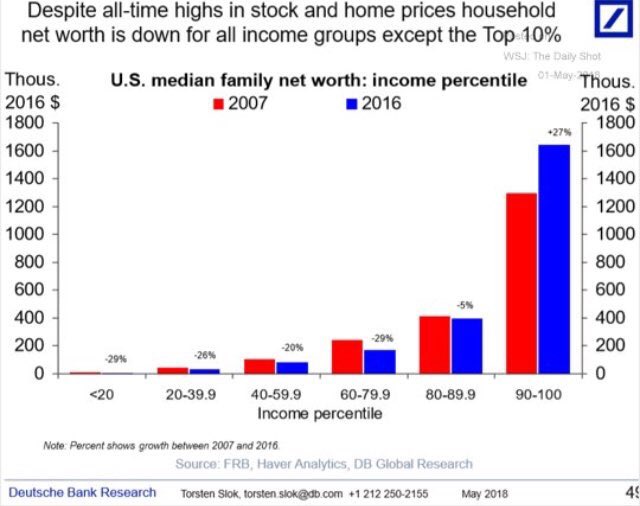
How Have the Significant Stock Market and Housing Gains Impacted You?

If you are fortunate enough to be in the Top 10% of income then you’ve done fairly well since the GFC. However, median family net worth for all but the Top 10% have fallen in the last decade. As we’ve pointed out before, 84% of the stock is owned by just 10% of the American population.  Corporate share buybacks provide a disproportionate benefit to a small percentage of Americans.


A Trend Worth Following For Public Pension Plans

There has been a movement to more fixed income and LDI use among corporate pension plans since the Great Financial Crisis, says CEM Benchmarking in a recently published report.  According to the analysis, corporate plan sponsors are using the plan’s funded status to drive de-risking approaches. We, at KCS, couldn’t agree more with this strategy. Despite strong equity gains since 2008, declining U.S. interest rates have slowed down gains in funded ratios for most plan sponsors.


“For the 69 U.S. corporate sponsors that participated in the CEM database in 2007 and 2008, the average decline in funded status over 2008 was 30%,” the analysis points out. “A quarter of the plans saw declines in excess of 37%, and fewer than 10% of plans remained fully funded on a U.S. GAAP basis at the end of 2008. Despite the relatively positive returns for many asset classes in recent years, the decline in interest rates has proven to be a large impediment to restoring the funded status of pension plans to pre-crisis levels.”

According to CEM’s study, the predominant investment theme among U.S. corporate plan sponsors has been to risk reduction, “both on an asset-only basis and also more importantly, with reference to their liabilities.”

One investment concept that has gained prominence is the de-risking glide path, a process by which a plan’s strategic asset allocation is gradually reduced, as either funded status improves, interest rates increase, or both. “Thirty percent of U.S. corporate sponsors in CEM’s database stated that they had a formal de-risking glide path in place at the end of 2016.”

Another point being stressed in the study is the fact that “a fixed-income allocation is not a perfect proxy for LDI investing, as it does not capture the duration of the fixed income investments in relation to liabilities.” We, at KCS and Ryan ALM, couldn’t agree more, which is why we recommend adopting a defeasement strategy that cash-matches retired lives from nearest to as far out as possible.

Taking risk off the table, as the plan’s funded status improves is a most prudent tool. Why continue to subject the plan to unreasonable risk of a potential 2007-2009 repeat when the average plans funded status declined by >30%? By reducing the chance that the public plan’s funded status will plummet, contribution expenses should be more consistent and less impactful on the greater social safety net provided by states and municipalities.

Plan sponsors have made a promise to their participants. Not knowing what that promise looks like on a regular basis is inappropriate, as it is this insight that should drive asset allocation and investment structure decisions.