Trouble Brewing In River City?

Actually, River City is probably fine right now, but there may, in fact, be some trouble brewing in New York City’s real estate market.  Why you ask? Well, it seems that nearly 1.1 million owner-occupants in NYC and Long Island have received a pre-foreclosure notice from their mortgage servicer.  Yes, that’s right, 1.1 million owner-occupants.

But, we all know that foreclosures and auctions are down, how could this be? You would be correct if you focused exclusively on foreclosed or auctioned properties, but for some strange reason, mortgage servicers are reluctant to foreclose. According to PropertyShark, only 2,000 properties within NYC have actually been foreclosed and auctioned in 2017, and only 731 are currently scheduled as we begin this year.

The real issue here just may be the impact on the local economy. Clearly, most of these 1.1 million delinquent owners are struggling with their monthly payments. That doesn’t bode well for the local economy that depends on the consumer to demand goods and services.

Amazingly, this issue is occurring even before the impact of tax policy changes that will significantly reduce one’s ability in places like NYC to deduct property taxes.  We can only imagine how many more will join this growing list of pre-foreclosure notice owner-occupants.


It’s Getting More Difficult

The U.S. retirement industry is fast becoming a one-trick pony, as defined benefit plans (DB) quickly disappear in favor of defined contribution plans.  We, at KCS, have stated for a long time that asking untrained employees to fund, manage, and disperse a defined contribution retirement program is an incredibly difficult task that will likely lead to a social and economic disaster.  Well, here is further proof that asking individuals to do this in today’s economic environment is increasingly challenging.

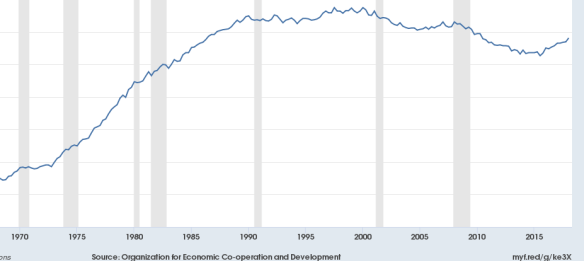
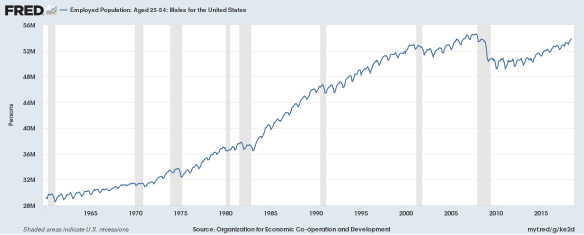
Despite “record low” unemployment (we seem to forget about the LPR at 62.7% and 95 million age-eligible workers on the sidelines), wage growth remains muted, and has recently fallen.

Furthermore, there is a certain level of income that is needed just to survive these days, and given the decades of modest real wage growth, we have a significant percentage of our citizens who just don’t have the disposable income needed to meet basic living expenses.

Furthermore, the following chart reflects some rethinking on the part of economists with regard to the actual level of disposable income in the U.S. and the effect of healthcare costs on this measure. Historically, healthcare costs have been considered discretionary, but in reality they are not. If one adjusts disposable income to reflect this observation, the percentage of debt to disposable income ratchets up significantly (see the chart below).

With wage growth lower and housing and healthcare costs rising, do most of our citizens really have the financial wherewithall to fund a retirement program?

CA Pension Decision Not Supportive of Long-term Funding Success

Randy Diamond, CIO Magazine, is reporting that the California Appeals Court has ruled that the use of unused vacation days to enhance retirement benefits is not a “right”, but it would not be “equitable” to take it away. The decision has likely paved the way to a review by the California Supreme Court.

The mission at KCS is to preserve and protect defined benefit plans. However, we are not supportive of provisions, such as the use of unused vacation days, to “spike” benefits that have not been actuarially funded. These practices are destabilizing, and subject the entire plan and all of the plan’s participants to greater risk.

We seek to keep DB plans as the core of one’s retirement portfolio, but not at any cost.  We need to fund these critically important benefits based on one’s salary, and we prefer that it be based on the last 3-5 years, at a minimum.  DB plans function best when benefits are actuarially funded based on anticipated growth in an individuals lifetime earnings, a formula, which cannot possibly factor in the spiking of these benefits through the inclusion of overtime, sick pay, vacation time, and hazard duty pay earned in one’s final year of employment.

Butch Lewis Act Gaining Critical Support

We are thrilled to read that Representative Peter King (R-N.Y.) has agreed to co-sponsor the Butch Lewis Act of 2017. As we’ve been reporting, this legislation is critical to protecting and preserving the promised benefits to millions of participants in multi-employer pension plans. The announcement by Rep. King clearly demonstrates that this legislation will not be burdened by partisan politics.

We applaud Rep. King’s action and hope that others from both sides of the aisle will quickly realize that providing these benefits will not only allow the participants to retire with dignity but equally important that they will remain active participants in our consumer-driven economy.

Here is the article from Teamsters.org

Today, Rep. Pete King (R-N.Y.) joined Sen. Chuck Schumer (D-N.Y.) at a press conference at Teamsters Local 707 in Hempstead, N.Y. to announce his co-sponsorship of the Butch Lewis Act of 2017 (H.R.4444/S.2147), legislation that will assist pension plans facing insolvency. Rep. King is the first Republican member of Congress to join the bill as a sponsor.

The Butch Lewis Act of 2017, which was introduced by Sen. Sherrod Brown (D-OH) and Rep. Richard Neal (D-MA) on Nov. 16, would provide a path to fixing the country’s growing pension crisis by providing the financial support the plans need to avoid insolvency.

“I am proud to support the Butch Lewis Act and I commend Jim Hoffa for his leadership,” Rep. King said. “Protecting retirees who worked hard for their pensions should not be a partisan issue. Republicans and Democrats should work together to allow workers to live their retirement years in dignity. It’s time to get started.”

The legislation would establish a new agency that will be called the Pension Rehabilitation Administration (PRA) within the U.S. Treasury Department. The PRA would be authorized to issue bonds in order to finance loans to pension plans in financial distress.

Kevin McCaffrey, President of Teamsters Local 707 joined Rep. King and Sen. Schumer to voice his support for the legislation.

“Like many other workers, our members have unfairly been the victims of failed government policies which have threatened their way of life and plans of retiring with dignity,” McCaffrey said. “I am proud to stand with these two elected officials who are stepping up to make a difference in the lives of working families.”

“The Teamsters Union thanks Rep. King for his leadership in co-sponsoring this bill,” said Teamsters General President Jim Hoffa. “This legislation is too important to be delayed by partisan politics. The pension crisis must be addressed now, and the Butch Lewis Act is the best option. We must protect the retirement security of hundreds of thousands of active and retired workers across the country.”

PBGC To Be Protected Under Butch Lewis Act

We continue to see on a weekly basis opinion pieces deriding attempts to rescue “critical and declining” status multi-employer defined benefit plans. Here is another one from Tom Schatz that appeared in the January 3rd edition of The Hill.  The author goes as far as comparing any future bailout of pensions to the sub-prime crisis that led to the great financial crisis, fearing that taxpayers will once again have to bail out a failing institution.

We don’t see it that way. In fact, we believe that it is imperative that these plans be rescued, as millions of U.S. workers are counting on the promised benefits to fund their retirements.  Furthermore, these workers have contributed to this future benefit through deferred wages. Does the author not realize that with failure comes the need to support all of these workers through very expensive Federal and state social safety nets?

The best proposal that we have seen (The Butch Lewis Act) provides low-interest rate loans to the multi-employer defined benefit plans that are currently the poorest funded (critical and declining status).  The proceeds from the loans must be used to immunize all of the retired lives so that those benefits are absolutely secured. The remaining assets in the plan will be used to meet future liabilities, as well as the repayment of the loan in 30 years.

By taking care of all of the retired lives, each plan has bought time for the remainder of the assets to outperform liability growth.  In the process of securing current retirement benefits, the pension funds are far less likely to need assistance from the PBGC that is currently in no position to support these funds.

Our economy has chugged along with <3% annual growth since 2005.  We need growing consumer demand to stimulate economic activity. The failure to support millions of U.S. workers will not do anything to provide them with the financial independence that they need to remain active consumers. Wake up, folks! Pension benefits are critically important to the future of our economy, especially as our labor force continues to age.

These are well-deserved benefits and are by no means hand-outs. Let’s stop with the pension envy that exists throughout the private sector and start to think of ways to increase the number of participants who have access to DB plans so that everyone benefits from the enhanced economic activity, including the tax-payer!

Just Shifting Deck Chairs On The Titanic

An article appears in today’s WSJ highlighting a dilemma for U.S. public pension plans, but it could be addressing a similar concern for all DB plans, including multiemployer and private plans, that continue to focus on the return on asset assumption (ROA) as the primary objective for both plan sponsors and their asset consultants. You see, most of the retirement community has been sold a bag of rotten goods claiming that a plan needs to generate the ROA or it will not meet its funding goals.  Hogwash!

So, when valuations for most asset classes seem to be stretched, where does a pension plan go to allocate their plan’s assets? Well, this “issue” has plan sponsors once again scratching their collective heads and doing the Curly shuffle.  You see, they have once again through the presumed support of their consultants, begun to approach asset allocation as nothing more than rearranging the deck chairs on the Titanic.

Despite tremendous gains from both equity and fixed income bull markets, these plans are willing to “let it ride” instead of altering their approach to possibly reduce risk, stabilize the funded status, and moderate contribution expense. Can you believe that the California State Teachers Retirement System, the country’s second-largest public plan, has recently decided to roll back fixed income exposure by 2% and equity exposure by 1% from 55% to 54%.  Are you kidding me? Is that truly meaningful or heroic?

Please note that generating a return commensurate with the ROA is not going to guarantee success.  Furthermore, since most public pension plans are currently woefully funded on an actuarial basis, meeting this objective will only further exacerbate the UAAL.

These plans don’t need the status quo approach that has been tried for decades. Real pension reform must be implemented before these plans are no longer sustainable, despite the claim that they are perpetual.  As an industry, we have an obligation to ensure the promised benefits are there when needed. Doing the same old, same old places our ability to meet this responsibility in jeopardy. If valuations are truly stretched, why allow your allocations to remain basically stagnant?

The U.S. 10-Year Treasury Yield Flatlined in 2017

For most plan sponsors and their asset consultants, the return on asset assumption (ROA) drives investment structure and asset allocation decisions.  As U.S. interest rates fell during most of the last 35 years, pension plan exposure to fixed income has fallen to record low allocations.  Yet, a plan’s liabilities (the promise) are highly correlated to interest rates.  The diminished exposure has created a huge mismatch between assets and liabilities.

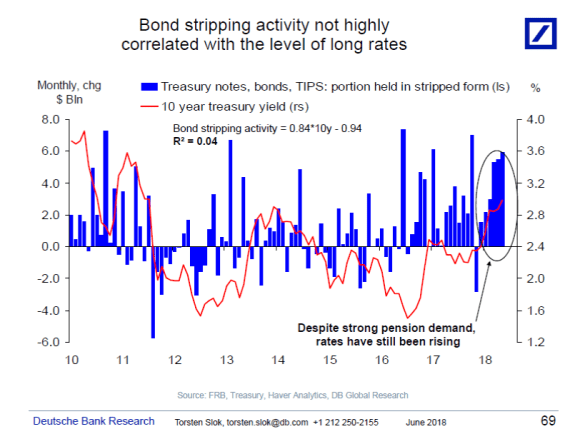
For years, most industry participants have fully expected growth, inflation, and higher U.S. rates. Well, we’ve seen short-term rates rise during the last 15+ months, but longer rates, such as the U.S. 10-year Treasury, have been in a period of relative calm.  In fact, yields on the 10-year have actually fallen by about 3-4 basis points in 2017, much to the dismay of many market forecasters.

For regular readers of the KCS blog and Fireside Chat series, you may recall that in March 2017 we reissued a Fireside Chat that we had produced back in 2013 on why we didn’t see U.S. long rates rising much in the near future.  Our interest in reproducing this piece was our feeling that 2017 would not be the year that longer rates would spike, and they haven’t.

As equity markets continue to move forward with little concern for valuation, plan sponsors should begin to reallocate their asset class exposures back to long-term policy normal levels.  In doing so, they should consider adopting a cashflow-matching strategy for their fixed income exposure to mirror monthly benefit payments for the plan’s retired lives.  We’d certainly welcome the opportunity to discuss the appropriateness of this strategy.

What Would You Pay For This Company?

For the year, UBI had an operating loss of $1.83 million on zero revenues. It had $15,406 in cash, and: “In order to keep the company operational and fully reporting, management anticipates a burn rate of approximately $220,000 per month, pre and post-offering.”

Well, it seems like many investors were willing to pay a lot.  You see, UBI Blockchain Internet, a Hong Kong outfit whose shares trade in the US [UBIA] saw it’s stock price during the six trading days starting on December 11, 2017, soar over 1,100%, from $7.20 to $87 on December 18, as the word “blockchain” is in its name.  By December 21, shares had plunged 67% to $29. They closed on Wednesday at $38.50.

The above information was found in an article by Wolf Richter, who points out that UBI isn’t the only “scam” in town.  There has obviously been tremendous interest in all things crypto and blockchain in 2017, but how different is it from the hundreds, perhaps thousands, of dot-com companies that briefly appeared in the late ’90s with absurd stock market returns only to meet catastrophic destruction like supernovas?

We would suggest that you proceed with caution, but if you feel that you must gamble, please choose a “game” with better odds.

Will You Retire One Day?

The Washington Post has produced a terrific story on the 998 workers impacted by the 1994 closure of the Tulsa, Oklahoma, McDonnell Douglas plant. Many of the employees interviewed were able to eventually find work again, but in many cases, their new wages were less than half of what they had been making at MD.  Unfortunately, it wasn’t just the loss of wages that has negatively impacted these workers, but the loss of pension benefits that they never were able to replace through their new employers.

Many of these individuals, now in their 70s, are still working today because of their lack of retirement assets and financial security. I’ve heard people joking over the years about likely having to work as a greeter at Wallmart because of their lack of retirement savings, but for several of the former employees in this cohort, that is exactly their reality.  Their financial struggles include losing their homes, incurring significant debt burdens, liens, etc.  Roughly 15% of them have had to file for bankruptcy.

Small companies have always found it challenging to be able to provide a retirement benefit to their employees, but for midsize and large companies, nearly 60% offered a pension plan at one point. Regrettably, the percentage covered by a traditional pension plan has fallen to only 14% of the private sector, when considering all employers, and that percentage is likely to continue to fall rapidly, as today’s employees are living longer exacerbating the liability that these companies are trying desperately to eliminate.

“The U.S. retirement system, and the workers and retirees it was designed to help, face major challenges,” according to an October report by the Government Accountability Office (GAO). “Traditional pensions have become much less common, and individuals are increasingly responsible for planning and managing their own retirement savings accounts and “many households are ill-equipped for this task and have little or no retirement savings.”

Amazingly, most of these employees were in the MD pension plan long enough to secure some retirement benefit, if even a small one. Can you imagine the financial distress that many of our workers will soon face knowing that they only have Social Security to rely on? The Washington Post story claimed that the average SS payout is a little more than $14,000 (we think that it is >$16,000), which certainly isn’t nearly enough for anyone to live on for any length of time.

We have written a ton on the impending retirement crisis. It isn’t a joke. The U.S. will have tens of millions of once productive members of our society falling onto the social safety net. Let’s not let that happen.  We need a recommitment to provide our employees with a benefit upon retirement that will supplement Social Security. Asking untrained employees to fund, manage, and then disperse a retirement benefit is a challenge that most of our workers are not going to handle appropriately.


A Cautionary Note?

Saw an interesting note this morning regarding Citigroup’s U.S. economic surprise index.

Obviously, 2017 has been an incredible year for the markets with the S&P 500 up more than 20% so far, reflecting a strong economy that has achieved its highest sustained growth in more than 3 years. However, when this reading has achieved such lofty heights previously (>70, it is now 84.5), the subsequent 6 month period has been modest at best for the U.S. equity markets.  In fact, according to Jim Paulsen, CIO, Leuthold Group, the S&P 500 has only achieved a 2.8% annualized return during the next 6 months.

The momentum witnessed in the economy is likely to lead research analysts to continue to ratchet up their economic forecasts making it very difficult for the economy to continue to surprise going forward. Markets tend to outperform when expectations are more modest providing opportunities for positive surprises.