A Whole Lot of Nothing

There appeared an article in P&I that reviewed recently implemented asset allocation changes of a massive nature for CalPERS. The largest U.S. public fund ($376.3 billion) shifted more than $150 billion in assets, including investing 15% in new products such as factor-weighted equities. In addition, they added a 3% commitment to high yield and a 1% allocation to a liquidity bucket that could range from 3% to -6% depending on opportunities provided by the market. Yes, leverage may be used if the markets provide unique opportunities.

We’ve discussed these allocation moves before (not specific to CalPERS) as nothing more than shifting deck chairs on the Titanic. The costs associated with shifting $150 billion in assets (commission, market impact, and opportunity cost) must have been massive. Given that they have failed to achieve their primary return objective for 1-, 3-, 5-, and 10-years through fiscal 2019 certainly speaks to needing to do something, but focusing exclusively on the return side of the equation remains the wrong strategy.

This statement attributed to Eric Baggesen, managing investment director for asset allocation, who said that he “expects the system to conduct a mid-cycle asset liability review”, confuses me. I’m not sure what a mid-cycle asset liability review is, but the fact that plans continue to allocate assets without the knowledge of what their liabilities look like or are performing is just silly. You wouldn’t be able to play a sport if you didn’t know how your opponent was performing, but that is precisely what happens in DB pension land every day.

Despite strong market returns for many asset classes in 2019, asset growth is barely exceeding liability growth as U.S. interest rates continue to plummet. Plans that have cash-flow matched their bond exposure to near-term liabilities (Retired lives) have actually insulated themselves from these unprecedented moves in rates by improving liquidity and removing interest rate sensitivity while extending the investing horizon for the alpha (growth) portfolio that is used to beat future liability growth.

Do they really believe that shifting assets among a variety of products and asset classes will stabilize the funded status and contribution expense? Glad to see that they have acknowledged that the plan has liabilities, but not managing to them on a regular basis does little to improve their fate.

Categorically Wrong!

There has been another article written by Rachel Greszler this one appearing in the Daily Signal that attacks legislative efforts to save struggling multiemployer pension plans. I have many issues with this article, such as the claim that H.R. 397, which is now before the Senate, would put taxpayers on the hook for $638 billion. That sum is a ridiculous exaggeration. That value is assuming that all multiemployer plans fail while using a risk-free discount rate to determine the potential unfunded liability.

She also claims “insolvent union pension plans would receive taxpayer dollars to invest in the stock market, as well as loans to cover their broken pension promises.” This is just not correct! Plans that are designated as in Critical and Declining status can file for a loan. The amount of the loan will be determined by the cost to defease all of the retired lives. The proceeds from the loan MUST be used to immunize those retired lives. The proceeds will not be used in a traditional asset allocation like the proceeds from pension obligation bonds (POBs). Plans are NOT allowed to play the arbitrage game between the interest rate charged on the loans and the targeted ROA.

I find it very funny that she can complain about the legislation’s $48 billion price tag spread over 10 years, but little is heard from her regarding the $1+ trillion deficits that the Republican Senate continues to create on an annual basis. Does she forget that the failure to provide this earned benefit will push most of these pensioners onto the Federal safety net? The cost of a pay-as-you-go safety net is far greater than providing a lifeline through a loan program in which nearly all of the plans are expected to repay the loan in 30 years.  The original analysis done by Cheiron had only three plans needing additional assistance through the PBGC.

There are problems in how these plans have been managed over the years, but much of that has been the fault of the accounting standards that forced plans to operate in a certain way.  For anyone who doubts this impact, I would encourage you to please read Ronald J. Ryan’s outstanding book, “The U.S. Pension Crisis”.

Unfortunately, we live with the consequences.  However, we now must address this major problem, and the loan program within H.R. 397 is the very best plan to solve this crisis before roughly 1.3 million American workers find that the promise that they were given is totally empty!

What Is Your Objective?

On August 6th we wrote a post titled, “Not The Correct Objective”, which received a lot of positive feedback. One of the commenters shared the following:

An older gentleman currently retired and living in Boca Raton, Florida was asked how he was able to retire to such a lovely place, and he responded that he was fortunate to have saved some money and made some good investments during his working years. The person asking the questions then asked if his investments had beaten the market. Our retiree quickly commented that he had no idea, but he didn’t think it mattered since he was able to retire to Boca.  We agree!

A plan sponsor shouldn’t be overly concerned with achieving the ROA if in fact her plan has built enough assets (through investments and contributions) to meet the promised benefits. As we’ve mentioned many times, the present value of future liabilities will rise and fall with changes in U.S. interest rates. In a flat to rising interest rate environment, asset growth doesn’t have to exceed the ROA objective to be able to beat liability growth. Unfortunately, most pension plans don’t see how the liabilities are performing on a quarterly basis, so comparing assets to liabilities, the only thing that matters, is an impossible exercise.  That is regrettable.

That Seems Aggressive

According to the Boston College Center for Retirement Research, state and local pensions now have on average 77% of their pension assets in equities or alternative investments, such as private equity and real estate. This is a dramatic change from 2001 when the average plan only had 67%. The significant move into equity-like strategies is likely fueled by the need to boost returns in a challenging environment for increasing contributions. Unfortunately, the increased exposure guarantees more risk, but not necessarily the corresponding return.

Who knows whether or not this lengthy bull market for equities is nearing its end (I certainly don’t), but pension systems that are in significantly negative cash flow conditions cannot afford the consequences from another devastating market correction.  By converting the current fixed income exposure to a cash flow matching strategy designed to match the nearest benefit payment as far out as the exposure will permit, a plan can significantly reduce the negative impact of a market decline on the equity exposure that no longer is a source of liquidity.

It makes no sense to continue to put all your chips on the table when just a little tweak to the portfolio can help reduce the risk of a major correction crushing the plan’s funded status. Public pension systems’ contribution rates are already testing taxpayer resolve in a number of situations. Let’s not give them more fuel for their fire!

Some Answers

On August 2nd we wrote a blog post on OPEBs and asked the question, “Just how awful is the funding issue?” Well, we have some additional anecdotal evidence and it isn’t looking too good. The Houston Chronicle has recently published information pertaining to the city’s OPEB liability, which is smaller than their pension debt, but not enough so to get excited. It seems that Houston’s OPEB liability has grown by $160 million per year in recent times, which equates to more than $400,000 per day. The total liability is now $2.4 billion, and with an aging workforce and healthcare inflation outpacing revenue growth, action to remedy the situation must occur now.

In addition, the Government Finance Officers Association estimates that the total OPEB liability for states and municipalities is roughly $2 trillion. Again, a pittance when compared to the total pension liability, but in many cases the OPEB liability has become a pay-as-you-go system.  According to the Chronicle’s article, U.S. states took on another $63 billion in OPEB liability in 2017 to just under $700 billion.

Going, Going, Gone!

As a lifelong Mets fan, I wish that the title of this article was referring to the heroics of Mets rookie first baseman Pete Alonso, but unfortunately, I am writing today about the continuing demise of defined benefit plans in the private sector.  Clearly, companies have been moving away from offering pension plans for years, but the pace has certainly accelerated and is now rivaling Usain Bolt in his heyday.

According to an article that appeared in the Greater Baton Rouge Business Report, only 81 companies within the Fortune 500 were still sponsoring a plan as of 2017. There were 288 as recently as 1998. Coinciding with this move is the greater use of pension risk transfer strategies, which has seen a 143% increase from 203 plans in 2012 to 493 in 2018.

Placing the burden on employees to fund, manage, and then disburse a retirement benefit is just not good policy. Many Americans are not comfortable with having this responsibility and furthermore don’t have the disposable income to put enough into an account to build the necessary nest egg for a successful retirement.


Painting a Grim Picture

The Pension Benefit Guaranty Corporation (PBGC) has issued a report detailing its financial health, and unfortunately, the agency may need life support. According to the release, the average expected deficit for the multiemployer backstop is $90 billion by 2028. Worse, however, is the fact that there is a 90% probability that the agency will be bankrupt by 2025.

If Congress fails to put in place a funding solution quickly, there’s a very high likelihood that benefit guarantees will have to be drastically slashed. As a reminder, multiemployer benefits are only protected at a small percentage of those in the private sector. For instance, a 30-year employee would only receive an annual benefit of $12,870, while the same private sector pension recipient would have there benefit protected to $65,000.

Given the projected insolvency for this agency in a relatively short period of time and you can see why tackling the multiemployer pension crisis is of utmost urgency given that we have 1.4 million American workers in plans that are currently designated as Critical and Declining and another 9 million workers who would no longer have the safety net available to them should their plans ultimately falter.

The House recently passed legislation (H.R. 397) to enact a loan program to provide a lifeline to those plans that are deemed Critical and Declining. Let’s hope that the Senate can support this legislation, too. However, I am afraid that they will seek alternatives to the Butch Lewis Act and in the process, mucking up currently healthy plans, while also subjecting participants to steep cuts. Let’s hope that I am wrong!

If Ever There Was a Time – It Is Now!

As anyone knows that follows this blog, the Butch Lewis Act has passed through the House and currently resides in the Senate. The backbone of this legislation is a government loan program that provides low-interest rate loans provided by a government agency within the Treasury. When the legislation was first contemplated the loan interest rate, which is set at 25 basis points above the prevailing 30-year Treasury Bond was going to be roughly 3.25%-3.5%.

This morning the U.S. 30-year Treasury Bond’s yield is an incredible 2.14%. If ever there was a time for these troubled funds to get a lifeline it is now. The roughly 1% savings on the interest rate further improves the likelihood that these loans get repaid in 30 years, while further reducing the needed annual return, which has been only 6.5%, to fund the interest payment, balloon payment, and future benefits.

Perhaps our friends at Cheiron could run a quick and dirty analysis to depict how this incredible move in rates would further aid our struggling multiemployer plans. I implore the U.S. Senate to stop dawdling and get to work passing this important legislation so that we can begin to heal these critically important plans at a likely deep discount to what was originally contemplated.

Not The Correct Objective

The WSJ published an article today titled, “America’s Pension Funds Fell Short in 2019”. The subtitle to the article mentioned that public pension plans with assets greater than $1 billion generated a median return of 6.79% during the fiscal year ending June 30, 2019.  Wilshire Trust Universe Comparison Service produced and published this information. The 6.79% was the weakest annual return since 2016 for these large funds and it fell short of the 7.25% average return on asset assumption (ROA) for plans of this size.

Given the fact that the average funded ratio for public pension systems in only 73% (under GASB accounting standards) just meeting the ROA target is going to do nothing to close the funding gap. But, more importantly, the primary objective in managing a pension plan shouldn’t be return focused. The primary objective should be to SECURE the promised benefits at low cost and reasonable risk. Furthermore, public pension systems should adopt a greater liability focus. I am always intrigued by the fact that plans generally know the total plan assets that they have on a daily basis, but can’t tell you what the plan’s liabilities are except on an annual basis (maybe).

In an environment of greater liability transparency and one that has liabilities measured on a mark-to-market basis, a year like 2019, in which the median large public plan generated a 6.79% return, may not be so bad if that return exceeded liability growth. Because the liabilities are bond-like in that their value rises and falls with changes in interest rates, liability growth could be negative. Does a plan really need to generate the 7.25% ROA in such an environment? Hell no. We need public pension systems to produce returns that exceed the growth in their liabilities- nothing more and certainly nothing less.

It may be a fun exercise to see how the median public pension system is performing, but given the fact that every pension’s liabilities are like snow flakes, it really is a worthless comparison. Pension plan trustees would be better served and they could make more informed decisions if we used the appropriate benchmark to measure plan assets versus plan specific liabilities.

The Time Has Come

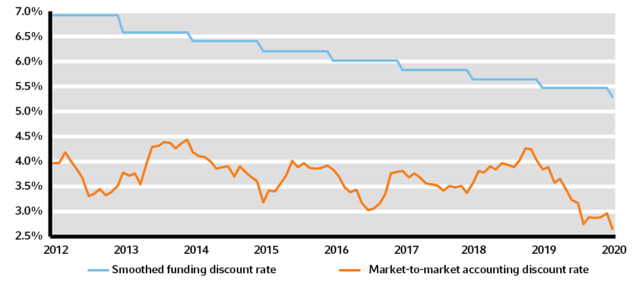
Using the return on asset assumption (ROA) as the discount rate for pension plan liabilities has masked the true funded status for those pension systems operating under a GASB accounting framework. As most everyone knows, liabilities are bond-like in how they move with changes in interest rates.  However, because the ROA is the discounting mechanism that fact is hidden from plan trustees.

The U.S. has enjoyed an incredible bull market for bonds since the early 1980s. In fact, my entire 38-year career in this industry has basically witnessed a bond bull market with only the occasional short-term “correction”. Most market practitioners felt that the bond market was about to enter bear market territory some three years ago only to have interest rates rally considerably since last November. In fact the U.S. 10-year Treasury yield has fallen to 1.76% as of this morning for an incredible rally from 3.24% just 9 months ago.

But, we believe that now is the time to adopt a true mark-to-market valuation for pension plan liabilities.  Why? There isn’t much more room for rates to fall given the rapid decline in rates that we’ve witnessed and the absolute level of yields today. Gaining a greater understanding of the true funded status will help plan sponsors and their consultants make more informed funding decisions.

Furthermore, because liabilities are bond-like, a rising interest rate environment will create a scenario in which liability growth could be negative.  In such an environment, asset growth of only 5% could dramatically improve the plan’s funded status.  Link together a few years of negative liability growth with modest asset growth and a plan could enjoy a rapid improvement in the system’s funding.

Most pension systems are reluctant to adopt a mark-to-market accounting of their plan’s liabilities given the potential optics associated with a more negative story. However, continuing on the current course may not show well either, as asset growth after a 10+ year bull market for equities may not deliver returns in line with the ROA. In an environment in which plans fail to deliver against the ROA the funded status will continue to deteriorate.  However, with a greater knowledge of plan liabilities plans my actually see improved funding even in an environment in which returns are more muted.

Let’s remember that the goal of a pension system should be to secure the promised benefits at reasonable cost. We believe that the objective is much more attainable when all of the relevant facts are known, including the true value of plan liabilities.