ARPA Update as of January 26, 2024

By: Russ Kamp, Managing Director, Ryan ALM, Inc.

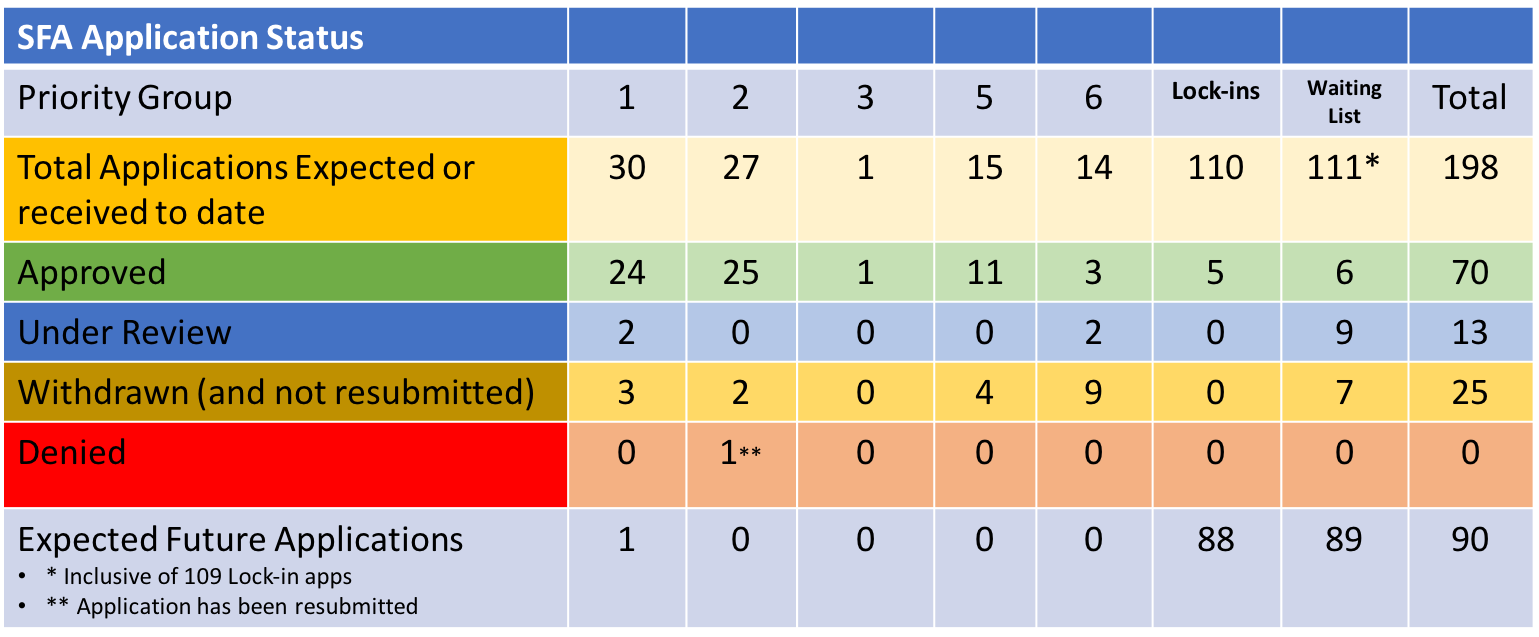
Another week, another ARPA update with little to report. Again, the PBGC has done a wonderful job implementing ARPA’s pension legislation in awarding $53.6 billion in Special Financial Assistance (SFA) to 70 multiemployer plans. But as reported in previous ARPA updates, the activity level has come to a screeching halt and this past week proved to be no exception as there were no new applications submitted through the PBGC’s portal, no applications were approved or denied, and none withdrawn.

As reflected in the chart above, there remain 90 applications that have to yet be submitted and another 38 that are either under review or have been withdrawn with the expectation that they will once again be submitted for consideration. I’m sure that the plan participants in those remaining plans are anxious for a positive outcome in the quest for SFA. Fortunately, US interest rates remain elevated, despite the bond rally in the fourth quarter, providing SFA recipients to secure years of benefits (and expenses) at reasonable cost.

Significant Interest – Time to Educate

By: Russ Kamp, Managing Director, Ryan ALM, Inc.

I sincerely appreciated the opportunity to speak at the IFEBP’s Construction Industry Benefits Conference in Las Vegas yesterday. My topic: Investing Benefit Plan Assets. I focused much of my attention on the current economic environment, capital market expectations, as well as asset allocation, both traditional views and an alternative approach focused on the plan’s liabilities to drive asset allocation decisions. I was very pleased with the response from the attendees, who were engaged throughout the 75 minutes that I got to spend with them, as they asked one good question after another.

What was particularly noteworthy to me was the considerable interest from the trustees related to “de-risking” their plans in this environment. They understood that funded status for many DB plans had improved, and that the US interest rate environment was providing opportunities not witnessed in decades, but they were frustrated because they didn’t know what to do. Some had heard about LDI, but that is like saying that they heard about equities, while others heard that de-risking was done using annuities. None of those in attendance had ever heard of Cash Flow Matching (CFM).

In one particular exchange, the trustee of this fairly large fund mentioned that their plan was 107.5% funded but they were concerned about de-risking because they wanted to be able to provide enhanced benefits at some point. The gentleman was incredibly excited to hear that de-risking a DB pension system isn’t an all or nothing proposition provided that you approach the issue appropriately. Corporate America has engaged in buyouts and buy-ins for quite some time now as they look to disengage from their DB plans through a pension risk transfer (PRT). Those initiatives can be related to a partial transfer of pension liabilities (Retired Lives) or they can be for the whole kit and kaboodle. But, once the contracts are signed, the plan sponsor often loses flexibility related to those liabilities and the assets that are matched against them.

Utilizing a CFM approach allows the plan sponsor to allocate whatever percentage of their assets to the program while maintaining complete control over the assets. That allocation decision should be predicated on the funded status of the plan. The flexibility of the implementation is one of the most attractive features related to CFM. Because the program uses the cash flows from investment grade bonds to match and fully fund the liability cash flows. These bonds can be sold and the program unwound without fear of penalty, which can occur with buyouts and buy-ins.

There is a great opportunity for the asset consulting industry to educate clients on the benefits of de-risking strategies. As a reminder, the primary objective in managing a DB plan is to SECURE the promised benefits at a reasonable cost and with prudent risk. It is not riding the asset allocation rollercoaster through up and down markets. DB plans were once managed similarly to that of insurance companies and lottery systems that focused on the future value obligation and funded it appropriately. They knew that current asset allocation approaches didn’t guarantee funding success, but they did lead to greater volatility and uncertainty.

If a DB plan terminates, no one wins, except perhaps the insurance company that is in the business to make money. The plan sponsor loses their ability to manage a labor force from retention to retirement. The plan participant, especially those still in the workforce, lose the ability to accrue greater benefits, while asset consultants, actuaries, plan administrators, investment managers, custodians, and any other entity that touches a plan, lose a client. We’ve witnessed thousands upon thousands of plans freeze and terminate throughout the last four decades or so.

Taking some risk off the table doesn’t diminish anyone’s role. It likely keeps them in the pension game longer, while securing those promises that plan participants are banking on. Let’s commit to providing the pension community with all of the information from which they can make informed decisions. De-risking may not be for every plan, but it certainly makes sense for most. We can certainly provide you with a series of benefits that result from engaging in this activity starting with a funding cost savings (reduction) of around 50%. Don’t hesitate to reach out to us. We are happy to provide you with the research resources (RyanALM.com) necessary to inform your clients.

Only 1/2 the Equation

By: Russ Kamp, Managing Director, Ryan ALM, Inc.

By now most everyone in the pension industry has read about the Illinois Supreme Court upholding a law signed by Gov. JB Pritzker in 2019 consolidating pensions for Illinois’s “down state” police and firefighter unions. The primary goal in signing the legislation was to give small police and fire pension systems the scale to participate in larger investment opportunities that just might provide for improved/enhanced returns on the plan’s assets. There were also expectations that some expenses might be mitigated/lessened given the new scale. Those goals may prove to be attainable, but they don’t help to address the liability side of managing a pension plan.

As I understand, most, if not all, of those down state funds have retained their own actuary and trustee boards. As a result, they continue to be responsible for the day-to-day operation of the fund. So, no economies of scale there. Yes, investment decisions have been removed from the individual boards and are now consolidated within the two combined entities. However, managing a pension plan is not just about investments. The true objective in managing a DB pension plan is to SECURE the promised benefits at a reasonable cost and with prudent risk. It isn’t an arms race focused on generating the highest return.

We believe that a plan’s asset allocation should be dictated by the funded status of that plan. A plan with a 60% funded ratio should have a very different asset allocation than one sitting at 100% funded. Yet, each down state fund is forced to have the same asset allocation no matter what the funded status. Does that make sense? As a member of a fire department for a small town somewhere in Illinois, I would want the opportunity to take risk off the table as my plan got better funded. I wouldn’t want the taxpayers of my community or the employees of my fund to take on too much risk when the battle has already been won.

In addition, as a member of a police department with a poor funded status, I would want the opportunity to perhaps reduce the future tax burden on my citizens or employees who need to contribute a greater % of their compensation by being able to inject more risk into the asset allocation. Unfortunately, neither scenario is available at this time, as every $ goes into one pool.

Here’s a thought, create commingled asset class sleeves in which these small pension systems can buy exposure based on their unique needs. A better funded plan can overweight fixed income, while a poorer funded plan will perhaps choose to overweight higher octane strategies. Again, managing a DB plan is not just about return. The liability side of the pension equation needs to be in focus every step of the way. You can’t secure the pension promise if you can’t manage to pension liabilities. The riding of the asset allocation rollercoaster in pursuit of higher and higher returns has led to unstable funded status and escalating contribution expenses. Bring some stability to the process by using the funded status to drive the investment decisions. All of the down state funds will appreciate having that opportunity.

The Psychology of Uncertainty

By: Russ Kamp, Managing Director, Ryan ALM, Inc.

When I was managing the Invesco quantitative group (>$30 billion in AUM), we attempted to take advantage of human biases that keep us from being great investors. By capturing those biases in a systematic framework, we were able to consistently apply our insights. By doing so, we removed a lot of uncertainty from within our process. I mention my history only because it amazes me how much uncertainty is being embraced by the pension plan sponsor community and their advisors.

The following is from an article by Catherine A. Sanderson, Ph.D., from September 21, 2021, in Psychology Today. The key points from her article are the following:

  • When facing ongoing uncertainty, our bodies stay at a high level of physiological arousal, exerting considerable wear and tear.
  • Uncertainty exerts a strong pull on our thoughts and inhibits our ability to act, leaving us in a suspended waiting game.
  • We can manage uncertainty by figuring out what we can control, distracting ourselves from negative thoughts, and reaching out to others.

By embracing an antiquated approach to asset allocation in which all of plan assets are focused on a return objective, plan sponsors live with great uncertainty, as markets are truly out of the control of the individual. By continuing to ride the asset allocation rollercoaster, plan sponsors are negatively impacted by their inability to act. As a result, we continuously ride markets up and down. The result of this behavior has led to significant volatility around contributions and funded status.

How can plan sponsors get off this rollercoaster and begin to take some control of their plan’s destiny? Stop aggregating all of the pension plan’s assets into one giant return bucket. The primary objective in managing a DB plan is to SECURE the promised benefits at a reasonable cost and with prudent risk. By chasing a performance objective you are subjecting all of the assets to great uncertainty. The Ryan ALM solution is to bifurcate the plan assets into two buckets – liquidity and growth. The liquidity assets will be bonds (investment grade preferred) whose cash flows of interest and principal will be used to match the plan’s liability cash flows (benefits). Once this process is completed, the plan will have brought certainty to at least that segment of the portfolio, as the asset and liability cash flows will move in lockstep whether interest rates move up or down.

Furthermore, the growth assets have now been given the luxury of time! With an extended investing horizon, growth assets have a much greater probability of achieving the expected outcome, as the volatility associated with 10-year periods is far smaller than volatility on 1-2-year horizons. As your plan’s funded status improves, port excess growth assets into the liquidity bucket further reducing uncertainty.

No one wants the psychological wear and tear associated with uncertainty. Stop embracing it through a traditional asset allocation. Adopt the Ryan ALM approach to asset allocation and you’ll be embracing greater certainty. As Catherine suggested, we can “manage uncertainty by figuring out what we can control“. Securing the promised benefits for even a relatively short period of time (say 10 years) sets us on a path to greater control. How comforting!

ARPA Update as of January 19, 2024

By: Russ Kamp, Managing Director, Ryan ALM, Inc.

January has lived up to its billing in Northern NJ this year with frigid temperatures and a little snow. However, there seems to be a bit of thawing as it relates to the PBGC’s implementation of the ARPA pension legislation. For the first time since November 22, 2023, a multiemployer plan has had its application for Special Financial Assistance (SFA) approved. Laborers’ International Union of North America Local Union No. 1822 Pension Fund, a non-priority plan, will receive nearly $16 million to cover the promised benefits for 525 plan participants.

In addition, two plans withdrew previously revised applications. Printing Local 72 Industry Pension Plan, a Priority Group 5 member seeking $38.1 million for its 787 members withdrew its application on January 15th, while Mount Laurel, NJ based UFCW Regional Pension Fund, looking for $52.4 million to help protect the pensions for their 4,605 participants withdrew its application on 1/18.

There were no additional applications submitted for review. Fortunately, there were no applications denied during the previous week. There is still a tremendous amount of work ahead for the PBGC. Hopefully whatever issue(s) there were that slowed down the process have been rectified and we’ll soon witness an accelerated pace once again.

What Recession?

By: Russ Kamp, Managing Director, Ryan ALM, Inc.

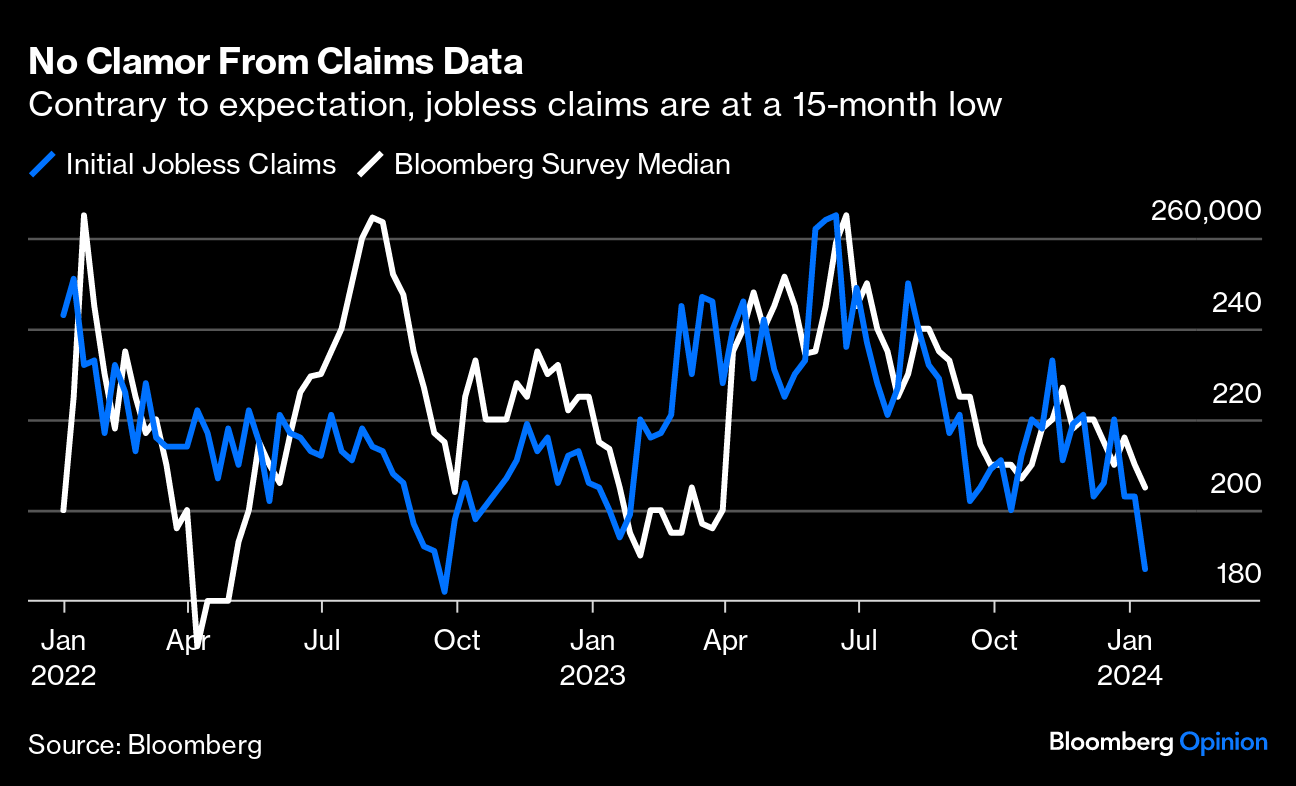
We have stated unequivocally that recessions do not occur when labor markets are at full employment. The expectation that the US Federal Reserve was going to reduce rates 6-7 times in 2024 was a pipe dream. Currently, US initial jobless claims continue to come in at levels last achieved in 2022. In the most recent release (1/18/24) initial claims were at only 187K while expectations were at 208K. As the chart below reveals, initial claims have remained at very modest levels.

The increase in the FFR from 0% to 5.25%-5.50% has had little impact on the US labor market, which continues to show unemployment at only 3.7% and a Labor Participation Rate (LPR) of 62.5% up from the depths following the initial Covid-19 restrictions when the LPR touched 60.8%. When folks are working and earning money, they are spending, as we witnessed in 2023 when the consumer carried the economy forward. They also tend to feel better about the economy as a whole. Today’s University of Michigan Survey of Consumers – preliminary data came it a 78.8 when it was expected to register at 70.2 certainly supports those enhanced expectations.

According to the Atlanta Fed’s GDPNow model, GDP growth for Q4’23 is estimated at 2.4%. Again, what recession? Why would the Fed be compelled to reduce rates in an environment of full employment and economic growth? The expectation of a looming recession drove investors into bonds during the 2022’s fourth quarter. As a result, Treasury yields collapsed from levels at or above 5% to in many cases below 4%. The extraordinary move certainly eased financial restrictions and brought Treasury yields to a level that seemed to be overbought. We wrote several posts related to the investing community getting ahead of themselves in the process.

Since the end of 2022, Treasury yields have once again climbed and the expectations for aggressive Fed easing have waned. What was once considered a slam dunk that the Fed would cut the FFR by 25 bps in March now has only a slightly > 50% of that occurring, and I think that those odds should be much lower.

There is good news for pension plan sponsors in this data. Higher interest rates help in two meaningful ways. First, higher rates reduce the present value (PV) of those future benefit payments. As a result, the asset side of the equation doesn’t have to work as hard. What really killed pensions in the private sector was the significant decline in US rates from 1982 to 2022, as the cost of pension promises went through the roof. Second, higher rates mean that bond yields can get you close to your ROA with far greater certainty and less volatility than investing in equities and alternatives. In addition, those bond cash flows of interest and principal provide the plan with the necessary liquidity to meet the monthly payments at lower costs.

Lower US interest rates certainly propped up risk assets during the last 4 decades, but in the process they truly harmed pension America as more and more risk needed to be injected into the asset allocation process. The subsequent rollercoaster ride of markets up and then down negatively impacted pension plan contributions and funded status since 1999. As I’ve stated before, humans hate uncertainty, yet traditional asset allocation frameworks bring with them great uncertainty. It is time to increase your allocation to bonds. Capture the greater yield currently available. In fact, defease those pension promises by matching bond cash flows to liability cash flows. You’ll sleep so much better and so will your plan participants!

Controversial? It’s Inane!

By: Russ Kamp, Managing Director, Ryan ALM, Inc.

I have a great appreciation for the research produced by the Center for Retirement Research (CCR) at Boston College and I’ve admired Alicia Munnell for years, but I have to say that I am absolutely opposed to her latest research that she produced with Andrew Biggs. They are proposing the elimination of the tax deferral for contributions into defined contribution plans, stating that the deferral doesn’t really matter. That “the percentage of workers age 25 to 65 participating in employer-sponsored retirement plans has remained stubbornly at roughly 50% since 1989” (P&I). Furthermore, they claim that those contributing tend to be high earners that don’t care about the deferral. Munnell and Biggs would rather see the lost tax revenue from these contributions be used to prop up Social Security claiming that action would be fairer to lower income earners.

Unfortunately, we’ve had defined benefit plans in the private sector go by the way of the dinosaur and now they want to eliminate the tax benefit for contributions into DC plans. Many, if not most Americans, especially Millennials and younger cohorts, are struggling to meet daily needs. You want to know why participation in employer-sponsored plans has remained around 50%, these younger workers are burdened with student loan debts, exorbitant housing costs, monthly child care expenses that rival a mortgage payment, ever increasing healthcare insurance costs, let alone food, energy, clothing, etc. Oh, and regrettably, contributions to a retirement account that were once made by one’s employer are now also on their plate.

You want to help Social Security? Eliminate the annual cap on the amount of compensation that gets taxed for SS purposes. For 2024, the amount of compensation that will be taxed for SS purposes is $168.6K. Why? Lower income Americans will pay 100% of the tax applied to their SS bill. Why should wealthy Americans not pay an equal percentage? Those earning < $168.6K will pay 6.2% toward SS. Those earning more than that amount will pay less on a percentage basis. Make $300,000? Your SS tax rate is 3.48%. How is that fair?

I think that the participation in employer-sponsored defined contribution plans has remained stubbornly at 50%, not because the tax-deferral isn’t enticing, but because the average American worker is stretched! They don’t have the financial means! Take away the tax deferral and let’s see how stubborn that 50% level really is. I’d hate to think of the potential impact of that level falling to 40% or less on our American worker’s retirement readiness. As a retirement industry we should be doing everything that we can to encourage the use of DB and DC plans. We should NOT try to find ways to further harm these programs, which eliminating the tax-deferral would in my humble opinion.

Finally, the US enjoys the benefits of a fiat currency. We will always be able to pay our debts as long as those debts remain in US $s, including SS, which they are! Eliminate the ceiling for the SS tax and you’ll go a long way to securing SS without screwing up DC plans.

An Answer?

By: Russ Kamp, Managing Director, Ryan ALM, Inc.

In yesterday’s weekly update on the PBGC’s ARPA implementation, I mentioned that I didn’t have any particular insight into why the process of receiving and approving applications seemed to have come to a screeching halt. Well, I may finally have an answer or at least an insight into what might be happening.

According to an article (NY Post) in the “King Report”, members of Congress have reached out to the PBGC with concerns about the potential overpayment of Special Financial Assistance (SFA) due to incorrect census data. In fact, they referenced the possibility that Central States received roughly $127 million in overpayments as a result of nearly 3,500 deceased participants included in the calculation for SFA. Now, let’s put that into context, as the $127 million was part of a $35.8 billion SFA payment (including interest) or roughly 0.35% of the total. In addition, the 3,479 deceased participants are roughly 1% of the plan participants.

I don’t know if there have been deceased members among the other 68 plans that have received SFA to date, but if the ratios are similar, the “overpayment” represents a drop in the bucket of the total outlay to date. Yes, the ARPA funds are taxpayer monies, but the benefit of this program on the lives of millions of plan participants far outweigh the potential impact of erroneous census data. I’m going to assume (always fraught with danger) that the lack of progress since November is tied to this action. I can imagine the PBGC requiring those plans seeking SFA to be 100% certain that their census data is correct.

Implementing this legislation has been a challenge for the PBGC based on the sheer magnitude of the program and the importance, certainly as it pertains to those pension plans that had cut benefits, of getting the promised benefits restored and secured. I have had my issues with the PBGC’s Final Final Rules (FFR) allowing for the inclusion of risk assets given the importance of maximizing benefit coverage, but overall I’ve been impressed with the pace by which plans have had applications approved and funds received. As reported yesterday, 69 pension plans have been granted nearly $54 billion in SFA.

Unfortunately, the Butch Lewis Act (BLA), which passed the House in 2019, was caught up in politics in the Senate during the same year. Fortunately, a very similar form of the BLA was attached to ARPA, passed, and signed into law in March 2021. The roughly $90 billion that will eventually flow to perhaps 200 or so plans will secure the pension promises for millions of plan participants, while providing them with the economic wherewithal to remain active participants in our economy. Without this legislation, many plan participants would have struggled in retirement and likely become more dependent on the Federal government through their social safety net.

It is important that this program be implemented appropriately, but let’s hope that politics doesn’t get in the way of the important task of allocating ARPA grant money to these struggling pension plans whose participants have worked long careers with the understanding that they would receive X in retirement. Not X minus something, if anything at all.

ARPA Update as of January 12, 2024

By: Russ Kamp, Managing Director, Ryan ALM, Inc.

It has been 46 days since the PBGC has permitted an application to be submitted through their portal. I was still digesting my Thanksgiving dinner when the last application, United Food and Commercial Workers Union Local 152 Retail Meat Pension Plan, was submitted seeking $266.1 million in SFA for its 10,252 plan participants. As we’ve reported before and as highlighted below, there are still dozens of applications waiting (patiently??) in the queue for the opportunity to request SFA.

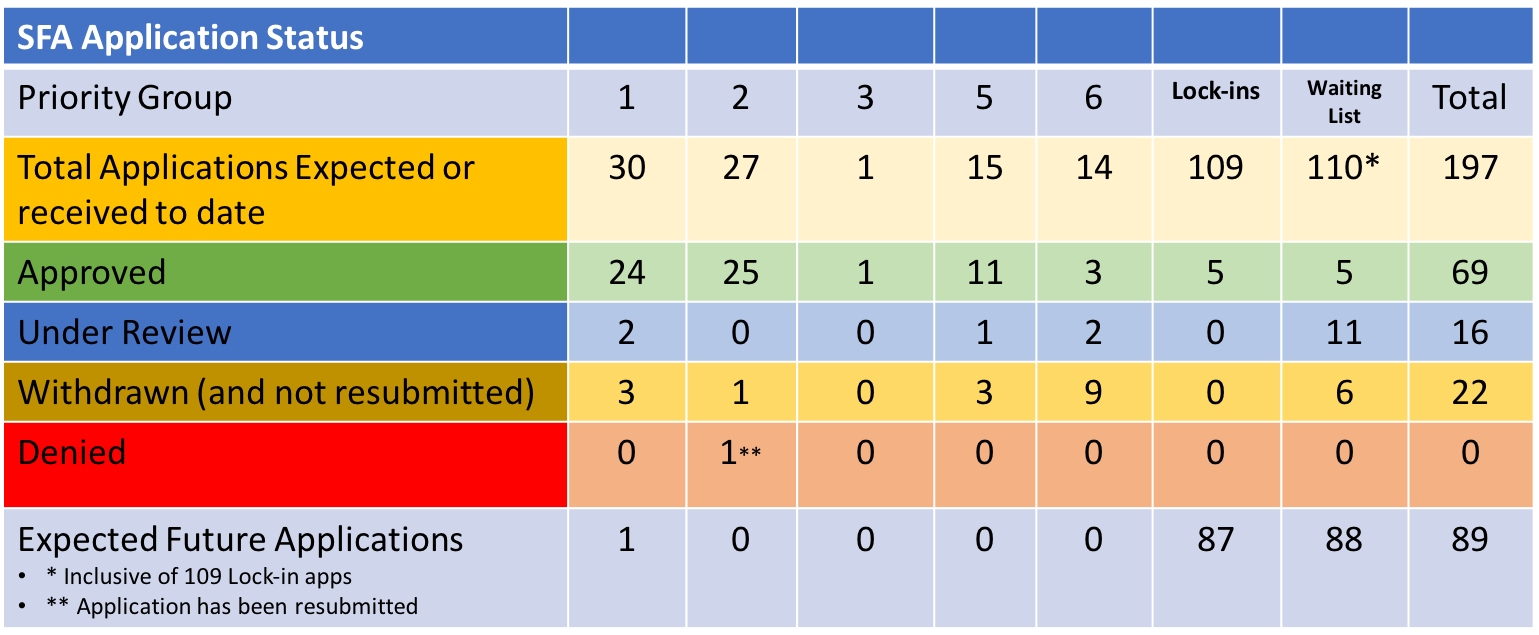
I don’t have any particular insight into why this process seems to have been halted following a frenzied pace that saw 69 plans gain approval for more than $53 billion in SFA. Most of those assets have been disbursed at this time. There are still 16 applications “under review”, but not a single one has been approved since November. Fortunately, no applications have been denied, while just one was withdrawn in the latest week. The Legacy Plan of the UNITE HERE Retirement Fund withdrew its already revised application that is seeking $938.1 million for the nearly 92K participants.

Let’s hope that whatever seems to be holding up this process gets resolved sooner than later, as many retirees and those hoping to retire wait patiently to see if the promised benefit will actually be available when needed.

Opal Public Fund Summit Follow-up

By: Russ Kamp, Managing Director, Ryan ALM, Inc.

I’ve been extremely fortunate to participate in the Opal Public Fund Summits – both East and West – for the better part of the last 10 years. I used to attend these events and almost never hear the word liability uttered, especially as it related to a pension liability. They might have spoken about so and sos golf swing being a liability or some teams QB, but pension liabilities were missing in action.

I’m thrilled to say that several of the panels/panelists mentioned pension liabilities, with terms such as ALM, defeasement, immunization, de-risking, duration, and even cash flow matching (CFM), and not just by me, also being uttered. It was so refreshing. They are right to be discussing this strategy at this time given the sea change that has occurred in US interest rates. The cost to implement asset/liability management strategies, especially CFM, have been reduced significantly in the last two years.

That said, there are still so many misconceptions regarding CFM. It is NOT a laddered bond portfolio, which would be quite inefficient and costly. It IS a highly sophisticated cost optimization process that maximizes cost savings by emphasizing longer maturity bonds (within the program’s parameters = # of years defeased) and higher yielding corporate bonds, such as A and BBB+.

Furthermore, it is not just a viable strategy for private pension plans, as it has been deployed successfully in public and multiemployer plans for decades. It is also NOT an all or nothing strategy. The exposure to CFM is a function of several factors, including the plan’s funded status, current allocation to core fixed income, Retired Lives Liability, etc. Many of our clients have chosen to defease their pension liabilities from 5-30 years or beyond. When asked, we recommend a minimum of 10 years, but again that will be a function of each plan’s unique funding situation.

CFM strategies are NOT “buy and hold” programs. CFM implementations must be dynamic and responsive to changes in the actuary’s forecasts of benefits, expenses, and contributions. There are also continuous changes in the fixed income environment (I.e. yields, spreads, credits) that might provide additional cost savings that need to be monitored and managed. Plan sponsors may seek to extend the initial length (years) of the program as it matures which will often necessitate a restructuring or rebalancing of the original portfolio to maximize potential funding coverage and cost reductions.

CFM programs CANNOT be managed against a generic index, as no pension plan’s liabilities will look like the BB Aggregate or any other generic index. Importantly, no pension plan’s liabilities will look like another pension plan given the unique characteristics of that plan’s workforce and plan provisions. The appropriate management of CFM requires the construction of a Custom Liability Index (CLI) that maps the plan’s liabilities in multiple dimensions and creates the path forward for the successful implementation of the asset/liability match.

Importantly, CFM programs are NOT going to negatively impact the plan’s ability to achieve its desired ROA. In fact, a successful CFM program, such as the one we produce, will actually enhance the probability of achieving the return target. How? Your plan likely has an allocation to core fixed income. Our implementation will likely outyield that portfolio over time creating alpha as well as SECURING the promised benefits. Given the higher corporate bond interest rates, an allocation to this asset class can generate a significant percentage of the ROA target with risks substantially below those of other asset classes.

What a successful CFM implementation does is the following:

Secures benefits for time horizon LBP is funding (1-10 years +)

Buys time for the alpha assets to grow unencumbered

Outyields active bond management… enhances ROA

Reduces Volatility of Funded Ratio/Status

Reduces Volatility of Contribution costs

Reduces Funding costs (roughly 2% per year)

Mitigates Interest Rate Risk as benefits are future values that are not interest rate sensitive.

It was a great conference spurred on by the fact that folks are beginning to think outside the “performance/return” box. Taking advantage of higher US interest rates is the prudent action today. CFM strategies accomplish a lot for the plan and plan sponsor, but most importantly it provides everyone with a great night’s sleep.