The Magnificent Seven Have Masked Reality

By: Russ Kamp, Managing Director, Ryan ALM, Inc.

Not much was expected from the capital markets in 2023 given the Federal Reserve’s focus on tamping inflation. Could 2023’s capital markets be as testy or worse? Well, what has transpired so far this year has caught a lot of folks off guard, including me. Few would have predicted that the S&P 500 would climb by 18.5% as of August 31, 2023, especially in the face of continuing rising rates and a short-live “banking crisis”. US interest rates, as measured by the Fed Fund’s Rate (FFR) are up 525 basis points since March 17, 2022. Yet, economic activity and the US labor force have seemed to shrug off this development with little difficulty.

But is this a fair depiction of what has truly occurred? We would say, “no”! Yes, the S&P 500 has advanced by 18.5% through the end of August, but the rally has been far from robust. In fact, seven securities, primarily Information Technology, which now makes up 28.2% of the index, have advanced roughly 50% YTD, while the average stock in the index is flat to down. Is that masking of reality impacting asset allocation decisions? Are plan sponsors and their advisors hanging on to these exposures in the hope that they are a prelude to a broadening of market leadership within the S&P 500? At present the “Magnificent Seven” account for 25.5% of the S&P 500 capitalization weighting and the top 10 holdings (as of 9/12) accounted for 34% of the index’s weight. I don’t recall another time when a concentration of this magnitude existed during my more than 41 years in the industry.

It would be one thing if the huge price gains of the Magnificent Seven were driven by earnings growth, but that isn’t true. In fact, most of the 18.5% gain (68% according to a UBS report) for the S&P 500 has been the result of P/E expansion. That isn’t a foundation on which I’d want to put too much weight. Given the dramatic rise in rates at what point do all equities come under selling pressure? Would you want to own the capitalization weighted index at this point? If you’ve been fortunate to have exposure to the S&P, would it not make sense to sell “high” and use the proceeds to secure some of those promises that have been made to the plan participants?

Equities appear to have had a phenomenal run this year because of the nature of the index’s construction, but an equal weighted index has appreciated only 1% according to the Invesco ETF RSP. Other asset classes have continued to struggle, with most remaining below 2021 peaks. It is time to get off the asset allocation rollercoaster driven by the focus on return. The current US interest rate environment is providing plan sponsors with a wonderful opportunity to take risk off the table. For better funded plans, significant risk should be withdrawn. We have an opportunity to secure benefits while also expanding the investment horizon for the alpha assets that remain in the plan. Don’t let this opportunity slip through our fingertips like we did at the end of the ’90s.

ARPA Update as of September 22, 2023

By: Russ Kamp, Managing Director, Ryan ALM, Inc.

Another Monday and another update on the progress of the PBGC in implementing the ARPA legislation providing Special Financial Assistance (SFA) for eligible multiemployer pension plans.

This past week was not particularly notable as only 1 new application was submitted for review, while one other plan received approval for their SFA application. That doesn’t mean that a ton of work wasn’t being done behind the scenes, as there currently are 23 applications in the review queue. The latest addition to that list is the Printing Local 72 Industry Pension Plan that is seeking $38.1 million for its 787 plan participants.

Congratulations to the members of the Paper Handlers’ – Publishers’ Pension Plan as its revised application was approved for just over $20 million, including interest, for the 244 participants in that plan. This latest approval brings to 65 the number of plans receiving SFA grants. The total allocation to date of SFA and interest is $53.5 billion.

There still remain 92 pension plans on the waiting list to submit the SFA applications in addition to the 23 applications that are currently in the queue to be reviewed. According to the legislation, this activity needs to be completed by December 31, 2025.

It’s All About Cash Flows

By: Russ Kamp, Managing Director, Ryan ALM, Inc.

The last 18 or so months have played havoc with total return-seeking fixed income strategies as US interest rates have risen precipitously from the depths of Covid-19-induced lows. In fact, there is the chance (likelihood) that the Aggregate Index may suffer losses for the third consecutive year. A performance outcome that has never been witnessed in the history of the index. As a reminder, 2021 saw the index fall by -1.5%, 2022 was a whopping -13.0% (largest decline in the index’s history, while the Agg is currently (as of 9/21) down -1.6% YTD.

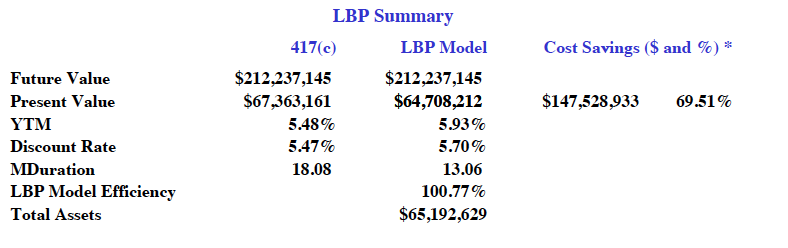
However, for fixed income ALM specialists, such as Ryan ALM, we are celebrating the rise in rates as the cash flows produced are providing excellent coverage for future benefits and expenses at lower and lower funding costs. In fact, one has to go back roughly two decades to find an environment this attractive. Within the last few days, we produced a Liability Beta Portfolio™ (our proprietary cash flow matching (CFM) product) that was asked to defease all of a plan’s $212 million in projected benefit payments. Given the extraordinary rise in rates, our modeling suggests that we can cash flow match all of the liabilities for ONLY $65 million as the present value of our LBP model to fully fund those future benefit payments is $64.7 million – extraordinary! The plan has $88 million in assets. This plan is well over funded producing an outcome which I’m sure was not anticipated.

As the information above highlights, the difference between the LBP PV and FV of those benefit payments is $147.5 million or 69.5% cost savings. Furthermore, the cost savings are locked in on the day that the portfolio is built. How many investment managers can tell you what their performance will be for the entire life of the program on the first day of the assignment? Given today’s YTM of nearly 6%, one can achieve a significant portion of the return on asset (ROA) assumption with minimal risk (IG credit risk which remains quite low).

Don’t continue to subject all of the plan’s assets to the whims of the market, especially given all of the uncertainty that presently exists. Take some of that risk off the table and utilize the cash flows of income and principal created by the higher US interest rates to defease a portion of your plan’s liabilities through a cash flow matching implementation. I’m sure that you will be quite surprised by the cost reduction to defease those liabilities. Assets not used to support the CFM program can now be managed more aggressively given the extended investing horizon.

Pension America needs to get off the asset allocation rollercoaster. Utilizing a cash flow matching strategy for a portion of the assets, if total defeasement isn’t the goal, is certainly a great first step. We are here to help. Let us model your plan’s liabilities. I think that you’ll be pleasantly surprised by what we reveal. Get ready for a great night’s sleep!

Milliman Releases Public Pension Funding Survey for August 2023

By: Russ Kamp, Managing Director, Ryan ALM, Inc.

According to the Milliman 100 Public Pension Funding Index (PPFI), the estimated aggregate funding for the top 100 public pension systems declined from 76.8% to 75.3% as of August 31, 2023. The change in the fund status was primarily driven by market losses during the month (estimated at -1.6%), which resulted in a decline of $74 billion along with negative cash flow of approximately -$10 billion. Total assets are estimated at $4.591 trillion at the end of August.

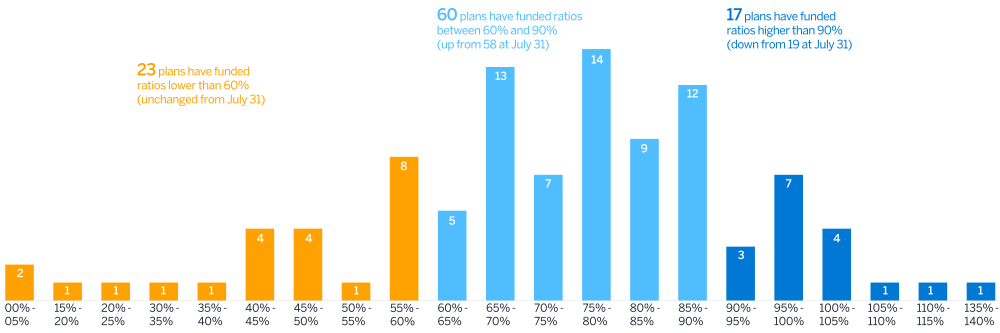
According to the Milliman chart above, there are presently 17 plans that have funded ratios of 90% or better, with three that are at 105% or better. Let’s hope that they are taking some risk off the table and not just letting this strong funded status be potentially harmed by market action. On the other hand, 41 of the largest US public pension plans have a funded ratio that is <70%, with 14 of those at <50% funded.

Unfortunately, the funded status of these plans may be worse since we know that the liabilities are being discounted at the ROA (roughly 7%) and not at a true market rate (FAS AA corporate rate) of approximately 4.5%. This difference is not nearly as bad as it was prior to the Fed’s aggressive interest rate campaign begun in March 2022, but it still under estimates the plan’s liabilities by about 1/3, which may lead to inappropriate asset allocation decisions.

ARPA Update as of September 15, 2023

By: Russ Kamp, Managing Director, Ryan ALM, Inc.

It may be rainy and somewhat gloomy in New Jersey this morning, but there is good news to report regarding ARPA and the PBGC’s implementation of this critically important legislation. Two more pension plans, the Legacy Plan of the UNITE HERE Retirement Fund and the United Food and Commercial Workers Unions and Employers Midwest Pension Plan, both with Priority 6 designations, have filed revised applications for Special Financial Assistance (SFA). In total, these plans are seeking $2.1 billion for just under 127K participants.

In addition to this activity, the PBGC reported that they had approved the SFA application for the Plasterers and Cement Masons Local No. 94 Pension Fund. This fund will be receiving nearly $3.9 million for the 108 participants in this plan. Congratulations!

There were no applications denied during the last week and no new additions to the waiting list. There are currently 23 pension plan applications for SFA under review by the PBGC seeking >$8.4 billion in grants. There remain more than 90 in the waiting list queue for future review.

The Scoreboard Should Dictate How You Play the Game!

By: Russ Kamp, Managing Director, Ryan ALM, Inc.

Managing a pension plan is not an easy task, but it doesn’t have to be as challenging as it currently seems to be. Why? For one thing, pension plans need to understand that they only exist to fund a promise that has been made to the plan participants. That promise – future benefit payments – needs to be measured, monitored, managed to, and then SECURED. But, without a means to do that on a frequent basis (daily, weekly, monthly, and/or quarterly) how does one actually accomplish the objective?

Importantly, a fund’s asset allocation should reflect the current funded status of the plan and not be driven by some return on asset (ROA) objective, that in many cases is a feel good number driven by the ability to manage contributions. Does it really make sense that two plans with very different funded ratios – say 60% and 90% – should have the same ROA objective? Absolutely not! Yet, we see that all the time. Furthermore, benefit payments are future values (FV) and plan assets are in present value (PV) terms, since we don’t know what value those assets will have in the future, except for bonds.

In order to successfully measure, monitor, and manage liabilities, let alone secure them, a plan sponsor needs a Custom Liability Index (CLI) on a frequent basis since each plan’s liabilities are going to be unique to that sponsoring entity. No generic index can ever truly replicate a pension’s liabilities. Importantly, those FV liabilities will be converted into a PV figure monthly providing the plan sponsor with a more accurate and frequent interpretation of the plan’s funded status. In this higher rate environment, the PV of liabilities will be much smaller than previously thought allowing sponsors to take more risk out of the current asset allocation framework.

Ron Ryan, Ryan ALM’s CEO, created the first CLI back in the early 1990s. We believe that every plan should install a CLI in order to do a more effective job of managing a plan’s assets to their liabilities. The CLI is a big part of our turnkey Asset/Liability Management (ALM) capability. Don’t hesitate to reach out to us if you’d like to have a CLI built for you. The first one is on us. We’re confident that you’ll quickly see the benefit in having one produced regularly.

It Still Ain’t Over!

By: Russ Kamp, Managing Director, Ryan ALM, Inc.

You may recall that on July 14, 2023, I penned the post “It Ain’t Over Until it is Over” in which I covered the subject of rising oil prices at that time stating, one of the key factors contributing to the Fed’s success in driving down the CPI has been the significant fall in the price of oil. As you may recall, the price of a barrel of WTI crude oil peaked on June 6, 2022 at $120.67. It currently resides (10:03 am EST) at $76.52 which is a fall of -36.6%. Since petrochemicals derived from oil and natural gas are used in the production of >6,000 everyday products, this significant decline in the price of oil obviously goes a long way to mitigating inflation. But, one must ask, has the price of oil peaked and will the slide in price continue or will OPEC and other factors potentially disrupt this favorable trend?

I went on to state, there recently has been an uptick in the price of WTI, which stood at $70.64 on June 30, 2023. At $76.52 today (as of July 14th), WTI is up 8.3% MTD. I mention this trend because bond investors seem to think that the Fed has accomplished everything that it set out to do when it first increased the Fed Funds Rate on March 17, 2022. The subsequent 10 rate increases have meaningfully addressed inflation, but as we witnessed in the 1970s, declaring victory prematurely can bring about a swift reversal of fortune.

Well, WTI currently sits at a price of $88.66, a 25.5% increase since June 30th, and 15.9% above the price on July 14, 2023 when I wrote of my concerns about the trend for oil. Since that post, both Russia and Saudi Arabia have stated that production cuts would be sustained until at least year-end. Ouch! There are three FOMC meetings remaining in 2023. It still amazes me that the collective investing community still believes that the Fed has accomplished its objective and that 2024 will be the year of Fed Fund Rate cuts. Given that GDP growth is currently forecast to be 5.6% for Q3’23 as calculated by the Atlanta Fed’s GDPNow model, unemployment remains historically low, and housing and rental costs remain stubbornly high, I just don’t see where there is room for a rate cut on the horizon.

As we’ve mentioned on many occasions, don’t play the game of predicting interest rates and markets, SECURE the promised pension benefits at very attractive rate levels today. You’ll realize the cost reduction of those future benefit payments with little to no variability relative to your plan’s liabilities. I know that your participants would appreciate hearing that their benefits are absolutely secure for some prescribed period no matter what transpires in the capital markets.

You’ve Won – Don’t Keep Your Chin Extended

By: Russ Kamp, Managing Director, Ryan ALM, Inc.

I’ve never been a boxer, but I can certainly appreciate the instructions to stay away from your opponent in the last or later rounds when you have the match won on points even though Jimmy Braddock didn’t adhere to that strategy in the movie classic, “Cinderella Man”.

Actuarial firm Milliman has released the results of its latest Milliman 100 Pension Funding Index (PFI) for August 2023, which analyzes the 100 largest U.S. corporate pension plans. According to its study, the funding ratio dropped from 103.6% at the end of July to 103.3% as of August 31, ending the month with a $43 billion surplus for these 100 plans. Unfortunately, asset losses for the month outweighed liability gains, which fell as a result of the 16 basis point increase (US interest rates were up!) in the monthly discount rate. According to Milliman, “the market value of PFI plan assets decreased by $27 billion because of August’s -1.55% investment return, while the monthly discount rate climbed from 5.25% in July to 5.41% for August.”

Given our expectation that the Fed hasn’t accomplished its primary goal of containing inflation, and we’ll get another update tomorrow, we expect US interest rates to keep rising. That possible increase will reduce the present value (PV) of those future liability promises (benefits), which will continue to improve funding without the need for further asset gains. Given the current level of funding (103.3%), why stick your chin out at this time when we all know that the markets can hit back with a fury! We’ve seen this movie unfold many times.

In the analysis provided by Milliman, they frame possible future scenarios for both interest rates and asset growth. “Under an optimistic forecast with rising interest rates (reaching 5.61% by the end of 2023 and 6.21% by the end of 2024) and asset gains (9.8% annual returns), the funded ratio would climb to 107% by the end of 2023 and 120% by the end of 2024. Under a pessimistic forecast (5.21% discount rate at the end of 2023 and 4.61% by the end of 2024 and 1.8% annual returns), the funded ratio would decline to 100% by the end of 2023 and 91% by the end of 2024.” Why take the risk?

Increases in US interest rates have certainly negatively impacted the performance for total return-seeking fixed-income managers, but they’ve also dramatically reduced the PV of pension liabilities. Take advantage of these higher rates to SECURE the promises that have been made to your plan participants through a Cash Flow Matching (CFM) implementation. Witnessing another market correction that reduces your plan’s funded ratio back to the low 90% range or worse, depending on the magnitude of the correction, would be criminal. As we stated above, you’ve won the match. It is time to stay at least arm’s length away from your opponent!

ARPA Update as of September 8, 2023

By: Russ Kamp, Managing Director, Ryan ALM, Inc.

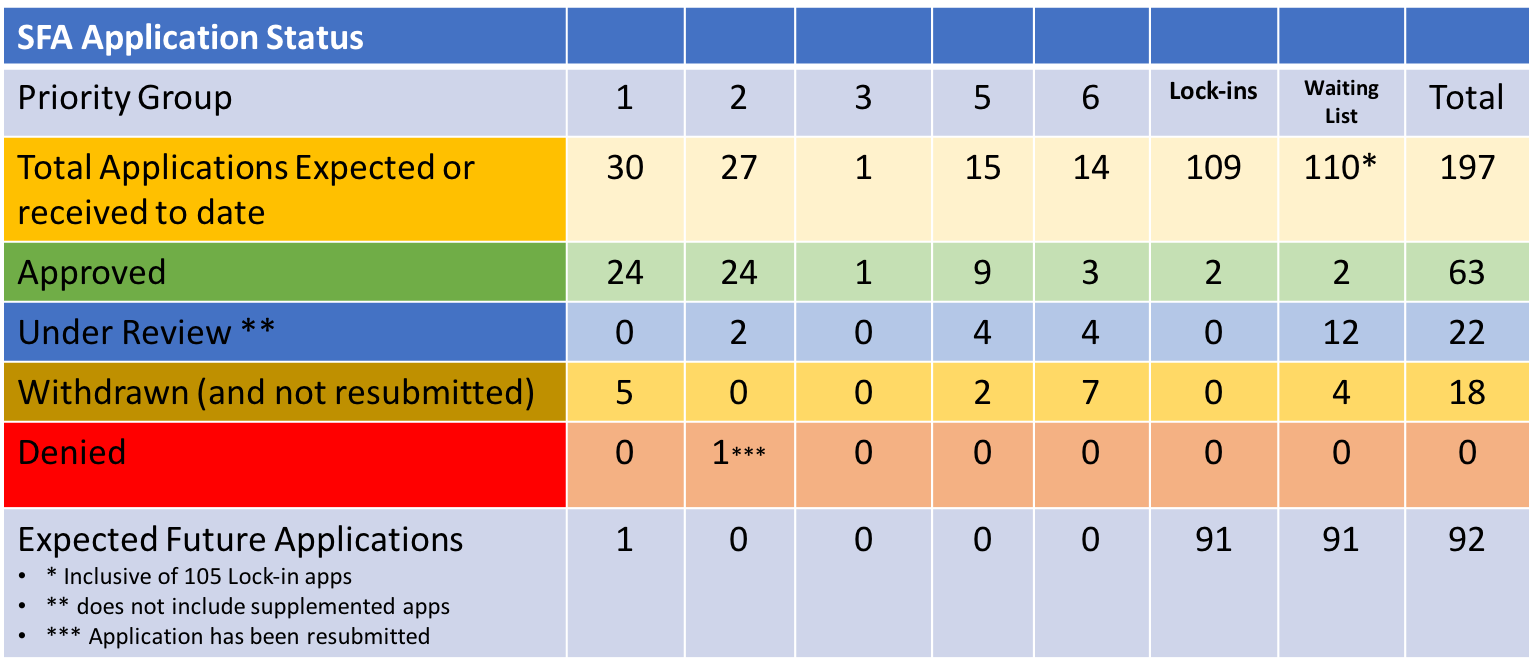
Football season has begun in earnest, so you can’t blame the PBGC if their activity level was not quite up to the pace that they’d been operating under. For the week ending September 8, the PBGC did not accept any new applications from the waiting list nor did they approve or deny any applications under review. In fact, there wasn’t any activity except that which took place behind the scenes, as there are currently 22 SFA applications in the review queue, as highlighted in the chart below.

There remain more than 100 applications that need to be reviewed and acted on by the PBGC, so their workload will keep them busy for some time to come. As reflected above, 63 funds have or will soon receive Special Financial Assistance. The total grant money received to date exceeds $53 billion. As a reminder, the proceeds from this legislation are to be used to secure benefits and expenses as far into the future as the grant will permit. With US interest rates continuing to rise, a cash flow matching strategy is able to secure more months. Pension plans should be focused on extending the coverage period as far as possible. Using a portion of the 33% of the SFA grant to attempt to increase the allocation is a risky strategy with very little upside potential.

Today is National 401(k) Day. Where is National DB Pension Plan Day?

By: Russ Kamp, Managing Director, Ryan ALM, Inc.

I suspect that most of us have no idea that today, September 8, 2023, is National 401(k) Day. This day is recognized every year on the Friday following Labor Day. The day is supposed to be an opportunity for retirement saving education and for companies to inform their employees about their ability to invest in company sponsored 401(k)s. Did you get your update today?

401(k) plans are defined contribution plans (DC). This plan type was created in the late 1970s as a “supplemental” benefit. Corporate America liked the idea of a DC offering because it helped them recruit middle and senior management types who wouldn’t accrue enough time in the company’s traditional pension plan. Again, the benefit was supplemental to the traditional monthly pension payment and not in lieu of it!

I think that defined contribution plans are fine as long as they remain supplemental to a DB plan. Asking untrained individuals to fund, manage, and then disburse a retirement benefit is a ridiculous exercise. Why do we think that 99.9% of Americans have this ability? Unfortunately, we have a significant percentage of our population living within 200% of the poverty line. Do you think that they have any discretionary income that would permit them to fund a retirement benefit when housing, health insurance, food, education, childcare, and transportation costs eat up most of an individual’s take home pay? Remember, these plans are predicated on what is contributed. Sure, there may be a company match of some kind, but we witnessed what can happen during difficult economic times. That employer contribution suddenly vanishes.

Defined benefit plans are the gold standard of retirement vehicles. They once covered more than 40% of the private sector workforce, most union employees, and roughly 85% of public sector workers. What happened? Did we lose focus on the primary objective in managing a DB plan which is to SECURE the promised benefits in a cost effective manner with prudent risk? Did our industry’s focus on the return on asset assumption (ROA) create an untenable environment? Yes, we got more volatility! Did we did we get the commensurate return? Not consistently. It was this volatility that impacted the financial statements and led to the decision to freeze and terminate a significant percentage of private DB plans. It is a tragic outcome.

What we have today is a growing economic divide among the haves and haves-not. This schism continues to grow, and the lack of retirement security is only making matters worse. DB plans can be managed effectively where excess volatility is not tolerated, where the focus is on the promised benefit and not some made up ROA, and where decisions that are made relative to investment structure and asset allocation are predicated on the financial health of the plan and the funded status. We need DB plans more than ever and ONLY a return to pension basics will help us in this quest. Forget about all the newfangled investment products being sold. Replacing one strategy for another is no better than shifting deck chairs on the Titanic. We need improved governance and a renewed focus on why pensions were provided in the first place.