ARPA Legislative Alert

By: Russ Kamp, Managing Director, Ryan ALM, Inc.

The PBGC has just announced the following: On Friday, March 10, 2023, the priority group application period (Groups 1-6) as specified in the SFA regulation will end, and on Saturday, March 11, 2023, the application period for all SFA-eligible plans (both priority group and non-priority group plans) will begin. As we’ve been reporting, the collection of non-priority group plans dwarfs the Priority Group plans in number (218 vs. 87), if not in potentially requested SFA.

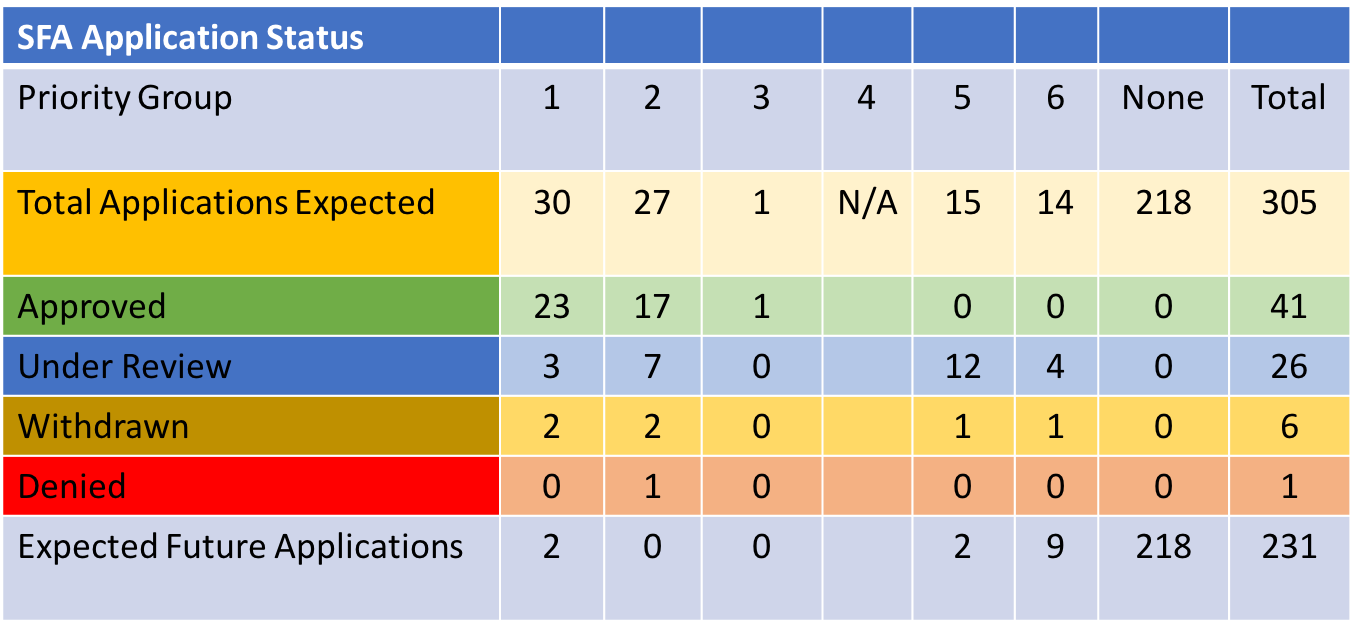
Since December 21, 2021, when Local 138 Pension Trust Fund became the first plan to receive PBGC approval for Special Financial Assistance, the PBGC has approved 41 initial/revised applications and 28 supplemental applications. These approvals amounted to a distribution of $45.8 billion in ARPA grants covering the pensions of 686,540 American workers! There are still a number of Priority Group applications to be approved by the PBGC in addition to the more than 200 potential new applications. It is going to get quite busy at the PBGC, as if it hasn’t already been the case.

ARPA Update as of March 3, 2023

By: Russ Kamp, Managing Director, Ryan ALM, Inc.

We are pleased to provide our weekly update on the implementation of the ARPA legislation. The week ending March 3rd had plenty of activity, as there were 6 applications filed, including a supplemental application by Bricklayers and Allied Craftsmen Local 7 Pension Plan seeking an additional $9 million for its 397 participants. The Bindery Industry Employers GCC/IBT Pension Plan, a Priority Group 1 plan, finally joined the party. Not sure what the wait was all about, but this entity has 686 members that were probably wondering if they’d ever see this day, given that Priority Group 1 plans were first eligible to file on July 9, 2021. This pension system is seeking nearly $19 million in Special Financial Assistance. The remaining four plans are each a Priority 6 member. In total, these four plans are requesting $6.8 billion for their 270,000+ participants.

Fortunately, there were no applications denied, but there also weren’t any that were approved either. The PBGC is currently reviewing 26 applications. With the filing of the Priority Group 1 application, the PBGC is only expecting another two plans from that category to potentially file. There was one application withdrawn last week. The Pension Plan of the Moving Picture Machine Operators Union Local 306 withdrew its initial application. This Priority Group 5 plan is seeking $22.5 million in SFA for its 542 participants.

The ARPA program is an incredible lifeline for these once-struggling pension systems. As we’ve articulated on many occasions, this grant is a gift that is likely a once-in-a-generation award. The proceeds, which are a precious resource, need to be invested with great prudence, especially given all of the uncertainty in today’s markets.

What a Choice!

By: Russ Kamp, Managing Director, Ryan ALM, Inc.

The Millennial, Gen X, and Gen Z cohorts are facing a huge challenge, as it pertains to funding education, a home, and now a “retirement” account. They must make some very difficult decisions. First, do they go to college in order to potentially set themselves up with a good-paying job, but knowing that they will most likely incur significant debt in the process? A debt that most of my generation didn’t have to face – not even close. In fact, public college education today will cost you more than twice what it did during the ’70s. According to a GoBankingRates report, public education costs have rocketed from $39,780 to more than $91,000 in 2022.

The shift to the knowledge economy has simultaneously increased the necessity of a college degree while the rising costs of that degree have eroded the ROI. Classic “rock and a hard place”! Once they have that degree and hopefully find that decent-paying job they must decide if settling down is in the cards. Does settling down include buying a home? For most younger Americans, buying that first home is getting to be nearly impossible. According to a Bloomberg article, first-time homebuyers face the least affordable market on record (dating back to at least 1986). Yes, home price growth YoY has moderated, but it hasn’t fallen. Furthermore, US mortgage rates have skyrocketed. At present, a 30-year conventional mortgage will result in the buyer paying 7.16% up more than 300 basis points in the last 12 months – ouch!

Well, if you are fortunate to have a good job that affords you the opportunity to pay down your student loans and finance a huge mortgage (average home price according to the St. Louis Fed database was $535,800 as of 12/31/22), you are in rare company, as only 26% of home purchases in 2022 were by first-time homebuyers. But wait, now you have to figure out how to fund a retirement benefit because you most likely don’t work for a private sector organization that provides you with access to a defined benefit plan. That “retirement” benefit, in the form of a defined contribution (DC) offering, requires you to fund (at least 15% is necessary to do it right), manage, and then disburse the benefit hoping that what you set aside will cover your entire golden years.

Given the recent updates provided by both Fidelity and Vanguard, which I reported on earlier this week, it is safe to say that most Americans will NOT come close to enjoying a dignified retirement. They might NOT be able to live in their own home! They might NOT be able to afford college! How have we as a nation arrived at this point? What has changed so meaningfully from when I was starting off to what the next three cohorts are facing?

So, if you found yourself in this bind from the lack of affordability, what would you choose? Education, a home, and a dignified retirement shouldn’t be mutually exclusive. Yet, that is where we find ourselves today. Let’s stop blaming young people for perceived poor financial management! Most Boomers would also be getting married later and having fewer kids. This isn’t because they are irresponsible! We’ve created an environment that is crushing them! So sad!

How has 2023 Begun for TRS Bond Managers?

By: Russ Kamp, Managing Director, Ryan ALM, Inc.

We all know that 2022 was a terrible year for total return-seeking (TRS) bond managers. In fact, it was the worst year by far since the creation of the Lehman Aggregate Index more than 4+ decades ago. Rising interest rates will do that to bond managers whether your duration is shorter or longer than the index. By the end of the calendar year 2022, the Aggregate Index had declined -13.01%, far eclipsing the -2.9% produced in 1994. Furthermore, it was only the fifth negative total return recorded in the Index’s history. That is a pretty amazing achievement.

What is happening in 2023? January was a terrific month as US interest rates fell in anticipation of a Federal Reserve that was going to moderate its increases in the Fed Funds Rate (FFR). For the month, the Aggregate Index rose +3.08%. A far cry from the activity of the previous 12 months. However, the celebration didn’t last too long, as January’s fine performance was quickly replaced by a -2.59% February. The economic environment hadn’t calmed down to any great extent and the anticipation that the moderation in FFR increases would be replaced by a pause or the “Great Pivot” proved to be illusionary.

So, at this point, we have a Fed that continues to promise further increases in the FFR (5.375% is the current target with a projected terminal rate at 7.0%!) and an inflationary environment that isn’t close to falling back to the 2% target that they have established. With a historic labor market and rising wages, it doesn’t appear that inflation will be contained in the near future. This environment will continue to prove challenging for TRS managers to provide a positive return despite the much higher yields offsetting principal losses.

We once again ask the question: Why don’t you de-risk your pension system’s exposure to fixed income by migrating the core total return-seeking mandates to cash flow matching assignments? This action will SECURE the promised benefits as far into the future as the allocation will cover while mitigating interest rate risk for that portion of the portfolio. Furthermore, you have now bought time for the plan’s alpha assets to grow unencumbered, as they are no longer a source of liquidity. This eliminates the common practice of sweeping cash from all assets to fund benefits (B) + expenses (E). Let your bond allocation pay B+E.

Great uncertainty exists within the US markets – both bond and stock – as a result of the Fed’s actions. Why gamble that we are close to the end of their activity? Secure the promises through cash flow matching B+E and let yourself and your participants sleep well at night knowing that markets won’t crush their promised benefits.