Have We Forgotten?

I haven’t seen anything in the business pages today referencing October 19, 1987.  Have we all forgotten the devastation wrought that day? I was working just off Wall Street at the time at 26 Broadway. As you may recall, on Friday, October 16, when all the markets in London were unexpectedly closed due to the Great Storm of 1987 (I didn’t remember this aspect of the event) the DJIA fell 108.35 points (4.6%) to close at 2,246.74 on record volume. It would prove to be the appetizer to the following Monday’s main course.

On October 19, 1987, a day that became known as “Black Monday,” the stock market crashed as the Dow Jones Industrial Average plunged 508 points, or 22.6% in value, its largest single-day percentage drop.  A drop of that magnitude today would be roughly equivalent to a 5,760-point drop. We fret 300 points down days. What was to blame? Historians cite heightened hostilities in the Persian Gulf, fear of higher interest rates, a five-year bull market without a significant correction, and computerized trading that accelerated the selling and fed the frenzy. That’s scary, as all of those elements exist today with one exception; we are now in the midst of a nearly 10-year bull market.

After the Black Monday free fall, the New York Stock Exchange installed what are known as circuit breakers, designed to stop trading when stocks dive too far too fast. It’s a forced timeout to give investors a chance to calm down and interrupt a panic. Today, if stocks dived even 7% (level 1) and 13% (level 2), trading would be suspended for 15 minutes. A decline of 20% would shut down trading for the rest of the day. Let’s hope that we never see this again.


When Is It Not Conservative?

The co-creator of the 401(k), Ted Benna, is raising an issue that I’ve been wondering about for years. Mr. Benna has published a book that’s part history book, part how-to manual, for plan participants.  It covers a wide range of issues, but one in particular is the greater use of target-date-funds (TDFs) as the default offering. He (nor I) is not opposed to their use as a QDIA, but fears that plan participants do not understand the potential risks associated with their use, especially as one nears retirement.

For instance, many of the target-date-fund providers have a TO retirement philosophy, as opposed to a through philosophy (to demise) designed to reduce risk as one nears that last date of employment. However, as is the case in many of the offerings, fixed income exposure is increased and equity exposure decreased. Yet, after a roughly 35-year bull bond market, are fixed income assets really the conservative choice, especially as U.S. interest rates are rising? How short in duration are these exposures and how does the composition of the exposure change among Treasuries, agencies, corporates, etc.? Given the rampant increase in BBB offerings, are these plans protecting their clients from adverse market moves?

The group of near-term retirees is the most vulnerable to a market decline. Just reducing equity exposure in these funds is not necessarily protecting the participants from the potential for dramatic losses. TDFs need to be more tactical in their exposures and the sponsors of these funds need to do a better job of communicating the potential risks associated with the various allocations.

Definitely A Step In The Right Direction

As anyone who reads our blog knows, we believe that the only “true” retirement program is the defined benefit plan. However, given that most of the private sector no longer have access to this benefit, improving defined contribution plans so that they look less like glorified savings accounts and more like retirement vehicles is imperative. To that end, there have been important changes that are helping Americans (those with some disposable income) to save toward the building of a dignified retirement.

One of the most important improvements in plan design is the automatic enrollment feature in which participants have to opt out from participating. As the above chart highlights, those that are placed into a DC plan are far more likely to contribute something than those that have to sign-up. Now, if we could get plans to stop offering loans and premature withdrawals we might just have something that looks more like a retirement account.

Well, Isn’t That Convenient?

Only three (Senator Hatch is retiring) of the sixteen members on Congress’s Joint Select Committee on Solvency of Multiemployer Pension Plans are NOT up for reelection this year. Interestingly, all three are Republican Senators. Isn’t that convenient that this group doesn’t have to face an election in the year in which they’ve been tasked with trying to protect and preserve the pension benefits for more than 1,000,000 American workers. Furthermore, we are lead to believe that little support is forthcoming from the Republicans for the Butch Lewis Act, which they perceive to be a bailout instead of the loan program that is at the core of the proposed legislation. I guess they feel that the delay tactics won’t hurt them during their next election cycle.

As we’ve reported before, little appears to be getting done within the JSC toward finding a bipartisan solution to the evolving multiemployer pension crisis.  That Congress is willing to sacrifice the financial well-being of so many hardworking Americans is beyond me.

Members of the Joint Select Committee on the Solvency of Multiemployer Pension Plans: (Members in bold are not up for reelection)

Senate Democrats

  • Sherrod Brown
  • Joe Manchin
  • Heidi Heitkamp
  • Tina Smith

Senate Republicans

  • Orrin Hatch – retiring
  • Lamar Alexander
  • Rob Portman
  • Mike Crapo

House Democrats

  • Richard Neal
  • Bobby Scott
  • Donald Norcross
  • Debbie Dingell

House Republicans

  • Virginia Foxx
  • Phil Roe
  • Vern Buchanan
  • David Schweikert

Previous attempts at tackling the pension crisis have proven to be disastrous. The Multiemployer Pension Reform Act (MPRA) of 2014 was enacted into law as a means to stabilize failing pension systems. In MPRA, “Congress established a new process for multiemployer pension plans to propose a temporary (who are they kidding?) or permanent reduction of pension benefits if a plan is projected to run out of money before paying all promised benefits (US Treasury Department)”. As of today, the Treasury Department has announced that Local 805’s application to modify (slash?) benefits has been accepted marking the 8th “successful” application since the legislation was enacted.

We find it outrageous that legislation designed to protect pensions and pensioners can call for substantial reductions in benefits for retirees who in most cases are no longer able to make up for the drastic income reduction because of age and/or disability. Given that MPRA might be the course chosen for the remaining 100+ multiemployer plans designated as in critical and declining status, it is imperative that the JSC pass the Butch Lewis Act now! There is no more time for delay.

What I truly fear is that this august body will cobble together a piece of legislation that will demand shared sacrifices (including pension benefit reductions) when the retirees have had nothing to do with the poor state of these plans. Worse, I can see them producing MPRA type legislation that will bring harm to the more than 60% of multiemployer plans that are currently in the green zone.

The U.S. government has the financial means to shore up these critically important plans (CBO estimates the cost at $34 billion) that support so many local economies through the receipt of monthly benefit checks. It is penny wise and pounds foolish to play games, especially since they are likely to have to expand the social safety net once these retirees lose their promised benefits.


The CBO

The Congressional Budget Office (CBO) is a  federal agency within the legislative branch of the U.S. government that provides budget and economic information to Congress. The CBO was created as a nonpartisan agency by the “Congressional Budget and Impoundment Control Act of 1974” (Wikipedia).

There is a consensus among economists that “the CBO has historically issued credible forecasts of the potential impact of both Democratic and Republican legislative proposals.” The mission of the CBO is to produce “independent analyses of budgetary and economic issues to support the Congressional budget process.” Each year, the agency releases reports and cost estimates for proposed legislation, without issuing any policy recommendations. If true, why is the latest estimate of the cost of the Butch Lewis Act not being accepted as a realistic estimate?

Senator Sherrod Brown (D-OH) and Representative Richard Neal (D-MA) have said that the U.S. Congressional Budget Office (CBO) has estimated that the pension reform legislation known as the Butch Lewis Act would cost only $34 billion over the next 10 years, roughly one-third of the $100-billion figure cited in its preliminary analysis earlier this year.

This news should have inspired immediate action on the part of the members of the Joint Select Committee on Solvency of Multiemployer Pension Plans (JSC) to come to some agreement/resolution on legislation to protect these critically important pension plans. Yet, members are questioning the analysis and no legislation has been forthcoming as the time to do something is running out for the JSC.

Are our “leaders” really willing to jeopardize the retirements (and financial freedom) of so many American workers over $34 billion? The Butch Lewis Act is the only proposed legislation that provides loans, protects the PBGC, employers, and plan participants. The issuance of low-interest rate loans provides a 30-year (there may be a provision to begin repayment in year 20) lifeline to these struggling plans. The analysis by Cheiron has determined that 111 of 114 critical and declining plans will not need any PBGC support and can pay back the loan using a more modest return on asset (ROA) assumption of only 6.5%.

Without government help, these plans are doomed to failure and the social and economic toll will be startling. Can we finally stop playing politics and make saving the financial health of these participants the priority?

Some Help For Seniors

COLA 2019 IAG social security

Finally, a little support for Social Security recipients, as there will be a 2.8% cost-of-living increase next year. Roughly 62 million Americans will benefit from this increase, but before we get too excited understand that we are talking about the average recipient receiving an additional $39/month bringing the average monthly payout to $1,461 or $17,532 yearly.

But we have no free lunch here as the taxable earnings threshold subject to the Social Security tax will increase from $128,400 to $132,900 in 2019 (a 3.5% increase). Furthermore, the Social Security Administration continues to base the COLAs on the Consumer Price Index for All Urban Consumers, as opposed to the CPI-E, which is a more appropriate measure of inflation for those over 65 years old. This needs to be addressed sooner than later, as many of those approaching retirement have anemic retirement account balances.

Nothing More Than Glorified Savings Accounts

Deloitte is reporting that 401(k) loan defaults have cost participants more than $2.5 trillion in lost retirement earnings. As shocking as that number seems to be it really isn’t. We’ve been referring to 401(k) plans as glorified savings accounts since our inception, as the permitting of loans, and in some plans, multiple loans, is improper if these are truly retirement vehicles!

According to the Deloitte study titled, “Loan Leakage: How can we keep loan defaults from draining $2 trillion from America’s 401(k) accounts?” 90% of 401(k) plans offer loans and roughly 40% of the participants have taken a loan to finance “their current consumption”. Unfortunately, about 10% of 401(k) loans default each year. For the plan participant that has defaulted they lose on average $300,000 of future retirement benefits.

Deloitte further reports that in 2018 alone, $7.3 billion worth of 401(k) loan defaults occurred and $48 billion worth of voluntary plan cash-outs, creating $155 billion in opportunity costs and an estimated $210 billion account leakage at retirement.

We highly recommend the creation of side-pocket accounts that would be payroll deducted and capped at some $ amount, such as $1,500. Money saved in these accounts could be used to meet short-term (and perhaps, emergency) expenses, while the balance of contributions would fund a long-term retirement account. We know through countless studies that most employees fail to save outside of an employer-sponsored fund. Having a payroll deducted side-pocket may be just the way to increase savings for America’s struggling working class while protecting retirement assets for long-term growth.

A Regressive Tax?

Student Loan Debt

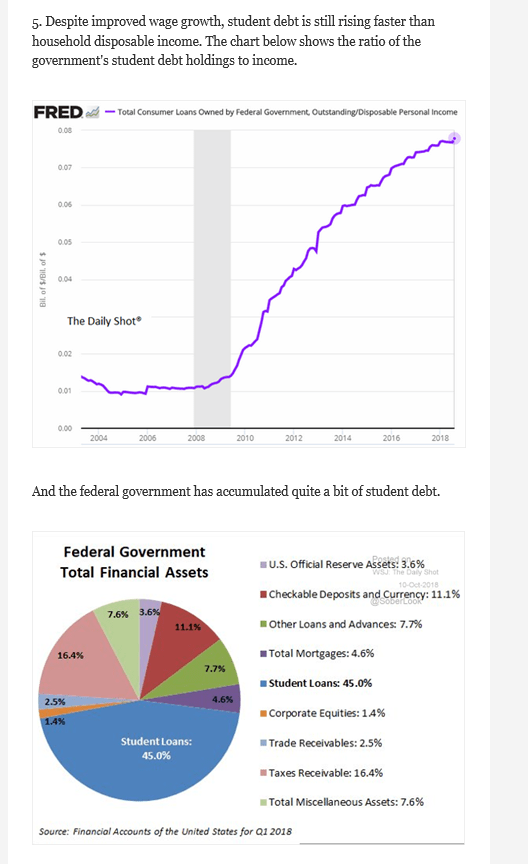
I’m much less concerned about the federal government accumulating debt as a result of the growth in student loans, as I am American households, especially those at or below median family wealth. The growth in student loan debt is crippling the financial future for many younger Americans, and it is impacting their ability to purchase first homes, start families, and save for retirement.

In this age of do-it-yourself retirements (DC plans) not having the financial means to fund one’s retirement at an early age will make it nearly impossible for these participants to ever create a pool of wealth to provide for a decent, let alone, dignified retirement.

No More Games!

Private equity firms and public pension systems have enjoyed a symbiotic relationship for years, with the latter providing the capital (about 35% of private equity capital comes from public pension systems) to the former to invest with the hope that significant returns can be achieved. However, this relationship may be changing as a result of the perceived mistreatment of workers through the actions of private equity firms.

The NY Times is reporting on how former workers for Toys “R” Us have rallied support from public pension systems when their demands from private equity firms went unheeded. Roughly 30,000 workers lost jobs when the former retailer went bankrupt last year, and worse, they did not receive any severance.

Participants in both public employee and union funds loath to see their pension assets used to harm other workers. Having failed in their quest to be heard by the private equity firms involved in the demise of their company, former employees took their case directly to the public pension systems that helped fund the acquisition. During a 3-month period, these former employees and their advocates (Rise Up Retail and the Private Equity Stakeholder Project) met with 14 public funds in 12 different states to begin to exert some control over just how these pension assets can be invested – it is about time!


Corporate Pension Plans Show Improved Funding

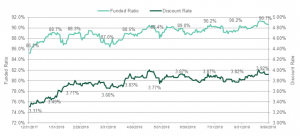
S&P 500 companies with defined benefit pension plans continued to show improved funded status in September, as assets were up marginally along with rising discount rates, which reduce the present value of the plans’ future liabilities. Given the improved funded status, will corporate pension plans take some risk off the table? They should continue to reduce equity exposure in favor of bonds that can more effectively mirror the plans’ liabilities.

For public and multiemployer plans that discount plan liabilities at the ROA, the notion that rising interest rates are reducing plan liabilities is a foreign concept, which is why plan sponsors in those pension systems need to get more transparency regarding plan liabilities. With this enhanced knowledge comes the ability to have a more responsive asset allocation policy.